
Edible
Lemon Basil
Ocimum citriodorum
Also known as Thai lemon basil, Kemangi, Maenglak
How to grow lemon basil, Ocimum citriodorum. The citrus-scented hybrid for Thai and Indonesian cooking, sowing it in warmth, and picking it before it flowers.
At a glance
- Difficulty
- Moderate
- Water
- When the top 2 cm of compost is dry, in the morning
- Light
- Full sun. A windowsill or greenhouse where summers are cool
- Temperature
- Damaged below 10 deg C and killed by frost
- Hardiness
- USDA 10-11, RHS H1c, hardy to 5 C
- Type
- Tender annual
- Height
- 20-50 cm
- Native to
- of cultivated hybrid origin
- Best month
- June and July in the Northern Hemisphere, December and January in the Southern Hemisphere
It runs to flower faster than any other basil, sometimes within eight weeks of sowing, so successional sowing every three weeks is how a supply is kept up. Chilling injury starts at 10 deg C. The citral that gives the lemon scent is volatile and largely lost in drying.
Hardiness zones describe winter cold alone. Summer heat, humidity, rainfall and the length of the growing season decide as much, so treat the range as the outer limit rather than as a recommendation.
Every month named in this guide is for the temperate Northern Hemisphere. If you garden in the Southern Hemisphere, shift each one by six months, so June becomes December. Closer to the equator the wet and dry seasons matter more than the calendar, and the shift stops being a useful guide.
Not known to be toxic
- Safe to eat
- Leaves and flowers
Non-toxic. Lemon basil is a culinary herb eaten in quantity across south-east Asia and it appears on neither the RHS list of potentially harmful garden plants nor the ASPCA list. Leaves and flowers are both eaten, and the seeds are soaked in water for drinks in Thailand and Indonesia in the same way as sweet basil seed. The usual mint-family qualification applies to the distilled essential oil, which is a concentrated product rather than a strong version of the herb and should not be given to animals or applied undiluted to skin.
Sources: RHS potentially harmful garden plants, ASPCA toxic and non-toxic plants
About
Lemon basil smells of lemon sherbet and basil at the same time, and it is the basil for Thai and Indonesian cooking rather than for Italian. In Thailand it goes into the soup kaeng liang and into fish curries; in Indonesia it is kemangi, eaten raw as part of a plate of leaves alongside grilled fish.
It is a hybrid, generally given as a cross between sweet basil and hoary basil, and it carries a strong citral content that neither parent has to the same degree. Rubbing a leaf produces an unmistakable lemon note.
Growing it is the same job as growing sweet basil and slightly harder. It is tender, it wants warmth and light, it hates wet compost, and it runs to flower readily. A pot on a bright warm windowsill is the reliable place for it where summers are cool.
Appearance and character
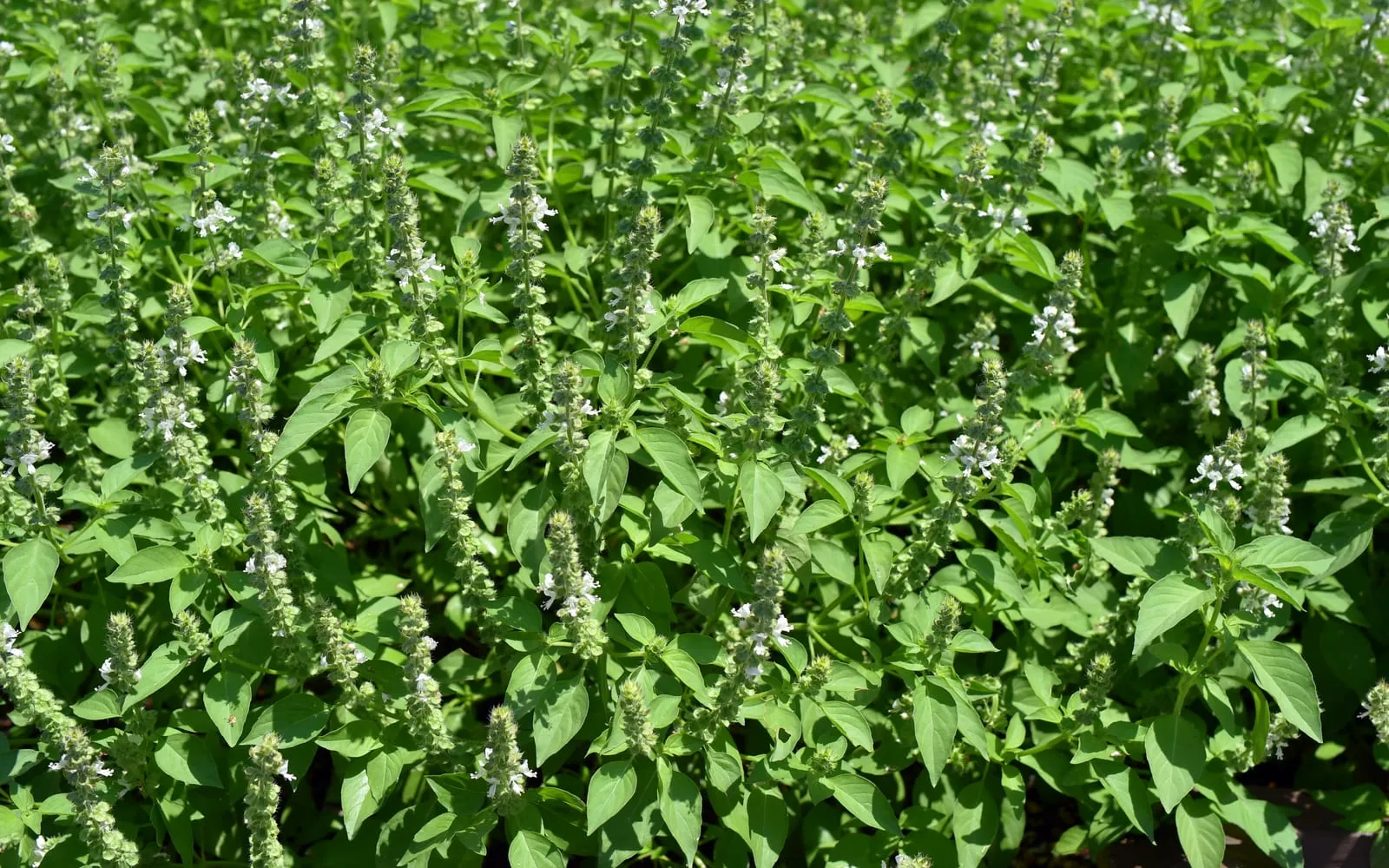
A bushy annual, 20 to 50 cm, branching from every pinched tip into a rounded plant.
Leaves are narrower and smaller than sweet basil’s, 2 to 4 cm, light green, slightly toothed and softly hairy.
Flowers open in slender spikes at the shoot tips, small and white, from midsummer onwards. The plant flowers more readily than sweet basil, which is the main practical difference in growing it.
Stems are square and green, going slightly woody at the base late in the season.
The scent is the point. Lemon and basil together, sharper and brighter than sweet basil, from a high citral content.
Seeds swell into a gelatinous coat in water, as sweet basil seeds do, and they are used in Asian drinks for that reason.
Where it is from
Lemon basil is a cultivated hybrid rather than a wild species, and it is generally treated as a cross between Ocimum basilicum and Ocimum americanum. Its origin is south-east Asia and north-east Africa, where both parents grow.
Thailand uses it as maenglak, one of three basils in Thai cooking alongside horapha, which is Thai sweet basil, and kaphrao, which is holy basil. Each has a distinct role and they are not interchangeable.
Indonesia uses it as kemangi, served raw in the mixed plate of leaves called lalap that accompanies grilled fish and fried chicken.
Laos and Vietnam both use it, and it appears in Indian cooking in the north-east as well.
It reached European seed catalogues comparatively recently, as south-east Asian cooking became popular here, and it is now widely available as seed and occasionally as a plant.
How it grows
Sow indoors from March at 20 deg C. Surface sow onto damp compost and press the seed in, since it germinates better with light.
Germination takes one to two weeks in warmth. Cold compost gives nothing.
Prick out into small pots and grow on somewhere bright and warm.
Pot on into 15 to 20 cm pots of free-draining compost, three or four plants to a pot, or plant out in a greenhouse border.
Keep it above 15 deg C. Below 10 deg C it stops and starts to deteriorate.
Pinch the growing tips from 15 cm and keep pinching. Every pinch produces two new shoots and delays flowering.
Remove flower spikes as they appear. This species runs to flower faster than sweet basil and the leaf quality drops once it does.
Sow again in June for a second batch, since plants tire by late summer.
Harvest whole shoot tips rather than individual leaves.
Through the seasons
Winter there is nothing outdoors. Lemon basil is an annual and it will not overwinter usefully outside the tropics.
Spring is sowing, from March in warmth. A second sowing in April gives a longer run.
Early summer is the start of harvesting. Pinch hard from the beginning.
Midsummer is the main crop, and flowering starts. Pinch the spikes out weekly.
Late summer is when plants tire. A June sowing takes over now.
Autumn ends it. Plants deteriorate as the nights cool and die at the first cold snap. Harvest everything before then and freeze what you cannot use.
Care difficulty
Moderate, and the same three problems as every basil.
Warmth is the first. It needs 20 deg C to germinate and 15 deg C to grow well, which in a cool climate means indoors or under glass for most of the year.
Watering is the second. Cold wet compost rots the base of the stem, and the answer is to water in the morning, never to stand the pot in water, and to let the surface dry between waterings.
Flowering is the third and it is more of a problem here than with sweet basil. This species runs to flower readily, and once it does the leaf goes coarse and the scent thins. Pinch the tips weekly from the start.
Light matters throughout. A dim windowsill produces a pale leggy plant that never amounts to much.
Given warmth, light and morning watering, it is straightforward and productive.
Watering
Water in the morning. Basil roots sitting in cold wet compost overnight is the commonest cause of failure.
Water when the top 2 cm of compost has dried, which is every two or three days in summer.
Water the compost rather than the leaves.
Never leave a pot in a saucer of water.
Use tepid water rather than cold.
Water a plant in a greenhouse border more generously than one in a pot, since the root run is larger and dries more slowly.
Warning signs, diseases and pests
Damping off collapses seedlings at soil level in cold wet compost. Sow into warm fresh compost and water carefully.
Blackening at the stem base on an older plant is root rot. There is no cure.
Leaves going dull, spotted or bronzed mean cold. Below 10 deg C the plant declines.
Aphids gather on the growing tips. Rub them off, since a herb you are eating is the wrong plant to spray.
Whitefly builds up fast under glass. Use sticky traps and a biological control.
Grey mould appears on crowded plants in still humid air. Thin and ventilate.
Flower spikes appearing constantly are normal for this species. Pinch them out weekly.
Leggy pale growth means too little light.
Growing environment
Full sun and warmth. A greenhouse, conservatory or the brightest windowsill.
Minimum 15 deg C for useful growth. It suffers below 10 deg C and dies at the first frost.
Free-draining compost in a pot. Multipurpose with added perlite or grit suits it.
pH around 6 to 7.
Outdoors it manages a warm sheltered patio from mid-June to early September and nothing beyond that.
Ventilate under glass. Still humid air produces mould and whitefly on soft growth.
Feeding
Feed lightly with a weak balanced liquid feed every three weeks from May to August.
Avoid heavy nitrogen, which gives soft growth with less scent.
Do not feed a plant that has stopped growing because of cold. Fix the temperature instead.
Use fresh compost each year rather than feeding an old pot harder.
Lean growing concentrates the citral, which is what makes the plant worth growing.
Troubleshooting
It flowered within weeks. This species runs to flower faster than sweet basil. Pinch the tips weekly from 15 cm and remove every spike as it forms.
Which basil goes in which Thai dish? Maenglak is this one, lemon basil, used in kaeng liang and fish curries. Horapha is Thai sweet basil, aniseed-scented, used in green curry. Kaphrao is holy basil, used in the stir-fry of the same name. They are not interchangeable.
The stem went black at the base. Root rot from cold wet compost. Water in the morning and never leave the pot in a saucer.
Nothing germinated. Too cold. It needs 20 deg C.
The plant is pale and leggy. Too little light. It needs the brightest place you have.
Can I dry it? Poorly. Basils lose most of their scent on drying. Freeze the leaves in oil or in ice cubes instead.
Can I keep it through the winter? Not usefully. Sow fresh each spring.