
Edible
Holy Basil
Ocimum tenuiflorum
Also known as Tulsi, Tulasi, Sacred basil
How to grow holy basil, Ocimum tenuiflorum. The clove-scented tulsi of Hindu courtyards, keeping it alive over a cool winter, and how it differs from sweet basil.
At a glance
- Difficulty
- Moderate
- Water
- When the top 2 cm of compost is dry, in the morning
- Light
- Full sun, and a windowsill or greenhouse where summers are cool
- Temperature
- Damaged below 10 deg C and killed by frost
- Hardiness
- USDA 10-11, RHS H1b, hardy to 8 C
- Type
- Tender perennial, grown as an annual wherever frost comes
- Height
- 30-60 cm, occasionally 1 m under glass
- Native to
- South Asia
- Best month
- June and July in the Northern Hemisphere, December and January in the Southern Hemisphere
Perennial in the frost-free tropics and an annual everywhere else, and flowering is short-day in most strains, so a plant at high latitude stays leafy until late summer. Nothing below 10 deg C. Seed germinates poorly in cold compost, which catches out most first attempts outside the tropics.
Hardiness zones describe winter cold alone. Summer heat, humidity, rainfall and the length of the growing season decide as much, so treat the range as the outer limit rather than as a recommendation.
Every month named in this guide is for the temperate Northern Hemisphere. If you garden in the Southern Hemisphere, shift each one by six months, so June becomes December. Closer to the equator the wet and dry seasons matter more than the calendar, and the shift stops being a useful guide.
Not known to be toxic
- Safe to eat
- Leaves and flowering tops
Non-toxic. Holy basil is drunk as a tea by many millions of people daily and it appears on neither the RHS list of potentially harmful garden plants nor the ASPCA list of plants toxic to cats, dogs and horses. The leaves and flowering tops are eaten and infused freely. The one qualification found in the herbal literature concerns concentrated extracts rather than the leaf: some studies suggest an effect on blood sugar and on blood clotting, so anyone on medication for either is generally advised to speak to a doctor before taking standardised preparations. That is a statement about supplements rather than about a cup of tulsi tea.
Sources: RHS potentially harmful garden plants, ASPCA toxic and non-toxic plants
About
Holy basil is a different plant from the sweet basil in a pesto. The scent is where they part company. Sweet basil is aniseed and sweet, and tulsi is sharp, peppery and strongly clove-scented, from the eugenol it carries. It goes into tea rather than into food, and it will not substitute for sweet basil in cooking.
In India it is sacred. Tulsi is grown in courtyards and outside temples, planted in a raised brick or stone container called a tulsi vrindavan, and it is associated with the goddess Tulsi and with Vishnu. Millions of households tend one, which makes it among the most widely cultivated plants in this collection.
Growing it in a cool climate means keeping it warm. It is a tender perennial, it sulks below 10 deg C, and it will not survive outdoors. A greenhouse or a bright warm windowsill is the right place.
Appearance and character
A bushy branching plant, 30 to 60 cm outdoors in a cool summer and up to a metre under glass, going woody at the base if kept through a second year.
Leaves are oval and toothed, 3 to 5 cm long, and hairy on both surfaces, which distinguishes them immediately from the smooth leaves of sweet basil.
Colour varies by type. Rama tulsi is green, Krishna tulsi is purple-flushed throughout, and vana tulsi is a separate species with a lighter scent.
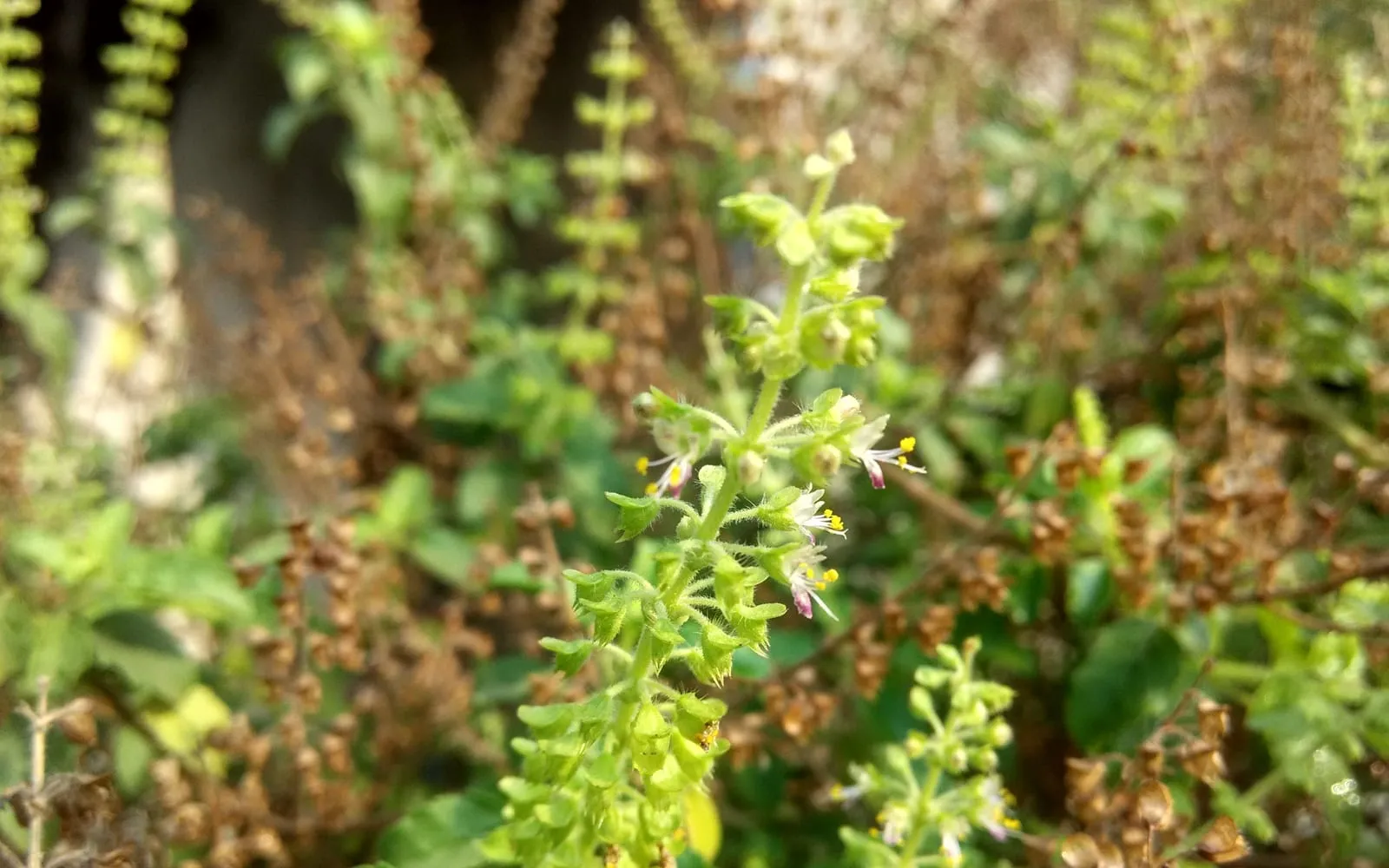
Flowers open in slender spikes at the shoot tips, small and purple to pink, with purple bracts, opening in whorls from midsummer.
Stems are square and hairy, purple in the darker forms.
The scent is the identification. Clove, pepper and a medicinal sharpness, very different from sweet basil, and it carries on the air around a healthy plant.
Where it is from
Holy basil is native to the Indian subcontinent and it has been cultivated across south and south-east Asia for at least three thousand years.
Its religious role is central rather than incidental. In Hinduism the plant is a manifestation of the goddess Tulsi, it is worshipped daily in many households, and the annual festival of Tulsi Vivah celebrates its ceremonial marriage to Vishnu at the start of the wedding season.
Ayurvedic medicine treats it as a major herb, classing it as an adaptogen and using it for respiratory complaints, fever and stress.
The tea trade has taken it worldwide. Tulsi tea is sold across Europe and North America, and the plant is grown commercially in India for that market as well as for essential oil.
Thai holy basil, sold as kaphrao and used in the stir-fry pad kaphrao, is this species, and it is the reason the plant appears in a Western supermarket at all.
How it grows
Sow indoors from March at 20 to 25 deg C. Surface sow onto damp compost and press the seed in, since it needs light.
Germination takes one to two weeks in warmth. Cold compost gives you nothing.
Prick out into small pots once the seedlings have two true leaves, and grow them on somewhere bright and warm.
Pot on into 20 cm pots of free-draining compost. It does better in a pot than in cool open ground.
Keep it above 15 deg C wherever possible. Below 10 deg C the plant stops growing, the leaves discolour and it rarely recovers well.
Pinch the growing tips from 15 cm to make it branch, and keep pinching as you harvest.
Remove flower spikes to keep the leaf coming, unless you want seed or the flowering tops for tea, which are also used.
Overwinter it on a warm bright windowsill above 15 deg C, watering sparingly. It will get through and become woody and less productive, so most people sow fresh each spring.
Harvest leaves and flowering tops from June, taking whole shoot tips rather than single leaves.
Through the seasons
Winter is survival indoors. Keep it above 15 deg C, in the brightest place you have, and water sparingly. Expect it to look poor.
Spring is sowing, from March in warmth, and repotting for an overwintered plant.
Early summer is when growth accelerates. Move plants to a greenhouse or the sunniest windowsill and start pinching.
Midsummer is the main harvest, and flowering starts. Pinch out the spikes for leaf, or let them open for the flowering tops.
Late summer is a second harvest, and the time to take cuttings if you want to overwinter a young plant rather than an old one.
Autumn ends outdoor plants at the first cold night. Bring anything you want to keep inside well before then, in September rather than October.
Care difficulty
Moderate in a cool climate, and the difficulty is warmth.
Holy basil is tender and it is more sensitive to cold than sweet basil. Below about 10 deg C it stops growing and the leaves discolour, which happens on a windowsill in October well before any frost.
Overwatering is the other common killer. Basils rot at the base from cold wet compost, and the plant should be watered in the morning and allowed to dry between times.
Seed needs real warmth to germinate. A propagator or a warm airing cupboard makes the difference between a tray of seedlings and an empty pot.
Given warmth, light and careful watering, it grows readily and crops from June to September.
Most people treat it as an annual. Overwintering works and produces a woody plant that crops less, so a fresh sowing each March is usually better.
Watering
Water in the morning, so the compost surface dries before night. Basils are vulnerable to rot from cold wet compost overnight.
Water when the top 2 cm of compost is dry, which is every two or three days in summer and weekly in winter.
Never leave the pot standing in a saucer of water. That is the fastest way to lose a basil.
Water the compost rather than the foliage.
Use tepid water rather than cold from a tap in winter, since a cold soak checks a tender plant.
Reduce watering sharply from October, keeping an overwintering plant barely moist.
Warning signs, diseases and pests
Damping off collapses seedlings at the base in cold wet compost. Sow into warm fresh compost, sow thinly and water carefully.
Blackening at the base of a mature plant is root rot from overwatering or from standing in water. There is no cure once it reaches the stem.
Leaves turning dull, spotted or bronzed usually mean cold rather than disease. Below 10 deg C the plant deteriorates steadily.
Aphids and whitefly both build up on plants under glass. Rub aphids off and use sticky traps or a biological control for whitefly.
Grey mould appears on crowded plants in still humid air. Thin the growth and improve ventilation.
Leggy pale growth means too little light. It needs the brightest position available.
A plant that flowers and stops producing leaf needs its spikes pinched out.
Growing environment
Full sun and warmth. A greenhouse, conservatory or the sunniest windowsill in the house.
Minimum 15 deg C for useful growth, and it suffers below 10 deg C.
Free-draining compost in a pot rather than a cool open bed. Multipurpose compost with a third perlite or grit added suits it.
pH around 6 to 7.
Outdoors it will manage a warm sheltered patio from June to early September, and it must come in before the nights cool.
Good ventilation matters under glass, since still humid air brings on mould and whitefly on a soft plant.
Feeding
Feed lightly. A weak balanced liquid feed every three weeks from May to August suits a pot-grown plant.
Avoid heavy nitrogen. It produces soft growth with less scent and more pest trouble.
Do not feed at all through the winter, when the plant is barely growing.
Use fresh compost each spring rather than feeding an old pot harder.
Lean growing gives a stronger clove scent, which is the point of the plant.
Troubleshooting
Is it the same as sweet basil? No. Holy basil has hairy toothed leaves and a sharp clove-and-pepper scent, and it goes into tea and Thai stir-fries. Sweet basil is smooth-leaved, sweet and aniseed, and it is the pesto plant. They do not substitute for each other.
The leaves went dull and spotted. Cold. Below 10 deg C the plant deteriorates and it rarely recovers well. Move it somewhere warmer.
It collapsed at the base. Root rot from overwatering or from standing in a saucer. Water in the morning and empty the saucer.
Nothing germinated. The compost was too cold. It needs 20 to 25 deg C.
Can I grow it outside? Only from June to early September in a warm sheltered spot, and it must come in before the nights cool. A greenhouse or windowsill is better.
What are Rama, Krishna and vana tulsi? Rama is the green form, Krishna the purple one, and vana tulsi is a separate species, Ocimum gratissimum, with a lighter scent. All are grown as tulsi.
Should I let it flower? Pinch the spikes out for leaf. The flowering tops are also used for tea, so if that is your interest, let some open.