
Edible
Summer Savory
Satureja hortensis
Also known as Savory, Bean herb
How to grow summer savory, Satureja hortensis. The bean herb, sowing it direct in May, and how it differs from the woody winter savory.
At a glance
- Difficulty
- Easy
- Water
- Weekly in dry weather, more in a pot
- Light
- Full sun
- Temperature
- Killed by frost. Sow after the last one
- Hardiness
- USDA 9-11, RHS H2, hardy to 0 C
- Type
- Half-hardy annual
- Height
- 20-40 cm
- Native to
- the Mediterranean, western Asia
- Best month
- May and August in the Northern Hemisphere, November and February in the Southern Hemisphere
An annual killed by the first frost, so it is sown after the last one and pulled in autumn, which makes it the easier savory to fit into a rotation. Poor dry soil concentrates the flavour. It is the classic bean herb across Europe, and the plants are traditionally sown alongside the beans.
Hardiness zones describe winter cold alone. Summer heat, humidity, rainfall and the length of the growing season decide as much, so treat the range as the outer limit rather than as a recommendation.
Every month named in this guide is for the temperate Northern Hemisphere. If you garden in the Southern Hemisphere, shift each one by six months, so May becomes November. Closer to the equator the wet and dry seasons matter more than the calendar, and the shift stops being a useful guide.
Not known to be toxic
- Safe to eat
- Leaves and flowering shoots
Non-toxic. Summer savory is a culinary herb with a long record of safe use in European cooking and it does not appear on the RHS list of potentially harmful garden plants. Neither the ASPCA nor the RHS records it as a hazard to cats, dogs or horses. The usual mint-family caveat applies to the distilled oil rather than the plant: savory oil is rich in carvacrol, it irritates skin undiluted and it should not be given to animals. The herb in a pot of beans is food.
Sources: RHS potentially harmful garden plants, ASPCA toxic and non-toxic plants
About
Summer savory is the bean herb. It goes into broad beans, French beans, haricot stews and lentils across Europe, and the German name Bohnenkraut says so directly. The flavour is peppery and slightly thymey, with a warmth that suits pulses better than any other herb does.
It is an annual, killed by the first frost, and that makes it easier to grow than its perennial cousin winter savory. Sow it where it is to crop in late May, thin it, and pick it from July until the frosts.
Nobody grows enough of it. One short row supplies a summer, and a second sowing in June extends the picking into October. It also dries well, which matters because a dried bean in January wants the herb as much as a fresh one in August.
Appearance and character
A slim upright plant, 20 to 40 cm, branching from near the base into a narrow bush.
Leaves are narrow, pointed and soft, 1 to 3 cm long, dark green, sometimes bronzed where the sun is strong, held in opposite pairs on square stems.
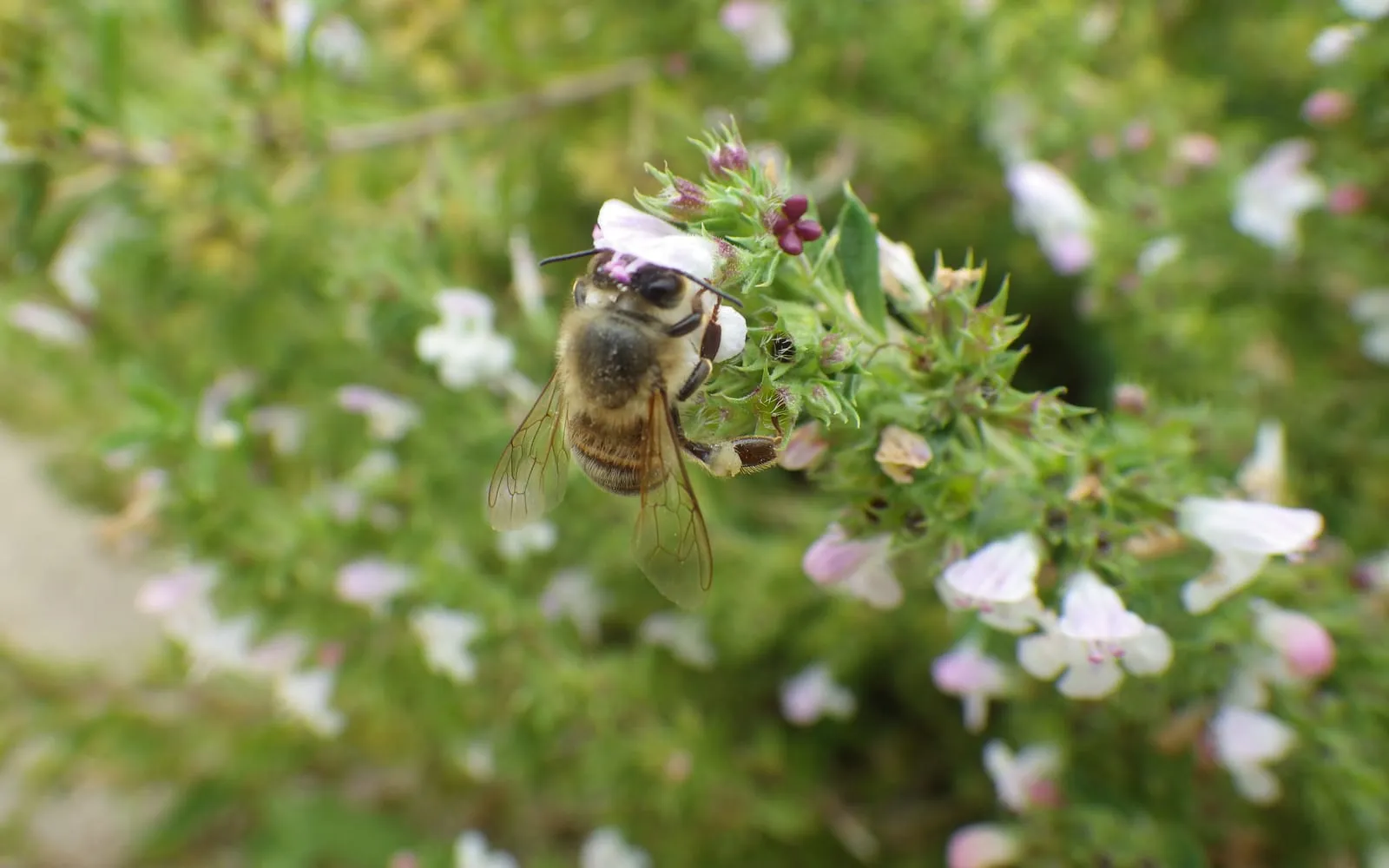
Flowers are tiny, white to pale lilac, sometimes pink-spotted in the throat, carried in the leaf axils along the upper stems from July.
Stems are square, thin, softly hairy and often reddish. The whole plant stays soft rather than going woody, which is the immediate difference from winter savory.
The scent is peppery and resinous, close to thyme but warmer and rounder, and it is at its strongest just before flowering.
It is an unremarkable-looking plant. Nobody grows summer savory for the border, and a row of it in a vegetable bed is the usual place for it.
Where it is from
Summer savory is native to the eastern Mediterranean and western Asia, from southern Europe through Turkey to Iran, on dry stony hillsides.
The Romans used it heavily and Virgil recommended planting it near beehives. Its Latin name, satureia, was linked by classical writers to satyrs, which tells you what it was reputed to do and says nothing reliable about the plant.
It reached Britain with the Romans and was one of the herbs the Anglo-Saxons grew. It was in general kitchen use here long before pepper became affordable, and it partly served that role.
Central and eastern Europe kept it when Britain largely lost it. It is standard in German, Bulgarian and Romanian cooking, where it is used in bean dishes, sausages and the spice mixes sold as chubritsa in Bulgaria.
Canada grows a surprising amount. Newfoundland uses savory in its traditional stuffing and dressing to a degree found nowhere else in North America, and a local variety is grown commercially there.
How it grows
Sow direct where it is to grow, from mid-May once the soil has warmed. Earlier sowings sit in cold ground and rot.
Scatter the seed thinly in a shallow drill and cover with no more than 5 mm of soil. It needs light to germinate, so a deep sowing gives you nothing.
Germination takes 10 to 14 days in warm soil. Thin the seedlings to 15 cm.
Sow again in mid-June for a later crop. Successional sowing is more use here than trying to keep one row going.
An earlier start is possible in modules under glass in April, planted out at the end of May. The plants resent root disturbance, so use modules rather than a seed tray.
Pinch out the tips at 10 cm to encourage branching, and keep pinching as you harvest.
Harvest whole shoots from July. Cut the plant to 5 cm as it comes into flower, which is when the flavour peaks, and it will regrow for a second cut.
Pull the plants out after the first hard frost. Save seed from one or two if you want, since it comes true.
Through the seasons
Winter there is nothing. The plant is dead and the ground is free for something else.
Spring is preparation. Rake a fine seedbed in a sunny spot in April and wait for warmth. Sowing in cold soil wastes the seed.
Late spring is sowing time, from mid-May outdoors.
Early summer brings thinning and a second sowing. Water in dry spells and watch for slugs on the seedlings.
Midsummer is the main harvest, from July as the flowers open. Cut hard, and cut a batch for drying at the same point.
Late summer is the second flush and the June sowing coming into use.
Autumn finishes it. Pick until the frosts, then clear the row.
Care difficulty
Easy, provided you wait for warmth before sowing.
Cold soil is the one reliable way to fail with it. Seed sown in April into a wet British seedbed rots, and gardeners then conclude the seed was bad. Sow from mid-May.
After that it needs nothing beyond thinning and occasional watering. No feeding, no staking, no winter protection.
It is untroubled by pests apart from slugs at the seedling stage, and it has no disease of consequence in a normal season.
The plant is small and easy to lose among vigorous neighbours, so give it a row of its own or the front of a bed rather than a gap between courgettes.
The end of the season needs no thought. It dies, you pull it up, and you sow again in May.
Watering
Water the seedbed before sowing rather than after, then keep it just damp until germination.
Water young plants weekly in dry weather until they are 15 cm tall.
An established plant in the ground copes with a dry summer and the flavour is better for a little drought.
Water a container twice a week in July. Pots dry fast and a wilted savory recovers poorly.
Water at the base in the morning. The plant is small and crowded, and wet foliage overnight invites mould.
Stop worrying about it from September. The plant is winding down and drier conditions concentrate the oils.
Warning signs, diseases and pests
Damping off kills seedlings at the base in cold wet compost, and it is the commonest problem with this species. Sow into warm soil, sow thinly, and use fresh compost for module sowings.
Slugs take young plants overnight in June. Protect the row until the plants are established.
Aphids gather on the tips in a warm early summer. Rub them off or cut the tips away.
Root rot in heavy wet ground turns the base of the stem brown and the plant collapses. Improve drainage or grow it in a pot.
Poor germination almost always means the seed went in too early, too deep, or both.
Yellow lower leaves on a crowded row mean the plants were not thinned. Thin to 15 cm.
Weak flavour follows too much water and too little sun.
Growing environment
Full sun. Summer savory in shade is a thin pale plant with little scent.
Light, free-draining soil of moderate fertility. It grows on stony ground in the wild and does not need a rich bed.
Neutral to slightly alkaline, around pH 6.5 to 7.5.
A vegetable bed suits it, and it is a traditional companion for beans. The claim that it repels blackfly is common and not well supported, though it does no harm and the herb is wanted for the beans anyway.
A pot of at least 20 cm works well and can be kept by the back door.
A cloche in early May warms the soil and lets you sow a fortnight sooner in a cold garden.
Feeding
Nothing is needed in reasonable soil. Summer savory is a short-lived plant that finds what it needs in a normal vegetable bed.
Do not add nitrogen. It gives you tall soft growth that flops, with less scent and more aphids.
Compost dug in the previous autumn is ample preparation.
A container plant benefits from a weak balanced feed every three weeks, since a pot exhausts itself faster than a bed.
If the plants look starved in the ground, the cause is usually crowding or dry soil rather than nutrition. Thin them and water.
Troubleshooting
Nothing came up. Sown too early into cold soil, or covered too deeply. Sow from mid-May with no more than 5 mm of covering.
The seedlings collapsed at soil level. Damping off. Sow thinner into warmer ground and avoid overwatering.
Which savory should I grow? Summer savory for cooking, because the flavour is softer and the leaf is tender. Winter savory for a permanent plant and for picking in the cold months, though it is coarser and more resinous.
It flowered and looked finished. Cut it to 5 cm as the flowers open. It regrows and the harvest at flowering is the best of the year.
The plants flopped over. Too rich a soil, too much water, or unthinned crowding. None of it is fatal.
Can I dry it? Yes, and it keeps its flavour well. Cut whole stems at flowering, hang them somewhere dry and airy, and strip the leaves when brittle.
It tastes like thyme. It is a close relative and the family resemblance is real. Savory is warmer and more peppery, which is what makes it work with beans.