
Outdoor plant
Japanese Sedge
Carex morrowii
Also known as Morrow's sedge
How to grow Japanese sedge, Carex morrowii, in shade. Its evergreen variegated foliage, and why it suits a dark corner better than almost any true grass.
At a glance
- Difficulty
- Easy
- Water
- Regular watering, especially in shade with root competition from trees
- Light
- Partial to full shade
- Hardiness
- USDA 5-9, RHS H6, hardy to -20 C
- Type
- Hardy evergreen perennial sedge
- Height
- 20-40 cm
- Native to
- Japan
Fully hardy through ordinary temperate winters, staying evergreen and holding its structure through the coldest months in most climates rather than dying back the way many true grasses do. It performs best with reliable soil moisture and struggles more in a hot, dry, exposed position than in cold, making it a better fit for shaded, sheltered ground than for an open, sun-baked border.
Hardiness zones describe winter cold alone. Summer heat, humidity, rainfall and the length of the growing season decide as much, so treat the range as the outer limit rather than as a recommendation.
Not known to be toxic
Japanese sedge has no toxicity listing from the RHS or the ASPCA and is considered safe around pets and children. It has no documented history of poisoning.
Source: RHS
About
Japanese sedge fills a role few true grasses can: reliable, evergreen, fine-textured foliage in shade, where most ornamental grasses either refuse to grow at all or lose their form and colour. Technically a sedge rather than a true grass, it forms a dense, arching, fountain-like tuft that holds its shape through every season, and several popular variegated cultivars, with white or gold striping along the leaf, brighten a dark corner of the garden more than most shade plants manage.
Its tolerance of both shade and reasonably heavy, moisture-retentive soil, conditions that would weaken or kill many sun-loving ornamental grasses, has made it a mainstay of woodland-edge planting schemes and a reliable choice for underplanting beneath deciduous trees and shrubs.
Appearance and character
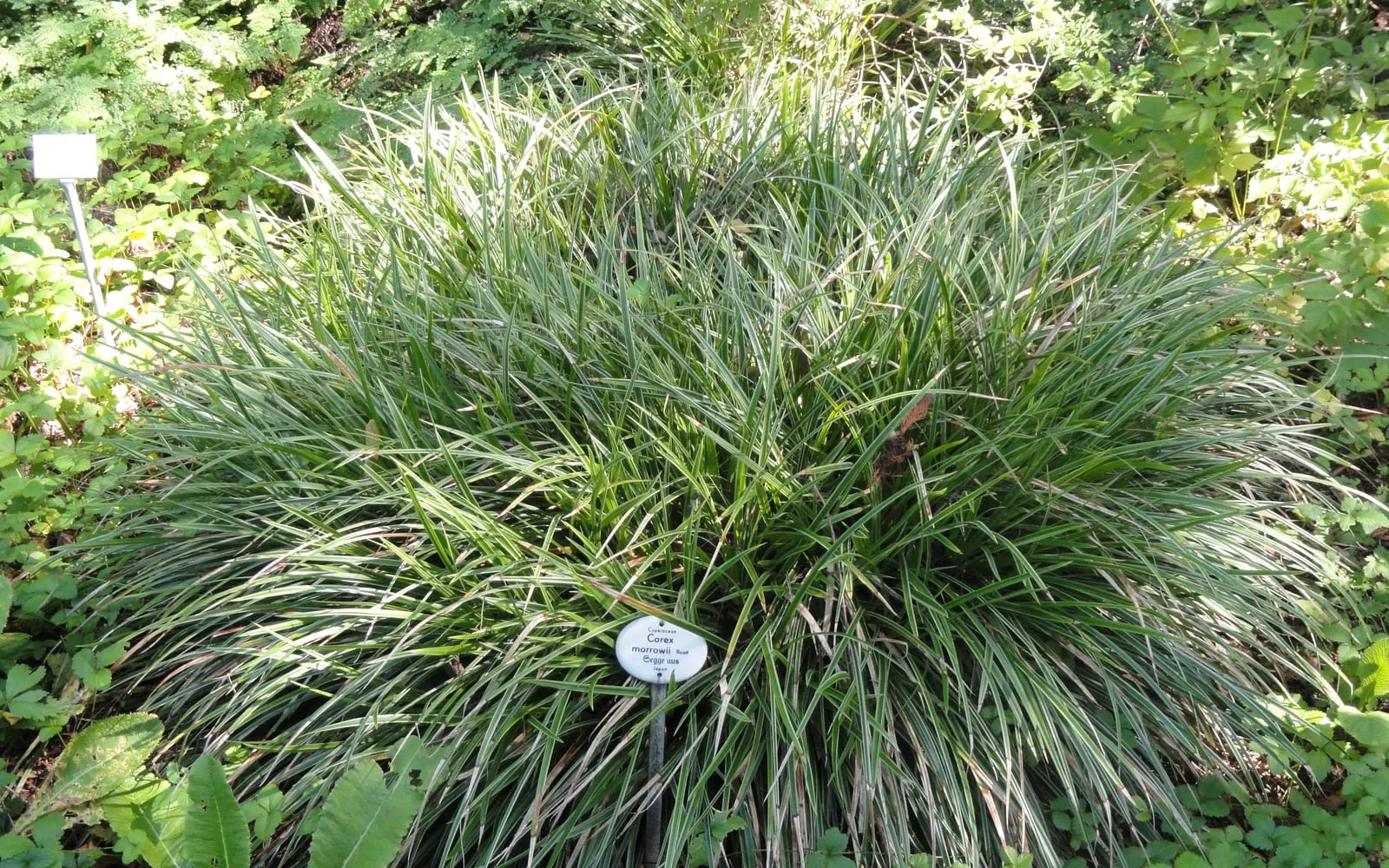
Narrow, arching leaves radiate outward from the base in a dense, symmetrical fountain shape, evergreen through the year rather than dying back to bare ground over winter the way many perennial grasses do. For that reason it is groomed rather than cut down: comb the dead leaves out by hand or with a light shear in spring, since cutting it hard to the ground as you would a deciduous grass spoils its shape for the season. Many widely grown cultivars carry variegation, most often a fine white or cream margin along each leaf, and this striping stays visible year round given the plant’s evergreen habit.
Flower spikes are small, brownish and largely inconspicuous compared with the plant’s foliage, which is the real reason this species is grown; few gardeners choose it for its flowers, and most barely notice them among the more visually dominant leaves.
Where it is from
Woodland and shaded, damp ground across Japan, typically beneath a tree canopy in soil enriched by leaf litter and reliably moist rather than prone to drying out.
That woodland floor origin explains its shade tolerance directly, and also its relative dislike of hot, dry, exposed conditions, which is the reverse of what most popular ornamental grasses, bred from open grassland species, prefer instead.
How it grows
A hardy evergreen perennial that slowly expands its tuft over successive years without spreading aggressively by runners, staying a well-behaved, clump-forming plant suited to a mixed shaded border. Growth is unhurried, and a young plant can take a couple of seasons to reach the full, dense fountain shape mature specimens are valued for.
Because it is evergreen, this species provides consistent structure and colour through winter in a way a dying-back grass cannot, which is particularly valuable in a shaded part of the garden where flowering options are already limited through the colder months.
Through the seasons
Spring fresh new leaves emerge among the retained evergreen foliage, refreshing the clump’s appearance.
Summer growth continues steadily given adequate shade and moisture, with inconspicuous flower spikes appearing on established clumps.
Autumn growth slows as temperatures drop, though the evergreen foliage remains largely unchanged in appearance.
Winter the clump holds its structure and, on variegated cultivars, its striping through the coldest months, providing valuable winter interest in a shaded border.
Care difficulty
Easy, provided it is given the shaded, reasonably moist conditions it needs rather than treated like a typical sun-loving ornamental grass. In the right spot it needs very little attention beyond an occasional tidy of tired old leaves.
Watering
Regular watering supports the best appearance, particularly in a shaded spot beneath trees, where root competition for moisture can be significant even though direct sun exposure is limited. Deep watering during any dry spell helps maintain the dense, healthy foliage this species is valued for.
Warning signs, diseases and pests
Slugs and snails occasionally graze the leaf tips, particularly on soft new growth in spring, though established clumps generally tolerate light grazing without lasting harm. Leaf spot can develop in consistently damp, poorly ventilated conditions, showing as small discoloured patches on the foliage, and improving air circulation around a crowded planting reduces its likelihood.
Browning leaf tips, particularly on a plant in a drier or more exposed spot than this species prefers, usually reflect insufficient moisture or too much sun rather than disease, and moving the plant to better-suited conditions, or improving watering, generally resolves it over the following season.
Growing environment
Partial to full shade suits it best, and this is one of the more shade- tolerant ornamental grass-like plants generally available. Humus-rich, moisture-retentive soil gives the best results, and this species is especially less at home in a hot, dry, sun-baked position than many other grasses commonly grown in gardens.
Feeding
A balanced granular feed applied once in spring supports steady growth, though established clumps in reasonably good woodland-type soil often need very little supplemental feeding to look their best.
Troubleshooting
Leaf tips are browning. Usually insufficient moisture or too much direct sun for this shade-loving species. Improve watering and consider whether the position has become sunnier than when it was first planted.
New leaves are notched or grazed. Check for slugs and snails on soft spring growth, and protect vulnerable young foliage where damage is significant.
Small discoloured patches have appeared on the leaves. Suspect leaf spot from consistently damp, poorly ventilated conditions. Improve air circulation around a crowded clump and remove badly affected leaves.
Variegation on a named cultivar looks weaker than expected. Confirm the plant is not in significantly deeper shade than the cultivar tolerates, since very low light can reduce the intensity of leaf striping on some variegated forms, though this species still tolerates much more shade than most other variegated grasses.
You want to divide an established clump to make more plants. Lift and split the tuft in spring, keeping a reasonable portion of roots with each division, and replant promptly into prepared, humus-rich shaded soil, watering well until the divisions show clear signs of settling into active growth.
You are choosing a companion for hostas or ferns in a shaded border. The fine, arching, evergreen habit of this species contrasts well with the broader leaves of many other shade-loving perennials, and because it holds its structure through winter, it keeps a mixed shaded planting from looking bare once its deciduous companions have died back for the season.