
Outdoor plant
Mexican Orange
Choisya ternata
Also known as Mexican orange blossom, Choisya
How to grow Mexican orange blossom, Choisya ternata. The trifoliate leaves that identify it, twice-yearly flowering, why it sulks in cold wind and the pruning that gets a second flush.
At a glance
- Difficulty
- Easy
- Water
- Rarely once established, and weekly in pots
- Light
- Full sun to partial shade, and best with shelter from cold wind
- Temperature
- Hardy to about -10 deg C, and damaged by cold drying wind
- Hardiness
- USDA 7-10, RHS H4, hardy to -10 C
- Type
- Evergreen shrub, long lived and dense
- Height
- Up to 2.5 m, and usually less in a temperate garden
- Native to
- Mexico and the south-western United States, on rocky slopes and canyon sides
- Best month
- May in the Northern Hemisphere, November in the Southern Hemisphere
It comes from the mountains of Mexico and the south-western United States, so it takes heat and drought better than it takes cold wet ground. Below about -10 C the leaves brown and the shoot tips die back, and a cold drying wind does the damage rather than still frost. Sundance and the other yellow-leaved forms scorch in full sun and go green in deep shade, so give them light shade.
Hardiness zones describe winter cold alone. Summer heat, humidity, rainfall and the length of the growing season decide as much, so treat the range as the outer limit rather than as a recommendation.
Every month named in this guide is for the temperate Northern Hemisphere. If you garden in the Southern Hemisphere, shift each one by six months, so May becomes November. Closer to the equator the wet and dry seasons matter more than the calendar, and the shift stops being a useful guide.
Not known to be toxic
Choisya is not listed as harmful by the RHS and is not recorded by the ASPCA as toxic to cats, dogs or horses. It belongs to the same family as citrus, the Rutaceae, and the aromatic oils in its leaves are what produce the sharp resinous smell when they are crushed. Those oils have not been associated with poisoning, and no part of the plant is recorded as a hazard to people or pets. One drawback is unrelated to toxicity. The crushed foliage smells strongly and unpleasantly to some people, often described as a mix of citrus peel and something more medicinal, so a plant beside a path where people brush against it will make itself known. That is a siting preference rather than a safety issue. Some members of the Rutaceae contain compounds that cause phototoxic skin reactions, and Choisya is not among the species where this has been reported, but gloves are sensible when pruning any large quantity of aromatic evergreen foliage.
Sources: RHS potentially harmful garden plants, ASPCA toxic and non-toxic plants
About
Choisya is the evergreen that flowers twice. A heavy show of white blossom in late spring, then a lighter second flush in late summer or autumn, on a shrub that looks respectable for the other ten months of the year.
That combination is the reason it appears in so many temperate front gardens. It holds its shape without clipping, it is glossy and dark rather than dusty, and it covers ground at the awkward scale between a herbaceous plant and a tree.
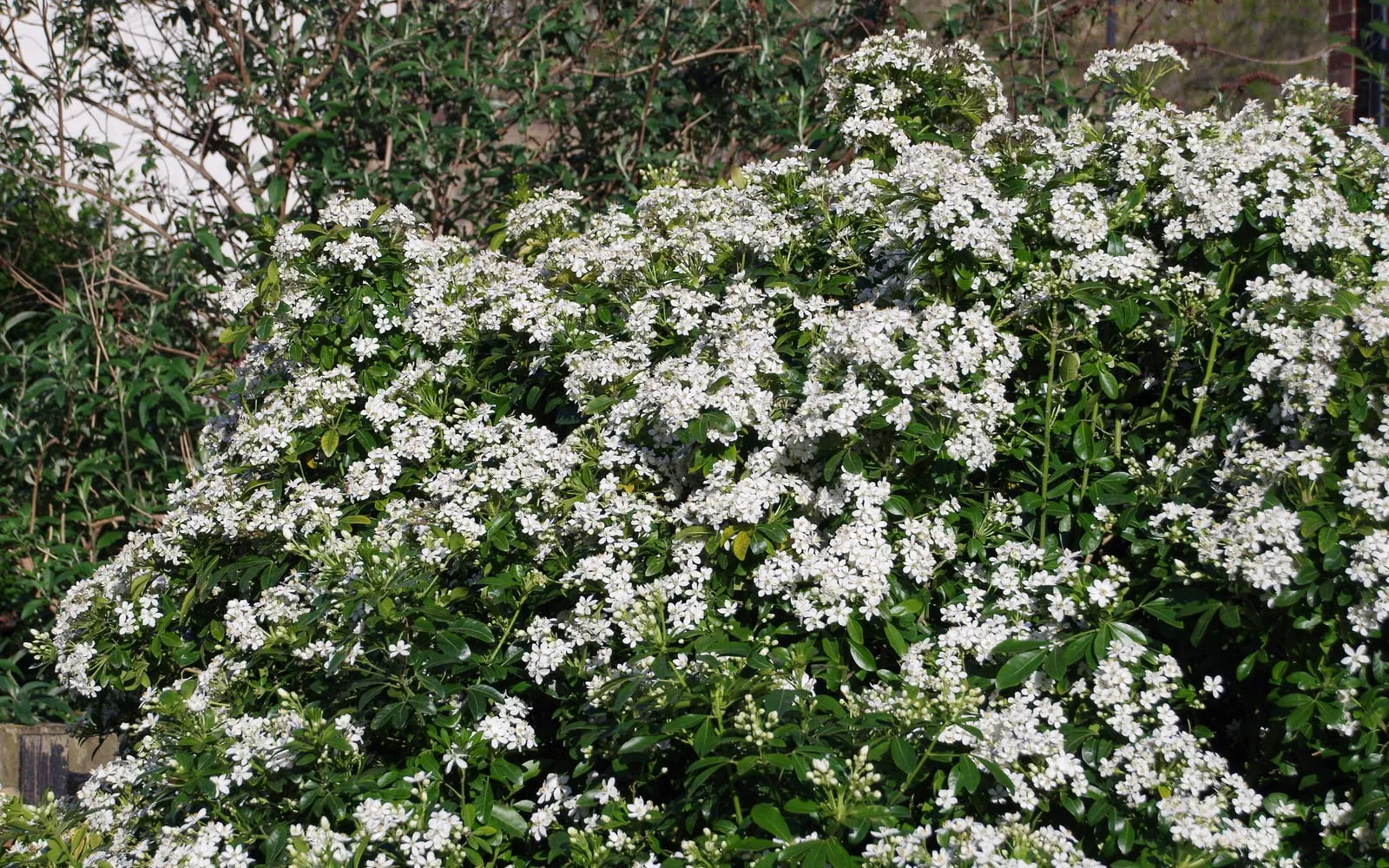
The name says what the flowers are like. They are white, five-petalled, sweetly scented and carried in loose clusters, and they resemble orange blossom, which is unsurprising given that the plant is a relative of citrus.
The leaves smell of something else entirely. Crushed, they are sharp and resinous, and opinion on the smell is divided in a way that is worth testing before planting one beside a doorway.
Appearance and character
An evergreen shrub forming a dense rounded dome, reaching about 2.5 m in ideal conditions and commonly 1.5 m in a temperate garden, usually wider than it is tall.
The leaf is the identification, and the species name says it. Ternata means in threes, and each leaf is divided into three narrow glossy leaflets radiating from a single point on the stalk. A choisya with simple undivided leaves is not C. ternata.
Leaflets are dark green, thick, glossy, aromatic when crushed, and held all year.
Flowers open in April and May in clusters at the shoot tips, each about 3 cm across, pure white with five petals and a boss of yellow stamens, and strongly scented.
A second flush follows in late summer and autumn, lighter than the first but useful for coming when little else is in flower.
The related ‘Sundance’ has bright yellow foliage and the hybrid ‘Aztec Pearl’ has much narrower leaflets and pink-flushed buds. Both are common in garden centres and neither is the plain green species.
Where it is from
Mexico and the south-western United States, growing on rocky slopes and canyon sides in areas with dry summers and sharp drainage.
The genus honours Jacques Denis Choisy, a Swiss botanist, and the plant reached Britain in the 1820s.
It wants drainage rather than damp, and it suffers below about -10 deg C.
Cold drying wind does more damage than cold alone. A plant that shrugs off a hard still frost will brown badly in an east wind at the same temperature, which is why choisyas look fine in a sheltered town garden and struggle on an exposed site.
How it grows
Plant in spring, which gives the shrub a full season to establish before its first winter. Autumn planting works in mild areas.
Choose a sheltered position in sun or partial shade. A wall that takes the edge off an east wind is ideal, and full shade gives leggy growth and few flowers.
Improve heavy soil with grit and compost before planting. Waterlogged clay is the one situation where this plant reliably fails.
Prune immediately after the main flowering in late spring or early summer. Shorten the flowered shoots by about a third, cutting to just above a leaf joint.
That timing is what produces the autumn flush. Pruning later removes the wood that would have carried the second flowering, and pruning in autumn or winter exposes soft regrowth to frost.
Renovate an old leggy plant by cutting one third of the oldest stems to near ground level each year for three years. Choisya breaks readily from old wood, so a hard cut is survivable, but the staged approach keeps the shrub presentable throughout.
Take semi-ripe cuttings in mid to late summer.
Through the seasons
Winter is when damage happens. Leaves brown and drop at the margins after cold wind, and the plant looks poor until spring growth covers it.
Spring brings new growth in March and the main flowering in April and May.
Summer is the pruning window, straight after the flowers finish, followed by a flush of new leaves.
Autumn produces the second, lighter flowering. Leave the plant alone now rather than cutting it, so the growth hardens before frost.
Care difficulty
Easy in the right position and disappointing in the wrong one.
Given shelter, drainage and some sun, it needs one prune a year and nothing else.
The failures are nearly always about site. Cold exposed positions cause winter leaf browning, heavy wet soil causes yellowing and root rot, and deep shade causes an open sprawling plant with few flowers.
It is not a plant for a windy northern garden without a wall to sit against.
Watering
Water regularly through the first two summers after planting, since the root system takes a while to reach out.
An established choisya in open ground needs watering only in a prolonged drought.
Pots are different and need consistent water through summer. Choisya grows well in a large container and dries out fast in one.
Do not overwater, and never let it sit wet in winter. Yellowing leaves on a plant in heavy soil are usually a drainage problem rather than a feeding one.
Warning signs, diseases and pests
Brown, scorched leaf margins after winter are the commonest complaint, and the cause is cold drying wind rather than disease. Wait until spring, cut out the worst affected shoots, and the plant refoliates. Repeated damage every year means the position is too exposed.
Yellow leaves, particularly on a plant in clay or a pot that stays wet, indicate waterlogging and root damage. Improve the drainage, ease off the watering, and consider moving the plant.
Snails shelter in the dense skirt of foliage at the base and graze soft new growth. Clearing leaf litter from underneath reduces the population.
Scale insects occasionally colonise the stems, followed by sticky honeydew and black sooty mould on the leaves below. Wipe or wash off small infestations.
Honey fungus attacks choisya and is fatal. White fungal sheets under the bark at the base and sudden collapse of the whole plant are the signs.
Leggy growth with bare lower stems and flowers only at the top means too much shade, too little pruning, or both.
Failure to produce a second flush in autumn almost always traces back to pruning at the wrong time of year.
Growing environment
Full sun to partial shade. Sun gives the best flowering, and light shade suits the yellow-leaved ‘Sundance’, which scorches in strong midday sun.
Shelter is the single most important factor. Give it a position out of cold east and north winds, ideally with a wall or a hedge behind it.
Free-draining soil, moderately fertile, ideally neutral to slightly alkaline. Add grit to clay. Avoid hollows where water stands in winter.
Allow 1.5 to 2 m of width. It is often planted too close to a path and then cut back annually, which spoils the natural dome.
It works well in a large pot, as informal low hedging in a mild area, and as a backdrop to a mixed border.
Site it where you will brush past it only if you like the smell of the crushed leaves. Plenty of gardeners dislike it.
Feeding
A balanced general-purpose fertiliser in spring, applied with a mulch of compost, is enough for the year.
Container plants need more. Feed monthly through the growing season with a balanced liquid feed, and top-dress the pot each spring.
Avoid heavy nitrogen, which produces soft growth that suffers badly in the first cold wind.
Yellowing leaves are more often waterlogging than hunger, so check the drainage before reaching for fertiliser. On an alkaline soil where the yellowing is between the veins, a sequestered iron feed will help.
Troubleshooting
How do I confirm it is Choisya ternata? Look at the leaf. It should be divided into three glossy leaflets from a single point. Narrow leaflets in fives suggest ‘Aztec Pearl’, and yellow foliage suggests ‘Sundance’.
The leaves went brown round the edges over winter. Wind scorch rather than disease. Cut out the worst shoots in spring and it will refoliate. Persistent damage means the site is too exposed.
When do I prune it? Straight after the main flowering ends in late spring or early summer. Shorten flowered shoots by about a third.
It only flowered once. The second flush comes on growth made after the summer prune, so pruning late or not at all costs you the autumn flowers.
The leaves are turning yellow. Usually waterlogging on heavy soil or in a pot that stays wet. Improve drainage before feeding.
It has gone leggy and bare at the bottom. Too much shade or years without pruning. Cut a third of the oldest stems low each year for three years to rebuild it.
Can I cut a big overgrown one hard? Yes, it breaks from old wood, but staging the renovation over three years keeps it looking better throughout.
Is it safe around pets and children? Yes. It is not listed as harmful by the RHS and not recorded as toxic by the ASPCA. The strong smell of the crushed leaves is the only thing most people notice.