
Outdoor plant
Carolina Allspice
Calycanthus floridus
Also known as Sweetshrub, Carolina Sweetshrub, Strawberry Shrub
How to grow Carolina allspice, Calycanthus floridus. Why seedlings vary so much in scent that a named cultivar is the safer bet, its habit of suckering into a wide colony left unchecked, and the strychnine-like toxin hidden in its seed pods.
At a glance
- Difficulty
- Easy
- Water
- Regularly while establishing, then only in extended dry spells
- Light
- Full sun to part shade, with the strongest fragrance in more sun
- Temperature
- Fully hardy across most of the range it is grown
- Hardiness
- USDA 4-9, RHS H6, hardy to -25 C
- Type
- Deciduous woody shrub, suckering into a wide colony over time
- Height
- 2-3 m, spreading 2-3 m wide
- Native to
- the southeastern United States
The zone range covers cold tolerance only, and this species takes a hard winter readily since it is a true understorey deciduous shrub of a climate with real seasons. What the range does not capture is its origin under a canopy: it flowers and grows most strongly with some shade from the hottest part of the day, and a plant baked in full sun through a long, humid summer performs less well than one given a little relief in the afternoon.
Hardiness zones describe winter cold alone. Summer heat, humidity, rainfall and the length of the growing season decide as much, so treat the range as the outer limit rather than as a recommendation.
Toxic if eaten
- Do not eat
- The seeds inside the woody seed pods
- Harm from
- Eating it
- Affects
- People and horses
Carolina allspice is grown for its fragrant bark and flowers, and the danger sits somewhere a casual visitor rarely looks: inside the hard, urn-shaped seed pods that follow flowering. The seeds contain calycanthine, an alkaloid that acts on the nervous system in a way similar to strychnine, and historical accounts from the southeastern United States describe convulsions in cattle and other livestock that grazed on the seeds when other forage was scarce. This species is not separately listed on the RHS harmful garden plants index or given its own ASPCA page, so the risk is drawn from documented plant chemistry and historical livestock poisoning rather than a structured toxicology listing, and the practical danger for people and pets is low: the pods are woody, unappealing to chew, and the leaves and bark that make up most of the plant carry nothing comparable. Horses and grazing livestock, which can encounter fallen pods in a paddock setting, are the group with the best documented risk.
Sources: RHS potentially harmful garden plants, ASPCA toxic and non-toxic plants
About
Carolina allspice is grown for a scent rather than for a striking display. Crush a leaf, scratch the bark, or bury your nose in an open flower and you get a warm, spicy fragrance that different people compare to strawberry, banana, apple or clove, and the variation in what people smell from plant to plant is well documented rather than a trick of imagination, since individual seedlings vary in the intensity and character of their scent.
It is an easy, tough native shrub of the southeastern United States, long grown in cottage gardens there for the bark and flowers, which were historically dried and used to scent linen drawers in the way lavender is used further north.
Left alone, it slowly spreads by suckering from the base into a broad, rounded colony rather than staying as a single neat specimen, which suits a naturalistic shrub border or a woodland edge better than a tightly controlled formal bed.
Appearance and character
A rounded, multi-stemmed deciduous shrub, usually wider than it is tall, with simple opposite leaves 8 to 15 cm long, matte mid-green above and paler and slightly downy beneath, turning a soft yellow in autumn.
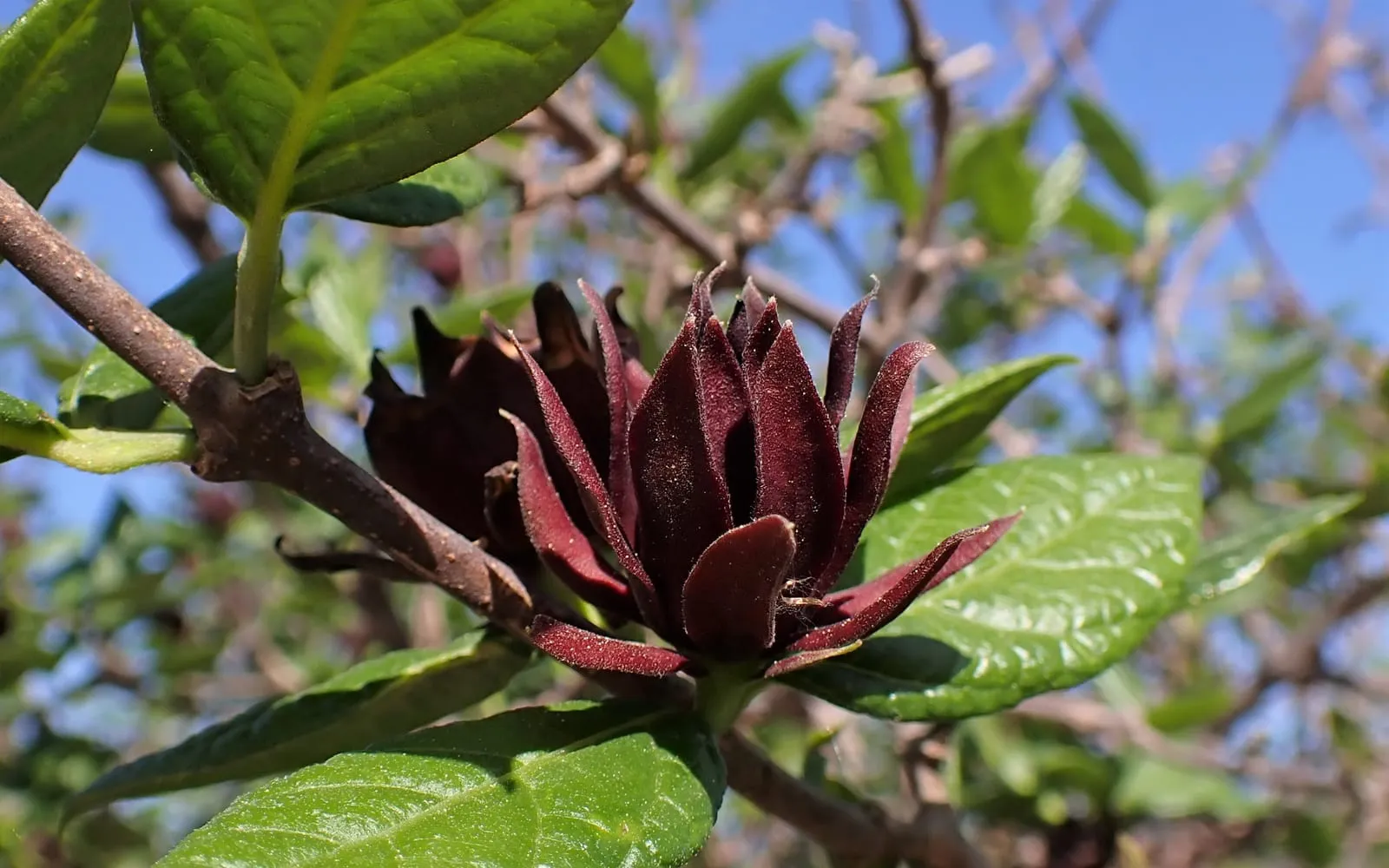
Flowers open from late spring into early summer, an unusual maroon to reddish-brown colour rather than anything bright, each made up of many narrow, strap-shaped petals arranged in a loose, slightly ragged spiral around a paler centre. They are carried singly at the shoot tips rather than in showy clusters, so the display rewards a close look rather than a distant one.
The bark on both young stems and roots carries the same spicy fragrance as the flowers and leaves when bruised or cut, a trait shared by the whole Calycanthus genus and one of the more reliable ways to confirm an unfamiliar shrub belongs to it.
Seed pods that follow flowering are woody, urn-shaped and persist on the bare stems well into winter, eventually splitting to release several dark brown, bean-like seeds.
Where it is from
Calycanthus floridus is native to the southeastern United States, from Virginia south through the Carolinas into Florida and west into Mississippi, typically growing as an understorey shrub along stream banks and in the partial shade of open deciduous woodland.
That woodland-edge origin explains why it flowers and grows best with some relief from the hottest part of the day rather than in the same open, baking sun that suits many other flowering shrubs, and why it tolerates a wide range of soil types provided moisture is reasonably reliable.
It has been in cultivation in American gardens since the eighteenth century, valued from early on for its fragrance rather than for any showiness of flower, and it reached British and European gardens not long afterwards as an unusual, sweetly scented curiosity from the New World.
How it grows
Plant in moist, humus-rich, well-drained soil, working in compost or leaf mould at planting time on poorer or sandy ground. It tolerates a range of soil pH from acid to neutral, which is broader than many flowering shrubs from similar habitats.
Choose a site with full sun to part shade. Some afternoon shade, particularly in a hot summer climate, keeps the plant looking its best and does not noticeably reduce flowering, while full baking sun through a long, humid summer can stress it.
Allow real space when planting, since a mature specimen spreads as wide as it grows tall and slowly suckers outward from the base to widen the clump further over years.
Water deeply and regularly through the first two growing seasons while the roots establish, then reduce to occasional deep watering during any extended dry spell once the plant is settled.
Prune only lightly, removing dead, damaged or crossing wood in late winter before growth resumes. It flowers on the previous year’s growth as well as on new wood through the season, so it tolerates a light shape without losing much of its display, and unwanted suckers at the base can be removed at any time to control the spread of the colony.
Through the seasons
Spring brings fresh leaf growth and, towards its end, the start of flowering, which continues into early summer.
Summer is quiet growth after the main flush of flowers, with the odd bloom sometimes appearing sporadically through warmer months.
Autumn turns the foliage a soft yellow before it drops, and is a good time to mulch the root zone and to plant new specimens.
Winter is fully dormant, with the woody seed pods often persisting on the bare stems as a minor point of winter interest.
Care difficulty
Easy, and one of the more forgiving flowering shrubs for a new gardener willing to give it a little shade and reasonably moist soil. It needs no elaborate feeding programme, no routine hard pruning, and tolerates a wide range of soil types.
The main task over time is managing the suckering habit, since a plant left entirely alone for years widens steadily into a broad thicket that some gardeners want and others find they need to control. Removing unwanted suckers at ground level as they appear keeps the clump to a manageable size without harming the parent plant.
Watering
Water deeply and regularly through the first two growing seasons after planting, since a young root system establishes best with consistent moisture rather than infrequent heavy soaking or light, frequent sprinkling.
Once established, the plant tolerates normal seasonal rainfall in most temperate gardens without supplementary watering, needing extra help only during an extended dry spell in summer, when a deep soak that reaches the full root zone matters more than a quick surface wetting.
Warning signs, diseases and pests
Powdery mildew can appear as a white coating on leaves in a humid summer, particularly on congested growth with poor air movement. Thin out crowded stems to improve airflow and avoid overhead watering late in the day.
Japanese beetle feeds on the foliage in midsummer in parts of its range where the beetle is established, skeletonising leaves between the veins. Hand-picking beetles into soapy water in the early morning, when they are sluggish, controls a light infestation without resorting to spraying a shrub grown mainly for scent close to the house.
Scale insects occasionally build up on older woody stems, appearing as small, flat, brownish bumps that sap the plant’s vigour gradually rather than suddenly. A dormant oil treatment in late winter is the standard control.
Leaf spot can appear in a particularly wet season combined with poor air circulation, showing as small dark blotches on the foliage. It is rarely serious enough to threaten the plant and is best managed by thinning congested growth rather than by fungicide.
Growing environment
Full sun to part shade both suit it, with some afternoon shade preferred in a hot summer climate to keep the foliage from stressing through the warmest weeks.
Moist, humus-rich soil gives the best growth, though the plant tolerates a range of conditions from acid to neutral pH provided drainage is reasonable and the ground does not dry out completely for long periods.
Shelter from the harshest wind is helpful but not essential, since this is a tough native shrub used to the varied conditions of open woodland edges.
Site it near a path, a door or a seating area where the fragrance of the crushed leaves and open flowers can be appreciated at close range, since the flowers themselves are easy to overlook from any distance.
Feeding
A balanced, slow-release fertiliser applied once in early spring as growth resumes is generally sufficient, and a mulch of well-rotted compost or leaf mould around the root zone supplies much of what the plant needs beyond that single application.
Avoid heavy nitrogen feeding, which pushes soft leafy growth without improving flowering and can make new shoots more prone to powdery mildew in a humid summer.
An established plant growing well in reasonably fertile soil often needs no supplementary feeding at all beyond an annual mulch.
Troubleshooting
My plant has spread well beyond where I planted it. Normal suckering habit. Remove unwanted suckers at ground level as they appear through the growing season to keep the clump to the size you want, without harming the parent plant in the process.
The flowers barely smell of anything. Individual seedlings vary widely in fragrance strength and character, and a plant grown from seed rather than from a named, scent-selected cultivar can turn out to have little scent at all. Buying a named cultivar rather than a generic seedling is the more reliable route to strong fragrance.
The leaves have a white, powdery coating in summer. Powdery mildew, usually on congested growth in humid weather. Thin out crowded stems for better air movement and avoid wetting the foliage late in the day.
Why has it barely flowered this year? Too much shade, a hard prune at the wrong time, or a recent transplant can all reduce flowering temporarily. Given a season or two to settle, an established plant in a reasonable amount of sun flowers reliably every year.
Are the seed pods safe to leave on the plant? They are best left in place rather than gathered or opened, since the seeds inside carry a genuine toxin. They cause no harm hanging on the bare winter stems and add a little seasonal interest of their own.