
Outdoor plant
Bulrush
Typha latifolia
Also known as Reedmace, Cattail, Great reedmace
How to grow bulrush, Typha latifolia, a tall marginal with brown poker flower spikes that needs firm containment in anything but a large pond.
At a glance
- Difficulty
- Moderate
- Water
- Constantly wet mud or shallow water at the margin
- Light
- Full sun
- Hardiness
- USDA 3-10, RHS H6, hardy to -20 C
- Type
- Hardy marginal perennial
- Height
- 1.5-3 m
- Native to
- Europe, Asia, North America, North Africa
One of the hardiest marginal plants available, native across most of the cold and cool temperate northern hemisphere and unbothered by an exposed, open site. Cold is never the limiting factor when growing it. Space is, since the same vigour that lets it survive a harsh winter also lets it fill a small pond within a few seasons if the roots are not contained.
Hardiness zones describe winter cold alone. Summer heat, humidity, rainfall and the length of the growing season decide as much, so treat the range as the outer limit rather than as a recommendation.
Not known to be toxic
- Safe to eat
- Young shoots can be peeled and cooked like asparagus, the pollen can be gathered and used as a flour additive, and the starchy rhizome has a long history as a foraged food, sometimes called Cossack asparagus
Bulrush has no toxicity listing from the RHS and is one of the more edible plants to grow at a pond edge. The only caution concerns where it is harvested from rather than the plant itself: the roots absorb pollutants readily from contaminated water, so shoots or rhizomes should only be gathered from a clean garden pond rather than a ditch or watercourse of unknown quality.
Source: RHS
About
Bulrush is a tall, architectural marginal plant grown for its dense stands of long, strap-shaped grey-green leaves and, above all, for the dark brown, sausage-shaped flower spikes that stand well clear of the foliage through summer and persist into winter. Few pond plants offer the same combination of height, structure and instantly recognisable silhouette, and a single clump can anchor the look of a wildlife pond on its own.
British usage of “bulrush” has shifted over time. Botanically, the name once belonged to the genus Scirpus, while Typha species were called reedmace. The two have swapped in everyday use, to the point that most gardeners, and the RHS itself, now call Typha latifolia bulrush. Either name reaches the same plant, but the older reedmace usage explains why some older gardening books describe a different-looking plant under the same name.
Appearance and character
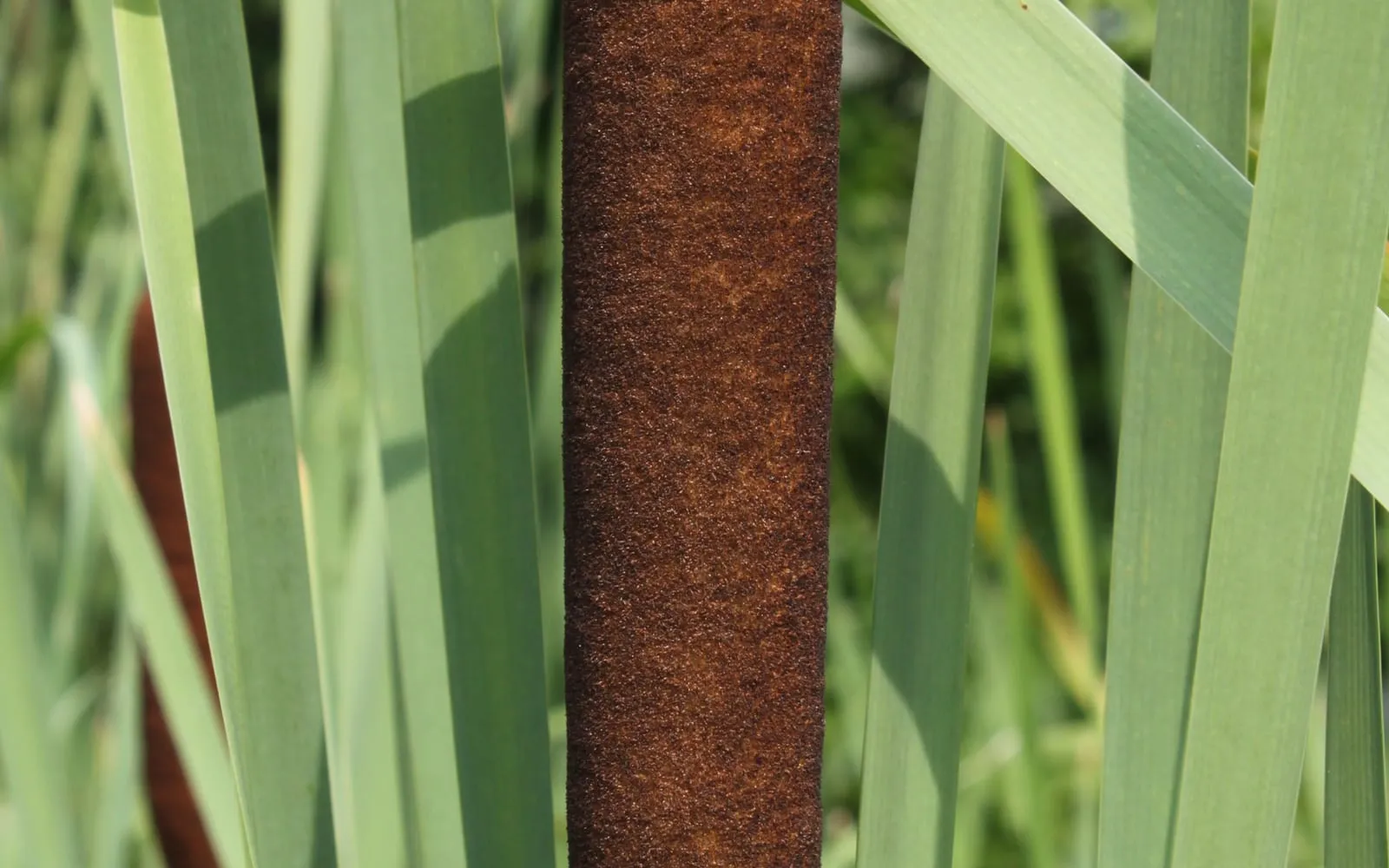
Leaves are flat, greyish-green and strap-shaped, growing in dense, upright fans from a thick, spreading rhizome and reaching well over head height in good conditions. Flower spikes emerge in midsummer on stiff stems above the leaves, each one a cylindrical, felted brown structure made up of tightly packed female flowers below and a slimmer male section above that sheds pollen and withers away, leaving the familiar solid brown poker shape that persists through autumn and winter.
Those spikes eventually break apart to release enormous quantities of fine, cottony seed, carried on the wind in a way few other pond plants match, and a single spike can hold hundreds of thousands of seeds. In practice, most spread in a garden pond comes from the spreading rhizome rather than from seed, since a contained clump multiplies quickly enough on its own without needing to set seed at all.
Where it is from
Bulrush has one of the widest native ranges of any wetland plant, found across Europe, Asia, North America and North Africa in marshes, pond margins, ditches and the shallow edges of lakes and slow rivers. It tolerates an unusually broad range of soil types and water chemistry, which is a large part of why it has spread so widely and why it succeeds in almost any garden pond regardless of local conditions.
It favours rich, fertile, permanently wet mud, and unlike many marginal plants that struggle where nutrients are high, bulrush is at its most vigorous in exactly the nutrient-loaded conditions that come from fish waste and decaying leaf litter, which is one reason it needs firm management in a stocked garden pond.
How it grows
Growth happens through a thick, fast-spreading rhizome that pushes out new shoots at intervals along its length, building a dense stand that expands outward year after year rather than staying in a fixed clump. Left unrestrained in open pond mud, a single planting can colonise several square metres within three or four seasons, gradually filling shallow water and turning open pond into solid stands of reeds.
Because the spread is so vigorous, almost every guide to growing bulrush in a garden setting recommends planting it in a large, bottomless container or a heavy-duty aquatic basket sunk into the margin, which allows the roots to draw water and nutrients while limiting how far the rhizome can travel. Without that containment, a small ornamental pond can be entirely taken over within a handful of years.
Through the seasons
Spring new shoots push up strongly from the rhizome as the water warms, and a contained clump quickly regains its full height by late spring.
Summer flower spikes form and mature through June and July, developing their familiar solid brown colour as the season progresses.
Autumn the spikes begin to break apart, releasing cottony seed on the wind, while the foliage starts to yellow and die back towards the base.
Winter growth dies back to the rhizome below the waterline, though the dried flower spikes and stems often stand through winter and provide valuable shelter and perching for birds before being cut back in late winter.
Care difficulty
Moderate, and the difficulty has almost nothing to do with keeping the plant alive, since it thrives with minimal input in almost any wet, sunny spot. The real work is containment: a rhizome left to spread unchecked in open pond mud will fill a small water feature within a few seasons, so growing it well in anything short of a large, naturalistic pond means planting it in a basket or bottomless container from the start and being prepared to divide and thin it regularly.
Watering
Bulrush needs permanently wet ground or shallow standing water and does not tolerate the margin drying out during the growing season. Plant at the pond edge with the crown covered by no more than about 15 cm of water, either directly into wet mud in a large wildlife pond or, in anything smaller, into a heavy-duty aquatic basket that will need lifting and dividing every couple of years to stop the roots escaping through the mesh.
Warning signs, diseases and pests
Cattail borer moth caterpillars sometimes tunnel into the stems, weakening them and occasionally causing individual leaves or spikes to collapse; affected material can be cut out and removed, though established stands generally shrug off light infestation without lasting harm. Aphids occasionally colonise the soft new shoots in spring and are usually cleared by natural predators or a jet of water before numbers build.
The main warning sign to watch for with this species is unchecked spread rather than disease. Shoots appearing well beyond the original planting spot, particularly through the base of an aquatic basket or between paving at the pond edge, mean the rhizome has escaped containment and needs cutting back and re-lining before it advances further.
Growing environment
Full sun brings the strongest growth and the best flower spikes; in shade the plant grows taller and leggier but flowers less freely. Rich, permanently wet mud or shallow standing water matches its natural habitat closely, and it is one of the few marginal plants unbothered by a heavily fed, nutrient-rich pond.
Choose the planting spot with its eventual spread in mind rather than its current size, since a small division sold in a single pot can fill several square metres of margin within a handful of seasons if planted directly into open pond mud.
Feeding
None needed once established. Bulrush draws more than enough nutrient from ordinary pond conditions, particularly from fish waste and decaying leaf matter, and typically grows too vigorously in a fertile pond rather than too weakly. A modest amount of aquatic compost worked into the basket at planting time is all it needs to establish; no ongoing feeding regime is required afterwards.
Troubleshooting
Shoots are coming up outside the original planting basket. The rhizome has escaped containment. Lift the planting, cut back the spreading roots, and either re-pot into a larger basket or accept the spread if the pond is large enough to absorb it.
The pond is filling up with bulrush faster than expected. Expected behaviour in rich, fertile mud without a container to restrain the roots. Divide and thin the clump, discarding surplus rhizome rather than composting it where it might resprout nearby.
Stems have collapsed or snapped partway up. Check for cattail borer moth caterpillars tunnelling inside the stem. Cut out and dispose of affected stems; established stands generally recover without further treatment.
Flower spikes never fully form, or fall apart early. Usually a sign of too little sun or overcrowding within a dense stand. Thin congested clumps and make sure the planting gets a full day of direct light.
Fluffy white seed is drifting everywhere in autumn. Normal behaviour as the flower spikes break apart to release their seed. It causes no harm but can seed into neighbouring wet ground, so remove spent spikes before they open fully if self-seeding elsewhere is unwanted.
Is this the same plant as true bulrush, Scirpus. No. Typha latifolia was historically called reedmace, with bulrush reserved for Scirpus species, but common usage has largely swapped the two names over time. Both names now commonly point to this plant in garden centres and reference books alike.