
Edible
Wild Sarsaparilla
Aralia nudicaulis
Also known as Small Spikenard, Rabbit Root, Wild Liquorice
How to grow wild sarsaparilla, Aralia nudicaulis. Why what looks like a small shrub is a single leaf rising from a hidden underground stem, its history as a settler substitute for true sarsaparilla, and the deep shade it needs to avoid leaf scorch.
At a glance
- Difficulty
- Easy
- Water
- Only in prolonged drought once established
- Light
- Deep to dappled shade; direct sun scorches the leaf
- Temperature
- Fully hardy
- Hardiness
- USDA 3-8, RHS H7, hardy to -35 C
- Type
- Herbaceous perennial, spreading by underground rhizome
- Height
- 30-45 cm
- Native to
- North America
Native across the boreal and northern temperate forests of Canada and the United States, it takes winter cold that few garden plants match and needs only shade and leaf litter in a garden. Hot, dry, sun-baked summers scorch it.
Hardiness zones describe winter cold alone. Summer heat, humidity, rainfall and the length of the growing season decide as much, so treat the range as the outer limit rather than as a recommendation.
Not known to be toxic
- Safe to eat
- Root, dried and steeped for tea; ripe berries in small quantity
Wild sarsaparilla does not appear on the RHS list of potentially harmful garden plants or on the ASPCA's toxic plant index. Its root has a long history of use as a tea and tonic among the Indigenous peoples of its native range, later adopted by European settlers as a substitute for the tropical Smilax root that historically flavoured root beer, a plant it is not related to beyond a shared common name. The berries are edible in small quantity, though most people find them bland. No part of the plant is documented as harmful to cats, dogs or horses.
Sources: RHS potentially harmful garden plants, ASPCA toxic and non-toxic plants
About
Wild sarsaparilla grows through most of Canada and the northern half of the United States as a woodland-floor perennial, spreading steadily by a slender rhizome just under the soil surface. What looks like a small shrub above ground is a leaf and a flower stalk rising from that hidden stem; the true stem never appears above the litter at all.
Gardeners plant it as shade groundcover under trees where grass struggles, valued for its handsome compound leaf and its tolerance of the deep, dry shade a mature canopy creates. Indigenous peoples across its native range used the aromatic root for tea long before European settlers adopted it as a substitute for true sarsaparilla, a tropical vine it is not related to.
Appearance and character
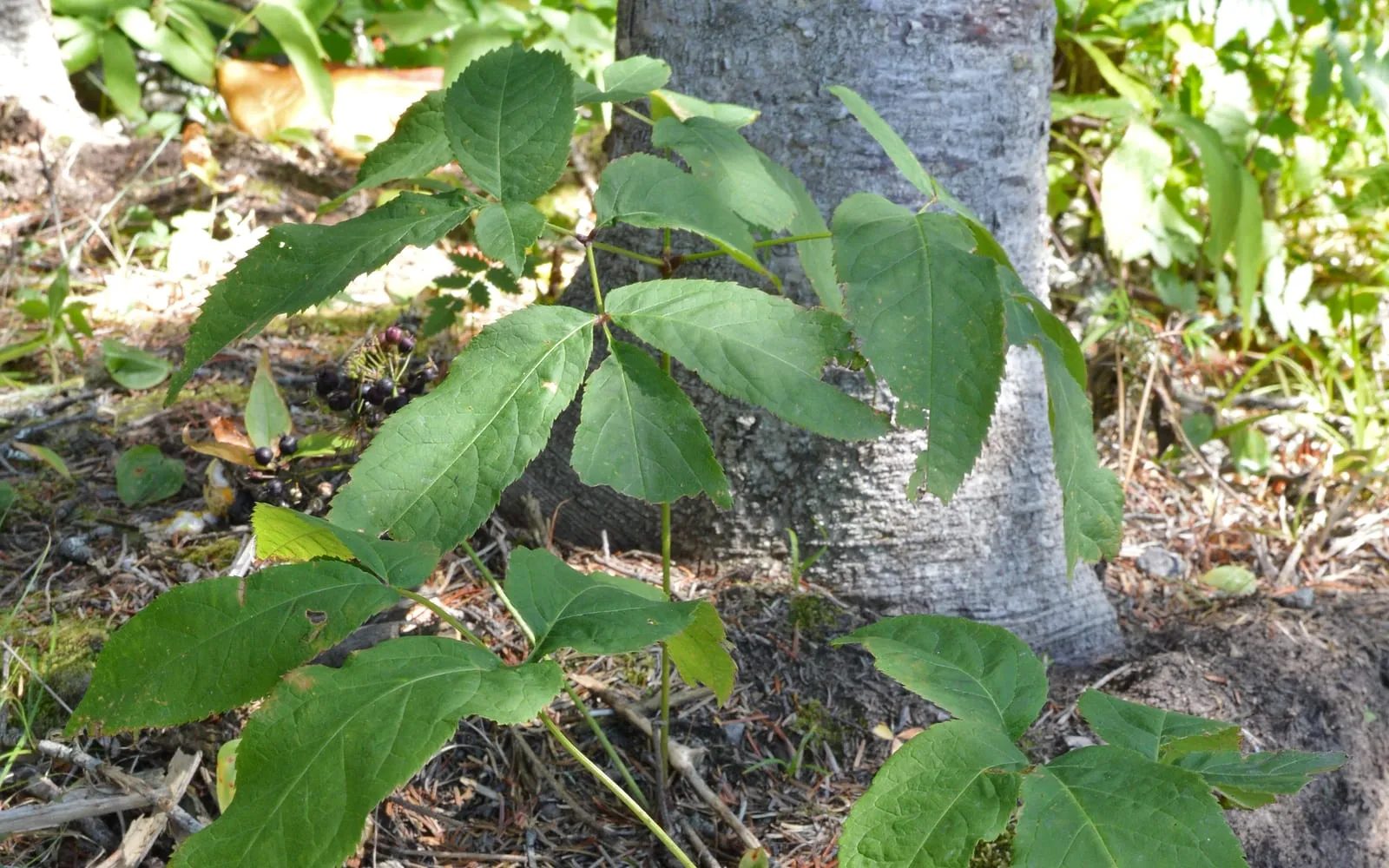
Each shoot produces a single leaf, divided into three main sections and each of those again into three to five sharply toothed leaflets, giving the whole leaf a lacy, three-times-divided structure held on a stalk 20 to 40 cm tall. A second, shorter stalk beside it carries the flowers, low enough to sit hidden beneath the leaf’s canopy.
Flowers open in early summer in three small, rounded, greenish-white clusters, inconspicuous and easy to miss under the foliage above them. They ripen by late summer into dark purple, almost black berries, held in the same hidden clusters and eaten by grouse, thrushes and small mammals more readily than by people.
Below ground, a woody rhizome runs horizontally through the leaf litter, sending up a new shoot every few centimetres and slowly turning a single plant into a spreading patch of identical, evenly spaced leaves.
Where it is from
Aralia nudicaulis grows wild across Canada and the northern United States, reaching as far south as the mountains of Georgia in shaded, high-elevation woodland. It is a plant of the forest floor throughout that range, growing under the closed canopy of coniferous and mixed deciduous forest where little else finds enough light to establish.
A forest floor stays cool, shaded and consistently damp under decades of accumulated leaf litter. A plant that evolved for those conditions has no mechanism for coping with full sun or compacted, mineral soil. In an open, sunny border, a garden planting fails quickly.
How it grows
Plant in humus-rich soil in full to dappled shade, working leaf mould or garden compost into the top layer beforehand to mimic the litter of its native forest floor.
Space new plants 30 to 45 cm apart. An established colony spreads outward by rhizome and fills the gaps between plants within a few seasons without further help. Dividing an existing clump in spring, lifting a section of rhizome with at least one shoot attached, is the fastest way to start a new patch and establishes quicker than seed.
Seed germinates slowly and often needs a period of cold before it will sprout at all, so gardeners wanting a woodland groundcover in a hurry generally start from a divided rhizome instead.
Once planted, wild sarsaparilla needs very little upkeep. Top up the leaf mulch each autumn, keep the ground from drying out completely during a rainless summer, and otherwise leave the colony to spread at its own pace.
Through the seasons
Spring brings the new leaf up through the litter, often before the trees overhead are fully in leaf, followed by the hidden flower clusters a few weeks later.
Summer is quiet growth under a closing canopy. Berries ripen from green to dark purple through the second half of the season.
Autumn yellows the foliage before it dies back completely to the rhizome. Leave fallen leaves in place rather than clearing them, since the plant’s own leaf litter is exactly what it evolved to grow under.
Winter shows nothing above ground. The rhizome survives extreme cold without any protection at all.
Care difficulty
Easy, given shade and moisture from the outset. Wild sarsaparilla needs no feeding, no pruning and no winter protection, and a colony left alone for years generally improves rather than declines.
The one way to lose it is the wrong site. Full sun, dry soil or heavy foot traffic all work against a plant built for an undisturbed forest floor, and watering alone does not fully compensate once the leaves start to scorch.
Watering
Water new divisions regularly through their first growing season while the rhizome builds a proper root run through the surrounding soil.
An established colony needs watering only in an unusually dry summer, since the leaf litter it grows under holds moisture far longer than open soil does. A deep soak during a prolonged dry spell keeps the leaves from scorching at the edges; routine watering beyond that does little for a plant already suited to its site.
Warning signs, diseases and pests
Slugs and snails graze new shoots as they push up through the leaf litter in spring, sometimes shredding a leaf before it has fully unfurled. A ring of grit around emerging shoots, or a torch check on a damp evening, catches most of the damage early.
Leaf spot shows as small brown or purple-ringed spots on the foliage, worse where plants grow crowded and airflow is poor. Thin a dense patch and clear affected leaves in autumn rather than leaving them to overwinter as infection.
Root rot follows ground that stays wet rather than merely moist, since even a shade-loving woodland plant needs the free drainage a forest floor’s loose litter naturally provides. Improve drainage or move divisions to a drier position if a patch starts thinning from the centre.
Rust occasionally appears as small orange pustules on the underside of the leaf. It rarely threatens an established colony, and clearing affected foliage in autumn is usually enough to keep it in check.
Growing environment
Deep to dappled shade suits it best, the kind cast by a mature deciduous or coniferous canopy rather than the lighter shade of a young tree or a wall. Direct sun, especially in the afternoon, scorches the leaves within a single season.
Moist, humus-rich soil with a covering of leaf litter or mulch reproduces the forest floor it grows on naturally. Ordinary garden soil benefits from a generous addition of leaf mould before planting.
It tolerates the root competition of established trees better than most shade perennials, since it evolved to grow among exactly that competition, but resents compacted soil where foot traffic has packed the ground hard.
Feeding
None needed. Wild sarsaparilla grows on the accumulated leaf litter of its native forest floor rather than on any fertiliser regime, and an annual autumn top-up of leaf mould or garden compost supplies everything a garden planting needs.
Avoid feeding it as you would a border perennial. Rich soil and added fertiliser push soft growth that a woodland plant is not adapted to support, and the colony spreads better on poor, litter-fed ground than on anything richer.
Troubleshooting
My plant has stayed as one leaf for two seasons. Slow establishment is normal for a new division. Growth speeds up once the rhizome has built enough reserves to send out side shoots, usually by the second or third year in a shaded, humus-rich site.
The leaves are scorched and papery at the edges. Too much sun, too little water, or both. Move the plant to deeper shade if the site gets more than an hour or two of direct sun, and check the soil is not drying out completely between rains.
Is it related to root beer sarsaparilla? No. Traditional root beer flavouring comes from Smilax, a tropical vine from Central America unrelated to Aralia nudicaulis beyond a shared common name and a similarly aromatic root, both used historically as substitutes for one another.
Can I eat the berries? They are not toxic, but most people find them bland or faintly bitter. The root carries the stronger flavour and the longer history of use, traditionally dried and steeped for tea rather than eaten raw.
It has spread further than I wanted. Lift and divide the rhizome at the edge of the patch in spring, replanting or discarding the sections you do not want. A buried edging strip, or an occasional root check along the boundary, keeps a vigorous colony inside its intended bed.