
Edible
American Beautyberry
Callicarpa americana
Also known as French Mulberry
How to grow American beautyberry, Callicarpa americana. A hard frost that kills the stems to the ground costs it nothing since it flowers on new wood, crushed leaves are a USDA-confirmed mosquito repellent, and the berries are cooked into jelly rather than eaten raw.
At a glance
- Difficulty
- Easy
- Water
- Regularly while establishing; moderate once established
- Light
- Full sun to part shade; best berry colour in more sun
- Temperature
- Fully hardy at the root; top growth cut back by hard frost
- Hardiness
- USDA 6-10, RHS H4-H5, hardy to -20 C
- Type
- Deciduous shrub, flowering and fruiting on new wood each year
- Height
- 1.5-2.5 m
- Native to
- the southeastern United States
Root-hardy well beyond its foliage hardiness, since it flowers and fruits on the current season's new wood rather than on growth carried over from the year before. A hard winter that kills the stems to ground level, common at the colder end of its range, costs it nothing but a later start; the shrub regrows from the root and still flowers and fruits the same year.
Hardiness zones describe winter cold alone. Summer heat, humidity, rainfall and the length of the growing season decide as much, so treat the range as the outer limit rather than as a recommendation.
Not known to be toxic
- Safe to eat
- Ripe berries, usually cooked into jelly or wine rather than eaten raw
American beautyberry does not appear on the RHS list of potentially harmful garden plants or on the ASPCA's toxic plant index, and its berries are safe for both people and wildlife, eaten fresh by birds in quantity and gathered by people mainly for jelly and wine, since raw berries are strongly astringent rather than harmful. Crushed leaves have a long history of folk use as an insect repellent, rubbed directly on skin, and research by the United States Department of Agriculture identified callicarpenal, a compound in the leaves, as an effective natural mosquito deterrent. Nothing about the plant is documented as toxic to cats, dogs or horses.
Sources: RHS potentially harmful garden plants, ASPCA toxic and non-toxic plants
About
American beautyberry grows wild through the woodlands and forest edges of the southeastern United States, grown in gardens for a display few autumn shrubs match, dense clusters of vivid magenta berries wrapped tightly around bare stems after the leaves have dropped. It is easy, fast-growing and reliably hardy at the root even where its top growth is not.
Birds strip a well-berried shrub through the winter, and the plant is a genuine wildlife asset as much as an ornamental one, feeding songbirds through the colder months when other food sources are scarce. Crushed leaves have a folk reputation, since supported by research, as a natural mosquito repellent, adding a practical use most flowering shrubs cannot claim.
Appearance and character
The shrub grows as a loose, arching mass of slender stems, wider than it is tall in an open position, with simple, opposite, toothed leaves that turn a soft yellow before falling in autumn.
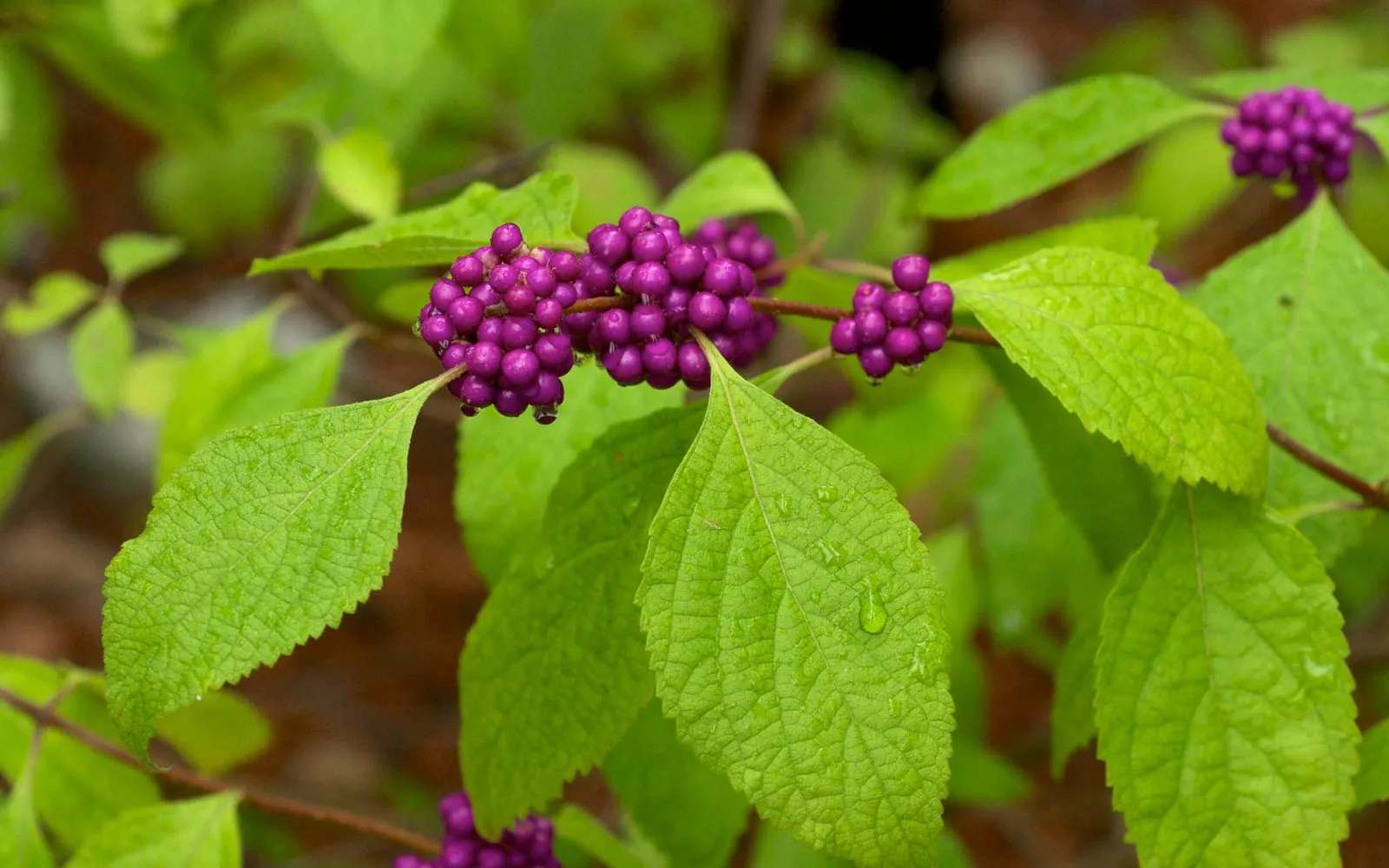
Small, pale pink to lavender flowers cluster tightly in the leaf axils through summer, easy to overlook against the foliage, but what follows them is the plant’s real display. Dense whorls of small, bright magenta berries ring the stems at each leaf node, so densely packed and so saturated in colour that a well-grown shrub in full berry looks almost artificial from a distance.
The berries persist after leaf fall, when bare purple-studded stems become the shrub’s main feature through late autumn, until birds gradually strip them over the following weeks.
Where it is from
Callicarpa americana grows wild from Maryland and Virginia south through Florida and west into Texas and Oklahoma, typically in the understorey of open pine and hardwood woodland, along forest edges and in disturbed or sandy ground.
Its native range covers a broad band of the humid subtropical and warm temperate southeastern United States, with mild winters over most of that area and a longer growing season than much of the country experiences. At the colder, more continental edge of cultivation, well north of its natural range, the top growth is routinely killed back by winter cold, and the plant survives entirely on the hardiness of its root system.
How it grows
Plant in moist, well-drained soil in full sun to part shade, choosing a sunnier position for the best berry colour, since a shrub grown in heavier shade produces a noticeably paler and sparser display.
It tolerates a wide range of soil types without much fuss, from sandy to average garden loam, and establishes quickly once planted, often flowering and fruiting within its first full growing season.
Prune hard in late winter or early spring, cutting the previous year’s growth back by a third to a half, or to the ground in a colder climate where frost has already done the work. Since flowers and fruit form on new wood, this hard annual cut encourages a fuller, more floriferous shrub rather than reducing the display.
Propagate from softwood cuttings in summer, which root readily, or from seed, which needs a period of cold stratification and produces a slower route to a flowering-size plant.
Through the seasons
Spring brings vigorous new growth from the roots or from the previous year’s cut-back stems, along with the year’s hard prune if not already done.
Summer is the main flowering period, small clustered blooms opening steadily along the new growth through the warmest months.
Autumn ripens the berries into their full magenta colour just as the leaves begin to yellow and drop, giving the shrub its best display of the year.
Winter shows bare stems still ringed with berries at the warmer end of its range, or dieback to ground level at the colder end, from which the plant reliably regrows the following spring.
Care difficulty
Easy. American beautyberry needs little beyond an annual hard prune and occasional watering during a dry summer, and it tolerates a wide range of soil and light conditions.
Its reliability owes a great deal to flowering and fruiting on new wood, which means winter dieback, whether from a hard frost or a deliberate prune, costs the shrub nothing in terms of that year’s display, unlike a shrub that blooms on wood from the previous season.
Watering
Water regularly through the first growing season while the shrub establishes a full root system, then reduce to occasional deep watering during any extended dry spell once it is settled.
It tolerates average garden conditions without special attention in most climates, and consistent watering through summer, while berries are developing, generally produces a fuller and more colourful crop than letting the shrub go dry.
Warning signs, diseases and pests
Leaf spot appears as small brown or black lesions on the foliage during humid, still weather, particularly where airflow around the shrub is poor. It rarely threatens the plant’s overall health and is best managed by improving circulation and removing badly affected leaves.
Whitefly colonises the undersides of the leaves, flying up in a small cloud when disturbed and leaving sticky honeydew behind. Yellow sticky traps and an insecticidal soap both help bring a bad infestation under control.
Spider mite can build up in hot, dry conditions, showing as fine speckling on the leaves with faint webbing in bad cases. Keeping the shrub adequately watered through a hot summer helps prevent it taking hold.
Root rot follows soil that stays waterlogged rather than merely moist. Good drainage at planting time is the main prevention, since this species otherwise tolerates a wide range of soil conditions well.
Growing environment
Full sun gives the richest berry colour and the densest overall display; part shade is tolerated well but produces a somewhat paler, more open shrub in comparison.
Moist, well-drained soil suits it best, though it adapts to a fairly wide range of garden soils without special amendment, from sandy ground to average loam.
At the colder end of its hardiness range, expect the top growth to die back to the ground most winters. This is not a sign of a struggling plant, since the shrub reliably regrows from its hardy root system each spring and still flowers and fruits well within the same season.
Feeding
Feed with a balanced fertiliser or well-rotted compost once in spring, as the year’s new growth gets under way, which is enough for most plants in ordinary garden soil.
Avoid heavy or repeated feeding, particularly with high-nitrogen fertiliser, which pushes excessive leafy growth at some cost to the flowering and berrying the shrub is grown for.
A mulch of compost or leaf mould around the root zone in spring supplies most of the additional fertility a mature shrub needs beyond that single feed.
Troubleshooting
A hard freeze killed all the top growth. Normal at the colder end of this shrub’s range, and not a cause for concern. Cut the dead stems back to the ground in late winter if frost has not already done so, and expect strong new growth, followed by the usual flowers and berries, within the same growing season.
The berries never turn as vivid a colour as I have seen elsewhere. Usually a light issue. A shrub grown in significant shade produces a noticeably paler crop of berries than one grown in full or nearly full sun, so moving it to a sunnier position, or thinning nearby growth that shades it, often improves the display.
Can I eat the berries? Yes, though raw they are quite astringent and most people find them better cooked with sugar into jelly or wine than eaten fresh off the shrub. They are entirely safe either way.
Do the leaves really repel mosquitoes? There is real evidence behind the folk use. Crushed fresh leaves rubbed on skin have been shown to deter mosquitoes, and researchers have identified the specific compound responsible, though a shop-bought repellent is a more practical everyday choice than crushing leaves each time you go outside.
Birds have stripped every berry within a few weeks. That is the shrub doing exactly what it is valued for in a wildlife garden. Berries are a genuine food source through the colder months, and a shrub completely cleared of fruit by midwinter is a sign the display has served its ecological purpose rather than a problem to solve.