
Edible
Malabar Tamarind
Garcinia gummi-gutta
Also known as Garcinia cambogia, Kudampuli, Brindleberry, Fish tamarind
How to grow Malabar tamarind, Garcinia gummi-gutta. The smoked rind that sours a Kerala fish curry, and the hard truth about the weight-loss supplement sold under the name Garcinia cambogia.
At a glance
- Difficulty
- Difficult
- Water
- Twice a week through growth, reduced in a cool winter
- Light
- Part shade when young, full sun when mature
- Temperature
- Minimum 12 deg C. Damaged below 10 deg C
- Humidity
- High
- Hardiness
- USDA 10-12, RHS H1b, hardy to 10 C
- Type
- Tender evergreen tree
- Height
- 5-20 m in the open, 1.5 m in a pot
- Native to
- the Western Ghats of India, Sri Lanka
- Best month
- July and August in the Northern Hemisphere, January and February in the Southern Hemisphere
Wet forest of the Western Ghats in southern India. It needs high humidity and a monsoon rhythm, and the rind is dried for souring rather than eaten fresh.
Hardiness zones describe winter cold alone. Summer heat, humidity, rainfall and the length of the growing season decide as much, so treat the range as the outer limit rather than as a recommendation.
Every month named in this guide is for the temperate Northern Hemisphere. If you garden in the Southern Hemisphere, shift each one by six months, so July becomes January. Closer to the equator the wet and dry seasons matter more than the calendar, and the shift stops being a useful guide.
Toxic if eaten
- Safe to eat
- The dried smoked rind, used as a souring agent in cooking
- Do not eat
- Concentrated hydroxycitric acid extracts sold as supplements
- Harm from
- Eating it
- Affects
- People
The rind used in cooking is safe and has been eaten in Kerala and Sri Lanka for centuries. The concentrated extract is where the harm is. Garcinia cambogia supplements, sold for weight loss and standardised for hydroxycitric acid, are among the most frequently reported causes of herb-induced liver injury in the United States, and the NIH LiverTox database records cases of acute hepatitis and acute liver failure, some needing transplant, in people taking them at the labelled dose. Reports also link them to serotonin syndrome when taken with antidepressants and to mania in susceptible people. Products combining Garcinia with green tea extract appear the most often in the case series. The evidence that the supplements produce meaningful weight loss is weak. Use the rind as a cooking ingredient and leave the capsules alone.
Sources: NIH LiverTox record for Garcinia cambogia, RHS potentially harmful garden plants
About
Malabar tamarind is a souring agent rather than a fruit. The pumpkin-shaped yellow fruit is dried and smoked until the rind is black and leathery, and a piece of that rind goes into the fish curries of Kerala, where it is called kudampuli.
It is unrelated to true tamarind and works in the same way, giving a clean sour note without the sharpness of lime.
The name most people know it by is a supplement label. Garcinia cambogia, an old botanical name for this species, has been sold worldwide as a weight-loss product for two decades, and the record of liver injury attached to those capsules is the reason the guide below spends more space on the extract than on the tree.
Appearance and character
A rounded evergreen tree with drooping branches, 5 to 20 m in the open.
Leaves are opposite, elliptic, 5 to 12 cm, dark green, glossy and leathery, with a pointed tip.
All parts exude a yellow latex when cut, as every Garcinia does.
Flowers are small, cream to pale yellow, borne at the shoot tips. The species is dioecious, so male and female flowers sit on separate trees and only females fruit.
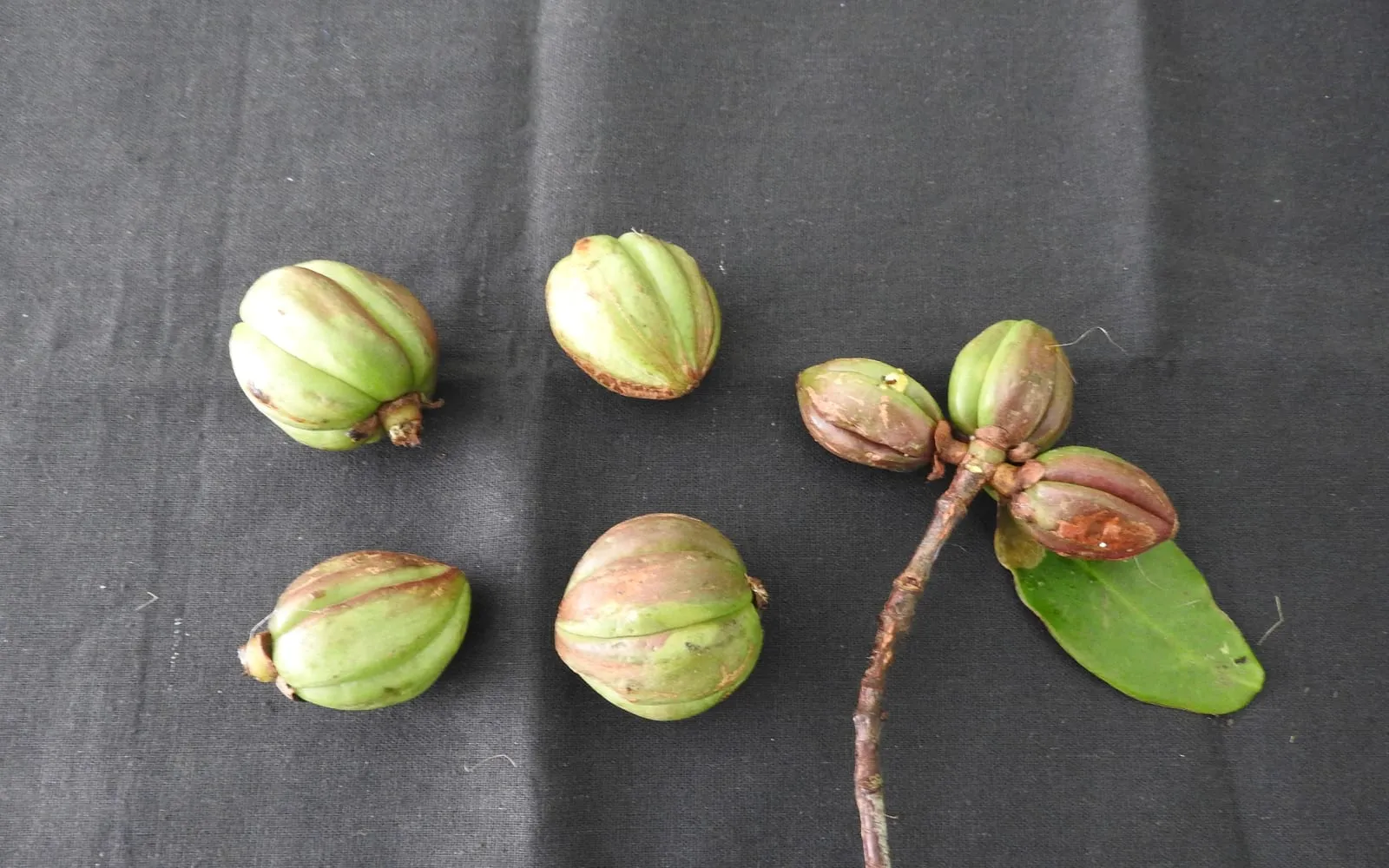
Fruit is the striking part. Round and deeply grooved into six to eight lobes, like a small ribbed pumpkin, 5 cm across, ripening from green to bright yellow or orange-red.
Flesh around the seeds is thin and sour, and the rind is the part used.
Drying and smoking turn the rind black, leathery and pungent, and it keeps for a year in that state.
Where it is from
Malabar tamarind is native to the Western Ghats of southern India and to Sri Lanka, where it grows in evergreen forest.
Kerala built a cuisine around it. Kudampuli is what sours a meen curry, and the combination of coconut oil, curry leaf and smoked Garcinia rind is the signature of Kerala fish cookery.
Sri Lanka uses it the same way under the name goraka, in curries and in the black fish preparation known as ambul thiyal.
The plant reached wider notice through a laboratory finding rather than a kitchen. Hydroxycitric acid in the rind was reported in the 1960s to inhibit an enzyme involved in fat synthesis, and the supplement industry built on that result from the 1990s.
India, Sri Lanka and parts of South East Asia grow it. The dried rind reaches Europe through South Asian food shops and is inexpensive.
How it grows
Sow seed fresh from a ripe fruit. Garcinia seed loses viability quickly.
Sow at 25 to 30 deg C in an acid humus-rich mix. Germination is slow and uneven, taking one to three months.
Shade a young plant. Full sun scorches seedlings.
Grow at a minimum of 12 deg C with high humidity.
Water regularly and never let it dry out.
Use rainwater and ericaceous compost, because this genus yellows badly on hard water.
Feed monthly from April to September.
Accept the sex problem. The species is dioecious, seedlings are male or female with even odds, and there is no way to tell for six to eight years.
Expect a very slow plant. Growth in a pot is measured in a few centimetres a year.
Through the seasons
Winter is a warm rest above 12 deg C with humidity kept up, watered lightly and unfed.
Spring brings a growth flush and, on a mature tree, flowering.
Early summer is the main growing period.
Midsummer is fruit development on a female tree that was pollinated.
Late summer is harvest in its native range, where the rind is then dried and smoked.
Autumn is when to stop feeding and reduce watering while keeping the plant warm.
Care difficulty
Difficult, with the standard tropical Garcinia demands.
Constant warmth is needed, at a minimum of 12 deg C and with no cool rest.
High humidity is needed year round.
Acid compost and rainwater are needed, or the plant yellows.
Growth is very slow, which tests patience more than skill.
Sex is unknowable for six to eight years, and only female trees fruit.
Fruit under glass is a remote prospect. The realistic outcome is a slow handsome evergreen, and the cooking ingredient is best bought dried from a South Asian grocer for very little money.
Watering
Water twice a week through the growing season, keeping the compost evenly damp.
Reduce in winter without letting the compost dry out.
Drain fully every time.
Use rainwater. Hard water causes iron shortage in this genus quickly.
Keep humidity high with misting and grouping.
Water with tepid water.
Never let a pot stand in cold water.
Warning signs, diseases and pests
Yellowing between green veins is iron shortage from hard water or alkaline compost.
Brown scorched leaf margins mean dry air or direct sun on a young plant.
Leaf drop after a cold night is chill damage below 10 deg C.
Fine webbing under the leaves is spider mite in dry heated air.
Brown limpets along the stems are scale.
Wilting in damp compost is root rot.
Very slow growth is normal for this genus rather than a fault.
A mature tree that flowers and never fruits is male, which half of all seedlings are.
Growing environment
A heated humid greenhouse. There is no outdoor option outside the tropics.
Minimum 12 deg C, ideally 25 to 30 deg C.
High humidity year round.
Part shade when young, more sun when mature.
Acid humus-rich free-draining compost.
pH from 5.0 to 6.0.
Rainwater rather than tap water.
Grouping with other tropical plants to hold humidity.
Feeding
Feed monthly from April to September with an ericaceous liquid feed containing iron.
Add sequestered iron at the first sign of yellowing between the veins.
Keep feeding light, since the plant grows slowly and cannot use much.
Stop feeding at the end of September.
Give nothing through winter.
Top-dress with leaf mould each spring.
Repot rarely, since root disturbance checks it.
Troubleshooting
Is this the same as tamarind? No. True tamarind is Tamarindus indica, a legume. This is a Garcinia, related to mangosteen, and it is used in the same way as a souring agent, which is where the shared name comes from.
What is kudampuli? The dried smoked rind of this fruit, used in Kerala fish curries. Sri Lanka calls it goraka. It is sold cheaply in South Asian groceries and keeps for a year.
Does Garcinia cambogia work for weight loss? The evidence is weak. What is well documented is the harm: the NIH LiverTox database records acute hepatitis and acute liver failure, some needing transplant, in people taking these supplements at the labelled dose.
Why is my tree yellow between the veins? Iron shortage from hard water or compost that is not acid enough. Use rainwater, ericaceous compost and sequestered iron.
It has hardly grown in two years. That is normal. Garcinia species are among the slowest trees in cultivation.
Will it fruit outside the tropics? Very unlikely. It needs constant warmth and humidity, six to eight years to reach flowering, and a female tree with a male nearby.
How do I use the rind? Rinse a piece, soak it briefly, and add it whole to a curry, removing it before serving. Two or three pieces sour a large pot.
Malabar Tamarind problem guides
Not sure what is wrong? See the common vegetable pests guide.