
Edible
Jackfruit
Artocarpus heterophyllus
Also known as Jack tree, Kathal, Nangka, Langka
How to grow jackfruit, Artocarpus heterophyllus. The largest fruit that grows on a tree, the latex that glues your hands together, and why green jackfruit ended up in vegan burgers.
At a glance
- Difficulty
- Difficult
- Water
- Twice a week in growth, less in winter
- Light
- Full sun
- Temperature
- Minimum 10 deg C. Damaged below 5 deg C
- Humidity
- High
- Hardiness
- USDA 10-12, RHS H1b, hardy to 10 C
- Type
- Tender evergreen tree
- Height
- 10-25 m in the open, 2 m in a pot
- Native to
- the Western Ghats of India
- Best month
- May, June and July in the Northern Hemisphere, November, December and January in the Southern Hemisphere
Wet tropical India and south-east Asia, and the most adaptable of the large Artocarpus fruit. It takes a brief cool spell that would kill a chempedak, though not frost.
Hardiness zones describe winter cold alone. Summer heat, humidity, rainfall and the length of the growing season decide as much, so treat the range as the outer limit rather than as a recommendation.
Every month named in this guide is for the temperate Northern Hemisphere. If you garden in the Southern Hemisphere, shift each one by six months, so May becomes November. Closer to the equator the wet and dry seasons matter more than the calendar, and the shift stops being a useful guide.
Skin irritant
- Safe to eat
- The ripe bulbs, the young green fruit cooked, and the seeds boiled or roasted
- Do not eat
- The white latex, and the seeds raw
- Harm from
- Eating it and handling it
- Affects
- People
Jackfruit is not toxic and nothing in the plant is listed as harmful to cats or dogs. Two practical points. The white latex that runs from cut unripe fruit and from the tree is sticky, hard to remove and mildly irritant to skin; the standard answer across South and South East Asia is to oil the hands and the knife before cutting one. Raw seeds contain trypsin inhibitors and lectins and are not eaten raw; boiled or roasted they are pleasant and are a common food in themselves. People allergic to birch pollen or to latex sometimes react to jackfruit, since it shares proteins with both, and reports of oral allergy after eating it are well documented in latex-sensitive people.
Sources: ASPCA toxic and non-toxic plants, RHS potentially harmful garden plants
About
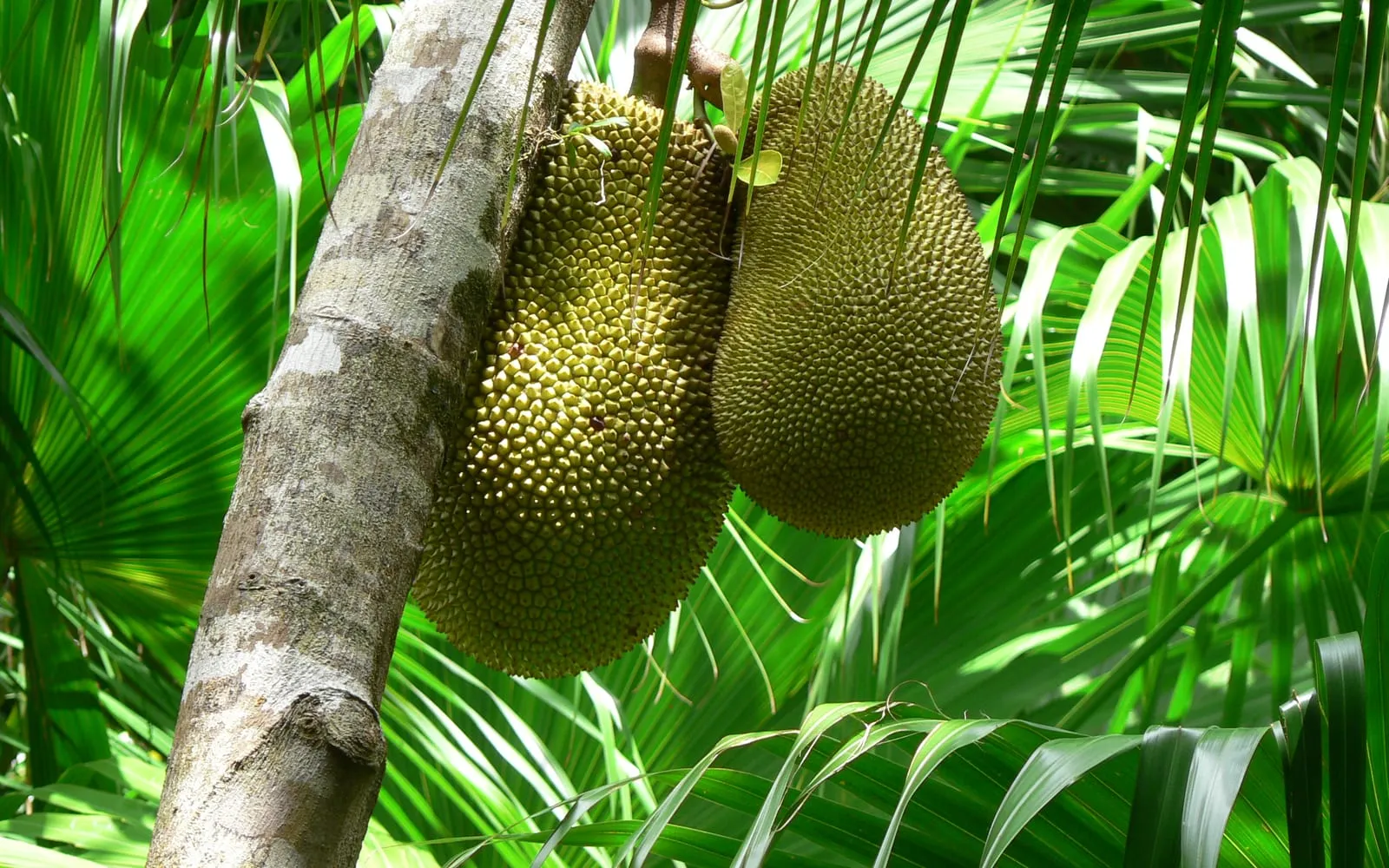
Jackfruit is the largest fruit that grows on a tree. A big one reaches 50 kg and a metre long, hangs directly off the trunk, and would kill anyone standing underneath when it comes down.
The fruit is two foods rather than one. Ripe, the yellow bulbs inside are sweet, heavily perfumed and eaten as fruit. Unripe and green, the same flesh is bland, firm and fibrous, and it shreds into something close enough to pulled pork that the vegan food industry built a product line on it.
Cutting one is a job. The white latex sticks to everything, sets like glue and does not wash off, so the knife and both hands are oiled before anyone starts.
Appearance and character
An upright evergreen tree with a dense conical crown, 10 to 25 m in the open, with a straight trunk.
All parts bleed a thick sticky white latex when cut.
Leaves are alternate, oval to elliptic, 10 to 25 cm, thick, glossy dark green above and paler below. Young trees often carry lobed leaves and mature ones entire ones, which is what heterophyllus means.
Flowers are tiny and packed into dense heads borne directly on the trunk and the main branches. Male heads are slender and finger-like, female heads are stouter and become the fruit.
Fruit is a compound structure formed from the whole flower head, oblong to barrel-shaped, 30 to 100 cm, 5 to 50 kg, with a green to yellow-brown rind covered in blunt hexagonal spines.
Inside, a fibrous core is surrounded by dozens of yellow bulbs, each wrapping a large pale seed, with inedible papery strands between them.
Ripeness is judged by smell, by a hollow sound when tapped, and by the spines flattening and the rind yellowing.
Where it is from
Jackfruit is native to the rainforests of the Western Ghats in southern India, where wild trees still grow.
Cultivation in India and Sri Lanka goes back thousands of years, and the tree is embedded in the food and the timber trade of Kerala, Tamil Nadu and Bangladesh.
It spread east into South East Asia early and became a staple garden tree from Burma to the Philippines, and traders carried it to East Africa and Brazil.
Bangladesh made it the national fruit, and Kerala and Tamil Nadu produce vast quantities, much of which historically went to waste.
The vegan meat trade changed that. From the 2010s green jackfruit was marketed in Europe and North America as a meat substitute, tinned and vacuum-packed, and Indian producers found an export market for a crop that had been undervalued at home.
The timber is valuable in its own right, orange-yellow, durable, and used for furniture and for the bodies of Indian string instruments.
How it grows
Sow seed from a ripe fruit within a few days. Jackfruit seed dies quickly and cannot be dried.
Sow at 25 to 30 deg C in a deep pot, since the seedling puts down a strong taproot immediately. Germination takes three to six weeks.
Do not disturb the roots more than necessary. Jackfruit resents repotting and sulks for months afterwards, so sow into the pot it will stay in for a year or two.
Grow in deep free-draining compost of moderate fertility.
Give full sun and a minimum of 10 deg C.
Water twice a week in growth and less in winter. It will not tolerate waterlogging.
Keep humidity high.
Feed monthly from April to September.
Expect fruit in three to four years on a grafted plant and six to eight on a seedling, and expect that only in a well-heated house with room for a large tree.
Through the seasons
Winter is a warm rest above 10 deg C, watered lightly and unfed.
Spring brings a growth flush and flowering on the trunk and branches.
Early summer is fruit set, though a pot plant rarely gets there.
Midsummer is the main growing period.
Late summer is a second flush of growth.
Autumn is when to stop feeding and reduce watering while keeping the plant warm.
Care difficulty
Difficult, and the difficulty is size and roots rather than climate.
The taproot is the first problem. Jackfruit resents disturbance and a repotted plant may sit and do nothing for months. Sow into a deep pot and leave it alone.
Waterlogging is the second. It tolerates wet feet worse than most tropical trees.
Size is the third. Even a restrained pot plant is large, the leaves are big and leathery, and a fruiting tree needs real room.
Minimum 10 deg C is needed, with damage below 5 deg C.
High humidity is needed, and dry heated air brings mite and leaf drop.
As a foliage plant in a large heated house it grows steadily and looks impressive, and that is the realistic outcome.
Watering
Water twice a week through the growing season, keeping the compost evenly damp.
Drain fully. Jackfruit dislikes standing water more than most tropical trees.
Reduce in winter without letting the compost dry.
Keep humidity high with misting and grouping.
Use rainwater where the supply is very hard.
Use a deep pot, because the root system goes down.
Water steadily during fruit development, since a jackfruit is a large object to supply.
Warning signs, diseases and pests
A plant that stops growing for months after repotting is reacting to root disturbance. Leave it alone and it usually resumes.
Wilting in damp compost is root rot, which follows waterlogging quickly in this species.
Brown leaf edges mean dry air.
Leaf drop after a cold night is chill damage below 5 deg C.
Brown limpets on the stems are scale.
White fluff in the leaf axils is mealybug.
Fine webbing on the leaves is spider mite.
Small fruit rotting on the tree in humid still air is fruit rot. Improve airflow.
Sticky white latex on every cut surface is normal for the species.
Growing environment
A large heated greenhouse. There is no outdoor option outside the tropics and a conservatory rarely has room.
Minimum 10 deg C, with 25 to 32 deg C for growth and fruit.
Full sun.
High humidity.
Deep free-draining compost of moderate fertility.
pH from 6.0 to 7.5.
A deep pot for the taproot, and as little repotting as possible.
Real head room and floor space, since this is a large tree with large leaves.
Feeding
Feed monthly from April to September with a balanced liquid feed.
Switch to high potash if fruit sets.
Stop feeding at the end of September.
Give nothing through winter.
Top-dress rather than repot wherever possible, since the roots resent disturbance.
Add magnesium if older leaves yellow between the veins.
Keep feeding steady, as this is a large tree with a real appetite.
Troubleshooting
How big does the fruit get? Up to 50 kg and a metre long, which makes it the largest fruit borne on a tree. It hangs directly off the trunk and the main branches.
How do I cut one without getting covered in glue? Oil the knife and both hands with vegetable oil first. The white latex sets hard and does not wash off, and oiling is the standard answer across South and South East Asia.
Why is green jackfruit sold as a meat substitute? Unripe, the flesh is bland, firm and fibrous, and it shreds into a texture close to pulled pork. Ripe jackfruit is sweet and heavily perfumed and is nothing like it.
Can I eat the seeds? Boiled or roasted, yes, and they are a food in their own right. Raw they contain trypsin inhibitors and are not eaten.
My plant stopped growing after I repotted it. Jackfruit has a strong taproot and resents disturbance. It may sit for months. Sow into a deep pot and repot as rarely as possible.
How do I tell if one is ripe? By smell, which becomes strong and sweet, by a hollow sound when tapped, and by the rind yellowing and the spines flattening.
Will it fruit outside the tropics? Only in a large heated greenhouse with a grafted plant, in three or four years, and it needs room most people do not have.
I ate some and my mouth tingled. Jackfruit shares proteins with latex and birch pollen, and oral allergy is documented in people sensitive to either.
Jackfruit problem guides
Not sure what is wrong? See the common vegetable pests guide.