
Edible
American Plum
Prunus americana
Also known as Wild Plum
How to grow American plum, Prunus americana. Why a lone tree can flower heavily and still crop poorly without a second plum nearby, the crescent scar that means plum curculio, and the root suckers that spread it into a thicket.
At a glance
- Difficulty
- Easy
- Water
- Deep watering while young; established plants tolerate drought
- Light
- Full sun for the heaviest flowering and fruiting; tolerates part shade
- Temperature
- Fully hardy; needs a cold winter to set flower buds well
- Hardiness
- USDA 3-8, RHS H7, hardy to -35 C
- Type
- Woody deciduous large shrub or small tree
- Height
- 3-8 m
- Native to
- central and eastern North America
A prairie-edge tree built for a short, hot summer and a long, severe winter, and it needs real winter cold to flower well the following spring rather than merely to survive it. It tolerates summer heat well into warmer zones but struggles where winters stay mild, since the chill hours that trigger even blossom never accumulate.
Hardiness zones describe winter cold alone. Summer heat, humidity, rainfall and the length of the growing season decide as much, so treat the range as the outer limit rather than as a recommendation.
Toxic if eaten
- Safe to eat
- The ripe flesh of the fruit
- Do not eat
- Wilted leaves, bark, twigs and the seed inside the stone
- Harm from
- Eating it
- Affects
- People, dogs, cats and horses
American plum belongs to the same genus as cherry and peach and shares their defining hazard: the leaves, bark and seed kernel carry cyanogenic glycosides that release cyanide once the tissue is damaged or wilted. Livestock and dogs that eat a quantity of wilted or frosted leaves, or chew through fallen branches, are at real risk, which is why the ASPCA lists wild plum among the Prunus species toxic to pets and horses. The ripe flesh people and animals eat carries none of this; the danger sits in the leaves and the stone. Swallowing one intact seed occasionally causes no harm, since the hard shell resists digestion, but deliberately crushing and eating a number of stones is a genuine risk for a person and takes far more than an accidental bite from a piece of fruit.
Sources: ASPCA toxic and non-toxic plants (Prunus species), RHS potentially harmful garden plants
About
American plum grows as a thorny, thicket-forming small tree across the prairie edges and river bottoms of central and eastern North America. Root suckers spread outward from an established plant, so a single specimen left alone for a decade can become a dense grove several metres across. Clusters of white flowers cover the bare branches in early spring, opening before the leaves and drawing out bees on the first mild days of the season. The fruit that follows ripens through late summer to a red or yellow skin over tart, juicy flesh built for jam, jelly and wine rather than for eating straight from the branch.
Appearance and character
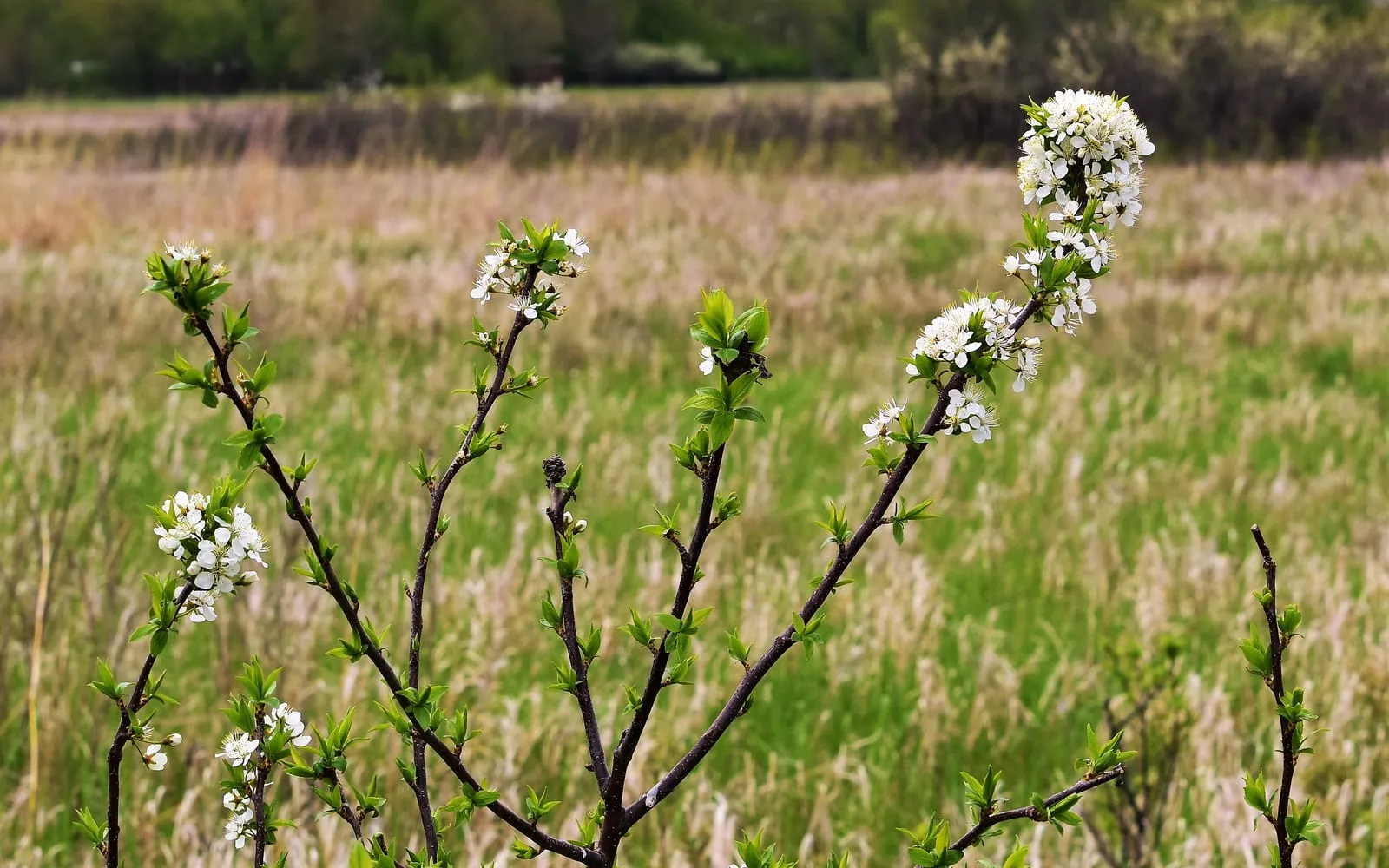
The bark is dark, scaly and marked with thorny spur shoots, a defensive habit that thickens with age into a properly spiny thicket. Leaves are oval, finely toothed and a dull mid-green, turning yellow before they drop in autumn. Flowers open in clusters of two or three along the previous year’s wood, five white petals around a centre of golden stamens, and a heavily flowering plant in April can look dusted with snow. Fruit is round, one to three centimetres across, red to yellow-orange at ripeness with a pale bloom over the skin and a single flattened stone at the centre. Left untended, several suckers grow up around the parent stem and the plant reads as a broad, twiggy shrub as often as a single-trunked tree.
Where it is from
Prunus americana is native across a wide stretch of central and eastern North America, from the eastern edge of the Rocky Mountains to the Atlantic states and north into southern Canada. It grows along fence lines, riverbanks and the margins of prairie and woodland, tolerating the extremes of a continental climate that swings from hard winter frost to hot, dry summer within a single year. Indigenous peoples across its range gathered the fruit for food long before European settlement, and it became one of the parent species used to breed the cold-hardy plum cultivars grown across the northern United States and the Canadian prairies, crossed with Japanese and European plums to combine the wild species’ hardiness with larger, sweeter fruit.
How it grows
Plant it in full sun for the best flowering and fruiting, in any reasonably drained soil; it is not fussy about fertility or pH and grows as readily in poor sandy ground as in richer loam. Because it suckers from the roots, decide early whether a thicket or a single tree is wanted. Mow or cut back suckers each year to keep one or a few trunks, or leave them to fill a hedge or wildlife planting. It flowers on wood grown the previous year, so any pruning to shape the plant is best done immediately after flowering rather than in winter, which would remove the coming season’s blossom. Most named selections and many wild seedlings need a second, genetically different plum nearby for reliable pollination and a full fruit set, since a lone tree can flower heavily and still crop poorly.
Through the seasons
Spring brings the flush of white blossom on bare wood, usually before or just as the first leaves open, followed by fruit set once pollination has taken place.
Summer is for fruit development, which ripens from midsummer into early autumn depending on climate and selection.
Autumn is harvest. It is also a good time to plant a new tree, giving the roots time to settle before winter.
Winter is dormancy, and the tree needs its cold to reset flower buds for the following spring.
Care difficulty
Easy. American plum survives neglect that would kill a refined orchard plum, tolerating poor soil, drought once established and a hard winter without complaint. The main task is deciding whether to control root suckers, which appear every year and spread outward from the base if left unchecked. Left entirely alone it becomes a wide thicket rather than a single tree, which suits a hedgerow or wildlife planting and frustrates anyone wanting one tidy specimen.
Watering
Water deeply through the first two growing seasons while the root system establishes, then expect the plant to manage on rainfall alone in most climates. A prolonged summer drought is the exception, when a deep soak every few weeks keeps fruit swelling and stops the leaves scorching at the margins.
Warning signs, diseases and pests
Plum curculio is the most consistent pest across its range, a small snout beetle that lays eggs in developing fruit and leaves a distinctive crescent-shaped scar where the grub tunnels in. Damaged fruit often drops early; picking up and destroying fallen fruit through the season reduces the following year’s population.
Brown rot infects blossom and ripening fruit in humid weather, turning fruit brown and eventually shrivelling it into a hard mummy that clings to the branch over winter and reinfects next year’s crop. Remove mummified fruit and any blighted blossom promptly, and improve air movement around the canopy by thinning overcrowded suckers.
Bacterial canker shows as gum oozing from cracks in the bark, usually on a tree already stressed by poor drainage, drought or a wound. There is no cure once it is established; keep the tree growing well and prune out affected wood in dry weather to slow its spread.
Japanese beetle, where it has become established, skeletonises leaves down to the veins in high summer, leaving a lacy brown husk behind. Hand-picking into soapy water in the cool of the morning controls a light infestation on a small tree.
Growing environment
Full sun gives the heaviest flowering and the sweetest fruit; a position with some afternoon shade still flowers but crops more lightly. Soil drainage counts for more than fertility. It grows in sand, clay or ordinary garden loam provided water does not sit around the roots after rain, and standing water around the roots is the one condition it will not tolerate long term. Space it well away from paths, lawns and beds it is not meant to colonise, since the roots send up suckers for several metres in every direction.
Feeding
Little is needed beyond a spring mulch of compost or well-rotted manure for a young, establishing plant, kept clear of the trunk. A mature tree growing in reasonable soil rarely needs feeding at all, and heavy nitrogen feeding pushes soft growth that is more vulnerable to bacterial canker without improving the fruit.
Troubleshooting
Why has my tree flowered heavily but set almost no fruit? Most American plums need a second, genetically different plum flowering nearby at the same time for pollination. A single isolated tree can put on a spectacular spring display and still crop poorly for want of a pollination partner.
Suckers keep appearing metres from the trunk. That is normal root suckering rather than a problem, and how far it travels depends on soil and root disturbance. Mow or cut suckers back at ground level as they appear if a single tree is wanted, and expect to repeat this every year.
The fruit has a crescent-shaped scar and drops early. Plum curculio, almost certainly. Collect and destroy fallen fruit through the season to cut down the numbers reinfecting next year’s crop, since the grub develops inside fruit that has already dropped.
Ripe fruit turned brown and shrivelled on the branch. Brown rot, especially likely after a wet spell during ripening. Remove and destroy affected fruit rather than composting it, and thin crowded growth to improve airflow through the canopy for next season.
Can I grow just one tree in a small garden? Yes, though expect a lighter crop unless a compatible plum grows within pollinating distance nearby, wild or cultivated. A single tree still flowers well and supports early pollinators even where fruit set is modest.