
Outdoor plant
King Protea
Protea cynaroides
Also known as Giant Protea
Practical guidance for growing king protea, Protea cynaroides, including fynbos origin, proteoid roots, sharp drainage, low-phosphorus feeding, and fire-adapted resprouting.
At a glance
- Difficulty
- Difficult
- Water
- Water through establishment, then let the soil run drier through summer
- Light
- Full sun and open air movement; poor flowering and fungal trouble in shade or still air
- Temperature
- A distinct dry summer and cool, wet winter suit it best
- Hardiness
- USDA 9-10, RHS H3, hardy to -5 C
- Type
- Evergreen shrub, slow-growing and long-lived where it is happy
- Height
- 1-2 m
- Native to
- South Africa
Established plants take a light, brief frost without damage, but the zone number says nothing about the real limit on this species, which is drainage and phosphorus rather than cold. A South African fynbos winter is wet and mild, a fynbos summer hot and dry, and a garden that reverses that rhythm with damp summer soil or heavy feeding kills king protea faster than any frost does.
Hardiness zones describe winter cold alone. Summer heat, humidity, rainfall and the length of the growing season decide as much, so treat the range as the outer limit rather than as a recommendation.
Not known to be toxic
King protea does not appear on the RHS potentially harmful plants index or the ASPCA toxic plant database, and no toxic principle is documented in its foliage, flowers or sap. The stiff, pointed flower bracts can scratch on handling, which is a mechanical annoyance rather than a poisoning risk, and cut flowers are commonly brought indoors around pets and children without incident.
Sources: ASPCA toxic and non-toxic plants, RHS potentially harmful garden plants
About
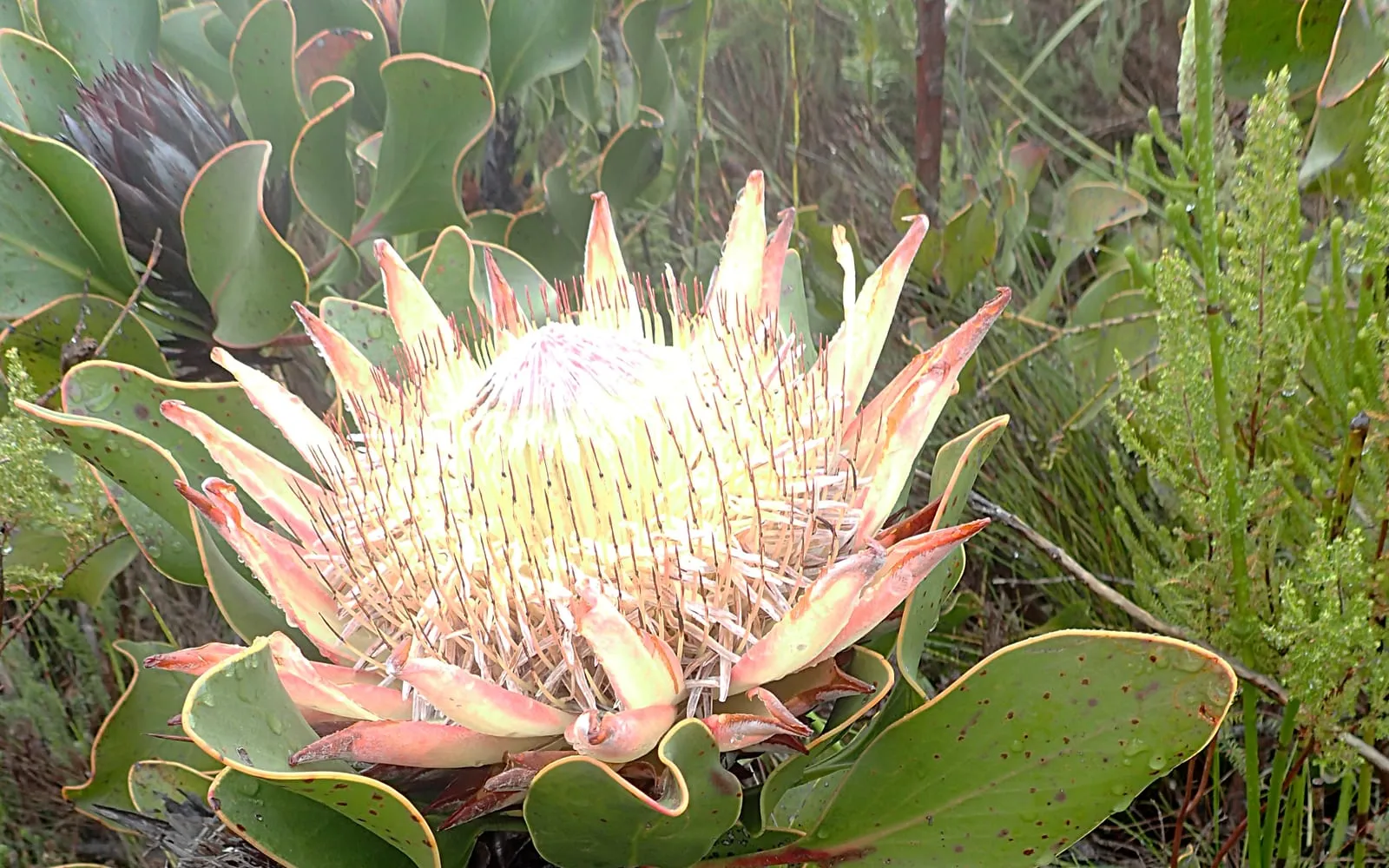
King protea carries the largest flower head of any Protea species, a huge artichoke-like bloom of stiff, waxy bracts wrapped around a dense central cushion of true flowers. It is South Africa’s national flower and the plant most people picture when they hear the word protea.
Growing it well outside the fynbos means recreating the poverty of its native soil rather than improving on it. A rich, well-fed border kills king protea faster than neglect does, because the proteoid roots that let it thrive in nutrient-starved sand cannot cope with ordinary garden fertility.
Appearance and character
The leaves are leathery, blue-green, oval and arranged spirally up tough, woody stems, tolerant of wind, salt spray and drought once established.
The flower head, technically a compound inflorescence rather than a single bloom, can reach 30 cm across, ringed by pointed bracts in shades from pale pink to deep crimson around a silvery, fringed centre. A single bush can carry a flower for weeks, and the cut stems are prized for their long vase life.
Beneath the surface, the roots form dense mats of fine, shallow proteoid roots, sometimes called cluster roots, which scavenge phosphorus and other minerals from soil too poor for most plants to use at all.
Where it is from
Protea cynaroides is native to the Cape fynbos of South Africa, a shrubland of extraordinary plant diversity growing on some of the poorest, most acidic soils in the world, derived from ancient weathered sandstone with almost no available phosphorus.
Fynbos burns periodically, and king protea survives fire by resprouting from a thick, woody rootstock buried below the reach of the flames rather than by seeding back from scratch the way many of its Proteaceae relatives do. That rootstock, not the visible stems, is the part of the plant that carries it through both fire and drought.
How it grows
Plant in full sun with excellent drainage, ideally a raised bed or a slope where water cannot pool around the roots after rain. Sandy or gravelly, acidic soil suits it far better than a rich, moisture-retentive loam.
Avoid phosphorus-rich fertiliser and manure entirely. The proteoid roots that make king protea so efficient at extracting nutrients from poor soil also make it unable to regulate phosphorus uptake the way most plants can, so a normal garden feed can scorch and kill roots that a starved soil never troubles.
Give it space and open air movement around the foliage, since still, humid air around the leaves invites the fungal problems this species is prone to. Mulch lightly with coarse bark or gravel rather than compost, which holds too much moisture and nutrient against the stem base.
Through the seasons
Spring brings a flush of new growth once the soil begins to warm, and the tail end of the main flowering season in a mild climate.
Summer is the dry season the plant expects. Water only if a drought runs long, and never enough to keep the soil constantly moist.
Autumn is a good planting time in a mild climate, giving roots a season to establish before the following summer’s heat.
Winter brings the bulk of the flowering in its native range and in a Mediterranean-type garden climate, alongside the season’s rainfall, which the plant uses for growth.
Care difficulty
Difficult for specific reasons. Within its hardiness zone, king protea tolerates temperature well. Wet feet and rich feeding are what kill it. Gardeners used to improving soil before planting have to avoid that instinct here, since the improvement is usually what does the damage.
Once sited correctly in sharply drained, poor, acidic soil with full sun and air movement, it needs comparatively little ongoing attention and can flower reliably for many years.
Watering
Water regularly through the first year or two while the root system establishes, then let the soil dry out between waterings once the plant is settled.
A summer drought does not need supplementing in most climates that already suit this species. Where extra water is given in a hot dry spell, water deeply and infrequently rather than little and often, and always let the soil surface dry before watering again.
Warning signs, diseases and pests
Phytophthora root rot is the single greatest threat to king protea outside its native range, thriving in soil that holds moisture around the roots and killing plants that show no warning beyond a sudden collapse. Sharp drainage from planting day onward is the only reliable prevention, since there is no cure once it takes hold.
Fertiliser scorch shows as browned leaf margins and dieback following a feed with even a modest phosphorus content, a direct consequence of the proteoid root system. Stop feeding immediately and flush the root zone with plain water if this happens.
Mealybug hides deep in the flower bracts, where it is easy to miss until a colony is well established. Treat with horticultural soap, working the spray into the bracts rather than just the foliage.
Scale insects form small, flat bumps along the woody stems and sap the plant’s vigour over time. Horticultural oil during the dormant season controls a light infestation.
Growing environment
Full sun and open air are essential, both for the flowering and for keeping fungal disease at bay around the foliage.
Sharply drained, poor, acidic sandy or gravelly soil is the single most important requirement this species has, more important than the winter minimum temperature. A raised bed or a naturally sloping site solves most drainage problems that a flat garden bed cannot.
Shelter from the harshest wind helps young plants establish, though a mature king protea tolerates far more exposure than most garden shrubs once its root system is established.
Feeding
Feed sparingly, if at all. In soil already low in nutrients, a specialist low-phosphorus proteaceae fertiliser applied once or twice a year is enough.
Never use a general-purpose garden fertiliser, bonemeal, or manure, all of which carry more phosphorus than the proteoid root system can tolerate. A plant that looks pale can usually be helped more by checking drainage than by feeding it.
Troubleshooting
The plant collapsed suddenly with no warning. Phytophthora root rot is the most likely cause, especially in soil that stays damp for any length of time. There is no cure once symptoms show; the only real defence is planting in sharp drainage from the start and avoiding it in future.
Leaf edges browned and the plant stopped growing after I fed it. This is classic fertiliser scorch from phosphorus. Stop feeding, flush the root zone with plain water over several waterings, and switch to a proteaceae-specific low-phosphorus feed if any is used again.
It has never flowered. Young plants can take three to five years to reach flowering size, and a plant grown too rich or too shaded may never flower well regardless of age. Check that the soil is poor and sharply drained and that the site gets full sun.
Can I grow it in a container? Yes, in a large pot of a specialist low-phosphorus, free-draining proteaceae or ericaceous mix, though it grows more slowly and needs more careful watering than one in open ground, since a pot dries and waterlogs faster than a garden bed.
Will it survive a garden fire or hard frost? It resprouts from its underground rootstock after fire, which is what carries it through both in its native range. A hard frost beyond its established tolerance kills the top growth outright, and unlike fire the rootstock cannot always recover from deep, prolonged cold.