
Outdoor plant
Japanese anemone
Anemone hupehensis
Also known as Chinese anemone, Windflower, Eriocapitella hupehensis
How to grow Anemone hupehensis. Late summer flowers for shade, why it sulks for a year and then runs, and how to get it out of a border once it has spread.
At a glance
- Difficulty
- Easy
- Water
- Rarely once established
- Light
- Partial shade, and full sun where the soil stays damp
- Temperature
- Very hardy, to -20 deg C
- Hardiness
- USDA 4-8, RHS H6, hardy to -25 C
- Type
- Herbaceous perennial spreading by underground runners
- Height
- 60-120 cm in flower
- Native to
- Central and western China
- Best month
- September in the Northern Hemisphere, March in the Southern Hemisphere
It is slow to settle and then hard to remove, spreading by brittle running roots that regrow from every fragment left in the ground. Plant it where that does not matter. New plantings resent disturbance and often sulk for a full season before growing away, so leave a disappointing first year alone.
Hardiness zones describe winter cold alone. Summer heat, humidity, rainfall and the length of the growing season decide as much, so treat the range as the outer limit rather than as a recommendation.
Every month named in this guide is for the temperate Northern Hemisphere. If you garden in the Southern Hemisphere, shift each one by six months, so September becomes March. Closer to the equator the wet and dry seasons matter more than the calendar, and the shift stops being a useful guide.
Toxic if eaten
- Do not eat
- Every part, and the sap most of all
- Harm from
- Eating it and handling it
- Affects
- People, cats, dogs and horses
Japanese anemones belong to the buttercup family and carry the irritant typical of it. The sap contains protoanemonin, released when the tissue is crushed or chewed, and it causes burning of the mouth, drooling, vomiting and diarrhoea if eaten, along with redness and blistering on sensitive skin. The RHS lists anemone among plants that are harmful if eaten and that may irritate the skin, and the ASPCA lists Anemone as toxic to cats, dogs and horses. The severity is low in practice because the taste is acrid enough to stop most animals after a mouthful, and no serious poisonings from garden anemones are on record. Wear gloves when dividing or pulling out runners, since that is the operation most likely to put sap on your hands, and wash afterwards. Drying destroys protoanemonin, so cut stems left on a compost heap quickly become harmless. This is a reasonable plant for a garden used by children and animals, treated with the same ordinary care given to buttercups, clematis and hellebores, all of which carry the same compound.
Sources: RHS potentially harmful garden plants, ASPCA toxic and non-toxic plants
About
Japanese anemones flower from late August until the first frosts, in shade, on stems tall enough to carry the colour above everything that has gone over. There is very little else that does all four of those things at once, which is why they turn up in almost every good late-summer border.
They have one habit that decides whether people love them or regret them. A newly planted anemone typically does nothing at all in its first year, which convinces the owner it has failed. In the second year it starts to travel, and by the fifth it has sent root runners under the path and come up in the middle of something else.
Plant it where that is welcome, and it is among the easiest perennials there is. Plant it in a small mixed border and you will spend years getting it out.
Appearance and character
A herbaceous perennial forming a low mound of foliage with flower stems rising well above it, reaching 60 to 120 cm in flower.
Leaves are dark green, roughly maple-shaped and divided into three toothed lobes, carried on long stalks from the base.
Flower stems are tall, wiry, branched and surprisingly strong, and they hold the blooms without staking in all but the most exposed gardens.
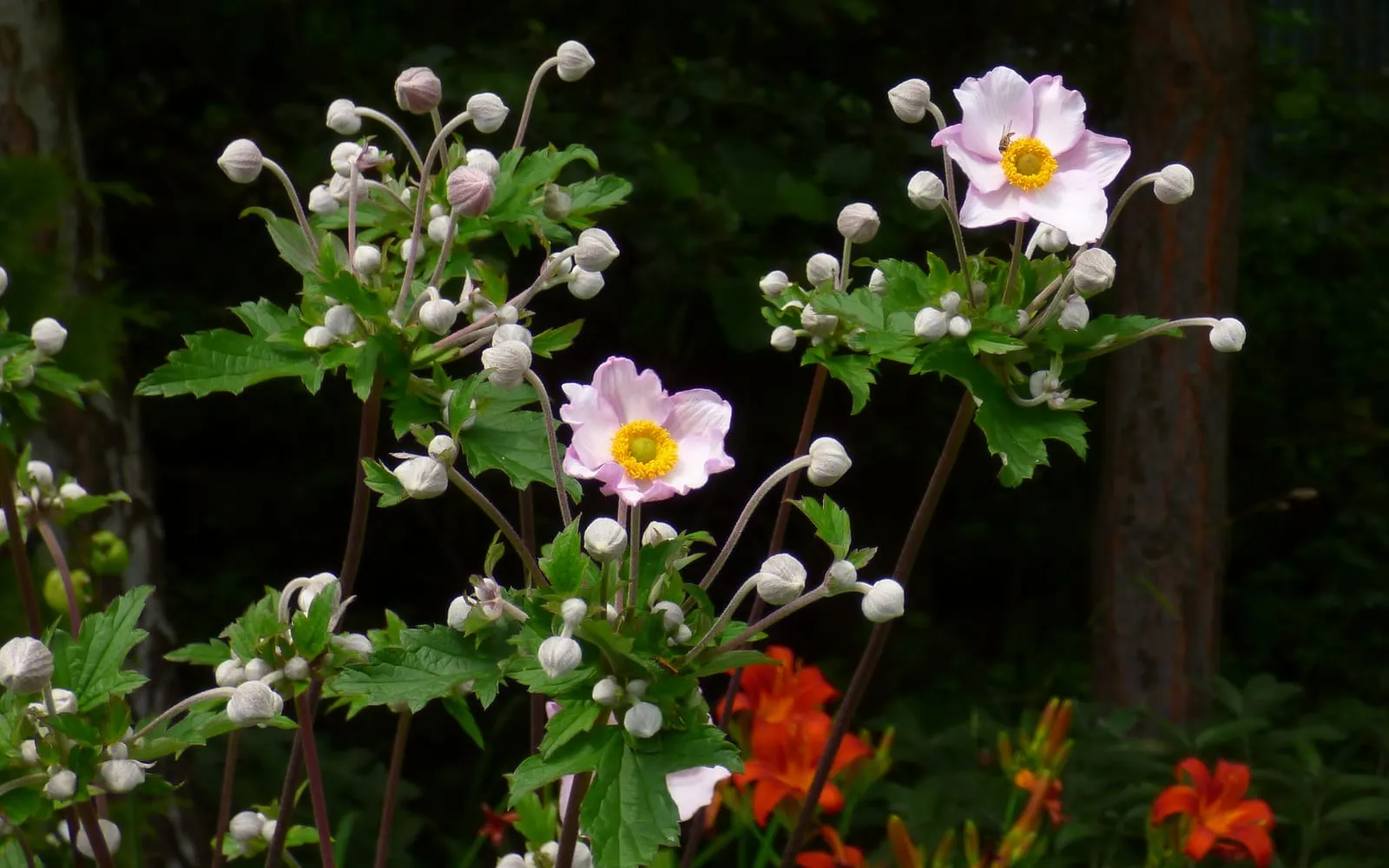
Flowers open from late August into October, 5 to 8 cm across, with five to twenty petal-like sepals in white or shades of pink around a boss of golden stamens and a green button of a centre.
Buds are almost as good as the flowers, rounded and silvery, opening in succession over many weeks.
Seed heads follow, tight woolly balls that split into cottony fluff and are worth leaving over winter.
Names to know. Anemone hupehensis is the species, ‘Hadspen Abundance’ is deep pink, and the taller white ‘Honorine Jobert’ is a hybrid, Anemone x hybrida, that has been grown since 1858. Botanists have moved the group to Eriocapitella, and the trade still uses Anemone.
Where it is from
Central and western China, where it grows on damp shaded slopes, along stream banks and at the edges of woodland.
The name is a long-standing mistake. Robert Fortune collected the plant near Shanghai in 1844 from a cemetery planting, and it had been cultivated in Japan for centuries, which is where the common name came from. The species is Chinese.
Its habitat sets the garden conditions. Damp soil, shade for part of the day and plenty of leaf litter reproduce the stream bank it comes from, and it flowers better and spreads faster there than in a dry sunny border.
Late flowering suits a plant from a monsoon climate, where the reliable moisture arrives in summer and the growing season runs on into autumn.
The spreading habit is how it colonises in the wild. Roots run horizontally and throw up new crowns at intervals, which is efficient on a stream bank and inconvenient in a border.
How it grows
Plant in spring rather than autumn. Japanese anemones establish poorly from an autumn planting and are far more reliable started in March or April.
Choose moist, fertile, humus-rich soil in partial shade, or in sun where the ground does not dry out.
Give it room and a boundary. A path, a lawn edge or a wall all help, and a bottomless container sunk into the ground contains it completely.
Expect nothing in year one. The plant puts its energy into roots and often produces a few leaves and no flowers, which is normal rather than a failure.
Water through the first summer while it establishes, and then leave it alone.
Mulch in spring with garden compost, keeping it clear of the crown.
Cut the stems down after flowering, or leave the seed heads through winter and tidy in early spring.
Divide in spring every four or five years if you want more plants. Digging up a rooted runner is easier still.
Wear gloves for any of the above involving roots, since the sap irritates skin.
Through the seasons
Winter is dormancy. The plant disappears. Leave the seed heads if you like them and clear them in early spring.
Spring brings the leaves through in April. Plant new stock now, mulch, feed, and watch for slugs on the young growth.
Summer is a long quiet build. The foliage mound fills out and the flower stems rise from July. Water only in a severe drought.
Autumn is the display, from late August through to the frosts. Nothing needs doing except deciding whether to cut back.
Care difficulty
Easy. The plant is hardy, long-lived, shade-tolerant, disease-resistant and needs no staking or feeding.
The two problems are opposites and both are about time. It does nothing for a year, and then it does rather too much.
Removal is the genuine difficulty. Every fragment of root left in the soil regrows, so digging out an established clump takes two or three seasons of returning to the same spot.
Powdery mildew marks the leaves in a dry summer and is cosmetic.
Choosing the position carefully at the outset avoids nearly all of this.
Watering
Established plants need no watering except in a prolonged drought.
Water new plantings through their first summer, which is when losses happen.
A dry summer produces smaller flowers, earlier mildew and scorched leaf margins. Mulching does more to prevent this than watering.
Avoid waterlogged ground over winter, which rots the crowns.
Containers are possible in a large pot and need regular summer watering, and the plant is happier in the ground.
Warning signs, diseases and pests
Spreading beyond its allotted ground is the complaint that dominates. The roots run horizontally and send up new crowns some distance from the parent, often through the middle of a neighbouring plant. Sink a barrier 30 cm deep to contain it, or accept the spread and plant it where that is wanted. Removing an established colony means digging out every root fragment and returning for the regrowth over two or three seasons.
Nothing happening in the first year after planting is normal. Water it, mulch it, and wait.
Powdery mildew coats the leaves in white in a dry summer, particularly in dry shade under trees. Mulch and water in drought, and cut affected growth away.
Slugs graze the emerging leaves in April.
Flopping stems mean the plant is in too much shade or has been overfed.
Leaves scorching brown at the edges in midsummer means the ground is too dry.
Few flowers usually means deep shade combined with dry soil, or a plant that is still in its establishing year.
Growing environment
Partial shade is the best position, and full sun works where the soil holds moisture.
Moist, fertile, humus-rich soil with good drainage. It tolerates clay and dislikes thin dry chalk.
Give it space and a boundary. Under shrubs, along a woodland edge, in a large border or in a shaded corner where it can colonise all suit it.
Avoid a small mixed border, a rock garden or anywhere near choice slow-growing plants.
Shelter is unnecessary, since the stems are strong enough to stand without staking.
It combines well with the other late performers. Asters, persicaria, hardy fuchsia and monkshood all flower at the same time and want similar ground.
Sink a physical barrier at planting if you have any doubt about the spread.
Feeding
Mulch with garden compost or leaf mould each spring.
A general-purpose fertiliser suits a plant on poor soil in its first two years.
Avoid rich or high-nitrogen feeding, which produces soft leafy growth that flops and flowers less.
A congested old clump responds to division rather than to feeding.
Troubleshooting
It did nothing at all in its first year. Normal. Japanese anemones spend a season establishing roots and often flower properly only from year two. Water it and wait.
It has come up all over the border. The roots run underground and throw up new crowns. Sink a barrier 30 cm deep, or dig out every fragment and expect to return for the regrowth over two or three seasons.
White powdery coating on the leaves. Powdery mildew, usually from dry soil in shade. Mulch, water in drought, and remove the affected growth.
When should I plant it? Spring. Autumn plantings establish poorly.
The stems flopped over. Too much shade or too much feeding. They stand without staking in reasonable light.
Can I grow it in a pot? Yes, in a large one with regular summer watering, which also contains the spread. It performs better in the ground.
Which one is least invasive? The Anemone x hybrida forms, including ‘Honorine Jobert’, spread more slowly than Anemone hupehensis itself, though none of them stays put indefinitely.
Is it poisonous? Mildly. The sap irritates skin and causes stomach upset if eaten, in the same way as buttercup and clematis. Wear gloves when dividing it.