
Outdoor plant
Great Bougainvillea
Bougainvillea spectabilis
Also known as Paper Flower, Great Bougainvillaea
Practical guidance for growing great bougainvillea, Bougainvillea spectabilis, including thorny climbing habit, drought-triggered flowering, full sun, pruning, frost protection, and mild skin irritation.
At a glance
- Difficulty
- Moderate
- Water
- Deep and infrequent once established; let the compost or ground dry out fully between waterings
- Light
- Full sun, at least five or six hours of direct sun a day
- Temperature
- Warm; leaf damage starts around 5 deg C and hard frost kills the top growth
- Hardiness
- USDA 9b-11, RHS H1c, hardy to -1 C
- Type
- Woody evergreen climber, losing leaves under cold or drought stress
- Height
- 5-12 m trained on a wall or pergola; 1-2 m as a container plant
- Native to
- South America
The zone range describes survival, not flowering. Bougainvillea spectabilis holds its leaves and blooms year-round only where the winter stays frost-free and where a real dry season forces the roots to go short of water. In a climate with reliable summer rain and no dry spell, a plant in open ground can grow strongly and flower only lightly, since the stress that triggers the bracts never arrives on its own.
Hardiness zones describe winter cold alone. Summer heat, humidity, rainfall and the length of the growing season decide as much, so treat the range as the outer limit rather than as a recommendation.
Skin irritant
- Do not eat
- Sap from cut or damaged stems; the thorns are a separate cutting hazard
- Harm from
- Handling it
- Affects
- People
The ASPCA lists bougainvillea as non-toxic to dogs, cats and horses, and it carries no history of serious poisoning in people either. The sap does irritate skin in some people on contact, producing redness or a mild rash similar to a nettle sting, and gardeners who prune it regularly sometimes develop a sensitivity over repeated exposure. The thorns are the more reliable hazard: they are long, stiff and hidden among the bracts, and a hedge or wall-trained plant near a path or a child's play area is worth siting with that in mind, independent of anything to do with toxicity.
Sources: ASPCA (Bougainvillea), RHS potentially harmful garden plants
About
Great bougainvillea is the vigorous, thorny climber behind most of the magenta, orange and purple walls seen across the Mediterranean, coastal California and the tropics. The showy part is not the flower itself. Each small white bloom sits inside three papery, brightly coloured bracts, and those bracts hold their colour for weeks after the true flowers inside have faded.
It climbs by scrambling rather than twining or gripping, so a wall, pergola or fence gives it something to lean on while ties hold the framework in place. Left alone it forms a dense, thorny thicket; trained hard, it becomes a wall of colour, a standard, or a clipped hedge.
Appearance and character
Bougainvillea spectabilis carries larger, more vigorous growth than the smoother-leaved Bougainvillea glabra it is often confused with, with hairy stems and leaves and thorns that are noticeably longer and stiffer. The woody stems thicken and roughen with age, arching and scrambling rather than standing upright on their own.
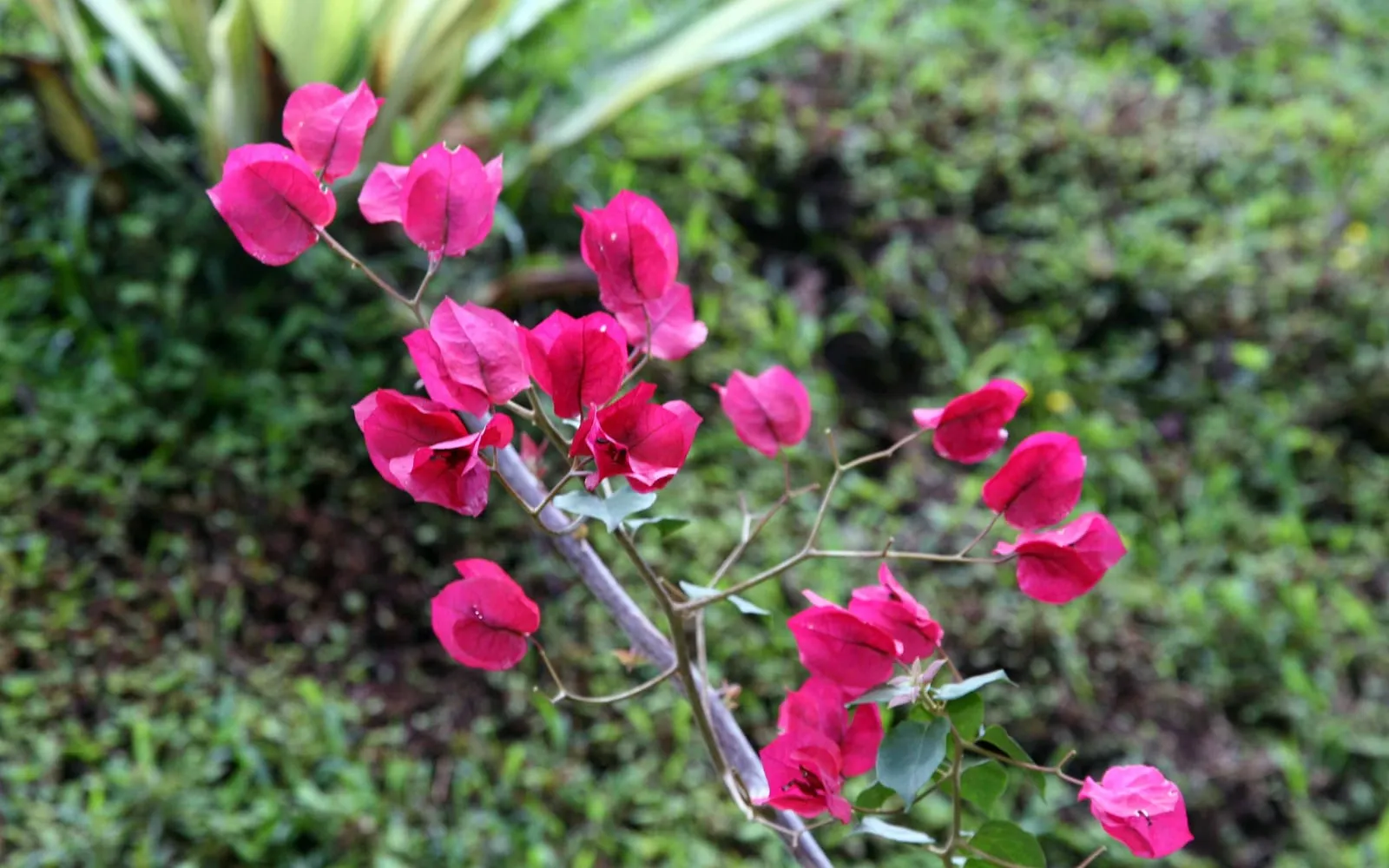
The bracts come in magenta, purple, orange, red, pink or white depending on the cultivar, carried in dense clusters that can smother the plant’s own foliage at the peak of a flush. Each true flower is small, tubular and short-lived, and it is the bract around it, not the flower, that keeps its colour once cut for an arrangement.
Leaves are oval, mid-green and slightly rough to the touch, and the plant sheds a good number of them under cold, drought or transplant stress, then refoliates readily once conditions improve.
Where it is from
Bougainvillea spectabilis is native to South America, with populations recorded from Brazil south into Argentina and Paraguay, growing along forest edges and in open, sunny ground where competition for light is strong. Its natural rhythm follows the wet and dry seasons of that range rather than four distinct temperate seasons, flowering hardest as the ground dries out.
Portuguese and French plant collectors carried it to Europe in the eighteenth century, and gardeners in warm climates worldwide have grown it since, from Mediterranean courtyards to Californian freeway embankments to gardens across South and Southeast Asia, wherever the winter stays free of hard frost.
How it grows
Plant it in full sun in free-draining, unremarkable soil. Soil that is too rich or too regularly irrigated pushes soft leafy growth and comparatively few bracts, since the plant flowers hardest under mild stress rather than under ideal feeding.
Give it a sturdy support from the start, since the woody framework becomes heavy and thorny fast and is awkward to redirect once it has set. Tie in the main stems loosely as they grow, and let side shoots scramble and branch across the support rather than training every stem individually.
In a container, use a loam-based compost with added grit for drainage, and keep the pot on the small side relative to the plant; a slightly pot-bound bougainvillea flowers more freely than one given a large pot and correspondingly generous root run.
Prune after each flowering flush to control size and shape and to encourage the next round of bracts, since flowers form on new growth. It tolerates hard pruning well, including cutting an overgrown specimen back close to the main framework.
Through the seasons
Spring is when growth resumes after winter dormancy or leaf drop, and the first flowering flush usually follows once the days lengthen and the weather warms.
Summer brings the heaviest flowering in a Mediterranean-type climate, particularly where a dry spell coincides with the heat. In a climate with reliable summer rain, flowering is lighter and more sporadic through this period.
Autumn often brings a second strong flush as watering is cut back and nights cool, echoing the dry-season trigger the plant experiences in the wild.
Winter is dormant or semi-dormant in any climate cool enough to check growth. Where frost threatens, move container plants under cover and reduce watering until the roots are barely ticking over.
Care difficulty
Moderate, mainly because restraint matters more than attention. A bougainvillea given full sun, lean soil and a proper dry period between waterings looks after itself and flowers hard; one given rich soil, frequent watering and a sheltered, part-shaded spot grows lush and green and disappoints its owner every summer. The thorns and eventual size are the other two things that catch people out, since a young plant in a small pot gives little sense of how large and armed the framework becomes within a few seasons.
Watering
Water a newly planted specimen regularly until the roots establish, usually through the first growing season. After that, let the ground or the compost dry out fully between waterings, since the plant’s natural trigger for flowering is exactly this kind of dry-wet cycle rather than steady moisture.
Container plants need more deliberate management than those in open ground: water thoroughly, then hold off until the compost is dry an inch or two down, resisting the urge to water on a schedule regardless of how dry the surface looks.
Warning signs, diseases and pests
Aphids gather on soft new shoot tips in spring, distorting the youngest growth and leaving a sticky residue behind them. A strong jet of water or an insecticidal soap usually clears a light infestation.
Mealybug hides in leaf joints and among the thorns, where its white, waxy coating makes it easy to miss until a colony has built up. Wipe accessible patches away and treat the rest with horticultural soap.
Scale insects show as small, flat, brownish bumps along older woody stems, weakening growth over time if left unchecked. Treat as for mealybug.
Root rot follows overwatering, especially in a container with poor drainage or too rich a compost. Leaves yellow and drop, and the base of the stems can darken and soften. Unpot, trim away soft roots, and repot into a gritty, free-draining mix, then water far more sparingly.
Growing environment
Full sun is essential; a plant grown in shade produces mostly leaf and flowers weakly, if at all. Give it the sunniest, most open position available, ideally against a warm south-facing wall in a cooler climate.
Free-draining, ordinary soil suits it better than a rich border, and a raised bed or a large container with grit worked into the compost both help where the native soil holds too much water.
Shelter from hard frost is essential anywhere near the cold edge of its range; a sheltered wall, a cold frame, or bringing a container under cover for winter all extend where it can be grown.
Feeding
Use a low-nitrogen, high-potassium feed formulated for flowering plants, such as a tomato or bloom fertiliser, rather than a balanced or leafy green feed. Potassium supports bract production directly, while nitrogen pushes the leafy growth that competes with it.
Feed every two to four weeks through the growing season and stop entirely once growth slows in autumn. A dormant or resting plant that keeps receiving fertiliser wastes it and risks a flush of soft, frost-tender growth at the wrong time of year.
Troubleshooting
Mine has plenty of leaves but almost no flowers. Too much water, too rich a soil, or not enough sun is the near-universal cause. Cut back watering to a proper dry-wet cycle, move a container plant somewhere sunnier if you can, and switch to a high-potassium bloom feed rather than a balanced one.
The bracts dropped suddenly after I moved the pot. Bougainvillea sheds bracts and leaves readily under any sudden change, whether that is a house move, a cold snap, a knock, or a change in the direction it faces the sun. New growth and buds usually follow within a few weeks once it settles.
Can I grow it somewhere with real winters? Yes, in a large container moved under cover before the first frost and kept in a bright, cool spot above about 10 deg C over winter, watered only enough to stop the compost turning to dust. It goes back outside once the frost risk has passed.
How hard can I cut it back? Harder than most gardeners expect. It regrows readily from old wood, so an overgrown specimen can be cut back close to its main framework after flowering without killing it, though it will take a season to rebuild a full display.
Is it safe to grow near children or pets? The ASPCA lists it as non-toxic, and there is no record of serious poisoning in people. The thorns are the real hazard: long, stiff and easy to miss among the bracts, so keep a hedge or wall-trained plant clear of paths and play areas.