
Outdoor plant
Silver Tree
Leucadendron argenteum
Also known as Silver leaf tree
How to grow silver tree outdoors in a mild, dry climate. Its shimmering silky leaves, short lifespan, and why it resists transplanting once established.
At a glance
- Difficulty
- Difficult
- Water
- Minimal once established; regular watering only while young
- Light
- Full sun
- Hardiness
- USDA 9-10, RHS H3, hardy to -4 C
- Type
- Evergreen shrub or small tree, relatively short-lived
- Height
- 6-10 m
- Native to
- South Africa
Adapted to a Mediterranean-type climate with dry summers and wet winters, tolerating a light frost once established but performing poorly in a persistently humid or summer-wet climate regardless of winter temperature. It needs poor, acidic, sharply draining soil and struggles badly on rich, fertile or alkaline ground, conditions that limit where it succeeds even within an otherwise suitable climate.
Hardiness zones describe winter cold alone. Summer heat, humidity, rainfall and the length of the growing season decide as much, so treat the range as the outer limit rather than as a recommendation.
Not known to be toxic
Silver tree has no toxicity listing from the RHS or the ASPCA and is considered safe around pets and children. There is no documented history of poisoning associated with this species.
Source: RHS
About
The silver tree is one of the most visually striking members of the protea family, its narrow, silky leaves covered in a dense layer of fine silver hairs that catch the light and shimmer in even a gentle breeze, giving the whole canopy a luminous, metallic quality unlike almost any other tree. It is restricted to a small native range on South Africa’s Cape Peninsula, where wild populations are considered vulnerable, and it has become a prized, if demanding, specimen tree in Mediterranean- climate gardens worldwide.
Unlike many long-lived trees, individual silver trees are relatively short-lived, often surviving only a few decades even in ideal conditions, and the species relies on periodic wildfire in its native habitat to release seed and regenerate, a detail that shapes how difficult it can be to establish and maintain in a garden setting where that natural cycle is absent.
Appearance and character
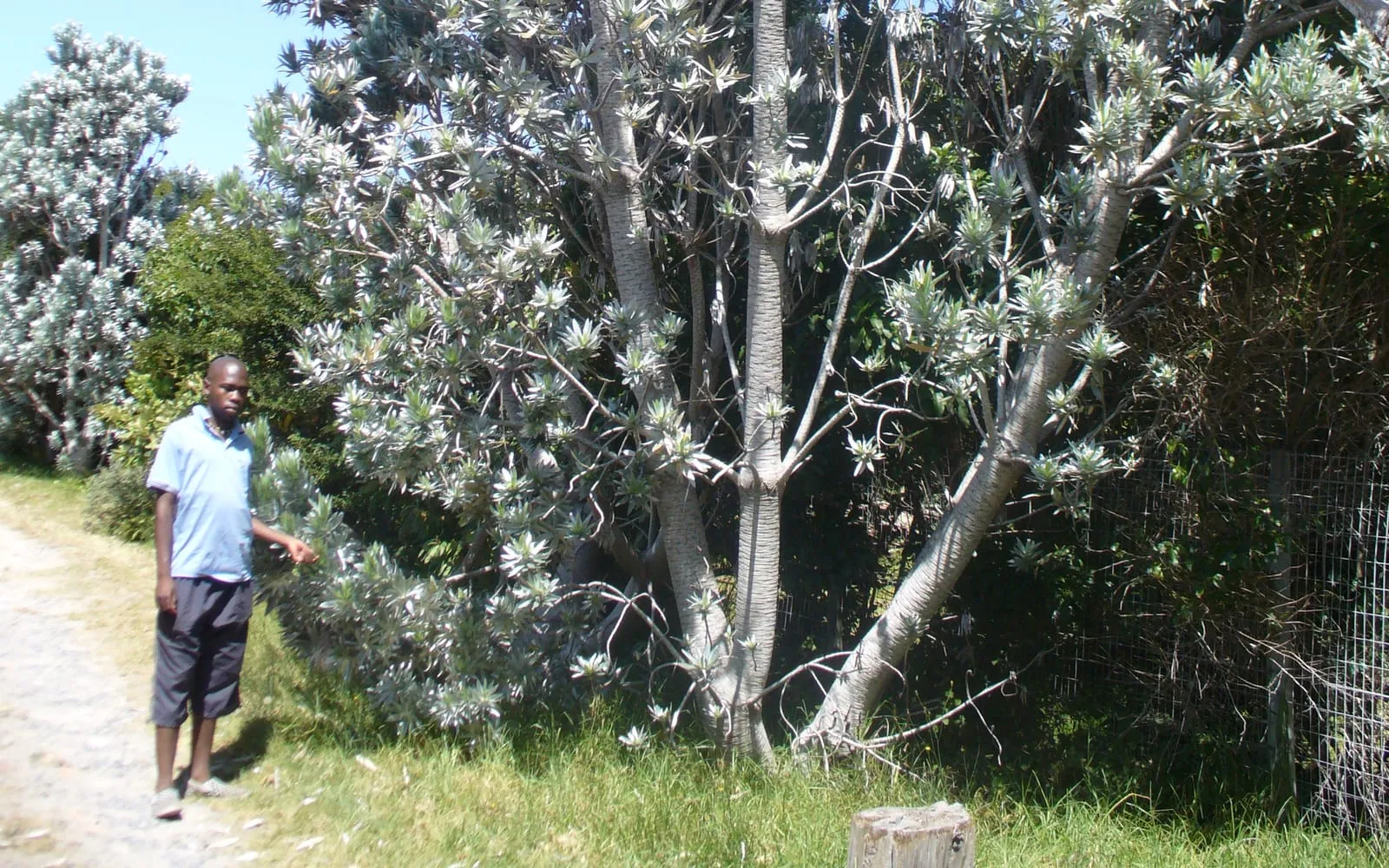
Narrow, lance-shaped leaves, densely covered in fine silky hairs, give the whole tree a shimmering silver-grey appearance that shifts with the light and the angle of viewing, particularly striking against a blue sky or dark background. The tree typically grows with a single or few main stems, developing an upright, somewhat open canopy as it matures.
Small, cone-like flower heads appear at the branch tips, much less showy than the flamboyant blooms of some related Proteaceae, since this species’ appeal rests almost entirely on its extraordinary foliage rather than on any showy flowers.
Where it is from
A narrow native range on South Africa’s Cape Peninsula, on poor, acidic, sharply draining mountain soil in a Mediterranean-type climate with dry summers and wet, mild winters, exposed to periodic wildfire as part of the fynbos ecosystem it belongs to.
That fire-adapted fynbos origin explains much of what makes this species difficult in cultivation: it evolved in an ecosystem that periodically burns and regenerates from seed, a cycle a typical garden setting cannot replicate, and its intolerance of rich, fertile or wet soil reflects millions of years of adaptation to the opposite conditions.
How it grows
A relatively fast-growing but short-lived tree, typically reaching a significant size within a decade or so before beginning to decline, reflecting its adaptation to a habitat where mature trees are periodically replaced by fire-triggered regeneration from seed rather than persisting indefinitely. Once established, it resents root disturbance strongly, and transplanting a specimen that has been in the ground for more than a season or two is rarely successful.
Because of this sensitivity, most successful plantings start from a young, container-grown specimen planted into its final position with as little root disturbance as possible, rather than from a plant moved from elsewhere in the garden.
Through the seasons
Spring growth resumes as temperatures rise; this is a good time to plant a new young specimen, giving it a full growing season to establish before the following summer’s dry season.
Summer growth continues given the dry, Mediterranean-type conditions this species tolerates well once established; avoid watering established plants during this period.
Autumn growth slows as temperatures drop and the wetter season approaches in a Mediterranean-type climate.
Winter this is typically the wetter part of the year in this species’ preferred climate, and established plants tolerate this naturally, so long as drainage is sharp enough to prevent waterlogging.
Care difficulty
Difficult. Beyond needing a specific Mediterranean-type climate, this species demands poor, acidic, sharply draining soil, resents both root disturbance and rich feeding, and is naturally short-lived even under good conditions, all of which combine to make it a much more demanding garden tree than its striking appearance might suggest.
Watering
Regular watering supports establishment in the first year after planting. Once settled, this species is adapted to a dry Mediterranean summer and generally performs poorly with regular summer watering, which favours root rot far more than it supports healthy growth.
Warning signs, diseases and pests
Root rot from soil that is too rich, wet or poorly drained is the most serious and common problem with this species, and prevention through correct siting and minimal watering matters far more than any treatment once it has taken hold. There are few significant pests specific to this species in cultivation, with most problems tracing back to unsuitable soil or climate conditions rather than pests or disease in the usual sense.
A declining, thinning canopy on a tree that has been in the ground for some years can reflect the species’ naturally limited lifespan rather than a treatable problem, and is worth distinguishing from a young plant’s decline, which more often points to unsuitable soil, watering or transplant stress instead.
Growing environment
Full sun is essential, and poor, acidic, extremely free-draining soil is just as important, closely mirroring the fynbos mountain slopes this species comes from. Avoid any spot with rich garden soil, standing water, or soil that has been limed or fertilised for other plants, all of which work against this species’ specific needs.
Feeding
None to minimal, and phosphorus in particular should be avoided, since members of the Proteaceae family, including this one, are especially intolerant of phosphorus levels that would be entirely unremarkable for most other garden plants, often showing toxicity symptoms rather than benefiting from feeds that contain it.
Troubleshooting
A newly planted specimen has failed to establish. Check that it was planted with minimal root disturbance and into suitably poor, acidic, sharply draining soil, since this species is especially sensitive to both factors at the establishment stage.
An established tree is declining or thinning in its canopy. Consider the species’ naturally limited lifespan, often just a few decades even in good conditions, alongside checking for waterlogged or overly fertile soil as a more immediate, correctable cause.
Leaves have yellowed after feeding with a general garden fertiliser. Suspect phosphorus toxicity, to which this species and its relatives are especially sensitive. Avoid feeding altogether, or use only a fertiliser specifically formulated as low-phosphorus for proteas and their relatives.
You are trying to move an established specimen to a new spot. This is rarely successful once a plant has been in the ground for more than a season or two, given how strongly this species resents root disturbance; starting a new, young specimen in the desired spot is generally more reliable than attempting to transplant an older one.