
Outdoor plant
Pincushion Protea
Leucospermum cordifolium
Also known as Nodding pincushion
How to grow pincushion protea outdoors. Its dome-shaped orange flower heads, why it needs strong wind and full sun, and its excellent cut-flower vase life.
At a glance
- Difficulty
- Difficult
- Water
- Regular watering while establishing, drought-tolerant once mature
- Light
- Full sun
- Hardiness
- USDA 9-10, RHS H3, hardy to -3 C
- Type
- Evergreen shrub
- Height
- 1-1.5 m
- Native to
- South Africa
Adapted to a Mediterranean-type climate with dry summers, good air movement and poor, acidic, sharply draining soil, tolerating only a light frost once established. Humidity and still, poorly ventilated air are a bigger threat than cold in many gardens, since this species evolved on open, wind-exposed slopes and is markedly more prone to fungal problems in sheltered, humid conditions.
Hardiness zones describe winter cold alone. Summer heat, humidity, rainfall and the length of the growing season decide as much, so treat the range as the outer limit rather than as a recommendation.
Not known to be toxic
Pincushion protea has no toxicity listing from the RHS or the ASPCA and is considered safe around pets and children. There is no documented history of poisoning associated with this species.
Source: RHS
About
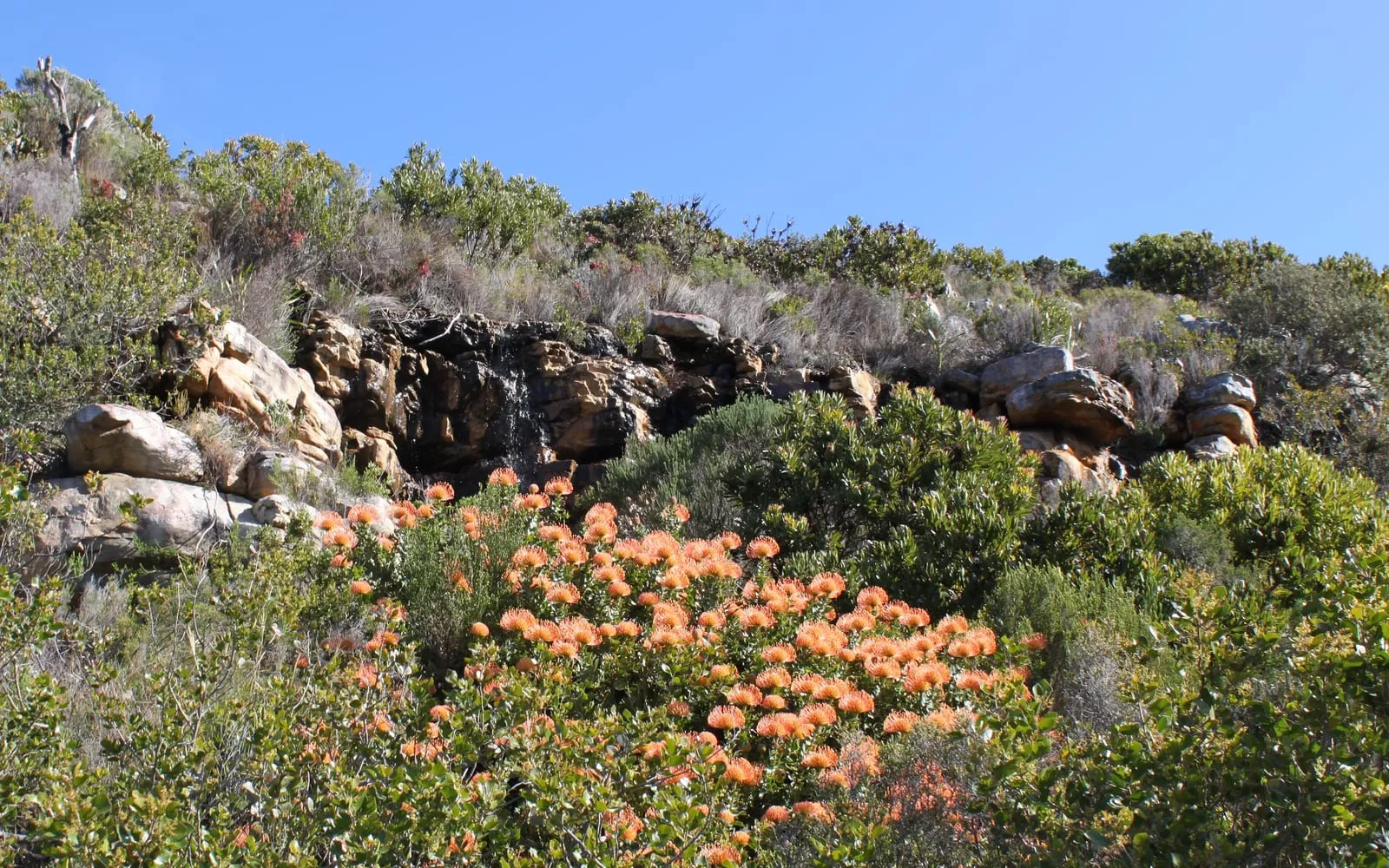
The pincushion protea is grown for its striking, dome-shaped flower heads, made up of dozens of long, curved styles radiating outward like the pins in a pincushion, typically in vivid shades of orange, red or yellow. It is a mainstay of the cut-flower trade thanks to an exceptionally long vase life, often two weeks or more, and a well-grown garden shrub produces a heavy flush of these distinctive blooms each spring given a suitable site.
Getting that site right matters more for this species than for many other garden shrubs: it comes from open, wind-swept, sun-baked slopes in South Africa and performs noticeably worse in a sheltered, still, humid position than in an exposed, breezy one, a reversal of what most gardeners assume a delicate-looking flowering shrub needs.
Appearance and character
Narrow, grey-green leaves, often with a reddish tinge at the tips, clothe a spreading, mounding shrub, and large, rounded to dome-shaped flower heads open at the branch tips, each one composed of numerous long, curved styles that give the bloom its distinctive pincushion texture and silhouette. Colour ranges from bright orange through red to yellow depending on the variety, often with more than one shade visible across a single flower head as it matures.
Flowering is concentrated mainly in spring, producing a dense, colourful display across a well-grown shrub, and the flowers hold their shape and colour for an unusually long time both on the plant and once cut, a trait that has made the species commercially significant well beyond its native range.
Where it is from
Open, wind-exposed, rocky slopes in South Africa’s fynbos region, in a Mediterranean-type climate with dry summers, wet winters and, critically, consistently good air movement across the exposed terrain the species naturally grows on.
That constant air movement in its native habitat is directly connected to the plant’s vulnerability to fungal disease in a more sheltered garden setting; still, humid air around the foliage, of the kind a sheltered courtyard or a densely planted border can create, favours the fungal problems this species evolved with little exposure to in the wild.
How it grows
An evergreen shrub building a spreading, mounding form over a few years, flowering most heavily on growth made in the previous season. A light trim after flowering, removing spent flower heads and shaping the plant, encourages strong new growth for the following year’s display without the harder cutting back some other flowering shrubs tolerate.
Because good air movement matters so much to this species’ health, spacing plants generously apart, and avoiding a tightly enclosed or densely planted position, does as much for its long-term wellbeing as correct soil and watering.
Through the seasons
Spring is the main flowering period, with dense, dome-shaped flower heads opening across the shrub. Trim lightly once flowering has finished.
Summer growth continues given the dry, well-ventilated conditions this species tolerates well once established; avoid regular watering of an established plant during this period.
Autumn growth slows as temperatures drop and the wetter season approaches in a Mediterranean-type climate.
Winter established plants tolerate mild, wet winter conditions reasonably well provided drainage is sharp, though real cold beyond a light frost poses a real risk.
Care difficulty
Difficult. This species needs a specific combination of poor, acidic, sharply draining soil, strong sun, and, less obviously, good air movement around the foliage, a combination not every garden can offer even in an otherwise suitable mild, dry climate.
Watering
Regular watering supports establishment in the first year or two. Once settled, this species tolerates real drought well and generally performs poorly with regular summer watering, which favours root and fungal problems over healthy growth; when watering is needed, direct it at the soil rather than wetting the foliage.
Warning signs, diseases and pests
Root rot and fungal dieback in poorly drained or poorly ventilated conditions are the most significant risks with this species, and prevention through correct siting, spacing and minimal watering matters far more than treatment once a problem has taken hold. Few significant insect pests trouble this species in a climate and site that suits it.
A shrub that declines despite apparently correct soil and watering is worth checking for poor air circulation, particularly if it is planted in a sheltered corner, a courtyard, or crowded closely among other plants, since still, humid air around the foliage is a less obvious but significant risk factor for this species.
Growing environment
Full sun and good air movement are both essential, and poor, acidic, sharply free-draining soil matters just as much, closely mirroring the open, wind-exposed fynbos slopes this species comes from. Avoid a sheltered, enclosed position even if it seems to offer welcome protection, since the still air it creates works against this species more than the shelter benefits it.
Feeding
None to minimal, and phosphorus should be avoided specifically, since members of the Proteaceae family, including this one, are especially intolerant of phosphorus levels that are unremarkable for most other garden plants.
Troubleshooting
A shrub is declining despite good soil and watering. Check air movement around the plant, since still, humid conditions favour the fungal problems this species is prone to. Thin out crowded surrounding planting or move a struggling specimen to a more open, breezy position.
Growth is soft and weak rather than compact. Suspect too much shelter, shade, or overly rich soil, since this species is adapted to open, exposed, poor-soil conditions and grows soft, uncharacteristic growth when given the opposite.
Leaves have yellowed after feeding with a general garden fertiliser. Suspect phosphorus sensitivity, common across this plant family. Avoid feeding, or use only a fertiliser specifically formulated as low-phosphorus for proteas and their relatives.
You want to use the flowers for cutting. Cut spikes once the flower head has opened but is not yet fully mature, and expect an unusually long vase life compared with most other cut flowers, often two weeks or more with fresh water changes.