
Edible
Japanese Millet
Echinochloa esculenta
Also known as Barnyard millet, Japanese barnyard millet, Hie, Sawa millet
How to grow Japanese millet, Echinochloa esculenta. A crop made from barnyard grass, ready in forty-five days, and the fastest cereal there is to sow.
At a glance
- Difficulty
- Easy
- Water
- Undemanding, and it tolerates standing water better than any other millet
- Light
- Full sun
- Temperature
- 20-30 deg C, and it starts at a lower soil temperature than most millets
- Hardiness
- USDA 5-11, RHS H2, hardy to 10 C
- Type
- Very fast tender annual grass
- Height
- 60-120 cm
- Native to
- Japan, the Korean peninsula
- Best month
- May, June and August in the Northern Hemisphere, November, December and February in the Southern Hemisphere
Domesticated from barnyard grass and ready in around forty-five days, which makes it the fastest cereal there is and the one that will fit into almost any gap in a season. It tolerates waterlogging better than any other millet, so it grows on ground too wet for maize. Frost ends it, so the window runs from the last spring frost to about seven weeks before the first autumn one.
Hardiness zones describe winter cold alone. Summer heat, humidity, rainfall and the length of the growing season decide as much, so treat the range as the outer limit rather than as a recommendation.
Every month named in this guide is for the temperate Northern Hemisphere. If you garden in the Southern Hemisphere, shift each one by six months, so May becomes November. Closer to the equator the wet and dry seasons matter more than the calendar, and the shift stops being a useful guide.
Not known to be toxic
- Safe to eat
- The grain, hulled and cooked
Japanese millet contains no gluten and no toxic compound worth naming. Its wild relative barnyard grass, Echinochloa crus-galli, has a record of nitrate accumulation when grown on heavily fertilised ground and then fed to livestock, which is the usual nitrate story rather than anything specific to the plant, and it does not apply to threshed grain. In Europe the crop is sold as a game cover and wild bird seed mix component rather than as human food, and it is grown deliberately on wet ground for ducks. The grain needs hulling before it can be eaten.
About
Japanese millet was made out of a weed. Barnyard grass, Echinochloa crus-galli, is one of the world’s worst agricultural weeds, particularly in rice, and farmers in Japan and Korea domesticated a form of it into a crop during the Jomon period several thousand years ago.
The result is the fastest cereal in cultivation. It takes forty-five to sixty days from sowing to harvest, faster even than proso millet, which makes it the crop you sow in July when something has failed and you still want a harvest.
Growers in cool climates use it without eating it. Japanese millet is a standard component of game cover mixes and wild bird seed plots, and it is sown on wet ground for duck flighting because it tolerates flooding that would kill any other cereal. Anyone who has walked past a shooting estate’s cover strip in September has probably seen it.
Appearance and character
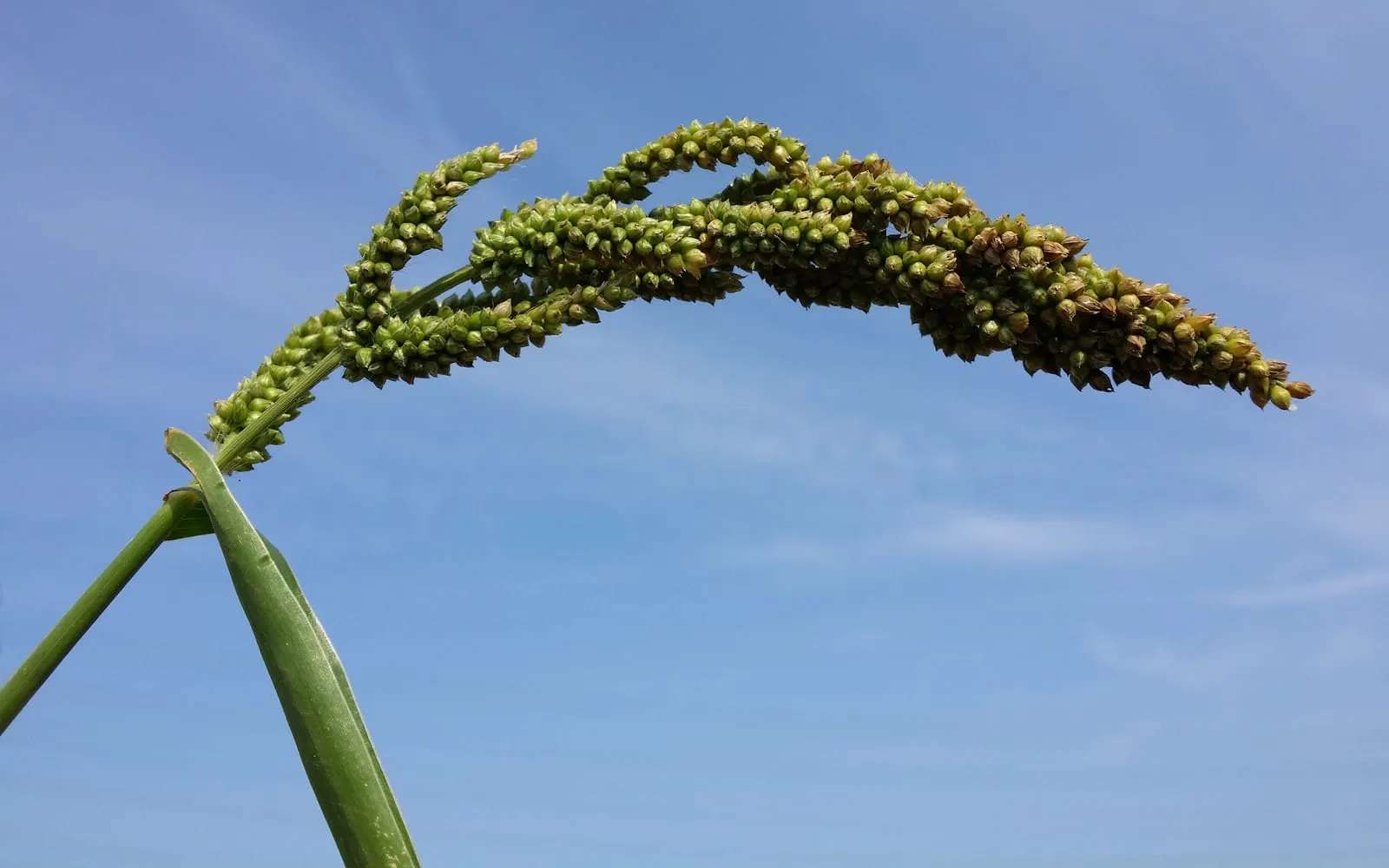
The panicle is compact and branched, with the branches held close to the main axis so the whole head looks like a short thick bottle brush rather than an open spray. It usually carries a purple or bronze tinge, and a ripe crop reads as distinctly reddish from a distance.
The plant is a coarse tufted grass with broad flat leaves, no ligule at the leaf base, and stems that often sprawl at the bottom before turning upright. The absence of a ligule is the family character and distinguishes Echinochloa from almost every other grass in a temperate field.
The seed is small, around 2 to 3 mm, and pale brown to purple inside a tight hull. Hulled, it is a small pale bead that cooks quickly to a soft porridge. Japanese cooking used hie as a poverty grain, and it has largely disappeared from the diet there.
Where it is from
Japanese millet was domesticated from barnyard grass in Japan and possibly Korea, with archaeological evidence from Jomon period sites suggesting cultivation from around 2000 BC and use of the wild plant much earlier.
A parallel domestication happened in India, producing Echinochloa frumentacea, Indian barnyard millet or sawa. The two crops are close relatives from different wild starting points, and they are frequently confused in seed catalogues.
The plant remained a subsistence and famine crop in Japan through the medieval and early modern periods, valued because it grows on cold northern ground and in wet paddies where rice fails. Rising prosperity pushed it out of the diet, and its modern use is largely as fodder, game cover and bird food.
How it grows
Germination is fast and it happens at a lower soil temperature than the other millets need, from about 12 deg C, which is what makes the crop practical in a cool summer.
Growth is very rapid. The plant tillers, throws a head at four to six weeks, and fills grain over the following fortnight. A June sowing can be cut in August.
The crop tolerates flooding to an unusual degree for a cereal, and it will grow with its roots in standing water for weeks. Ripe seed shatters readily, which is useful when the purpose is feeding ducks and a nuisance when the purpose is collecting a harvest.
Through the seasons
Sow from May through July, once the soil has reached 12 to 15 deg C. Broadcast it for cover or sow in rows at 20 cm for a seed crop, and rake it in shallowly.
The crop emerges within a week and grows fast. Heads appear four to six weeks after sowing, and the panicles colour purple-bronze over the fortnight after that.
Harvest six to nine weeks after sowing, which for a May sowing means late July and for a July sowing means September. Cut when most of the seed has darkened, before shattering takes it. Dry the heads and rub the seed out, and expect to hull it before eating.
Care difficulty
This is the easiest millet on the plot. It germinates in cooler soil than the others, grows in six weeks, tolerates wet ground, heavy clay and acidity, and needs nothing from the gardener beyond a warm start.
Two things to plan for. It shatters, so the harvest window is short and the ground under a ripe crop collects seed. And it self-seeds enthusiastically, which turns a one-year experiment into a three-year weeding job if you let a crop shed.
Cut it on time and the rest looks after itself. As a catch crop after early potatoes or broad beans, sown in July and cut in September, it fits a short season better than any other cereal.
Watering
Water at sowing to get even germination and then leave it. The crop is undemanding and grows fast enough to finish before the ground dries out.
Its tolerance of wet ground is the unusual quality. Japanese millet will grow with standing water around its base for weeks, which is why it is sown on flood meadows and duck ponds, and no other cereal in this collection will do that.
A soak during head fill in a dry August helps a seed crop. There is no benefit to watering once the panicle has coloured.
Warning signs, diseases and pests
Birds take the crop, which is what it is often sown for. If you want the seed, net the heads as they begin to colour.
Smut turns individual grains into dark spore masses in the head, and affected heads should be cut and burned rather than composted.
Shattering is the loss to plan around. Ripe Japanese millet drops seed at a touch, so cut when about two-thirds of the panicle has darkened rather than waiting for all of it.
Slugs take seedlings in a cool damp start, though the crop’s speed usually outruns them. Self-seeding is the problem that arrives the following year, when a shed crop comes up through everything else in the bed.
Growing environment
Full sun and almost any soil. This is the least fussy cereal in the wave, growing on heavy clay, on acid ground, on wet ground and on land that has been flooded.
The pH range runs from about 4.5 to 8, which is wider than any other crop here tolerates. Fertility is not required, and rich ground produces a taller plant that falls over.
Temperature is the one requirement, and it is modest by millet standards. Soil at 12 to 15 deg C is enough to sow into, growth is good from 20 deg C, and frost ends the plant, which in a temperate climate gives a sowing window from May to July.
Feeding
Feed it lightly or not at all. The plant grows fast and tall on its own, and nitrogen produces soft stems that lodge before the seed has set.
On exhausted ground a single dressing of a balanced feed before sowing is reasonable. On anything that grew a fed crop this year, apply nothing.
Because the crop is often sown as a catch crop after something else has come out, the residual fertility in the bed is usually more than enough.
Troubleshooting
Is this the same as barnyard grass? It is the crop domesticated from it. Barnyard grass, Echinochloa crus-galli, is a major agricultural weed, and Japanese millet is the cultivated form with a denser head and larger seed.
How fast is it? Forty-five to sixty days from sowing to harvest, which is the fastest cereal in cultivation. That speed is why it works as a catch crop after an early vegetable comes out.
Can I grow it on wet ground? Yes, and it is the only cereal in this collection that will. Japanese millet grows with standing water around its base for weeks, which is why it is sown for duck cover on flood meadows.
Will it become a weed? It can. The crop shatters and self-seeds freely, so a plot that is allowed to shed will produce volunteers for two or three years. Cut it before the seed is fully ripe.
Is it the same as Indian barnyard millet? No, though the two are close. Sawa millet is Echinochloa frumentacea, domesticated separately in India from a different wild ancestor. Seed catalogues confuse them regularly.
Can I eat it? Yes, once it is hulled. It cooks quickly to a soft porridge, and it was a staple in northern Japan for centuries. The hulling is the same awkward job as with every millet.
Where do I buy seed? Game cover and wild bird seed suppliers sell it by the kilogram, which is far more than a garden needs but is usually the cheapest route.
Japanese Millet problem guides
Not sure what is wrong? See the common vegetable pests guide.