
Outdoor plant
Japanese Barberry
Berberis thunbergii
Practical guidance for growing Japanese barberry, Berberis thunbergii, including its spiny stems, autumn colour, invasive spread in parts of North America, wheat-rust resistance, and mild toxicity.
At a glance
- Difficulty
- Easy
- Water
- Regular watering while establishing, then only in prolonged drought
- Light
- Full sun for the best autumn colour and densest growth; tolerates part shade
- Temperature
- Very hardy; tolerates severe winter cold once established
- Hardiness
- USDA 4-8, RHS H7, hardy to -25 C
- Type
- Deciduous shrub
- Height
- 1-2 m
- Native to
- Japan
Cold is not the limiting factor for this shrub anywhere it is sold. Japanese barberry survives winters far harder than most gardens provide, and the zone range instead marks where it stops growing well rather than where it dies: a tropical or near-tropical climate with no winter chill at all suits it poorly, while everything from a cold continental winter to a mild maritime one grows it without difficulty.
Hardiness zones describe winter cold alone. Summer heat, humidity, rainfall and the length of the growing season decide as much, so treat the range as the outer limit rather than as a recommendation.
Harmful if eaten
- Do not eat
- All parts contain berberine, most concentrated in the roots, stems and inner bark
- Harm from
- Eating it
- Affects
- People
Japanese barberry contains berberine and related alkaloids throughout the plant, at their highest concentration in the roots, stems and the bright yellow inner bark, and at their lowest in the red berries. Eating a significant quantity of the tougher, more concentrated tissue causes stomach upset, vomiting or diarrhoea; the berries themselves are tart and rarely eaten in quantity by children by choice. The RHS does not list Berberis among its potentially harmful garden plants, and reports of poisoning from garden-grown Japanese barberry are rare in practice, since the tissue that carries the highest concentration is also the least palatable part of the shrub. The more immediate hazard day to day is physical rather than chemical: the stems carry sharp spines capable of a painful puncture wound. Those spines are why it is planted as a barrier hedge in the first place.
Sources: RHS potentially harmful garden plants, ASPCA toxic and non-toxic plants
About
Japanese barberry is a dense, thorny shrub grown for foliage that holds its shape all season and turns a reliable, bright red in autumn regardless of soil or climate. Purple-leaved and golden-leaved cultivars have made it one of the most widely planted foundation shrubs in temperate gardens, valued as much for colour that needs no flowers to deliver it as for the security its spines provide along a boundary.
That same toughness has made it a serious weed in parts of eastern North America, where birds spread its seed into woodland far from any garden and dense thickets displace native undergrowth. Several US states now restrict or ban its sale, and a gardener outside its native range does well to check local rules before planting the species form rather than a sterile cultivar.
Appearance and character
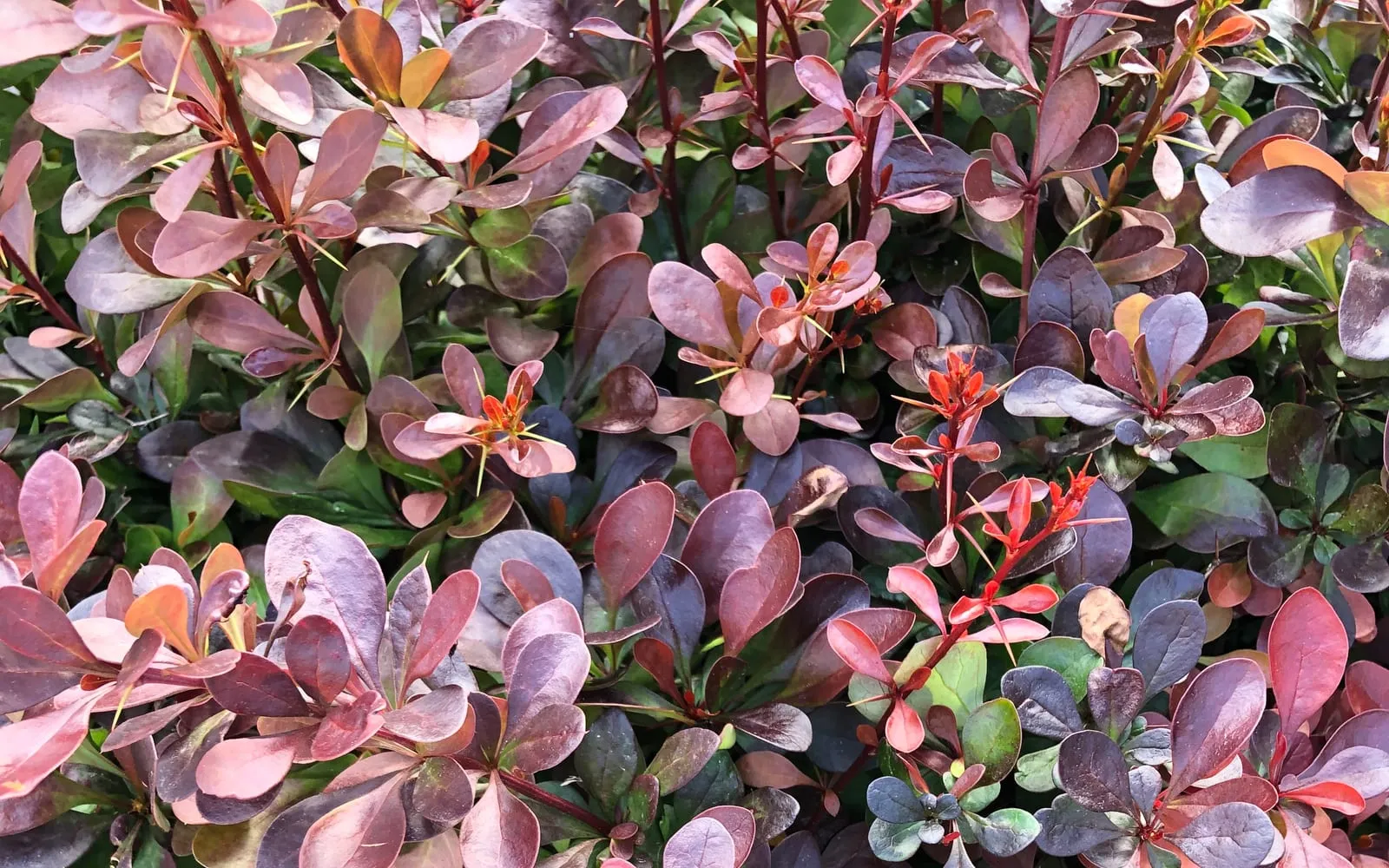
Small, oval leaves, typically 1 to 3 cm long, cluster along arching, spiny stems in whorls, giving the whole shrub a fine, dense texture even before autumn colour arrives. Leaf colour varies by cultivar from fresh green through deep purple-red to bright gold, and every one of them turns a strong red to orange in autumn as the season ends.
Small, pale yellow flowers appear in mid-spring, hanging in clusters along the stems, inconspicuous against the foliage and easy to miss unless you are looking closely. Bright red, oblong berries follow in autumn and often persist on the bare stems well into winter, adding colour after the leaves have dropped.
The spines, one at each leaf node, are the shrub’s most distinctive practical feature. They are sharp enough to discourage deer and other browsing animals almost entirely, which is a large part of why the species has stayed popular in gardens where deer make many other shrubs impossible.
Where it is from
Berberis thunbergii is native to Japan, growing on hillsides and forest edges across a range with cold winters and warm, humid summers. Its toughness in cultivation traces directly back to that native range, which selected for a shrub able to tolerate both severe cold and difficult soil.
That same adaptability, combined with birds that readily eat and disperse the berries, is what has let it escape gardens across the northeastern United States and establish in woodland far from where it was planted. Dense stands of Japanese barberry also hold humidity at ground level higher than the surrounding woodland, and researchers have linked those thickets to larger populations of the ticks that spread Lyme disease, giving the species an ecological reach well beyond the garden it started in.
How it grows
Plant in any reasonable garden soil with adequate drainage; this is one of the least fussy shrubs available; it establishes readily in poor, dry, or compacted ground where many other shrubs struggle.
Full sun brings out the strongest leaf colour in the purple and gold cultivars and keeps growth dense; in shade, the same plants grow looser and the colour fades toward green.
Prune, wearing thick gloves against the spines, in late winter or after flowering, removing any dead or crossing stems and shaping lightly. It tolerates hard pruning well and regrows quickly from old wood, which makes it a forgiving choice for a formal hedge.
Where local rules restrict the species, look for a sterile cultivar bred not to set viable seed, which gives the same foliage and form without the same capacity to spread into surrounding land.
Through the seasons
Spring brings small yellow flowers along the stems and the flush of new leaf colour that defines the cultivar.
Summer is steady, dense growth, needing little beyond occasional water in an extended dry spell.
Autumn turns the foliage red to orange across every cultivar and ripens the berries to bright red.
Winter shows the bare, spiny stems and the berries, which often persist long after the leaves have fallen and into the coldest months.
Care difficulty
Easy, and among the most tolerant shrubs commonly sold. It tolerates poor soil, urban pollution, road salt and drought once established, needs no routine feeding on reasonable ground, and recovers readily from hard pruning. Handle it with gloves, since the spines that make it such an effective barrier plant are just as effective against the gardener pruning it.
Watering
Water regularly through the first growing season while the roots establish, then rely on rainfall in most climates. Established plants tolerate real drought without significant damage, one of the more useful traits it brings to a low-maintenance planting.
Container-grown plants need more consistent attention than anything planted in open ground, since a pot dries out faster than the soil this shrub otherwise tolerates so well.
Warning signs, diseases and pests
The alternate host for wheat stem rust, a fungal disease that devastates cereal crops, is the common barberry, Berberis vulgaris, and it was that species the United States eradicated across much of its wheat-growing region in the twentieth century. Japanese barberry resists the disease and was planted widely as the safe substitute, which is part of how it spread so far. Growing it near arable farmland does not spread stem rust, but several US states restrict or ban it as an invasive plant, so a gardener should still check local rules before planting.
Powdery mildew coats leaves in a pale film during humid, still weather, mostly cosmetic on an established shrub and eased by better air movement around the plant.
Aphids sometimes cluster on soft new shoots in spring; they rarely cause lasting damage and predatory insects usually bring them under control on their own.
Leaf spot appears as small dark blotches in prolonged wet weather, again mostly cosmetic and rarely a problem on an otherwise healthy shrub.
Growing environment
Full sun gives the densest growth and the strongest leaf colour, particularly on the purple and gold cultivars grown for foliage rather than flowers.
Almost any soil suits it, from poor and sandy to heavy clay, provided water does not stand around the roots for long periods. It tolerates urban conditions, including pollution and road salt, better than most flowering shrubs.
Little shelter is needed. The shrub is naturally wind-tolerant and copes with an exposed site that would damage many broadleaf evergreens.
Feeding
A balanced, general-purpose fertiliser in spring benefits a young plant getting established, though many gardeners never feed an established Japanese barberry at all and see no decline in its performance.
Avoid heavy feeding on a mature plant grown for its compact form, since extra vigour mostly means more pruning rather than a better-looking shrub.
Troubleshooting
The leaves have lost their purple colour and turned green. Too much shade is the usual cause. Move the plant, or a replacement, into full sun, where the anthocyanin pigments that give the leaf its colour develop properly.
Is it safe to plant where children play? The spines are the real hazard, capable of a painful scratch or puncture, more than the mild toxicity of the tissue itself. Site it away from a path where a child runs, or choose a thornless cultivar if one is available locally.
Can I grow the plain green species, or should I choose a cultivar? Check local invasive species rules first. Many regions in North America restrict the fertile species form because of its spread into woodland; a sterile cultivar gives the same shrub without that risk.
Mine has stopped flowering and fruiting. Flowering and fruiting are usually light on this shrub compared with the foliage display, and a hard annual pruning removes most of the wood that would otherwise flower. Leave more old growth in place if berries matter to you.
How hard can I cut it back? Very hard, if needed. It regrows readily from old wood, even cut close to the ground, and recovers a full, dense shape within a season or two.