
Edible
Vanilla
Vanilla planifolia
Also known as Flat-leaved vanilla, Bourbon vanilla, Vanilla orchid
How to grow vanilla, Vanilla planifolia. Warmth, humidity, hand pollination, flowering and curing the pods.
At a glance
- Difficulty
- Difficult
- Water
- Two or three times a week, letting the roots dry between
- Light
- Bright indirect light or dappled shade
- Temperature
- Damaged below 15 deg C and killed below about 10 deg C
- Humidity
- Very high, 80 per cent or more
- Hardiness
- USDA 10-12, RHS H1b, hardy to 15 C
- Type
- Tender evergreen perennial climbing orchid
- Height
- Up to 30 m in the wild, 3-5 m under glass
- Native to
- Mexico, Central America
- Best month
- May and June in the Northern Hemisphere, November and December in the Southern Hemisphere
Wet Mexican forest, growing as a climbing orchid in shade. Its natural pollinators do not occur outside Mexico, so every commercial pod in Madagascar, Indonesia and elsewhere is pollinated by hand within a few hours of the flower opening, which is why the spice costs what it does.
Hardiness zones describe winter cold alone. Summer heat, humidity, rainfall and the length of the growing season decide as much, so treat the range as the outer limit rather than as a recommendation.
Every month named in this guide is for the temperate Northern Hemisphere. If you garden in the Southern Hemisphere, shift each one by six months, so May becomes November. Closer to the equator the wet and dry seasons matter more than the calendar, and the shift stops being a useful guide.
Skin irritant
- Safe to eat
- The cured pods
- Do not eat
- The sap, which irritates skin in some people
- Harm from
- Handling it
- Affects
- People
Vanilla pods are eaten worldwide with no toxicity concern and the plant is not on the RHS list of potentially harmful garden plants. The caution concerns the fresh plant rather than the spice. The sap of Vanilla planifolia contains calcium oxalate crystals and can cause contact dermatitis in some people, and workers handling green pods during harvest are known to develop it, so gloves are sensible when pruning or harvesting. The uncured green pod also carries no vanilla flavour, which develops only during curing. The ASPCA holds no entry for it.
Sources: RHS potentially harmful garden plants, ASPCA toxic and non-toxic plants
About
Vanilla is the second most expensive spice in the world after saffron, and every pod is pollinated by hand. The flower opens for a single morning, the plant’s own structure keeps the pollen away from the stigma, and the bee that does the job in Mexico exists nowhere else. Everywhere else, someone lifts the flap with a sliver of bamboo and presses the two together, one flower at a time.
The technique was worked out in 1841 by Edmond Albius, a twelve-year-old enslaved boy on Reunion, and it is still the method used across the world today.
It is an orchid, a climbing one, and it grows as a vine up trees. Outside the tropics it needs a heated humid greenhouse, a support to climb, and three years of growth before it will flower. Pods then take nine months to ripen and several weeks to cure. Almost nobody outside the tropics gets that far, and the vine is worth growing without it.
Appearance and character
A thick fleshy climbing vine reaching 30 m in the wild and 3 to 5 m in a greenhouse, clinging with aerial roots produced at each node.
Stems are succulent, green and about 1 cm thick, and they carry on growing from the tip indefinitely.
Leaves are flat, thick, oblong and glossy dark green, 10 to 25 cm long, held alternately along the stem.
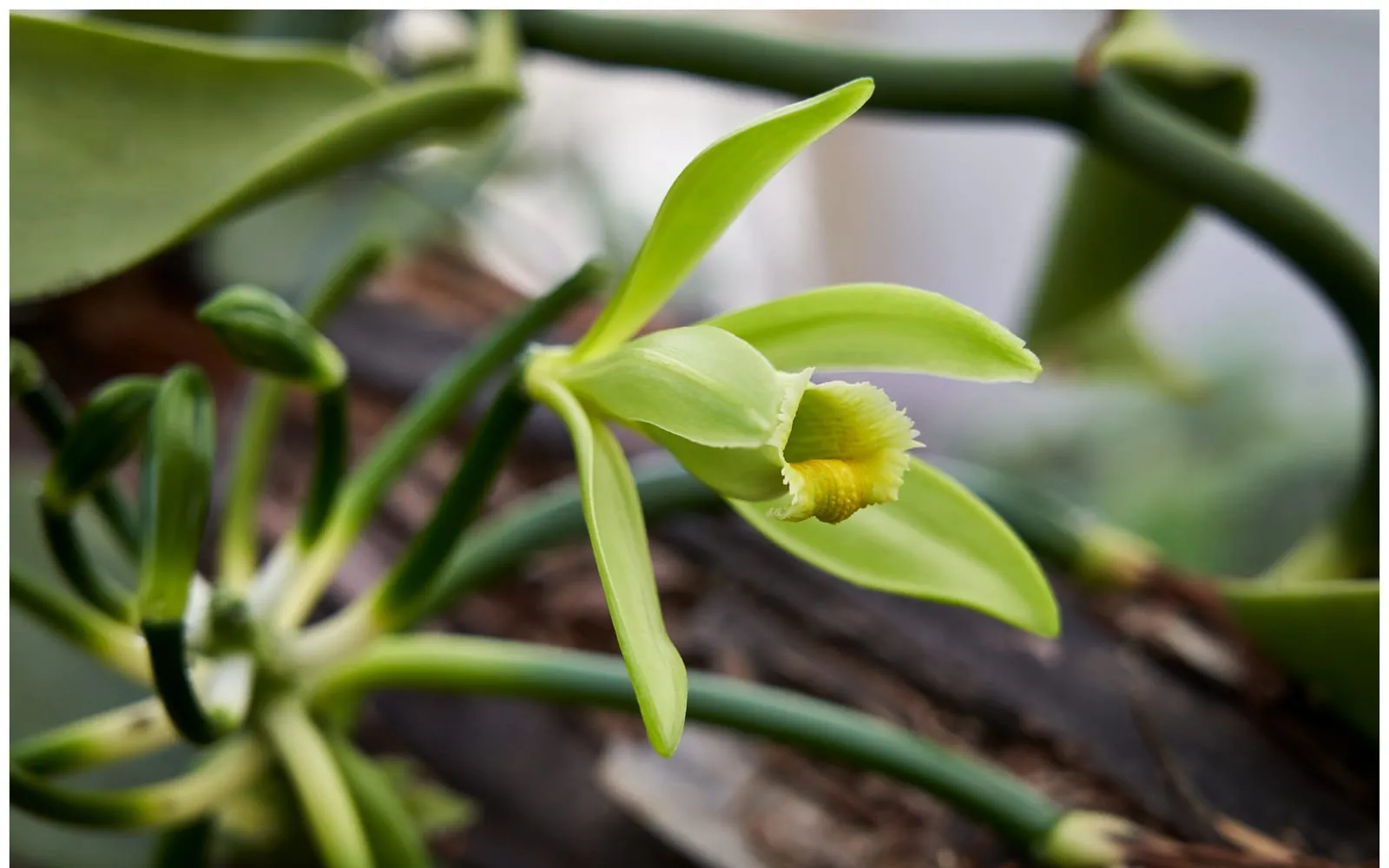
Flowers open on short spikes from the leaf axils, greenish-yellow, 5 to 8 cm across, with the trumpet-shaped lip typical of an orchid. Each opens in the morning and closes by afternoon, and it is finished by evening.
Pods follow only on pollinated flowers, hanging in bunches, green and slender, 15 to 25 cm long, taking eight or nine months to mature.
The green pod smells of nothing. The vanilla aroma develops during curing.
Where it is from
Vanilla is native to the tropical forests of eastern Mexico and Central America, where it grows as a vine up trees.
The Totonac people of Veracruz cultivated it first, and the Aztecs took it as tribute and used it to flavour chocolate. Spanish colonists carried it to Europe in the sixteenth century.
For three hundred years it could only be grown in Mexico. Cuttings planted elsewhere grew well and never fruited, because the Melipona bee that pollinates it lives only in Mexico, and nobody understood the mechanism.
Edmond Albius solved it. Working on a plantation on Reunion in 1841, aged twelve and enslaved, he devised the method of lifting the rostellum with a thin sliver and pressing anther to stigma. That single technique created the world vanilla industry, and he died in poverty.
Madagascar is now the dominant producer, and its crop is still called Bourbon vanilla after the old name for Reunion. Indonesia, Uganda and Mexico supply most of the rest, and prices swing violently with Madagascan cyclones.
How it grows
Start from a cutting. A stem cutting of four or five nodes, taken from a mature vine, roots readily in warm humid conditions.
Plant into a very open orchid mix or coarse bark rather than compost. This is an epiphyte and ordinary potting compost will rot the roots.
Give it something to climb. A moss pole, a slab of bark or a wire frame all work, and the aerial roots need something to grip.
Grow it in a heated greenhouse or conservatory at a minimum of 15 deg C, and preferably 25 to 30 deg C.
Keep the humidity very high, at 80 per cent or more. This is the requirement that defeats most attempts.
Give bright indirect light or dappled shade. Direct sun scorches the leaves.
Water two or three times a week, drenching the roots and letting them drain and dry between times.
Wait three years and let the vine reach several metres before expecting flowers. A short vine will not flower.
Pollinate by hand on the morning a flower opens. Use a cocktail stick to lift the flap separating anther from stigma, and press them together.
Harvest pods after eight or nine months, when the tip starts to yellow.
Cure them, which takes weeks. Blanch in hot water, then sweat wrapped in cloth in a warm box each day and dry in the sun by day, over three to six months.
Through the seasons
Winter is survival under glass above 15 deg C with high humidity. Water less and expect little growth.
Spring brings new growth from March. Repot, take cuttings and start feeding.
Late spring is flowering season on a mature vine, and it needs daily attention, since each flower lasts one morning.
Summer is when the pods develop on pollinated flowers, and when the vine makes most of its growth.
Autumn is continued pod development. Reduce feeding.
Late winter to early spring is when pods harvested from a spring flowering finally ripen, eight or nine months on.
Care difficulty
Difficult, and the hardest thing in this wave to bring to a harvest.
Humidity is the first barrier. Vanilla wants 80 per cent or more, which is higher than almost any other plant here, and it declines steadily in dry air.
Heat is the second. Minimum 15 deg C and preferably 25 to 30 deg C, year round.
The growing medium is the third and it catches people out. This is an epiphytic orchid, and ordinary potting compost holds too much water and rots the roots. Use coarse bark or an orchid mix.
Flowering needs a mature vine several metres long and three years old. A young plant will not flower whatever you do.
Pollination has to be done by hand, on the morning each flower opens, one at a time.
Curing takes months and needs daily attention. Very few people outside the tropics get that far, and the plant is worth growing as a striking foliage climber regardless.
Watering
Water two or three times a week, drenching the roots so water runs through, then letting them dry before the next watering.
Never let the roots sit wet. That is the fastest way to kill an epiphytic orchid.
Use tepid rainwater rather than hard tap water.
Keep the humidity very high with misting, damp gravel, a humidifier or a wet greenhouse floor. Humidity does more than watering for this plant.
Mist the aerial roots as well as the compost, since they take up moisture from the air.
Reduce watering slightly in winter without letting the plant dry out.
Warning signs, diseases and pests
Root rot is the main killer and it comes from an unsuitable growing medium. Use coarse bark or an orchid mix, never ordinary compost.
Shrivelled stems mean too little humidity or too little water at the roots.
Yellowing leaves that drop mean cold or wet roots.
Scale insects appear on the stems as brown limpets with sticky honeydew below.
Mealybug hides in the leaf axils as white waxy fluff.
Spider mite takes hold in dry heated air.
No flowers on a vine under three years old, or under three metres long, is normal rather than a fault.
Pods that yellow and drop early were not properly pollinated or the plant was stressed.
Growing environment
A heated humid greenhouse. A conservatory works if the humidity can be kept up, and an ordinary room cannot.
Minimum 15 deg C and preferably 25 to 30 deg C.
Humidity of 80 per cent or more, which is the single hardest condition to provide.
Bright indirect light or dappled shade, never direct sun through glass.
A very open orchid mix or coarse bark, in a pot with a support to climb.
pH around 6 to 7.
Room to climb. The vine wants several metres of run before it will flower, so a long wire or a wall of bark is more use than a short pole.
Feeding
Feed a dilute orchid feed fortnightly from May to August. Ordinary plant food at full strength will scorch the roots.
Alternate a balanced feed with a high-potash one, which suits a plant being grown towards flowering.
Feed at quarter to half the strength recommended on the bottle.
Stop feeding from September and give nothing through the winter.
Refresh the bark or orchid mix every second year, since it breaks down and starts holding water.
Troubleshooting
Why does vanilla cost so much? Every flower is pollinated by hand, on the one morning it opens. Pods then take eight or nine months to mature and several months to cure. It is one of the most labour-intensive crops in the world.
Who worked out how to pollinate it? Edmond Albius, a twelve-year-old enslaved boy on Reunion, in 1841. His method of lifting the flap with a sliver and pressing anther to stigma is still what is used everywhere today.
It has never flowered. The vine needs to be about three years old and several metres long. A short young plant will not flower whatever the conditions.
The roots rotted. Almost certainly the growing medium. Vanilla is an epiphytic orchid and ordinary potting compost holds far too much water. Use coarse bark or an orchid mix.
Can I grow it as a houseplant? As a foliage climber in a very humid warm room, yes. Flowering and fruiting need a heated greenhouse.
The green pod smells of nothing. Correct. Vanilla aroma develops during curing, not on the plant. Blanching, sweating and drying over several months is what creates it.
How do I pollinate it? On the morning the flower opens, use a cocktail stick to lift the flap between anther and stigma and press them together. It takes a few seconds per flower and cannot be left until the afternoon.