
Outdoor plant
Panicle Hydrangea
Hydrangea paniculata
Also known as Peegee Hydrangea
How to grow panicle hydrangea, Hydrangea paniculata. Why its colour change is about flower age rather than soil pH, and the trade-off between a hard prune for fewer, larger flower heads and a light one for more, smaller ones.
At a glance
- Difficulty
- Easy
- Water
- Regularly while establishing, then during dry spells once mature
- Light
- Full sun to part shade
- Temperature
- Fully hardy
- Hardiness
- USDA 3-8, RHS H6, hardy to -30 C
- Type
- Deciduous shrub or small tree, living several decades
- Height
- 2-5 m, or trained as a small standard tree
- Native to
- eastern Asia
Among the hardiest hydrangeas grown, surviving winters that kill other species outright without any special protection. That toughness has a mechanical cause rather than a genetic one: it sets its flowers on the current year's growth, so a severe winter that kills the previous year's stems back to the ground still leaves a plant that flowers normally that summer.
Hardiness zones describe winter cold alone. Summer heat, humidity, rainfall and the length of the growing season decide as much, so treat the range as the outer limit rather than as a recommendation.
Toxic if eaten
- Do not eat
- The leaves, flower buds and bark
- Harm from
- Eating it and handling it
- Affects
- People, cats, dogs and horses
Hydrangea carries cyanogenic glycosides, which release cyanide when the plant material is chewed and digested. In practice poisoning is uncommon, since an animal would need to eat a considerable amount and the taste discourages it, but the signs when it happens are vomiting, stomach pain, diarrhoea and lethargy, and in a serious case rapid breathing and collapse. Dogs and horses are the usual cases, horses particularly where a shrub overhangs a fence into a paddock. Children are drawn to the large flower heads, and a mouthful of florets is a reason to call for advice rather than panic. The more frequent complaint by a wide margin is a skin one: the sap causes contact dermatitis in people who prune hydrangeas regularly, with itching and small blisters on the fingers, and it is a familiar nuisance to anyone who cuts them back often. Wear gloves to prune. Dried flower heads used indoors in arrangements retain the compounds, so they are not a safe substitute in a home with a chewing pet, and cut branches should never be thrown over a paddock fence.
Sources: RHS potentially harmful garden plants, ASPCA (Hydrangea)
About
Panicle hydrangea is one of the hardiest hydrangeas and flowers on new wood. That makes it more reliable in cold gardens than mophead hydrangeas, whose flower buds are formed the previous year and can be lost to frost or bad pruning.
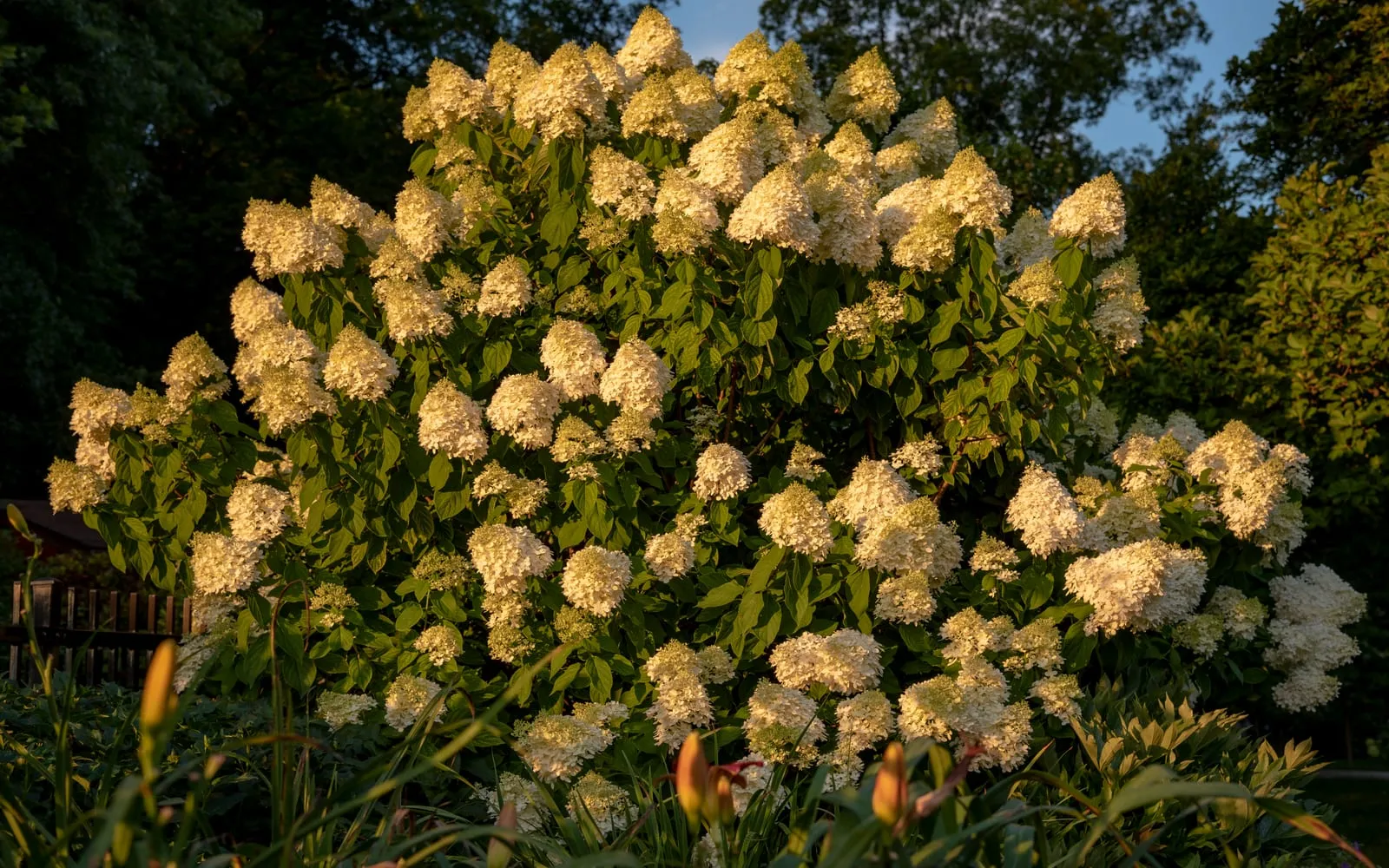
Its cone-shaped flower heads open white in summer and age towards pink or rose. The colour change is part of normal ageing, not a response to soil pH. Pruning controls the size of the shrub and the size of the flower heads.
Appearance and character
Leaves are oval to elliptic, 7 to 15 cm, mid-green with finely toothed edges, unremarkable in themselves and mostly a backdrop to the flowers.
Flower heads are large, cone-shaped panicles up to 30 cm long, tapering to a point rather than the flat or ball-shaped heads of other hydrangeas. They open pure white in mid to late summer and age gradually through pale pink to a dusky rose as autumn approaches, often holding their shape and colour on the plant well into winter if left uncut.
Growth is upright and vigorous, forming a rounded, deciduous shrub 2 to 5 m depending on the cultivar and how hard it is pruned, and it can also be trained with a single clear stem into a small standard tree, a form particularly popular for cultivars with especially large flower heads.
Bark on older stems is reddish brown and peels in thin, papery strips, adding a small amount of winter interest once the leaves and flowers have gone.
Where it is from
Hydrangea paniculata is native to eastern Asia, including Japan, China and parts of Russia’s Far East, growing in woodland edges and along streams across a climate that includes properly severe winters, which accounts for the exceptional cold hardiness the species carries into cultivation.
Wild plants and the many named cultivars bred from them share the same underlying trait: flowering on new wood, which in the wild lets the species recover reliably from the hard winters common across its native range, regrowing and flowering the following summer regardless of how far the previous year’s stems were cut back by cold.
How it grows
Plant in moist, fertile, well-drained soil in full sun or part shade. It tolerates a wide pH range without the colour changes that affect mophead hydrangeas, so soil chemistry is not something to manage here.
Prune hard in late winter or very early spring, before growth starts, cutting back to a low framework of permanent branches, typically to within a few buds of the previous year’s growth. Because flowers form on the new growth that follows, this hard prune produces fewer but noticeably larger flower heads; a lighter prune produces more numerous but smaller heads, which is a genuine trade-off gardeners can choose between rather than a rule with only one right answer.
Water well for the first two seasons while the root system establishes, and mulch in spring to help retain soil moisture through summer, since the large flower heads and broad leaves both draw on a lot of water.
Deadhead spent flower heads in late winter, just before the hard prune, rather than immediately after flowering, since the ageing, colouring heads remain attractive through autumn and much of winter.
Through the seasons
Late winter is for the main prune, cutting back to the permanent framework before new growth starts, and for removing the previous season’s flower heads.
Spring brings vigorous new growth, on which the whole summer’s flowering depends. Mulch and feed as growth resumes.
Summer brings the main flowering display, opening white and holding through much of the season.
Autumn brings the slow colour change from white through pink to rose, often the most striking phase of the display, and the flowers frequently hold well into the start of winter if left uncut.
Care difficulty
Easy, and one of the more reliable flowering shrubs for a properly cold garden. Because it flowers on new wood, there is none of the anxiety that comes with other hydrangeas over whether a hard winter or a mistimed prune has removed the coming season’s flowers; it regrows and flowers regardless. The main skill involved is choosing how hard to prune each year, which affects flower size and shrub size rather than whether it flowers at all.
Watering
Water regularly through the first two growing seasons while the plant establishes, a deep soak rather than light, frequent watering.
Once established, water during any extended dry spell, particularly while flower heads are developing in summer, since the broad leaves wilt visibly in drought and the flower heads can be smaller and shorter lived if the plant is stressed for water at that stage.
Mulching in spring helps retain soil moisture through the summer months and reduces how often supplementary watering is needed on all but the driest soils.
Warning signs, diseases and pests
Aphids cluster on soft new growth in spring, distorting the shoot tips. They rarely need treatment beyond a strong jet of water and are usually brought under control by natural predators within a few weeks.
Powdery mildew shows as a white, dusty coating on the leaves in still, humid conditions with poor air movement. Space plants to allow airflow and avoid overhead watering, which wets the foliage and encourages it.
Leaf scorch appears as browning at the leaf margins in strong sun combined with dry soil, and is a watering and siting issue rather than a disease. Improve watering during hot spells and consider light afternoon shade if it recurs.
Growing environment
Full sun produces the strongest flowering, though it tolerates part shade well, particularly useful in a hot climate where some afternoon shade reduces stress on the leaves and flowers.
Fully hardy, and untroubled by even a severe winter given that it flowers on the following season’s new growth rather than on wood that needs to survive the cold intact.
Moist, fertile, well-drained soil suits it best. It tolerates both slightly acid and slightly alkaline soils without any effect on flower colour, unlike a mophead hydrangea.
Shelter from strong wind helps the largest-flowered cultivars, whose heavy heads can be top-heavy enough to bend or snap unsupported stems in exposed positions.
Feeding
Apply a balanced, general-purpose fertiliser in spring as growth resumes, following the product’s guidance for a flowering shrub.
A mulch of well-rotted compost or manure applied at the same time supplies additional general fertility and helps retain the soil moisture the plant needs through summer.
There is no need for the aluminium sulphate or lime treatments used to shift mophead hydrangea flower colour, since panicle hydrangea’s white flowers are not pH-dependent.
Troubleshooting
The flowers are smaller than in previous years. Usually pruning or water. A harder prune the previous winter produces fewer, larger heads, while a lighter prune produces more numerous, smaller ones; check whether your pruning approach changed, and also check the plant is not short of water while the heads are developing in summer.
It survived a severe winter with dieback but still flowered well. That is expected rather than a surprise. Because flowering happens on new wood, winter dieback of old stems has little effect on that summer’s display, provided the roots survived, which for an established plant of this species they generally do.
Can I change the flower colour like a mophead hydrangea? No. Panicle hydrangea’s white-to-pink colour change is driven by the age of the flower rather than by soil pH, so aluminium sulphate or lime treatments used on mophead hydrangeas have no effect here.
When exactly should I prune? Late winter to very early spring, before new growth starts, is the standard timing. Pruning too late, after growth has begun, wastes some of the energy already put into that growth and can delay flowering slightly.
Can it be grown as a small tree rather than a shrub? Yes, and many nurseries sell it already trained this way, with a single clear stem topped by a rounded head. It needs the same annual hard prune to the head to keep flower size good, just applied above the clear stem rather than at ground level.