
Outdoor plant
Bloody cranesbill
Geranium sanguineum
Also known as Bloody crane's-bill, Hardy geranium, Blood-red geranium
How to grow Geranium sanguineum. A native hardy geranium for hot dry ground, the shear that brings a second flush, and telling a true geranium from a pelargonium.
At a glance
- Difficulty
- Easy
- Water
- Rarely once established
- Light
- Full sun to light shade
- Temperature
- Very hardy, to -25 deg C
- Hardiness
- USDA 4-8, RHS H7, hardy to -30 C
- Type
- Herbaceous perennial, clump-forming and long-lived
- Height
- 20-30 cm, spreading to 50 cm
- Native to
- Europe and western Asia, including native Britain
- Best month
- June in the Northern Hemisphere, December in the Southern Hemisphere
Poor thin alkaline soil and full sun suit it, and rich damp ground gives soft growth that flops. It takes drought, cold and coastal exposure without complaint, and the only thing it dislikes is winter wet at the crown. Cut the whole plant back after the main flush and it makes fresh leaves and a second flowering.
Hardiness zones describe winter cold alone. Summer heat, humidity, rainfall and the length of the growing season decide as much, so treat the range as the outer limit rather than as a recommendation.
Every month named in this guide is for the temperate Northern Hemisphere. If you garden in the Southern Hemisphere, shift each one by six months, so June becomes December. Closer to the equator the wet and dry seasons matter more than the calendar, and the shift stops being a useful guide.
Not known to be toxic
Non-toxic. The ASPCA lists Geranium among plants that are not harmful to cats, dogs or horses, and the RHS does not include hardy geraniums in its list of potentially harmful garden plants. Leaves, flowers and roots present no poisoning risk, and the flowers are occasionally used to decorate salads. A point of naming causes genuine confusion and is worth separating out. The bedding plants sold as geraniums, with rounded scented leaves and heads of red or pink flowers, are Pelargonium rather than Geranium, and the ASPCA does list Pelargonium as toxic to cats and dogs through geraniol and linalool, causing vomiting and skin irritation. So the answer to whether a geranium is safe around a cat depends entirely on which plant is meant. A true hardy geranium such as this one, growing outdoors in a border with five-petalled flowers and deeply cut leaves, is harmless. A pelargonium in a pot on the windowsill is not. Buy by botanical name and the ambiguity disappears.
Sources: ASPCA toxic and non-toxic plants, RHS potentially harmful garden plants
About
Hardy geraniums are the workhorses of a temperate border and this is the one for the hard places. Bloody cranesbill grows on limestone pavement and coastal dunes in the wild, which means it will take a hot dry bank, a gravel garden or the thin soil at the foot of a wall without complaint.
It flowers for months. Magenta saucers open in June and keep coming into September, over a low hummock of finely cut leaves that turns red in autumn.
It is also a British native, which is unusual among the hardy geraniums people plant, and it supports bees from June onward at a point in the year when a lot of spring planting has finished.
Appearance and character
A low spreading herbaceous perennial forming a dense hummock 20 to 30 cm high and up to 50 cm across.
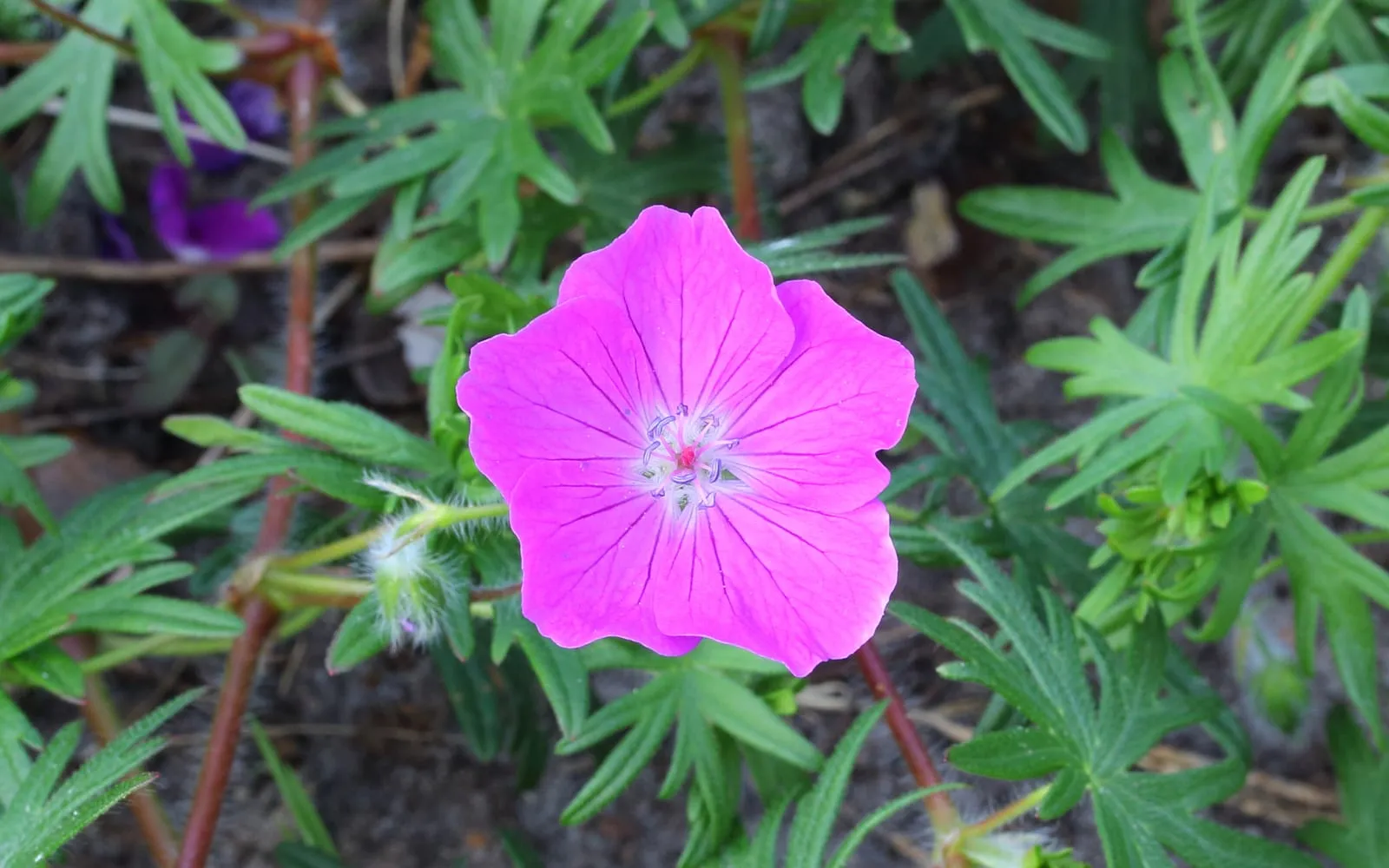
Leaves are the family signature. Rounded in outline but deeply divided almost to the base into five or seven narrow lobes, each cut again, giving a fine lacy texture. They colour red and orange in autumn.
Flowers open from June to September, 3 to 4 cm across, with five rounded petals in a strong magenta-crimson, veined more darkly and notched at the tip.
The name is about the leaves rather than the flowers. Sanguineum means blood-red and refers to the autumn colour, not the bloom.
Seed pods are the other family signature. Each is a long beak, hence cranesbill, which dries and springs open to fling the seed several metres.
Common forms include ‘Album’, which is white, ‘Max Frei’, compact and deep magenta, and var. striatum is pale pink with darker veins and is the form found wild on Walney Island in Cumbria.
Where it is from
Europe and western Asia, including Britain, where it is native and grows on limestone pavement, coastal dunes, sea cliffs and dry grassland.
Its strongholds here are the limestone of Cumbria, north Wales and the Burren, along with sandy coasts. It is a plant of thin, sharply drained, alkaline ground in full exposure.
That habitat is the whole explanation for the garden performance. Poor soil, drought, wind and salt are what it evolved for, and rich moist ground produces a softer, floppier, shorter-lived plant.
The genus Geranium contains around 400 species and roughly a dozen are widely grown, including ‘Rozanne’, which is probably the most-planted perennial in Britain and which flowers even longer than this one.
Cranesbills are wholly distinct from the tender South African Pelargonium sold as bedding geraniums, despite sharing an old genus name and a beaked seed pod.
How it grows
Plant in autumn or spring into any free-draining soil, in full sun or light shade.
Space plants 40 to 45 cm apart. They knit together into weed-suppressing ground cover within two years.
Shear the whole plant back hard when the first flush of flowers begins to fade, usually in late July. Cut it to within a few centimetres of the ground. It looks brutal, and within three weeks there is a fresh mound of clean leaves and a second flush of flowers that runs to September.
That single job is the difference between a hardy geranium that looks good all season and one that goes bare and tired in the middle by August.
Deadheading individual flowers is unnecessary and not worth the time.
Divide in spring or autumn every four or five years, which is the easiest way to increase it.
Cut the old foliage away in late winter, or leave it as frost protection and clear it in March.
The plant is long-lived and needs no other attention.
Through the seasons
Winter is dormancy. The plant dies back to a woody crown. Clear old growth in late winter.
Spring brings the leaves through in April, forming the mound. Divide or plant now, and mulch on poor ground.
Summer is the main display, opening in June. Shear the plant hard in late July for a second flush.
Autumn brings the second flowering into September and then the leaf colour, which turns red and orange before the plant dies back.
Care difficulty
Easy, and among the most reliable perennials available. It withstands drought, cold, wind, salt, poor soil and neglect.
The July shear is the only real technique, and skipping it costs appearance rather than health.
Waterlogged winter ground is the one condition that kills it.
Powdery mildew appears in a very dry summer and the shear removes it.
There is essentially no pest or disease worth planning for.
Watering
Established plants need no watering. Bloody cranesbill copes with real drought.
Water new plantings through their first summer.
Water once after the July shear to speed the regrowth, which is the only watering that materially helps.
Avoid waterlogged ground, particularly over winter, which rots the crown.
Container plants need regular summer watering and free-draining compost with added grit.
Warning signs, diseases and pests
Going bare and open in the middle by August is the commonest complaint and it is a maintenance matter rather than a disease. Shear the whole plant to a few centimetres in late July and it regrows a clean mound with a second flush of flowers.
Powdery mildew coats the leaves in white in a hot dry summer, usually just as the first flush finishes. The shear removes it entirely.
Soft rotting crowns in late winter mean the ground is too wet. Add grit, or plant on a slope or raised bed.
Vine weevil grubs eat the roots of container-grown plants and cause sudden collapse. Check the rootball when repotting.
Very floppy growth with few flowers usually means the soil is too rich or the position too shaded.
Leaves scorching in high summer point to drought on very thin soil, and the plant recovers after the shear.
Slugs occasionally graze the emerging spring growth without doing real damage.
Growing environment
Full sun gives the heaviest flowering. Light shade is tolerated with a looser habit and fewer blooms.
Any free-draining soil, and it performs best on poor thin ground. Chalk and limestone suit it particularly well.
A hot dry bank, a gravel garden, the front of a sunny border, the top of a retaining wall and the base of a south-facing wall are all ideal positions.
Coastal gardens suit it, since it stands salt wind without damage.
Avoid heavy wet clay and deep shade.
It works well as ground cover under roses and shrubs, where it suppresses weeds and covers bare stems.
No staking or shelter is required.
Feeding
Bloody cranesbill needs no feeding and flowers better without it.
A light mulch of compost in spring is enough on very poor ground.
Avoid rich or high-nitrogen feeding, which produces lax growth and fewer flowers.
Division every four or five years does more for a tired clump than any fertiliser.
Container plants need a slow-release feed in spring and free-draining compost.
Troubleshooting
It has gone bare in the middle and stopped flowering. Shear the whole plant to within a few centimetres of the ground in late July. It regrows a fresh mound and flowers again into September.
Is this the same as the geraniums I buy for pots? No. Those are Pelargonium, which are tender South African plants and are toxic to cats and dogs. Hardy geraniums like this one are frost-hardy perennials and are non-toxic.
White powdery coating on the leaves. Powdery mildew after a dry spell. The July shear removes it.
The crown rotted over winter. Waterlogged ground. Add grit, or move it to a raised bed or a slope.
Will it grow on chalk? Yes, and better than on most soils. It grows wild on limestone pavement.
Does it need deadheading? No. Shear the whole plant once in July instead, which is far quicker and more effective.
How do I get more plants? Divide the clump in spring or autumn. It splits easily and every piece grows.
Which hardy geranium flowers longest? ‘Rozanne’ runs from June to the frosts without a break, and it is a sprawler rather than a neat hummock like this one.