
Outdoor plant
Houpo Magnolia
Magnolia officinalis
Also known as Hou po, Magnolia bark tree
How to grow Magnolia officinalis, a large-leaved deciduous magnolia. Leaves to forty centimetres, cream flowers in May, and a tree extinct in the wild in China.
At a glance
- Difficulty
- Moderate
- Water
- Through the first three summers, then in dry spells
- Light
- Full sun to light shade, sheltered from wind
- Temperature
- Hardy to about minus 20 deg C
- Hardiness
- USDA 5-8, RHS H6, hardy to -20 C
- Type
- Deciduous tree
- Height
- 15-20 m
- Native to
- the mountains of central and southern China
- Best month
- April in the Northern Hemisphere, October in the Southern Hemisphere
Hardy to -20 deg C and slow, taking fifteen to twenty years before the bark is worth stripping, and stripping it kills the tree. That is why the species is now grown in plantations across China rather than cut from the wild. Deep moist soil and shelter from wind suit it.
Hardiness zones describe winter cold alone. Summer heat, humidity, rainfall and the length of the growing season decide as much, so treat the range as the outer limit rather than as a recommendation.
Every month named in this guide is for the temperate Northern Hemisphere. If you garden in the Southern Hemisphere, shift each one by six months, so April becomes October. Closer to the equator the wet and dry seasons matter more than the calendar, and the shift stops being a useful guide.
Harmful if eaten
- Do not eat
- The bark, which is a strong preparation rather than a food
- Harm from
- Eating it
- Affects
- People
The bark is the part with a medicinal history, used in Chinese practice under the name hou po, and it contains magnolol and honokiol. The tree does not appear on the RHS list of potentially harmful garden plants, and the ASPCA does not list it among plants toxic to dogs, cats or horses. Magnolias are not a group with a record of poisoning in gardens, and this one is a large ornamental tree with no hazard to a child or a dog. The caution belongs to supplements rather than to the tree: magnolia bark extracts are documented as sedative, so combining one with alcohol or with prescribed sedatives is a question for a GP rather than for guesswork. There is no reason for anyone to be stripping bark from a garden specimen, and doing so would damage a tree that is functionally extinct in the wild.
Sources: RHS potentially harmful garden plants, ASPCA toxic and non-toxic plants, NHS on herbal medicines, LiverTox, Chinese and other Asian herbal medicines
About
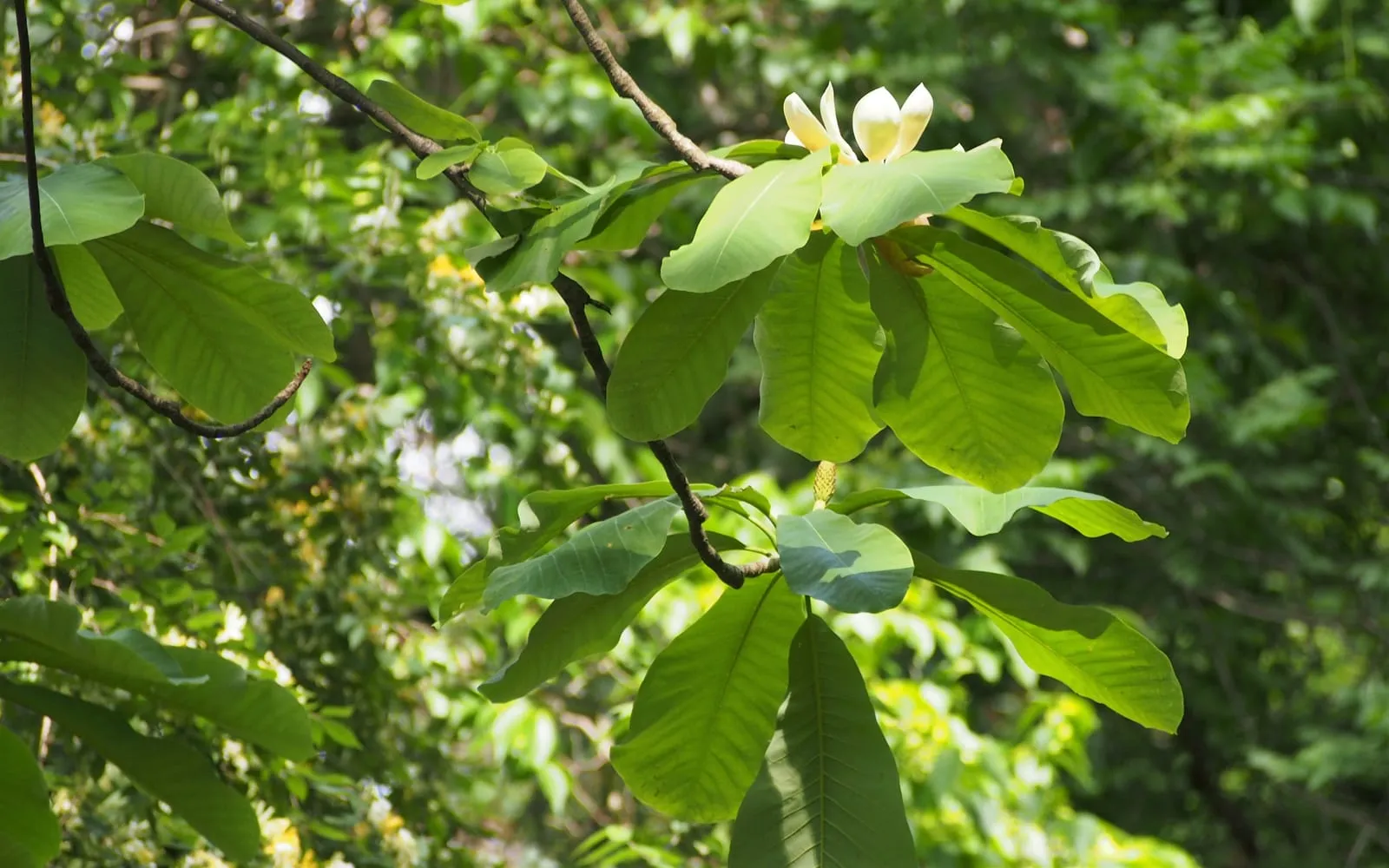
Magnolia officinalis is grown for foliage rather than for flowers, which is unusual in the genus. The leaves reach 40 cm long and are held in whorled clusters at the ends of the shoots, so a mature tree in summer has a bold almost tropical presence that no other hardy magnolia offers.
The flowers, when they come, are worth waiting for. Large creamy-white cups 15 to 20 cm across open in May after the leaves, sweetly scented, held upright at the shoot tips. A tree flowers from about ten years old and does so unpredictably in a cool climate.
The bark is the reason the species has a name meaning of the shops. Hou po has been a major item in Chinese medicine for two thousand years, harvested by stripping the bark from trees of fifteen to twenty years, and that harvest is why the species is now regarded as extinct or nearly so in the wild, surviving in cultivation and in planted stands.
Appearance and character
The leaves are the identifying feature. Each is obovate, 20 to 40 cm long and up to 20 cm wide, with a rounded or slightly notched tip, thin-textured, matt green above and grey-downy beneath, clustered in rosettes at the shoot tips.
Bark on young wood is smooth and grey. On older trunks it thickens and becomes rough and furrowed, and it is strongly aromatic when cut, with a spicy scent that carries.
Flowers open in May after the leaves, creamy white, cup-shaped, 15 to 20 cm across, with nine to twelve thick fleshy tepals and a strong sweet fragrance. They are followed by the cone-like fruit typical of the genus, which splits to release orange-red seeds on fine threads.
Where it is from
The species is native to the mountains of central and southern China, in Sichuan, Hubei, Guizhou and neighbouring provinces, in moist mixed forest between 300 and 1500 m. Those are humid summers with high rainfall and cold winters.
Wild populations have gone. Centuries of bark harvest, which kills the tree, combined with forest clearance, have left the species dependent on cultivation, and most material in the herb trade now comes from planted stands. The variety biloba, with a notched leaf tip, is treated as the same species by most authorities.
It is grown in larger gardens and arboreta and is hardy through most temperate winters. It is not common in the trade and is worth seeking out from a specialist magnolia nursery.
How it grows
Growth is moderately fast when young in good conditions, and a tree reaches eight to ten metres in twenty years. The habit is upright at first and becomes broader and more spreading with age.
Roots are fleshy, shallow and easily damaged, which is a family characteristic and has three consequences. The tree resents being moved once established, it dislikes cultivation around its base, and it needs watering in a drought for longer after planting than most trees.
Flowering begins at around ten years from a seedling and earlier on a grafted plant. Flowers open after the leaves, which protects them from the late frosts that ruin the early-flowering magnolias.
Through the seasons
Plant in April, which suits magnolias better than autumn planting because the fleshy roots establish in warming soil. Prepare a wide hole with plenty of organic matter, and mulch generously without piling material against the trunk.
Leaves come through in late April and May and the flowers follow in May. Growth continues through summer, and the leaves fall in October without much colour.
Water through the first three summers, which is longer than most trees need. Prune only to remove dead or crossing branches, in midsummer rather than winter, since magnolias bleed from winter cuts.
Care difficulty
Moderate, and the difficulties are all about siting. The tree needs shelter, deep moist soil and room, and it is difficult to correct any of those once it is in place.
Wind is the main enemy. A 40 cm leaf on a thin stalk shreds in exposure, and a tree in a windy garden looks tattered by July every year. A sheltered position in a woodland garden is what it wants.
The shallow fleshy roots need protecting. Do not cultivate under the tree, do not plant into its root zone, and mulch rather than digging. Damage to those roots shows as dieback in the crown two seasons later.
Watering
Water through the first three summers after planting, deeply and thoroughly. The shallow root system takes longer than most trees to establish and drought in those years does lasting damage.
An established tree on moisture-retentive soil manages most cool summers. In a prolonged drought it wilts and drops leaves, and a deep soak is worth giving.
A mulch of leaf mould or compost each spring, kept clear of the trunk, does more for the root zone than watering. Mulch each spring while the tree establishes.
Warning signs, diseases and pests
Honey fungus is the disease that kills magnolias, and this species has no particular resistance. A crown that thins and dies back, white fungal sheets under the bark at the base and black bootlaces in the soil are the signs, and there is no cure.
Coral spot colonises dead and damaged wood, showing as bright orange pustules, and it can move into live wood on a stressed tree. Prune out dead wood promptly and in summer rather than winter.
Scale insects settle on stems and branches. The commonest problem, though, is mechanical. Torn shredded leaves by midsummer mean the tree is too exposed, and the only real answer is shelter planting.
Growing environment
Full sun to light shade, in a sheltered position out of cold and drying winds. Shelter matters more for this tree than for almost any other hardy magnolia because of the leaf size.
Soil should be deep, moisture-retentive, rich in organic matter and neutral to slightly acid. It tolerates neutral soil and dislikes shallow chalk.
Hardiness is adequate rather than generous. The tree survives to about minus 20 deg C, and young growth can be caught by a late frost, so a frost pocket is a poor position.
Feeding
A mulch of leaf mould or garden compost each spring, spread wide and kept off the trunk. Magnolias respond to organic matter over the root zone more than to fertiliser.
On poor soil a balanced slow-release feed in spring supports a young tree. Avoid anything high in nitrogen, which produces soft growth that frost damages.
Never dig fertiliser in around the base. The fleshy roots sit close to the surface and damaging them costs more than any feed provides.
Troubleshooting
Why grow it if the flowers are unreliable? For the foliage. Leaves 40 cm long in whorled clusters give the tree a bold presence no other hardy magnolia matches, and the flowers are a bonus when they come.
Is it hardy? To about minus 20 deg C. It needs shelter from wind more than it needs protection from cold.
Why are the leaves torn and tattered? Wind. A leaf that size on a thin stalk shreds in exposure, and the only fix is a more sheltered position or a shelter planting around it.
When does it flower? May, after the leaves, from about ten years old. Coming after the foliage keeps the flowers clear of the late frosts that spoil the early magnolias.
Is it really extinct in the wild? In all but name. Centuries of bark harvest, which kills the tree, and forest clearance have left the species dependent on cultivated and planted stands in China.
Can I harvest the bark? No. Stripping bark kills the tree, and there is no reason to do it to a garden specimen of a species in this position.
When should I prune it? Midsummer, and only to remove dead or crossing branches. Magnolias bleed from winter cuts and resent hard pruning.