
Outdoor plant
Star Magnolia
Magnolia stellata
How to grow star magnolia, Magnolia stellata. Why a late frost can brown its open flowers within hours of a cold night, why it dislikes being moved once settled, and why its compact size suits an ordinary-sized garden.
At a glance
- Difficulty
- Easy
- Water
- Regularly while establishing, then during dry spells
- Light
- Full sun to light shade
- Temperature
- Fully hardy; spring flowers are frost-tender
- Hardiness
- USDA 4-8, RHS H6, hardy to -25 C
- Type
- Deciduous large shrub or small tree, living many decades
- Height
- Up to 5 m
- Native to
- Japan
Among the hardiest of the magnolias, tolerating a severe winter without damage to the woody framework. As with many early-flowering magnolias, the risk sits in spring rather than winter: it is one of the first trees to flower in the year, and a late frost after the buds open can brown the petals within hours, on wood that itself takes no lasting harm.
Hardiness zones describe winter cold alone. Summer heat, humidity, rainfall and the length of the growing season decide as much, so treat the range as the outer limit rather than as a recommendation.
Not known to be toxic
Magnolia is not listed as toxic by the ASPCA or the RHS, and no harmful compound is documented in the species. Extracts of magnolia bark have a history of use in traditional medicine and in some modern herbal supplements, but that is a matter of a prepared, concentrated extract taken deliberately, and it says nothing about the safety of a child or pet chewing a leaf, flower or twig in the garden, which causes no more than the mild stomach upset any fibrous plant material might. This is a tree you can plant close to a play area or a path without factoring toxicity into the decision.
Sources: RHS potentially harmful garden plants, ASPCA toxic and non-toxic plants
About
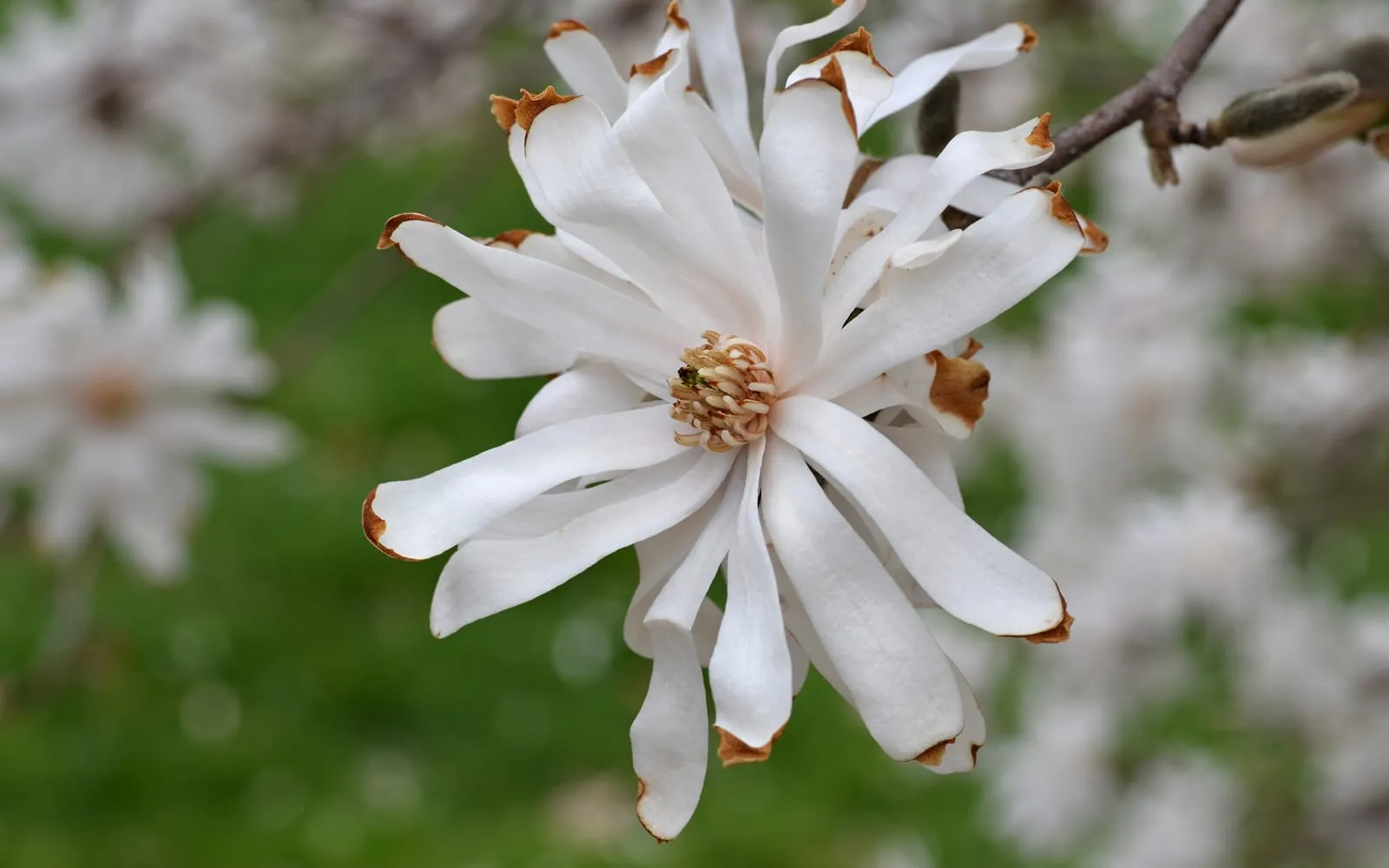
Star magnolia is a compact magnolia that flowers on bare branches in early spring, before the leaves open. The flowers have many narrow white tepals, which gives them a star-like shape rather than the broad cup of many other magnolias.
The wood is hardy, but the open flowers are vulnerable to late frost. In gardens where spring frosts are common, plant it away from frost pockets and accept that some years will have a shorter display.
Appearance and character
Leaves are narrowly obovate, 5 to 10 cm, noticeably smaller than most other magnolia species, mid-green through summer with no particular autumn colour to speak of, which is the trade-off for a tree grown primarily for a spectacular early spring flowering rather than for foliage interest.
Flowers are pure white, occasionally flushed pale pink in some cultivars, star-shaped with twelve to eighteen narrow petal-like tepals, opening in earliest spring before the leaves emerge and typically lasting two to three weeks if the weather stays mild.
Growth is compact and rounded compared with most magnolias, forming a dense, multi-stemmed shrub or small tree rarely exceeding 5 m, which makes it one of the few magnolias suited to a smaller garden.
Bark is smooth and silvery grey, with small, pale, raised lenticels, adding a modest amount of interest through the bare winter months before flowering begins.
Where it is from
Magnolia stellata is native to Japan, where it grows in wet, mountainous areas, often near streams and in boggy ground, a habitat that explains its preference for consistently moist soil in cultivation.
Wild populations are now considered vulnerable in parts of their native range, and the plant is far more familiar from cultivation than from the wild today, having been grown in gardens for well over a century and bred into numerous named cultivars selected for flower colour, size and hardiness.
How it grows
Plant in moist, fertile, well-drained soil, ideally neutral to slightly acidic, in a position sheltered from the coldest early spring winds and, where possible, from the earliest morning sun, which thaws frosted flowers too quickly and worsens the resulting damage.
Choose the planting site with some care, since magnolias in general dislike being moved once established, developing a root system that resents disturbance; a position chosen for the long term saves problems later.
Prune only to remove dead, damaged or crossing growth, and do so in summer after flowering rather than in winter, since winter pruning wounds are slow to heal on magnolias and more prone to dieback.
Mulch in spring with well-rotted organic matter to help retain the soil moisture the shallow, fleshy roots depend on, particularly through a dry summer.
Through the seasons
Late winter to early spring brings the main event: flowers opening on bare branches, often the first significant flowering tree of the year in a temperate garden.
Spring sees the leaves emerge as the flowers fade, and any light pruning of dead or damaged wood should wait until after this.
Summer is quiet leaf growth. Water during dry spells and mulch to retain moisture around the shallow roots.
Autumn brings unremarkable leaf colour and leaf fall, with little seasonal interest beyond the bare, silvery-barked framework that carries through winter.
Care difficulty
Easy, and one of the more compact, manageable magnolias for a garden of ordinary size. It needs little beyond a stable position chosen well the first time, consistent soil moisture, and shelter from the worst of a late spring frost. The one real source of disappointment is weather rather than care: an early flowering display is always at some risk from a cold snap, and no amount of good cultivation prevents that.
Watering
Water regularly through the first two to three growing seasons while the root system establishes, a deep soak rather than frequent light watering, since the shallow, fleshy roots dislike drying out repeatedly during this period.
Once established, water during any extended dry spell, particularly in a young or recently planted specimen, and maintain a mulch layer to help the soil hold moisture through summer with less need for supplementary watering.
Warning signs, diseases and pests
Magnolia scale is a large, soft, brown scale insect that can build up on the stems, excreting sticky honeydew that often attracts sooty mould. Treat with horticultural oil applied at the appropriate season for the pest’s life cycle, since timing affects how well it works.
Frost damage to open flowers is by far the most common issue, browning the delicate white petals within hours of a cold snap. There is no treatment once it happens; only siting and, for a young or particularly valued specimen, temporary fleece cover on a forecast frosty night during flowering can reduce it.
Honey fungus occasionally affects older or stressed trees, showing as gradual dieback and, eventually, fungal growth at the base near soil level. There is no reliable treatment once established.
Growing environment
Full sun to light shade suits it well; full sun generally produces the heaviest flowering, though light shade can help protect open flowers from scorching on an unusually warm early spring day.
Moist, fertile, well-drained soil is important, and it performs poorly on ground that dries out repeatedly or that stays waterlogged for long periods.
Shelter from strong wind and from the coldest early spring air helps protect the vulnerable open flowers, and a position out of the earliest direct morning sun reduces frost damage by allowing frosted petals to thaw more gradually.
A stable, permanent position matters more here than for many garden trees, since it establishes slowly after being moved and does best planted once and left undisturbed for the rest of its life.
Feeding
Apply a balanced, slow-release fertiliser in early spring as growth resumes, following the product’s guidance for a woody tree or shrub.
A mulch of well-rotted compost or leaf mould applied at the same time supplies additional general fertility and helps the soil retain the moisture the shallow roots depend on.
Avoid heavy feeding of an already well-established, healthy specimen, since excessive fertility encourages soft growth without improving flowering, which depends far more on light, shelter and weather than on nutrition.
Troubleshooting
The flowers turned brown within a day of opening. Frost, almost certainly, if a cold night followed. There is no recovery for that season’s flowers; for future springs, consider a more sheltered position or temporary fleece cover on forecast frosty nights during flowering.
It has not flowered well since I moved it. Transplanting stress. Like other magnolias, this species dislikes root disturbance and can take a year or more to settle and resume flowering well after being moved, which is the main argument for choosing its final position carefully the first time.
Sticky residue and black mould are appearing on the stems and nearby surfaces. Magnolia scale, most likely, excreting honeydew that sooty mould grows on. Treat the scale directly with horticultural oil at the recommended season rather than only cleaning off the mould.
How much space does it need? Less than most magnolias. Star magnolia rarely exceeds 5 m and often stays considerably smaller, making it one of the few species in the genus that fits an average-sized garden rather than a large one.
Can I grow it in a container? Yes, in a large pot with good drainage and a moisture-retentive compost, though it will need repotting into fresh compost every few years and grows and flowers somewhat more slowly than one planted in open ground.