
Outdoor plant
Maidenhair Tree
Ginkgo biloba
Also known as Ginkgo, Kew Tree
Practical guidance for growing maidenhair tree, Ginkgo biloba, including fan-shaped leaves, male and female trees, pest resistance, autumn colour, and seed toxicity.
At a glance
- Difficulty
- Easy
- Water
- Regularly while young and establishing; drought tolerant once mature
- Light
- Full sun
- Temperature
- Fully hardy across a wide range of climates
- Hardiness
- USDA 3-8, RHS H7, hardy to -35 C
- Type
- Deciduous, exceptionally long-lived tree
- Height
- 20-30 m over many decades, occasionally more
- Native to
- China
Hardy across an unusually wide band of climates for a single tree species, tolerating both severe winter cold and, once established, real summer heat and urban pollution that would stress most other large trees. What the zone range does not capture is soil chemistry: in alkaline soil far from its native range, a young tree can develop iron chlorosis, pale yellow leaves with green veins, even though the cold and heat either side of the growing season give it no trouble at all.
Hardiness zones describe winter cold alone. Summer heat, humidity, rainfall and the length of the growing season decide as much, so treat the range as the outer limit rather than as a recommendation.
Toxic if eaten
- Safe to eat
- Roasted seed kernel, eaten in small quantities in some East Asian cuisines
- Do not eat
- The fleshy outer seed coat, and raw or excessive seed kernels
- Harm from
- Eating it and handling it
- Affects
- People
Female trees produce a soft, fleshy-coated seed that smells strongly of rancid butter as it rots on the ground, and handling that flesh with bare skin causes an allergic contact dermatitis in many people, similar to a poison ivy reaction, from compounds related to those found in poison ivy sap. The kernel inside is eaten roasted in small quantities in some East Asian cooking traditions, but it contains a compound that interferes with vitamin B6 and can cause vomiting and, in a large enough quantity, seizures, a risk documented mainly in children who have eaten many raw or roasted seeds at once. Casual contact with fallen leaves carries no such risk; the hazard sits specifically in the seed coat and the kernel inside it. Cultivars sold for gardens and streets are almost always male, which avoids the fruit and its mess and smell entirely.
Sources: RHS potentially harmful garden plants, National Capital Poison Center
About
Maidenhair tree is the last surviving species in a lineage of trees that otherwise died out tens of millions of years ago, closer botanically to conifers than to any broadleaf tree despite its flat, fan-shaped leaves. It is separately either male or female, and only female trees produce the fleshy, foul-smelling seeds that give the species its reputation as a messy street tree, which is why almost every cultivar sold for gardens and paving is a named male clone.
Few trees match its combination of resilience and patience. It tolerates pests, disease, pollution and poor soil that would trouble most large trees, and in return needs very little beyond an initial few years of watering while it establishes a root system to match its eventual size.
Appearance and character
Leaves are fan-shaped and leathery, 5 to 10 cm across, with fine parallel veins running out from the base rather than the branching network most broadleaf trees show, a structure unchanged since long before flowering plants existed. Many leaves carry a shallow notch splitting the fan into two lobes, which is where the species name biloba comes from.
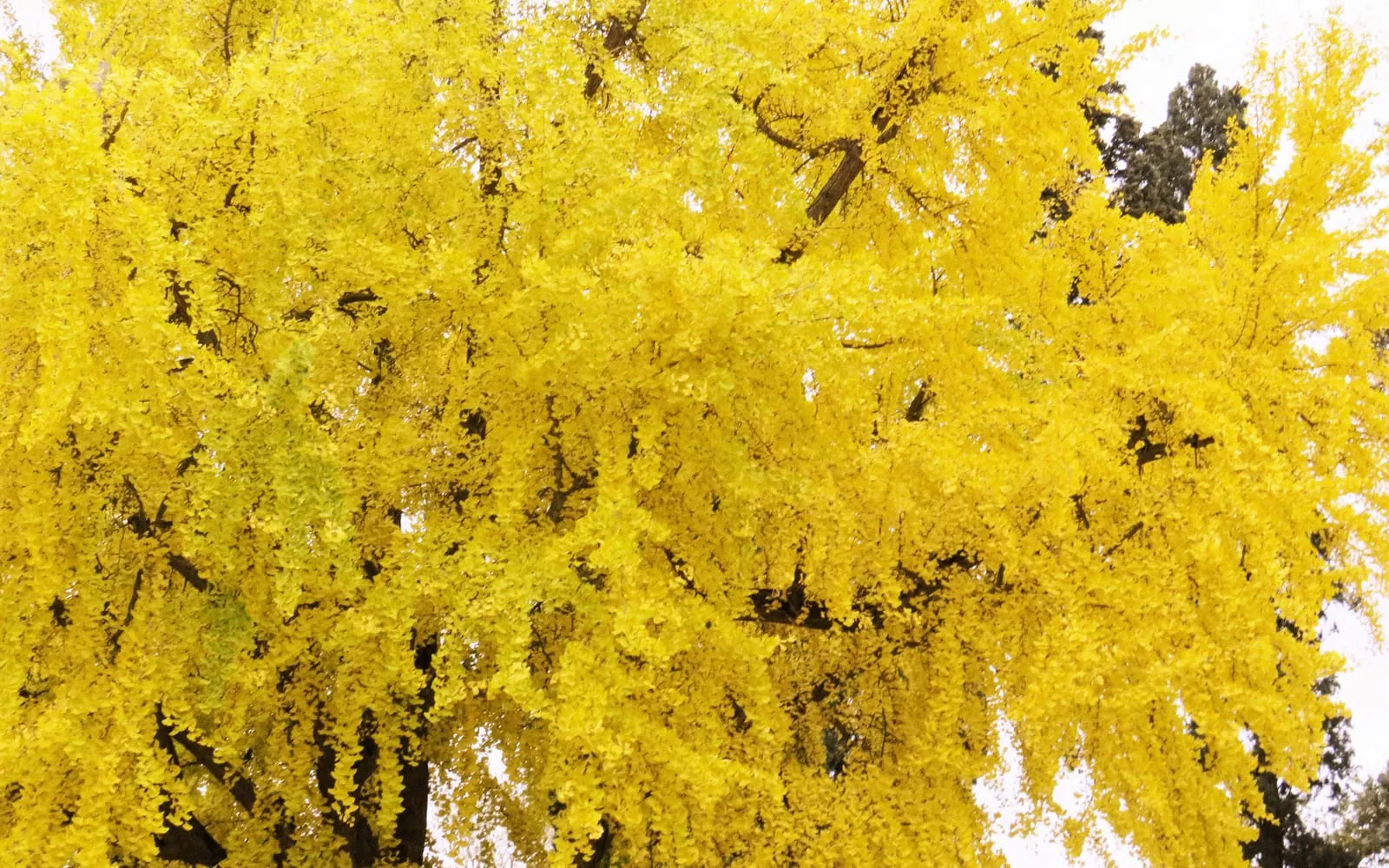
Autumn brings one of the most reliable, uniform colour displays of any large tree, every leaf on the canopy turning a clear, even gold within a narrow window of days before dropping in a single dramatic shed rather than straggling over weeks the way many trees do.
Young trees grow narrow and upright, almost columnar, and broaden gradually with age into a wider, more irregular crown that can eventually spread as wide as the tree is tall. Bark is grey and furrowed, thickening with age into a texture that helps the tree tolerate fire and pest damage that would kill a thinner-barked species.
Where it is from
Ginkgo biloba is native to China, where wild, self-sustaining populations now survive only in a small number of restricted mountain areas, most notably in Zhejiang province, and are considered endangered in the wild even though the species is common and thriving everywhere it has been planted by people. It has been cultivated around Buddhist and Confucian temples across East Asia for well over a thousand years, valued for its longevity and resistance to disease as much as for its appearance.
European botanists encountered it in Japanese temple gardens in the late seventeenth century and introduced it to European cultivation in the 1730s, and specimens planted in Britain not long after still stand today. The tree can live for centuries.
How it grows
Plant in any reasonably well-drained soil; Ginkgo is remarkably unfussy about soil type and tolerates the compacted, nutrient-poor conditions of an urban street verge better than almost any other large deciduous tree, provided drainage is adequate.
Choose a sunny position with enough room for its eventual width as well as its height, since a tree planted too close to a building or another large tree will need corrective pruning later that a wider spacing avoids entirely. If avoiding the female tree’s fruit matters, buy a named male cultivar rather than a seed-grown tree, since a seedling cannot be sexed until it is mature enough to flower, which can take twenty years or more.
Water regularly through the first two to three growing seasons while the root system establishes, then reduce watering as the tree becomes increasingly drought tolerant with age. Established trees rarely need supplemental water except in the most extreme, prolonged dry spells.
Pruning is rarely necessary beyond removing dead, damaged or crossing wood while the tree is young and shaping its framework, since a mature Ginkgo holds a naturally sound structure without the routine correction many faster-growing trees need.
Through the seasons
Spring brings fresh green leaves unfurling from the fan-shaped buds, along with small, inconspicuous flowers if the tree is old enough to flower, wind-pollinated and easy to miss.
Summer is steady growth. Water young trees through any extended dry spell; established trees generally need no attention at all.
Autumn brings the tree’s signature uniform gold colour change, followed by a dramatic, near-simultaneous leaf drop. Female trees of fruiting age also drop their fleshy, strong-smelling seeds around this time.
Winter is dormancy, showing the bare, structural form of an older tree, its furrowed bark and broadening crown a useful guide to how much room a young tree will eventually need.
Care difficulty
Easy, and among the lowest-maintenance large trees available once past its first few establishing years. It carries no serious pest or disease of note anywhere it is commonly grown, which is why individual specimens have survived for centuries under very different care regimes. The only real decisions come at planting: a male cultivar if fruit is unwanted, and enough space and drainage from the start.
Watering
Water young trees deeply and regularly through their first two to three growing seasons, particularly during any dry spell, while the root system establishes.
Once established, a Ginkgo tolerates real drought and generally needs no supplemental watering except in an unusually severe or prolonged dry period, when a deep, occasional soak does more good than frequent light watering.
Warning signs, diseases and pests
Root rot can develop in poorly drained or waterlogged ground, showing as yellowing foliage and stunted growth despite otherwise good care. Improving drainage before planting is far more effective than trying to correct it afterward, since Ginkgo has no particular tolerance for wet feet despite its resilience elsewhere.
Leaf scorch shows as browning along leaf edges in hot, dry wind, most often on a newly planted tree that has not yet built the root system to keep up with moisture loss through its leaves. Regular watering through the establishment period largely prevents it.
Transplant shock can follow moving an especially large or old tree, showing as slow, sparse leaf-out the following spring. Younger trees establish far more reliably after a move, which is one reason to plant a smaller specimen rather than the largest one available.
Nutrient deficiency, most often iron chlorosis in strongly alkaline soil, shows as pale yellow leaves with the veins still green. A chelated iron feed corrects it where soil pH cannot easily be changed.
Growing environment
Full sun brings out the best growth and the most even autumn colour, though a Ginkgo tolerates a good deal of shade without serious harm, growing more slowly and colouring less uniformly than one in open sun.
Soil adaptability is one of this species’ defining strengths. It performs well in compacted urban ground, tolerates air pollution better than most large trees, and is rarely troubled by the salt exposure that limits many street tree choices near roads that are gritted in winter.
Space it well clear of paths, patios and parking if a female tree is possible, since the fallen fruit is slippery underfoot and its smell is strong enough to be a genuine nuisance directly beneath the canopy in autumn.
Feeding
Established trees in reasonable soil generally need no feeding at all. A Ginkgo’s slow, steady growth habit means it rarely shows the kind of nutrient hunger that pushes a gardener toward regular fertilising.
A young tree can be given a balanced, slow-release fertiliser once in spring for its first few seasons to support establishment, but this is a help rather than a requirement, and over-feeding pushes soft growth without improving the tree’s long-term structure.
Troubleshooting
Why does my tree have foul-smelling fruit on the ground every autumn? It is a female tree of fruiting age. Female trees produce the fleshy seeds this species is notorious for; a male cultivar, grafted or grown from a cutting rather than from seed, avoids the problem entirely and is what most garden centres now sell for that reason.
The leaves are pale yellow with the veins still green. Iron chlorosis from alkaline soil, most common where a tree is planted in ground with a high pH far from what it would naturally root into. A chelated iron treatment applied to the soil or as a foliar feed usually greens the new growth within a season.
How long before my newly planted tree looks like a mature specimen? Considerably longer than most trees, since Ginkgo grows at a measured pace and a specimen usually needs several decades to develop the broad, spreading crown seen on old street and park trees. Growth in the first few years after planting is often the slowest part of the tree’s life.
Is it safe to plant near my house or a play area? Yes, as long as it is given room for its eventual width and, if avoiding fruit and its smell matters, is a known male cultivar rather than a seed-grown tree of unknown sex.
Can I eat the seeds? In small, occasional quantities and properly roasted, as is traditional in some East Asian cooking, most adults tolerate them without issue. Eating raw seeds, or eating many at once, carries a real risk of vomiting and, in children especially, seizures, so this is not a foraging opportunity to take lightly even where the fruit is abundant.