
Outdoor plant
Lily Magnolia
Magnolia liliiflora
Also known as Mulan Magnolia, Purple Magnolia, Woody Orchid
How to grow lily magnolia, Magnolia liliiflora, whose slim wine-purple flowers open late enough to escape frosts, and parent of the saucer magnolia.
At a glance
- Difficulty
- Easy
- Water
- Regularly while establishing, then in dry spells
- Light
- Full sun to light shade
- Temperature
- Hardy, and flowers late enough to usually miss the frosts
- Hardiness
- USDA 5-9, RHS H6, hardy to -20 C
- Type
- Deciduous shrub or small tree, living many decades
- Height
- Up to 4 m
- Native to
- China
The woody framework takes a hard winter without harm. What separates this species from the early magnolias is timing: it flowers in mid to late spring, weeks after star magnolia, so the buds open once the worst of the frosts have passed and a display is lost far less often. It needs soil on the acid side of neutral and performs poorly on shallow chalk, where the leaves yellow between the veins. Summer heat is no obstacle across its hardiness range.
Hardiness zones describe winter cold alone. Summer heat, humidity, rainfall and the length of the growing season decide as much, so treat the range as the outer limit rather than as a recommendation.
Not known to be toxic
Neither the ASPCA nor the RHS lists magnolia as toxic, and no harmful compound is recorded in the species. The dried flower buds are the source of xin yi hua in Chinese herbal medicine, but that is a concentrated, deliberately prepared remedy and does not make garden nibbling a concern. A child or pet that chewed a bud or leaf would be unlikely to have more than mild stomach upset.
Sources: RHS potentially harmful garden plants, ASPCA toxic and non-toxic plants
About
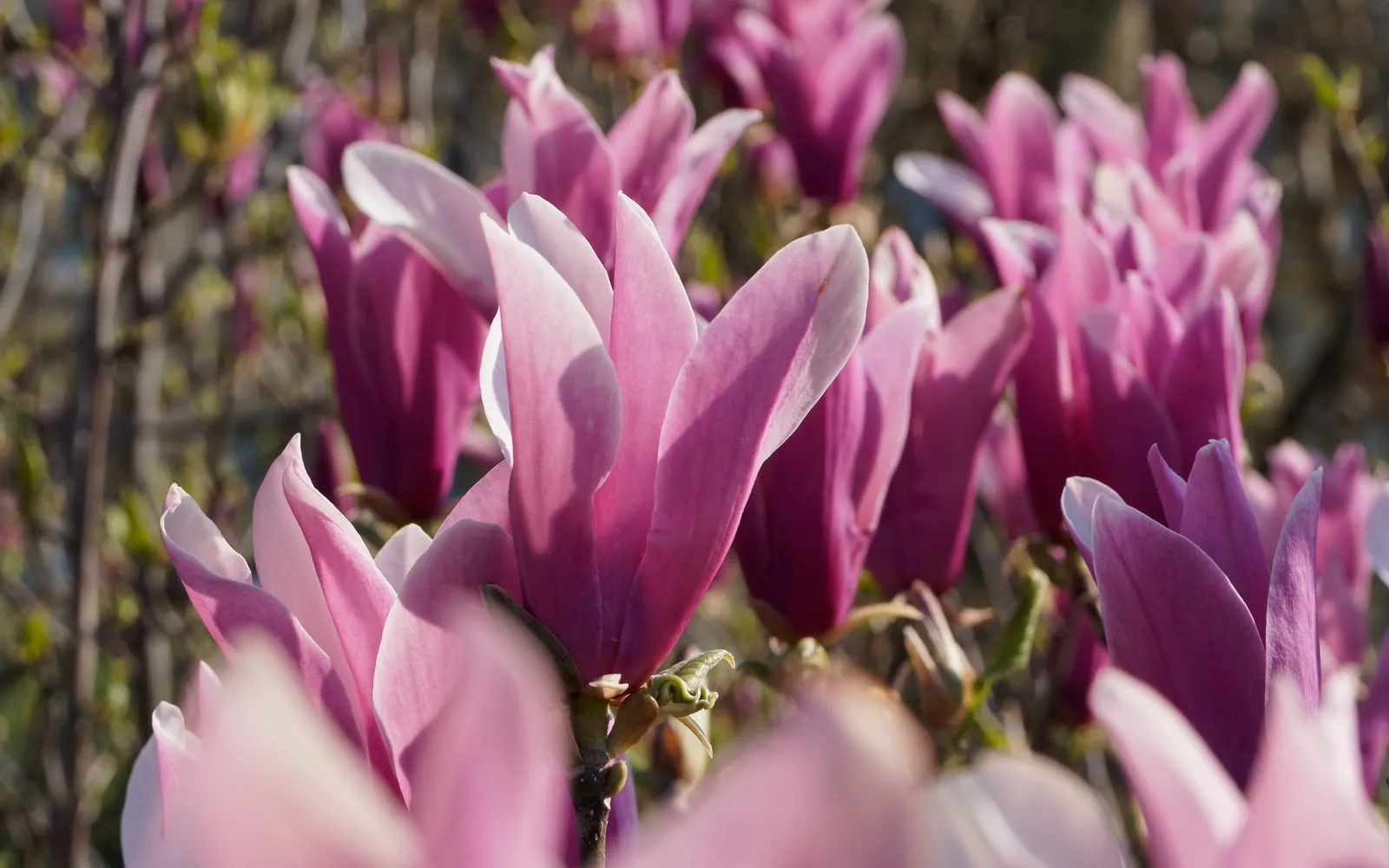
Lily magnolia has slim, upright flowers in a deep wine purple, held like narrow tulips on the bare branch tips as the leaves begin to unfurl. It flowers in mid to late spring, a good three or four weeks after star magnolia. That later flowering means frost ruins the display less often than it does on the early magnolias.
It stays small. A mature plant is a rounded, multi-stemmed shrub of three to four metres instead of a tree, so it fits a bed or a courtyard where a full magnolia never could.
Its importance in gardens goes well beyond the species itself. Crossed with Yulan magnolia, it produced the saucer magnolias that are now the commonest large-flowered magnolias in cultivation, and crossed again it gave the Little Girl hybrids, a group of late-flowering, frost-dodging shrubs with girls’ names such as ‘Ann’, ‘Jane’ and ‘Susan’. If you like the look of those and have less room, the species is a good smaller plant in its own right.
Appearance and character
The flowers are slim goblets of six tepals, wine purple to reddish purple on the outside and much paler, almost white, within, opening from a narrow furry bud. They appear in mid to late spring, mostly before the leaves are fully out, and often give a second, lighter flush in summer once the plant is in full leaf.
Leaves are broad and obovate, ten to twenty centimetres long, mid to dark green and slightly leathery, turning a dull yellow before they drop in autumn with no great colour display.
The habit is bushy and rounded, branching low and building into a dense mound of stems instead of a single trunk. Most plants settle between three and four metres tall and about as wide.
‘Nigra’ is the cultivar you are most likely to meet, selected for darker, larger flowers and a slightly taller frame, and it is a better garden plant than the wild type if you want a purple flower that shows at a distance.
Where it is from
Magnolia liliiflora is native to south-west China, in mountain forest, and has been cultivated in Chinese and Japanese gardens for so long that its exact wild origins are blurred. It reached European gardens in the late eighteenth century and has been a parent of new magnolias ever since.
In the garden, give it moisture-retentive soil that never bakes dry and the dappled light of taller deciduous trees, with shelter from hard wind.
How it grows
Plant in moist, fertile, well-drained soil that leans neutral to acid, in full sun or the light shade of taller deciduous trees. Avoid a shallow chalk soil, where the foliage yellows between the veins and the plant never thrives.
Choose the position carefully. Magnolias grow fleshy, brittle roots that resent being cut, and a plant moved after a few years can take a season or two to settle and flower again. Dig in leaf mould or well-rotted compost at planting to give the roots the open, humus-rich ground they favour.
Prune as little as you can, and only to take out dead, damaged or crossing stems, in summer after flowering. Winter cuts heal slowly on magnolia wood and invite dieback. Because it flowers on the previous year’s growth, hard pruning also costs you the next spring’s display.
Mulch each spring with leaf mould or compost, kept clear of the stems, to hold moisture around the shallow roots through summer.
Through the seasons
Early to mid spring brings flower buds swelling on bare wood, their grey fur splitting to show the purple within.
Mid to late spring is the main flowering, the slim purple goblets opening as the first leaves push out, later and more weather-proof than the early magnolias.
Summer is leafy growth, often with a scattering of extra flowers among the foliage. Water in dry spells and keep the mulch topped up.
Autumn is quiet. The leaves yellow and fall, leaving a tidy framework of grey stems for winter.
Care difficulty
Easy, and one of the more forgiving magnolias for a smaller garden. It needs an acid-to-neutral soil that stays moist, a sheltered spot chosen once and left alone, and very little pruning. The late flowering reduces the main frustration of the genus, which is watching a spring display browned by a cold night. Give it the right soil and it needs little routine attention.
Watering
Water regularly through the first two or three growing seasons while the roots spread, giving a deep soak instead of frequent sprinkles, since the shallow root system dislikes repeated drying and recovers slowly from it.
Once established, water only in a prolonged dry spell, and rely on a spring mulch to hold summer moisture in the soil. A plant in a container needs far more attention, because the limited compost dries fast in warm weather.
Warning signs, diseases and pests
Magnolia scale is the pest most likely to trouble it, a large brown soft scale that clusters on young stems and drips honeydew, which sooty mould then blackens. Treat with a horticultural oil timed to the crawler stage, since spraying the armoured adults achieves little.
Frost can still catch an early flush in a cold garden, browning open petals within hours, though it happens far less than with star or saucer magnolias because of the later flowering. There is no cure once petals brown; only siting away from frost pockets reduces it.
Yellowing between the leaf veins points to the soil instead of a pest. On shallow chalk the plant cannot take up iron and manganese. Grow it in a large container of ericaceous compost instead; correcting a whole chalk bed is rarely worth it.
Honey fungus occasionally kills old or already-stressed plants, showing as slow dieback and white fungal growth under the bark at the base. There is no reliable cure once it takes hold.
Growing environment
Full sun gives the heaviest flowering, while light shade suits it well and can spare an early flush from scorching on a hot, bright day. Deep shade thins the display.
Soil matters more than light. It needs ground that holds moisture yet drains freely, rich in organic matter and neutral to acid. Heavy, waterlogged clay rots the roots, and thin chalk starves them.
Shelter from strong and cold winds protects both the brittle stems and the open flowers, so a spot backed by a wall or taller planting is better than an exposed lawn.
A permanent position counts for more here than with most shrubs, because the plant establishes slowly after any move and does best planted once and left in place for good.
Feeding
Feed once in early spring, as growth resumes, with a balanced slow-release fertiliser suited to trees and shrubs, ideally one formulated for acid-loving plants where the soil is only just on the acid side.
The spring mulch of compost or leaf mould supplies much of the nutrition, giving steady fertility while it conserves moisture.
Do not overfeed an established, healthy plant. Rich feeding pushes soft leafy growth at the expense of flowers, and flowering depends far more on light, shelter and a settled root system than on how much you feed.
Troubleshooting
The leaves are yellow between the veins. The soil is too alkaline, almost certainly a shallow chalk. The plant cannot take up iron there. Move it to a large pot of ericaceous compost, or grow one of the many acid-tolerant shrubs instead.
It flowered the first year and then stopped. Most often transplant shock. Like other magnolias it handles root disturbance poorly and can pause for a season or more after planting or moving before it settles and flowers freely again.
Sticky leaves and black mould on the stems. Magnolia scale is feeding on the bark and dripping honeydew. Treat the scale with horticultural oil at the crawler stage rather than only wiping off the mould.
How big will it get, and how fast? Slowly to three or four metres, rarely more, and about as wide. It is one of the few magnolias that suits an average-sized garden without constant cutting back.
Can I grow it in a pot? Yes, in a large container of moisture-retentive ericaceous compost with good drainage. It will flower well but needs regular watering, an annual feed, and repotting or top-dressing every couple of years as it fills the pot.