
Edible
Indian Frankincense
Boswellia serrata
Also known as Salai Guggul, Indian Olibanum
How to grow Indian frankincense, Boswellia serrata. Why leaf drop through its dry-season rest is normal rather than a sign of dying, the resin tapped from cuts in the bark for incense and Ayurvedic use, and the sharp drainage it needs to avoid root rot.
At a glance
- Difficulty
- Difficult
- Water
- Sparing; water only once the soil has dried out, and far less in the dry-season rest
- Light
- Full sun
- Temperature
- Frost-tender; needs warmth and a pronounced dry rest
- Hardiness
- USDA 10-12, RHS H1c, hardy to 5 C
- Type
- Deciduous resin-bearing tree, dropping its leaves through the dry season
- Height
- 4-9 m; considerably smaller and slower in a container
- Native to
- the Indian subcontinent
A tree of dry, rocky, deciduous forest on the Indian subcontinent, built around a monsoon climate with a long, pronounced dry season rather than around cold tolerance, since it has essentially none. It drops its leaves and rests through the dry months in its native range, and expects the same seasonal cue, dry soil and reduced water, to stay healthy wherever else it is grown, tolerating heat and drought far better than damp, humid or cold conditions.
Hardiness zones describe winter cold alone. Summer heat, humidity, rainfall and the length of the growing season decide as much, so treat the range as the outer limit rather than as a recommendation.
Skin irritant
- Safe to eat
- None; the resin is used as incense and in supplements, not eaten as food
- Do not eat
- The resin, in a minority of people, and any part if eaten in quantity
- Harm from
- Handling it and eating it
- Affects
- People
Boswellia serrata is grown for its resin, tapped from cuts in the bark and burned as incense or processed into extracts used in traditional Ayurvedic medicine and, more recently, in supplements marketed for joint health. The resin is generally well tolerated at typical doses, and serious poisoning is not documented, but it is not free of risk. A minority of people develop contact dermatitis from handling raw resin, a reaction shared with other aromatic tree resins in the same wider family, and taking a concentrated extract in quantity can cause nausea, diarrhoea or heartburn in some users. Neither the RHS harmful plants index nor the ASPCA toxic and non-toxic plants list carries an entry for Boswellia, and no toxicity to cats, dogs or horses is documented for this species. Anyone using the resin or an extract medicinally, rather than only growing the tree, should treat it as an active substance and check with a doctor before combining it with other medication, since traditional use is not the same thing as formal safety testing.
Sources: RHS potentially harmful garden plants, National Capital Poison Center
About
Indian frankincense is the source of Indian olibanum, a fragrant resin tapped from cuts in the bark and burned as incense across South Asia for thousands of years. It grows as a small deciduous tree of dry, rocky forest, shedding its leaves and resting through a long dry season rather than growing continuously the way a typical tropical tree does. Outside its native climate it is a demanding plant to keep alive, let alone to tap for resin, and suits a grower prepared to replicate a sharp wet-dry rhythm rather than treat it as an ordinary warm-climate shrub.
Appearance and character
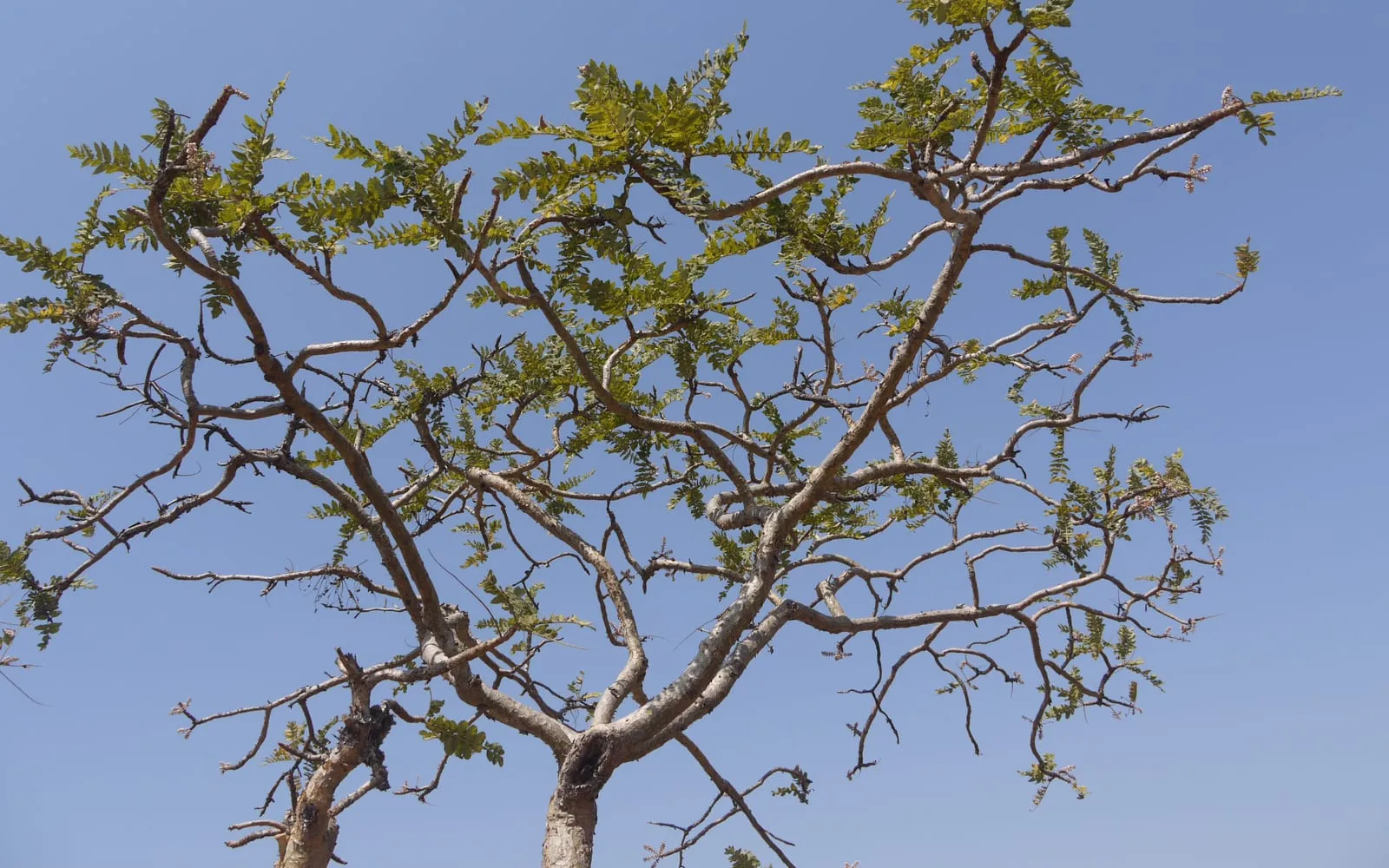
Bark is pale, thin and papery, peeling away in flakes to reveal a greener layer beneath, a texture distinctive enough on its own to identify a mature specimen at a glance. Leaves are pinnately compound, greyish-green and aromatic when crushed, carried in a thin, open crown that casts light rather than dense shade. Small, pale flowers appear in clusters, easily overlooked against the foliage, followed by small three-lobed fruit capsules. The resin itself is the plant’s most distinctive feature in cultivation: wounding the bark releases a milky sap that hardens into translucent, amber to greenish tears over several days, harvested by repeated shallow cuts made into the same wound over a season.
Where it is from
Boswellia serrata is native to the drier parts of the Indian subcontinent, growing on rocky hillsides and in dry deciduous forest across a belt running through central and northern India and into neighbouring countries, typically on poor, thin, well-drained soil where few other trees compete successfully. Its native climate follows the monsoon pattern closely, months of intense heat and drought followed by concentrated seasonal rainfall, and the tree drops its leaves and stops active growth through the driest months as a direct response to that rhythm rather than to cold, which it barely experiences in its native range. Resin tapping has been practised across its range for millennia, supplying incense used in religious and ceremonial contexts across South Asia and, through ancient trade routes, well beyond it, and it remains an important non-timber forest product and a subject of ongoing conservation concern where overtapping has stressed wild populations.
How it grows
Give it the sharpest drainage available, ideally a gritty, mineral-heavy mix if grown in a container, since this is a tree adapted to poor, rocky ground and resents anything that holds moisture around its roots for long. Full sun and real heat suit it best; a cool, overcast or humid position produces weak, straggly growth at best. Replicate its native dry season deliberately rather than watering on a fixed schedule: reduce water sharply as the tree begins to drop its leaves, and keep it close to dry until new growth signals the start of the following season. Resin tapping, where attempted at all, is a specialist skill best learned from an experienced grower rather than improvised, since repeated or careless wounding stresses a young tree considerably more than the wild, well-established specimens usually tapped commercially.
Through the seasons
The growing season, which follows a monsoon rhythm rather than a temperate calendar, brings new leaf growth and the small flowers that precede the fruit.
The dry season that follows is when the tree sheds its leaves and rests almost completely. Cut watering back hardest at this stage.
In a temperate climate grown under glass, treat spring and summer as the growing season and autumn and winter as the dry rest, watering accordingly regardless of the calendar month.
Any sustained cold spell, at any time of year, is the one condition this species has no tolerance for at all and must be protected against immediately.
Care difficulty
Difficult. This is not a forgiving beginner’s plant outside a reliably hot, dry, frost-free climate. Getting the watering rhythm wrong, keeping it too wet through what should be a dry rest, or too dry during active growth, causes more harm than almost any pest or disease it is likely to encounter. Cold and damp are the two conditions it tolerates least, and both are exactly the conditions many temperate homes and greenhouses default to without deliberate adjustment.
Watering
Water sparingly even during active growth, allowing the soil to dry out between waterings rather than keeping it consistently moist. Through the dry-season rest, cut back sharply, watering only enough to stop the roots desiccating completely rather than to support any visible growth. A plant kept damp through its rest period is at serious risk of root rot, since its whole physiology expects a real dry spell at that point in the year.
Warning signs, diseases and pests
Scale insects form small bumps along the stems and on the bark, sapping vigour gradually; horticultural oil applied during their active phase controls most infestations.
Sooty mould grows on honeydew left behind by sap-sucking insects such as scale, appearing as a black, sooty film across the leaves; treating the insect causing it clears the mould over time as the honeydew supply stops.
Root rot follows soil kept too wet for a species this strongly adapted to dry, sharply drained ground, showing as a plant that declines despite regular watering. Repot into a grittier, faster-draining mix and reduce watering sharply at the first sign of decline, since recovery depends on correcting the underlying moisture rather than treating a symptom.
Spider mite thrives in hot, dry indoor air, showing as fine pale speckling on the leaves and, in bad cases, faint webbing; raising humidity slightly around the plant, without wetting the roots, helps prevent it establishing.
Growing environment
Full sun and real heat are essential; this is not a plant that tolerates a shaded or cool position with any grace. Soil has to drain sharply and should be on the poor side rather than rich, mirroring the rocky ground it grows in naturally. Humidity should stay low, particularly through its dry-season rest, since damp air combined with wet roots is the combination most likely to kill it outright.
Feeding
Feed sparingly if at all, using a dilute, low-nitrogen fertiliser only during active growth and never through the dry-season rest. A plant adapted to poor, rocky native soil has little use for the fertility a typical container-grown houseplant regime provides, and overfeeding does more harm than the modest benefit it might otherwise offer.
Troubleshooting
My plant dropped all its leaves. Is it dying? Not necessarily. This species is deciduous through its natural dry season, and a leafless plant resting with reduced watering is behaving normally rather than failing. Check the stems for firmness and greenish tissue beneath the bark before assuming the worst, and hold off on extra water, which is more likely to cause harm than help at this stage.
The roots have gone soft and the plant looks unwell despite regular watering. Root rot from soil that has stayed too wet is the likely cause, since this species tolerates being kept dry far better than being kept moist. Repot into a grittier, faster-draining mix, trim away any soft or blackened roots, and water only once the new mix has dried out.
Can I tap my own plant for resin at home? Technically, once it is several years old and well established, though a young or stressed plant tolerates tapping poorly and the resulting wounds are an entry point for disease. Most home growers are better served treating this as an ornamental and historical curiosity than attempting to harvest resin from a single specimen.
Why does my plant look thin and sparse compared with photographs of it in the wild? A container-grown plant in a temperate climate rarely reaches the size or density of a mature wild tree growing in full sun and real heat over many decades. Thin, open growth is normal for this species even in ideal conditions, so a sparse crown is not on its own a sign of poor health.
Is the resin the same thing as the frankincense used in the Middle East? Related but not identical. Middle Eastern and East African frankincense comes mainly from other Boswellia species, and while all produce a similar aromatic resin, growers and buyers who care about the exact fragrance profile do distinguish between species rather than treating “frankincense” as one uniform product.