
Outdoor plant
Ash
Fraxinus excelsior
Also known as Common ash, European ash
How to identify ash, Fraxinus excelsior. The black winter buds, ash dieback and what it means for your tree, and whether to fell or wait.
At a glance
- Difficulty
- Easy
- Water
- Rarely once established
- Light
- Full sun, and it is intolerant of deep shade when mature
- Temperature
- Fully hardy, to about -40 deg C
- Hardiness
- USDA 3-8, RHS H7, hardy to -40 C
- Type
- Deciduous tree, long lived and fast growing when young
- Height
- 25-35 m
- Native to
- Europe and western Asia, and native throughout Britain
- Best month
- February in the Northern Hemisphere, August in the Southern Hemisphere
Cold never limits it. Two pests do, and which one you face depends on where you are. Ash dieback, a fungus from east Asia, has killed a large share of the ash across Europe. Emerald ash borer, a beetle from the same region, has killed hundreds of millions of trees across North America since 2002 and is moving west through European Russia. North American ash species have almost no resistance to the beetle, so in the United States and Canada the question is not whether to plant ash but whether the ones you have can be treated.
Hardiness zones describe winter cold alone. Summer heat, humidity, rainfall and the length of the growing season decide as much, so treat the range as the outer limit rather than as a recommendation.
Every month named in this guide is for the temperate Northern Hemisphere. If you garden in the Southern Hemisphere, shift each one by six months, so February becomes August. Closer to the equator the wet and dry seasons matter more than the calendar, and the shift stops being a useful guide.
Not known to be toxic
Ash is not listed by the RHS as a potentially harmful garden plant and is not recorded by the ASPCA as toxic to cats, dogs or horses. No part of it is a recognised poisoning hazard, and ash leaves have been used as fodder for livestock for centuries, which is why so many old ash trees across Europe were pollarded. The keys, which are the winged seeds, have been pickled and eaten historically and are not a hazard. The genuine danger from an ash tree is physical rather than chemical, and it comes from ash dieback. Infected trees become brittle and shed limbs unpredictably, and whole trees fail at the base where secondary honey fungus has taken hold. That is a real and well documented risk to people working under or felling affected trees, and it is the reason professional guidance is to assess an ash showing dieback rather than to climb it. Where an affected tree overhangs a road, a path or a building, get it inspected by an arboriculturist rather than working on it yourself.
Sources: RHS potentially harmful garden plants, ASPCA toxic and non-toxic plants
About
Two continents are losing their ash at once.
Ash was one of the three commonest trees in Britain and one of the commonest across Europe, the airy pale-barked tree of hedgerows and limestone woods, the wood that made tool handles and cricket stumps because it bends without snapping.
Ash dieback, a fungus from east Asia, reached Britain in 2012 and is expected to kill a large proportion of the ash across Europe. Emerald ash borer, a beetle from the same region, has killed hundreds of millions of trees in North America since 2002 and is working west through European Russia towards the same trees. The estimates vary and none of them are small.
That changes what a guide about this tree is for. Planting one is now a decision requiring thought rather than an obvious good idea, and the more useful information is how to recognise the disease, how to judge whether a tree is dangerous, and when to wait rather than fell.
The waiting matters. A small percentage of ash show natural tolerance, and those trees are the future of the species. Felling every ash that looks unwell removes exactly the genetic material that a recovery depends on.
Appearance and character
A large deciduous tree reaching 25 to 35 m, with a domed but open crown that casts noticeably light shade.
Winter buds are the identification and nothing else in Europe looks like them. They are matt black, shaped like a bishop’s mitre, and held in opposite pairs along a smooth grey twig.
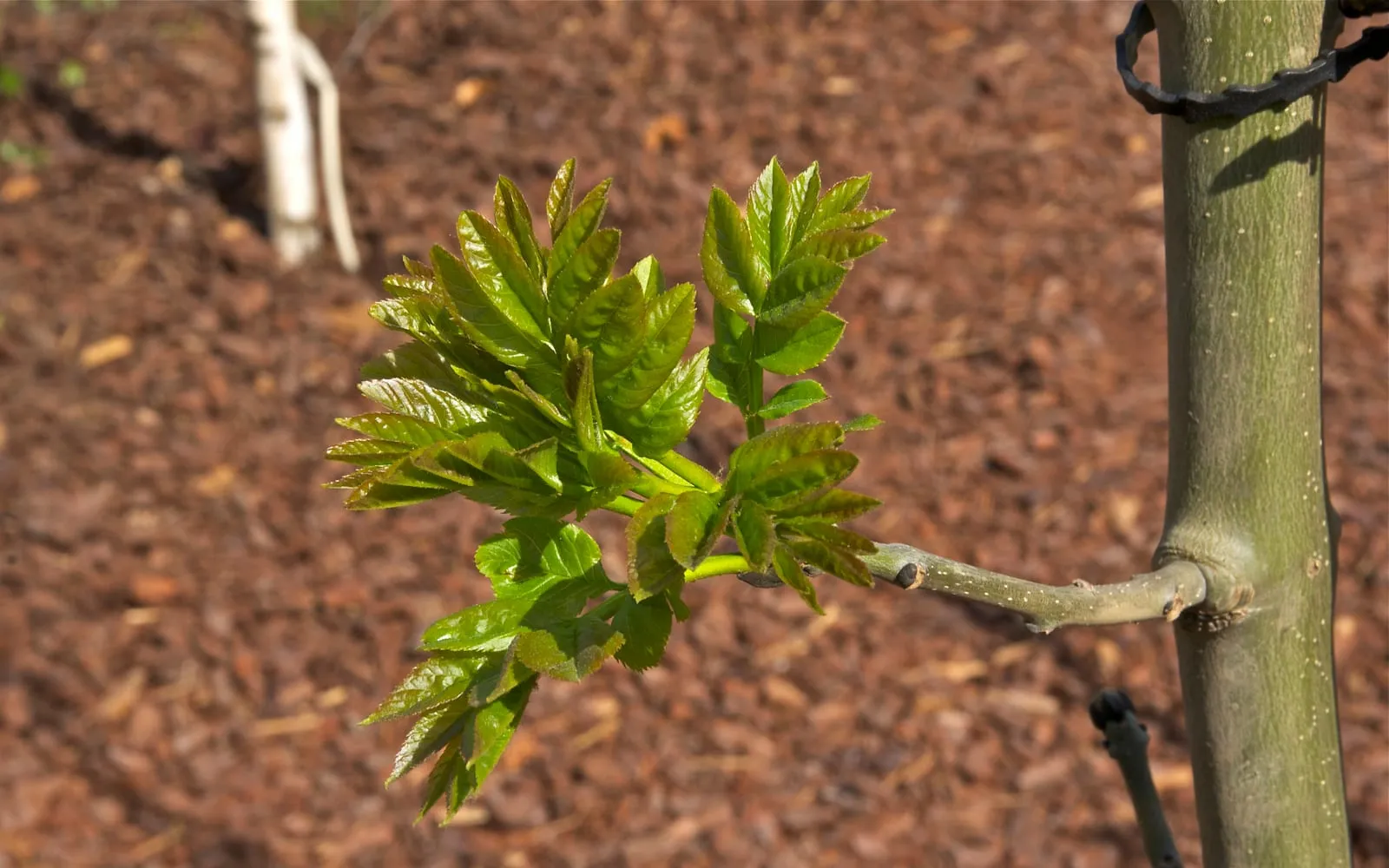
Leaves are pinnate, made of three to six opposite pairs of narrow toothed leaflets plus a single leaflet at the tip, the whole leaf 20 to 35 cm long.
Ash comes into leaf very late, often not until May, and drops early, which is why the ground beneath an ash carries a rich flora that would be shaded out under beech.
Flowers appear before the leaves in April as dense purple-black tufts. Ash is variable in sex, and a single tree can be male, female, or both, and can change between years.
Keys are the fruit, single-winged, hanging in bunches, green through summer and brown by autumn, often staying on the tree all winter.
Bark is pale grey and smooth on young trees, developing an interlaced network of ridges with age.
Where it is from
Europe and western Asia, and native throughout Britain and Ireland.
It grows in woodland, hedgerows, on limestone pavements and in scrub, and it is at its best on deep moist base-rich soils. Ash woodland on limestone is a distinct habitat and a protected one across Europe.
The tree is fast growing, colonises gaps readily, and seeds itself into gardens freely.
Its cultural weight is considerable. Yggdrasil, the world tree of Norse mythology, is usually described as an ash, and ash was regarded as protective in English folklore.
The timber is exceptional. It is strong, elastic and shock-resistant, which is why it was used for tool handles, oars, wheel spokes, hockey sticks and the frames of early aircraft and Morgan cars.
Ash dieback is caused by Hymenoscyphus fraxineus, a fungus from east Asia where the local ash species are resistant to it. It was found in Britain in 2012 in imported nursery stock and in the wider environment shortly afterwards.
How it grows
Think carefully before planting one, and there are still good reasons to.
Ash seedlings appear everywhere and grow fast. The species is not going to disappear from the seed bank, and planting tolerant stock is part of the response to the disease.
If you plant, use locally grown stock from a reputable source, and be aware that tolerant cultivars are being developed and are not yet widely available.
Plant between November and March in an open sunny position, in deep moist soil, ideally on limestone or a base-rich clay.
Ash needs light. It is intolerant of shade once past the sapling stage and will not thrive under other trees.
Do not plant it close to a building. It is a large tree with a vigorous root system.
Prune in late summer or autumn, and only to remove dead, damaged or crossing wood.
Pollarding and coppicing both suit ash and were traditional. A pollarded ash cut every ten to fifteen years lives far longer than a maiden tree, and many of the oldest ash in Europe are old pollards.
Remove seedlings from borders while small, since the taproot makes them hard to pull later.
Through the seasons
Winter is the best time to identify ash, by the matt black buds in opposite pairs, and to assess a tree for dieback by looking at the outline of the crown against the sky.
Spring flowers in April before the leaves, and the leaves themselves come very late, often in May.
Summer is when dieback shows most clearly, as wilting black leaves, dead shoot tips and diamond-shaped lesions on the bark of young stems.
Autumn turns the leaves yellow and drops them early, often while still green after a dry summer. Keys hang on into winter.
Care difficulty
Easy to grow and increasingly difficult to own.
The tree itself needs almost nothing, and a healthy ash is one of the least demanding large trees you can plant.
The difficulty now is disease management and safety judgement. Ash dieback is not treatable, spreads on wind-blown spores and cannot be excluded from a garden.
The decisions it forces are hard. Whether a tree is safe, whether to fell or wait, and whether the tree is one of the tolerant minority worth keeping.
Watering
Water through the first two summers after planting.
An established ash needs no watering in a temperate climate, though it prefers moisture and shows stress early in drought by dropping leaves.
It dislikes waterlogging and thin dry sand equally.
Warning signs, diseases and pests
Ash dieback is the thing to know. The signs, in rough order of appearance, are black or dark brown patches on leaves in mid to late summer, wilting and blackening of whole leaves, dead shoot tips with the leaves still hanging on, and diamond-shaped dark lesions on the bark of young stems, often centred on a side shoot.
As it progresses the crown thins from the top and outside inwards, and the tree responds by throwing out dense bushy epicormic growth lower down the trunk and main branches. That combination of a thin dying crown and a shaggy trunk is the recognisable signature.
There is no treatment. Fungicides do not work at tree scale.
Do not fell immediately. Young trees usually die within a few years. Mature trees often decline over a decade or more, and a proportion survive with tolerance that appears to be genetic. A tree that is holding its own after several seasons may be one worth keeping.
Do assess for safety. The specific danger is that dieback makes ash brittle and unpredictable, and secondary infection by honey fungus at the base can cause whole- tree failure with little warning. An affected tree overhanging a road, a path, a building or a boundary needs professional assessment. Climbing an ash with advanced dieback is a job for a professional using a mobile platform rather than for a homeowner with a ladder.
Emerald ash borer is a beetle that has killed hundreds of millions of ash across North America since 2002 and is spreading west through European Russia. Where it is established, the only way to save a valued tree is a systemic insecticide reapplied every one to three years by an arborist. It has not reached Britain, and suspected sightings go to the Forestry Commission’s TreeAlert system.
Honey fungus attacks ash, particularly trees already weakened by dieback, and is fatal.
Growing environment
Full sun. Ash is a light-demanding tree and will not develop properly in shade.
Deep, moist, fertile soil, and it is at its finest on limestone and base-rich clay.
It stands wind and exposure well, including near the coast, and it is hardy to about -40 deg C.
Allow a great deal of space. This is a 25 to 35 m tree with a wide root system, and it should be well away from buildings and drains.
The light canopy is its ecological virtue. Bluebells, dog’s mercury, ramsons and other woodland flowers grow under ash where they would fail under beech, and ash supports a large number of dependent species including many lichens and invertebrates.
Where you have lost an ash, planting a mix rather than a single replacement species is the resilient response. Oak, small-leaved lime, hornbeam, field maple and wild cherry all fill the gap in different ways.
Feeding
None needed. Ash on ordinary soil finds what it requires.
Mulch a young tree with compost for its first few springs, keeping it clear of the trunk.
Feeding a tree with dieback does not help and is not a treatment.
Troubleshooting
How do I identify an ash? The matt black, mitre-shaped buds held in opposite pairs on a grey twig are unmistakable in winter. In summer, look for pinnate leaves made of several pairs of toothed leaflets with one at the tip.
Does my tree have ash dieback? Look for dead shoot tips with leaves still hanging on, blackened wilting leaves in summer, diamond-shaped lesions on young bark, a crown thinning from the top down, and dense bushy regrowth on the trunk.
Should I fell it? Not automatically. Young trees usually die, mature trees often decline slowly, and some show real tolerance. Fell where the tree is a genuine safety risk, and otherwise wait and watch.
Is it dangerous? It can be. Dieback makes the wood brittle and secondary honey fungus can cause failure at the base. Get a professional assessment for any affected tree near a road, path or building, and do not climb one.
Is there a cure? No. There is no treatment for ash dieback at tree scale.
Should I still plant ash? It is a reasonable choice where you accept the risk, and tolerant stock is being developed. Planting a mixture of species is the more resilient answer for replacing a lost tree.
Can I burn the wood? Yes. Ash is among the best firewood there is and burns well even when relatively green. Diseased wood is safe to burn.
Something is eating the bark of my young ash. More likely rabbits, deer or voles than disease. Use a tree guard.