
Edible
Cattley Guava
Psidium cattleianum
Also known as Strawberry guava, Cherry guava, Chinese guava
How to grow Cattley guava, Psidium cattleianum. The hardiest guava, small enough to fruit on a windowsill, red and yellow forms, and the reason Hawaii would like it gone.
At a glance
- Difficulty
- Easy
- Water
- Weekly in growth, sparingly in winter
- Light
- Full sun to light shade
- Temperature
- Takes a few degrees of frost once established, the hardiest of the guavas
- Humidity
- Moderate
- Hardiness
- USDA 9-11, RHS H1c, hardy to -3 C
- Type
- Tender to half-hardy evergreen shrub
- Height
- 2-6 m in the open, 1-1.5 m in a pot
- Native to
- coastal Brazil
- Best month
- June, September and October in the Northern Hemisphere, December, March and April in the Southern Hemisphere
Coastal Brazil, and hardier than common guava, which is why it is more dangerous. It forms dense monospecific thickets and is ranked among the most damaging invasive plants in Hawaii, Mauritius, Reunion and French Polynesia, where it has displaced native forest outright. Do not plant it anywhere in the humid subtropics or tropics.
Hardiness zones describe winter cold alone. Summer heat, humidity, rainfall and the length of the growing season decide as much, so treat the range as the outer limit rather than as a recommendation.
Every month named in this guide is for the temperate Northern Hemisphere. If you garden in the Southern Hemisphere, shift each one by six months, so June becomes December. Closer to the equator the wet and dry seasons matter more than the calendar, and the shift stops being a useful guide.
Not known to be toxic
- Safe to eat
- The whole fruit, skin and seeds included
Cattley guava is not toxic. The whole fruit is eaten skin and all, the seeds are small and swallowed with it, and nothing in the plant is listed as harmful to people or to cats and dogs. The concern attached to this species is environmental rather than medical. It is one of the worst plant invaders in Hawaii, Mauritius, Reunion and French Polynesia, where birds and feral pigs spread the seed and the shrub forms thickets so dense that nothing native regenerates beneath them. Several jurisdictions restrict its sale. Grow it in a pot and never plant it out in a frost-free climate.
Sources: ASPCA toxic and non-toxic plants, RHS potentially harmful garden plants
About
Cattley guava is the guava for a heated greenhouse. It is smaller than the common guava in every dimension, it takes a few degrees of frost, and it will carry a crop in a 30 cm pot on a conservatory shelf.
The fruit is the size of a cherry and comes in two forms. The red one, sold as strawberry guava, tastes of strawberry and guava at once. The yellow one, often called lemon guava, is larger, more acid and by most accounts the better fruit.
Everything that makes it a good pot plant makes it a bad neighbour in the tropics. It fruits young, seeds heavily, and birds carry it, and in Hawaii and the Mascarene islands it has become one of the most damaging invasive plants there is.
Appearance and character
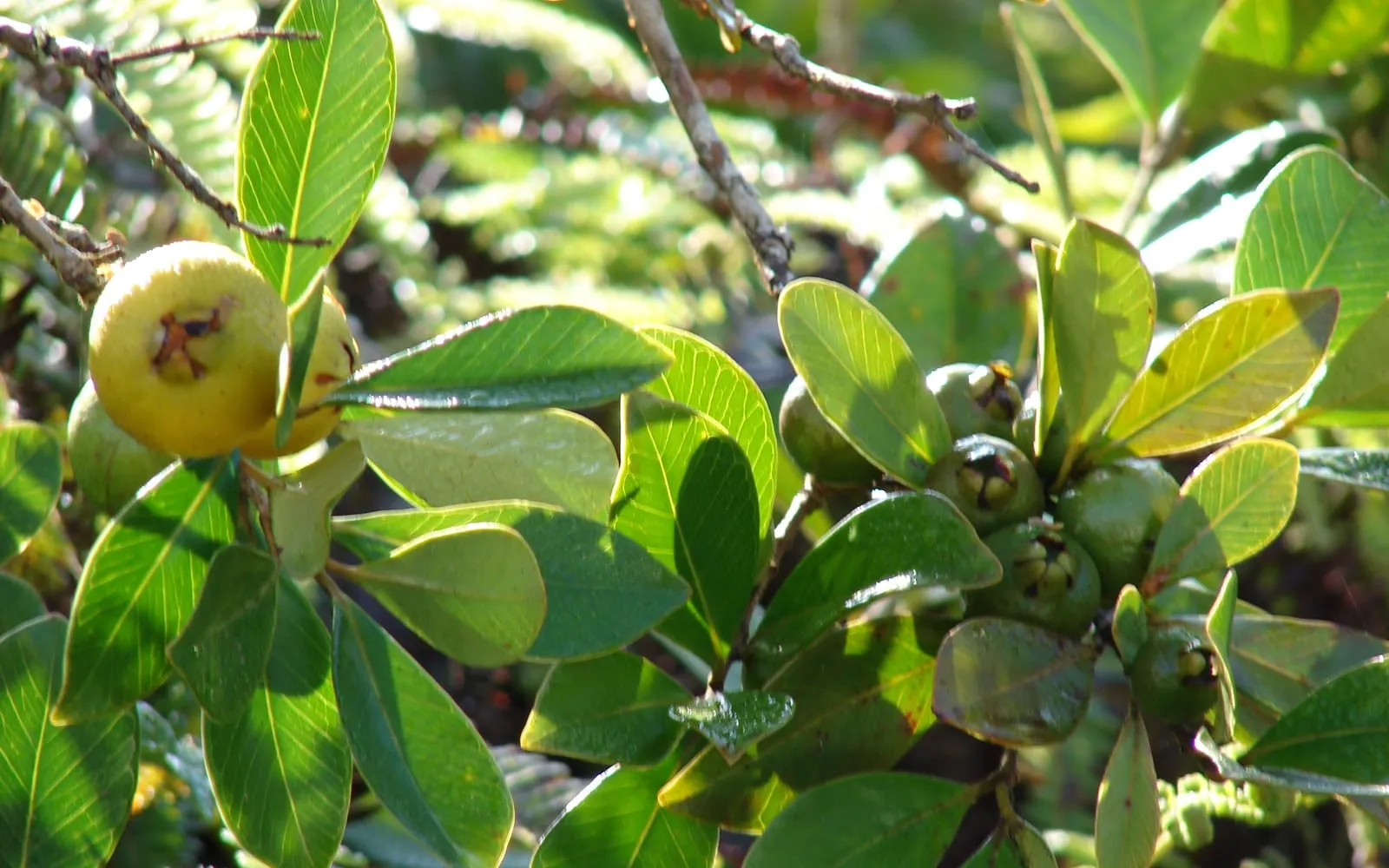
A dense twiggy evergreen shrub, 2 to 6 m in the open and easily kept to a metre in a pot.
Bark is smooth and reddish brown, flaking in thin patches to leave a mottled surface, like a small-scale version of the common guava’s.
Leaves are opposite, oval, 4 to 8 cm, thick, stiff and glossy dark green, with a smooth margin and a blunt tip. They are noticeably smaller and shinier than the common guava’s quilted matt leaves.
Flowers are white with a boss of stamens, about 2 cm across, borne singly in the leaf axils, and they smell faintly of honey.
Fruit is round, 2 to 4 cm, either dark red or clear yellow depending on the form, with a thin skin carrying the dried calyx at the tip.
Flesh is white to pale pink, soft, juicy and full of small hard seeds, and the whole fruit is eaten.
The plant is naturally dense and needs little pruning to make a good shape.
Where it is from
Cattley guava is native to the coastal Atlantic forest of Brazil, from Bahia south to Rio Grande do Sul, where it is a shrub of forest margins.
It was named for William Cattley, the English horticulturist whose collection also gave the orchid genus Cattleya its name, and it reached Europe as a greenhouse plant in the early nineteenth century.
Its spread was largely deliberate. It was planted across the tropics as a fruit crop and a hedge, and it escaped everywhere it was tried.
Hawaii is the worst case. Cattley guava now covers large areas of lowland and mid-elevation forest, feral pigs spread the seed and open the ground for seedlings, and native forest cannot regenerate under it. Mauritius and Reunion tell the same story.
Temperate growers keep it as a conservatory fruit and it has been in cultivation here for nearly two hundred years without escaping, because it cannot survive our winters.
How it grows
Sow seed from a ripe fruit. It germinates freely and the seed keeps reasonably well.
Sow at 20 to 25 deg C on free-draining compost, covering lightly. Germination takes three to six weeks.
Pot on into ordinary free-draining compost with a little added grit, slightly on the acid side.
Grow in full sun or light shade. It fruits better in sun and tolerates a good deal of shade without complaint.
Keep it frost free in a cool winter. It survives a few degrees of frost once established, and a pot plant with cold roots is far more vulnerable than a plant in the ground.
Water weekly in growth and sparingly in winter.
Feed monthly from April to September.
Prune lightly after fruiting if the shape needs it. This species is naturally dense.
Expect fruit in two to three years from seed, which is faster than almost any other fruit tree.
Keep it in a pot. Never plant it out in a frost-free climate.
Through the seasons
Winter is a cool frost-free rest. Water sparingly and feed nothing. The plant holds its leaves.
Early spring is the time to repot and prune if needed, and to start feeding as growth resumes.
Late spring brings the flowers, white and honey-scented, in the leaf axils.
Early summer is fruit set and the main growth flush.
Late summer to autumn is harvest, and the fruit ripens over several weeks rather than all at once.
Autumn is when to stop feeding and reduce watering.
A second lighter crop sometimes follows in a warm greenhouse.
Care difficulty
Easy, which makes it almost unique on this list.
Cold hardiness is the reason. It takes a few degrees of frost once established and only needs to be kept frost free, rather than heated, through a cool winter.
Size suits a pot. A metre-tall plant in a 30 cm pot will fruit, which no mango or lychee will do.
Fruiting comes early, in two to three years from seed.
Soil is undemanding, provided it drains and is not strongly alkaline.
Pruning is barely needed, since the plant is naturally dense and twiggy.
The one real caution is environmental. Grow it in a pot, and do not plant it out or give seed to anyone in a warm climate.
Watering
Water weekly through the growing season, letting the surface dry between times.
Reduce to occasional watering in winter, keeping the compost barely damp.
Water steadily during fruit swell to avoid splitting and drop.
Drain fully. This species dislikes standing water as much as any guava.
Tap water is acceptable, though rainwater suits it slightly better.
Mulch the pot surface in summer.
Watch a pot outdoors in a wet temperate summer, since a saturated pot in cool weather is the main risk.
Warning signs, diseases and pests
Brown limpets on the stems are scale insects, which this species gets readily under glass.
White fluff in the leaf axils is mealybug.
Blackened shoot tips after a cold snap are frost damage. Cut back to live wood in spring and it recovers well.
Wilting in wet compost is root rot.
Yellowing between the veins is iron shortage on alkaline compost or hard water.
Leaf drop in a dark cold winter is a light problem rather than a disease.
Fruit dropping before ripening usually means irregular watering.
Seedlings appearing in nearby pots is the species doing what it does. Remove them and do not let fruit fall outside.
Growing environment
A cool greenhouse, conservatory or bright windowsill. It can stand outside for the summer and must come in before hard frost.
Minimum around minus 3 deg C for an established plant, though frost free is safer for anything in a pot.
Full sun for the best crop, tolerating light shade.
Moderate humidity.
Free-draining compost with added grit, slightly acid.
pH from 5.0 to 6.5.
A pot of 25 to 35 cm is enough for a fruiting plant.
Shelter from cold wind, which browns the leaf edges.
Feeding
Feed monthly from April to September with a balanced liquid feed.
Switch to a high-potash feed as the fruit swells.
Stop feeding at the end of September.
Give nothing through winter.
Top-dress or repot each spring into fresh free-draining compost.
Add sequestered iron if the young leaves yellow between the veins.
Avoid heavy feeding, which produces leafy growth at the expense of fruit.
Troubleshooting
Which is better, the red or the yellow? The yellow form is larger, more acid and generally reckoned the better fruit. The red tastes of strawberry and guava together and is the one usually sold as strawberry guava.
How hardy is it? The hardiest of the guavas. An established plant in the ground takes a few degrees of frost. A plant in a pot has cold roots and is much more vulnerable, so keep it frost free.
How soon will it fruit? Two to three years from seed, which is very fast for a fruit tree, and it will fruit in a 30 cm pot.
Can I eat the whole fruit? Yes. Skin, flesh and seeds are all eaten. The seeds are small and hard and go down whole.
How is it different from a common guava? Smaller in every way. Smaller leaves, glossier and thicker, smaller white or honey-scented flowers, cherry sized fruit, a denser twiggy habit, and far better cold tolerance.
Should I plant one out somewhere warm? No. It is among the worst invasive plants in Hawaii, Mauritius and Reunion, where birds and pigs spread the seed and it forms thickets that stop native forest regenerating. Several places restrict its sale.
The leaves went yellow between the veins. Iron shortage from hard water or alkaline compost. Use rainwater and slightly acid compost.
The tips went black after a cold night. Frost damage to soft growth. Cut back to live wood in spring and it will regrow.
Cattley Guava problem guides
Not sure what is wrong? See the common vegetable pests guide.