
Edible
Surinam Cherry
Eugenia uniflora
Also known as Pitanga, Brazilian cherry, Florida cherry
How to grow Surinam cherry, Eugenia uniflora. The ribbed red fruit with a resinous edge that people either love or spit out, the hedge it makes, and the invasion it has caused.
At a glance
- Difficulty
- Easy
- Water
- Weekly in growth, sparingly in winter
- Light
- Full sun to light shade
- Temperature
- Minimum around minus 3 deg C once established
- Humidity
- Moderate
- Hardiness
- USDA 9-11, RHS H1c, hardy to -2 C
- Type
- Tender to half-hardy evergreen shrub
- Height
- 2-8 m in the open, 1-1.5 m in a pot
- Native to
- coastal Brazil, Uruguay
- Best month
- May, June and September in the Northern Hemisphere, November, December and March in the Southern Hemisphere
Subtropical eastern Brazil, and hardy enough to be a problem. It is one of the more damaging invasive shrubs in Florida, Hawaii and Bermuda, spread by birds into native forest, and is listed as a noxious weed in several of them.
Hardiness zones describe winter cold alone. Summer heat, humidity, rainfall and the length of the growing season decide as much, so treat the range as the outer limit rather than as a recommendation.
Every month named in this guide is for the temperate Northern Hemisphere. If you garden in the Southern Hemisphere, shift each one by six months, so May becomes November. Closer to the equator the wet and dry seasons matter more than the calendar, and the shift stops being a useful guide.
Edible, with limits
- Safe to eat
- The ripe flesh
- Do not eat
- The seeds, which are resinous, and unripe fruit
- Harm from
- Eating it
- Affects
- People
Surinam cherry is not toxic and nothing in it is listed as harmful to cats or dogs. The seeds carry the resinous compounds that give the fruit its divisive flavour in concentrated form, they are bitter and unpleasant, and they should not be chewed or blended; they are spat out. Unripe fruit is strongly resinous and astringent, which is the reason most people who dislike the fruit tried a red one rather than a fully ripe dark one. The concern attached to this species is environmental. It is a listed invasive plant in Florida, Hawaii, Bermuda and several Pacific islands, where birds spread the seed and dense thickets replace native vegetation, and Florida prohibits its sale in some counties. Grow it in a pot and do not plant it out in any frost-free climate.
Sources: ASPCA toxic and non-toxic plants, RHS potentially harmful garden plants
About
Surinam cherry is a fruit people argue about. The ripe berry is bright red or near-black, deeply ribbed like a tiny pumpkin, and it tastes sweet and acid with a strong resinous note underneath that some people read as aromatic and others as turpentine.
Ripeness settles most of the argument. A red one is resinous and sharp. A fully ripe one, dark and soft enough to fall into the hand, is sweet and far less divisive, and the dark-fruited cultivars are milder still.
The shrub is dense, twiggy and takes clipping, which made it a favourite hedge across the subtropics. That popularity is why it now sits on invasive species lists in Florida, Hawaii and Bermuda.
Appearance and character
A dense twiggy evergreen shrub, upright, 2 to 8 m in the open and easily held to a metre in a pot.
Bark is smooth and pale brown, flaking in thin patches.
Leaves are opposite, oval, 2 to 6 cm, glossy dark green, and strongly aromatic when crushed, smelling resinous and slightly spicy. New growth flushes bronze to coppery red, and the whole shrub reddens in cold weather.
Flowers are small, white, about 1.5 cm, with a boss of long stamens, borne singly or in small groups in the leaf axils, and lightly fragrant.
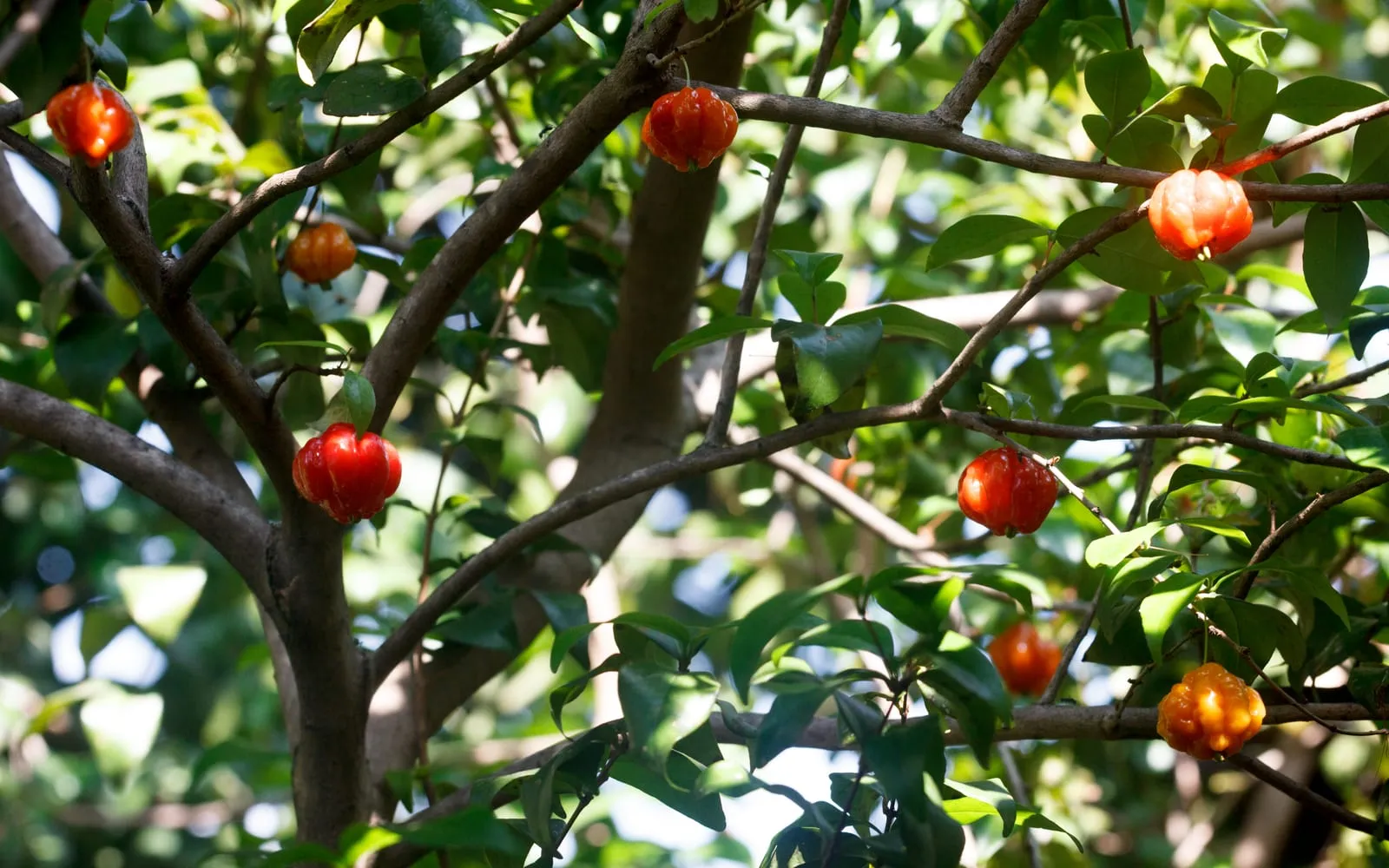
Fruit is round and deeply ribbed into seven or eight lobes, 2 to 4 cm, ripening green through orange to bright red or, in the dark cultivars, to a near-black purple.
Flesh is orange-red, soft and juicy, with one or two round seeds at the centre.
The ribs are the identifying feature and nothing else in this collection has them.
Where it is from
Surinam cherry is native to the coastal Atlantic forest of eastern Brazil and Uruguay, where it is a shrub of forest margins.
Brazil calls it pitanga and grows it widely, both for fruit and as a garden plant, and pitanga juice and ice cream are common there.
The Portuguese carried it around their empire early, and it reached Goa, then India, then South East Asia within a century.
Florida, Hawaii, Bermuda and much of the Caribbean planted it as an ornamental hedge in the nineteenth and twentieth centuries.
It escaped everywhere it was planted. Birds spread the seed, thickets form, and Florida, Hawaii and Bermuda now list it as an invasive species, with some Florida counties prohibiting sale.
Temperate growers keep it as a conservatory shrub, where it cannot escape, and it has been in cultivation here for well over a century.
How it grows
Sow seed from a fully ripe fruit. It germinates freely at 20 to 25 deg C in three to six weeks and loses viability within a few weeks.
Pot into free-draining slightly acid compost.
Grow in full sun for the best crop, tolerating light shade.
Keep it frost free in a pot, though an established plant in the ground takes a few degrees of frost.
Water weekly in growth and sparingly in winter.
Feed monthly from April to September.
Clip to shape. This species takes hard clipping and is grown as a hedge across the subtropics.
Expect fruit in two to four years from seed, which is among the quickest here, and a warm greenhouse gives two crops a year.
Keep it in a pot and never plant it out in a frost-free climate.
Through the seasons
Winter is a cool frost-free rest. Water sparingly and feed nothing. The foliage often takes on a red flush.
Early spring is the time to clip, repot and start feeding.
Late spring brings flowering.
Early summer is fruit, which develops in about three weeks from flower.
Midsummer brings a second flowering.
Autumn is a second crop, then the point to stop feeding and reduce watering.
Care difficulty
Easy, and alongside the Cattley guava the most approachable fruit in this wave.
Cold tolerance is the reason. An established plant takes a few degrees of frost and only needs to be kept frost free in a pot.
Size suits a pot, and the shrub takes hard clipping.
Fruiting comes in two to four years from seed, and a warm greenhouse gives two crops.
Soil is undemanding, provided it drains and is not strongly alkaline.
Fruit develops in about three weeks from flower, which is the fastest in this wave.
The one real caution is environmental rather than horticultural.
Watering
Water weekly in growth, giving a thorough soak and letting the surface dry.
Reduce in winter, keeping the compost barely damp.
Water steadily during fruit swell, since irregular watering causes drop.
Drain fully.
Tap water is acceptable, though rainwater suits it better.
Keep humidity moderate.
Watch a pot standing outdoors in a wet temperate summer.
Warning signs, diseases and pests
A resinous, sharp, turpentine-tasting fruit was picked at the red stage. Wait until it is dark and soft enough to fall into the hand.
Red-flushed foliage in winter is normal and is a cold response.
Brown limpets clinging along the stems are scale.
White waxy fluff tucked into the leaf joints is mealybug.
Shoot tips blackened after a cold snap are frost damage. Cut back into live wood in spring and the plant makes it up quickly.
A plant wilting while the compost is wet is rotting at the root.
Veins standing green against a yellowing blade is iron shortage, which happens once the compost drifts alkaline.
Seedlings coming up in the pots around it mean fruit dropped and was not picked up. Pull them, and take the point seriously in a frost-free climate, where this species has escaped gardens and become a weed of bushland in Florida, Hawaii and eastern Australia.
Growing environment
A cool glasshouse, a conservatory or a bright windowsill, with the pot stood outside once the nights warm up.
An established plant takes about minus 3 deg C. Keep a potted one frost free, since the roots have no depth of soil insulating them.
Full sun gives the heaviest crop and light shade is tolerated.
Moderate humidity.
Open compost on the acid side, pH 5.5 to 6.5.
A pot of 25 to 35 cm carries a fruiting plant, which is modest for the return.
Keep it in that pot anywhere frost free. Planting it out is how it got loose in Florida and Hawaii in the first place.
Feeding
Feed monthly from April to September with a balanced liquid feed.
Switch to high potash as fruit swells.
Stop feeding at the end of September.
Give nothing through winter.
Top-dress or repot each spring.
Add sequestered iron if young leaves yellow between the veins.
Keep feeding moderate, since heavy feeding gives leaf rather than fruit.
Troubleshooting
It tasted of turpentine. It was picked at the red stage. Wait until the fruit is dark and soft enough to drop into your hand, and try a dark-fruited cultivar, which is milder.
Can I eat the seeds? No. They hold the resinous compounds in concentrated form and are bitter. Spit them out and never blend them.
How hardy is it? An established plant in the ground takes a few degrees of frost. A pot has cold roots and should be kept frost free.
How soon will it fruit? Two to four years from seed, and the fruit develops in about three weeks from flower, which is the fastest in this collection.
Can I grow it as a hedge? Under glass, yes. It takes hard clipping and is grown as a hedge across the subtropics. It is not hardy enough for a temperate boundary.
Should I plant one out somewhere warm? No. Florida, Hawaii and Bermuda list it as invasive and some Florida counties prohibit its sale.
Why is the foliage red in winter? A normal cold response. It greens up again in spring.
What is pitanga? The Brazilian name for this fruit, used for the juice and ice cream made from it.
Surinam Cherry problem guides
Not sure what is wrong? See the common vegetable pests guide.