
Outdoor plant
Golden Wattle
Acacia pycnantha
Also known as Golden Mimosa
How to grow golden wattle, Acacia pycnantha. Why wet roots in winter kill it faster than frost does, why a high-phosphorus feed can do the same, and living just fifteen to thirty years even in ideal conditions despite its fast growth.
At a glance
- Difficulty
- Moderate
- Water
- Water regularly while young, then rarely once established
- Light
- Full sun
- Temperature
- Tolerates light frost once established; young growth is frost-tender
- Hardiness
- USDA 9-11, RHS H3, hardy to -5 C
- Type
- Fast-growing, relatively short-lived evergreen shrub or small tree
- Height
- 4-8 m
- Native to
- southern Australia
Comes from a climate with a hot, dry summer and a cool, wet winter, and established plants tolerate a light frost that would not be part of that pattern at home. What it will not tolerate is a cold, wet winter, since waterlogged roots in cold ground kill it faster than the cold itself does. Outside a near-frost-free climate it needs a sheltered, sunny wall or a large pot that can be moved under cover for winter.
Hardiness zones describe winter cold alone. Summer heat, humidity, rainfall and the length of the growing season decide as much, so treat the range as the outer limit rather than as a recommendation.
Not known to be toxic
Golden wattle does not appear on the RHS list of potentially harmful garden plants or on the ASPCA's toxic plant database, and no significant poisoning cases are recorded against the species in livestock, pets or people. Some Acacia species carry tannins that can upset a grazing animal's digestion in large quantity, but pycnantha is not among the wattles flagged for that. The more relevant health note is airborne rather than eaten: the profusion of fragrant flowers releases a great deal of pollen in late winter and is a recognised trigger for hay fever and asthma in sensitive people during its flowering season.
Sources: RHS potentially harmful garden plants, ASPCA toxic and non-toxic plants
About
Golden wattle is Australia’s floral emblem, grown for the mass of small, fragrant, golden-yellow flower heads that smother its branches in late winter and early spring. It grows fast, often reaching flowering size within two or three years from seed, and needs little beyond full sun and soil that drains well.
That speed comes with a trade-off. It is not a long-lived plant even in its native range, commonly living fifteen to thirty years, and it dislikes wet feet more than almost anything else that can kill it. Good drainage matters more to its long-term survival than any amount of feeding or watering.
Appearance and character
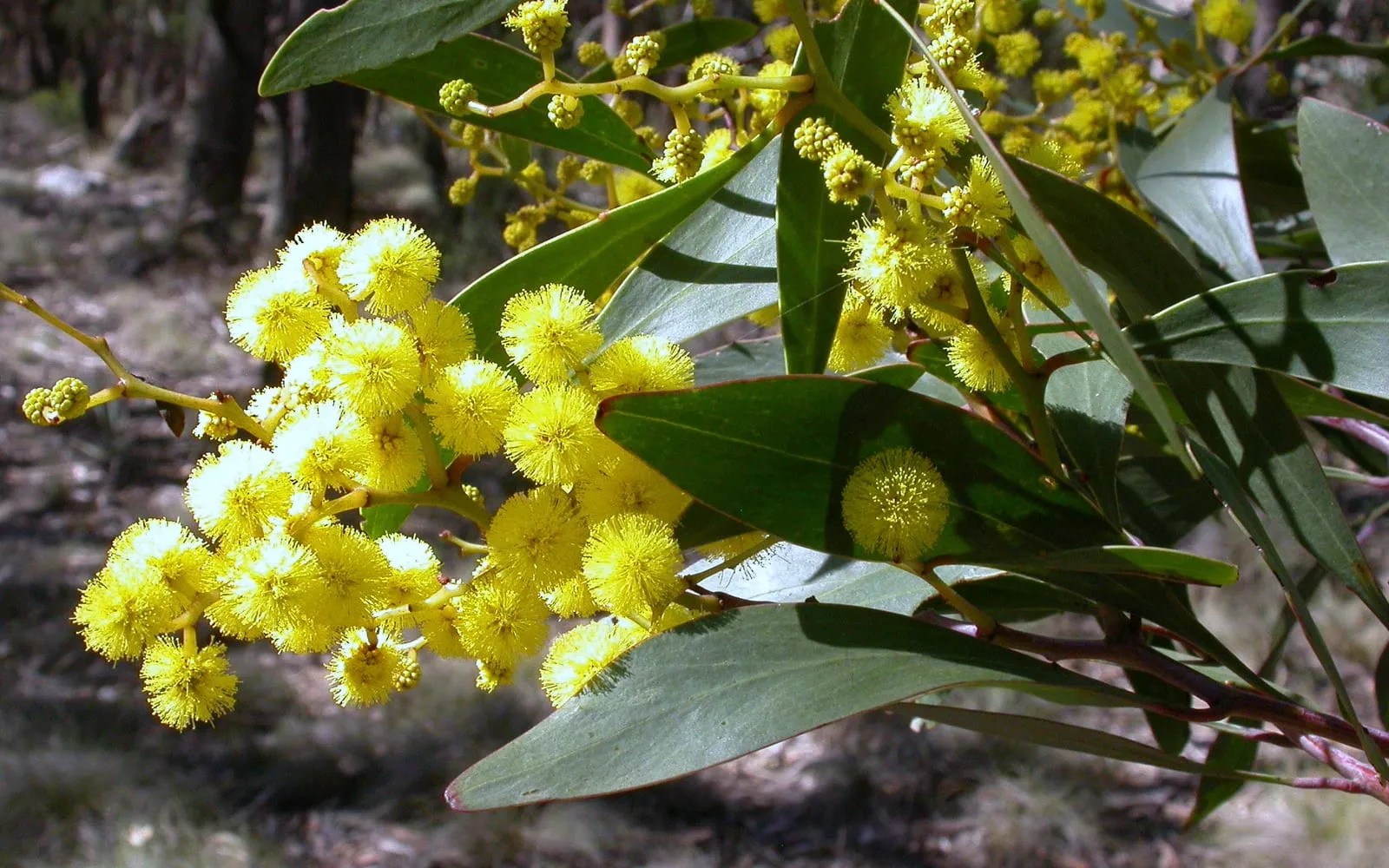
What look like leaves are phyllodes, flattened leaf stalks that do the work of photosynthesis in place of true leaves, which only appear briefly on young seedlings before the mature phyllode form takes over. They are sickle-shaped, glossy dark green, and up to 15 cm long, giving the plant a slightly grey-green, willowy texture even without flowers.
The flowers are the main event: dense, fluffy, ball-shaped heads of tiny golden florets, carried in long sprays that can cover the whole plant so thickly the foliage almost disappears beneath them. They open in late winter into spring and carry a strong, sweet fragrance that travels well beyond the plant itself.
The branches have a naturally weeping, arching habit that gives an established specimen real grace even out of flower, and the smooth grey bark, once an important source of tannin for leather processing, adds further interest through the rest of the year.
Where it is from
Acacia pycnantha is native to southern Australia, mainly through Victoria and South Australia with an extension into southern New South Wales, where it grows in dry sclerophyll forest and open woodland on clay and loam soils. It typically colonises disturbed or open ground quickly after fire or clearing, which is part of why it grows so fast from seed.
Its native climate pairs a hot, dry summer with a cooler, wetter winter, and the plant is built for exactly that rhythm. Deep roots find moisture through a dry summer, and the dormant season expects cool conditions rather than prolonged cold and waterlogging.
How it grows
Plant in full sun in soil that drains freely, since this matters more to its survival than soil fertility, which it tolerates at almost any level from poor sand to average garden loam. Avoid heavy clay that holds winter wet around the roots.
Young plants need regular watering to establish a strong root system, but once settled, an established wattle copes with drought far better than with excess moisture and rarely needs supplemental watering except in a prolonged dry spell.
Prune lightly after flowering to keep growth compact and to encourage branching, since an unpruned plant can become leggy and top-heavy as it ages. Avoid cutting hard into old wood, which many wattles regenerate from poorly.
Where winters are too cold for it outdoors, grow it in a large container of free-draining, gritty compost, in the sunniest spot available, and move it under cover once temperatures approach freezing.
Through the seasons
Winter brings the start of flowering in a mild climate, with the full golden display peaking as the season turns towards spring.
Spring is the tail end of flowering and the main period of vigorous new growth, the best time for any formative pruning once the flowers have finished.
Summer is a quieter growth period. Water young or container-grown plants during dry weather, and watch established plants for any sign of stress in extreme heat.
Autumn is a reasonable time to plant a new specimen where winters stay mild, giving roots a chance to establish before the following spring’s flush of growth.
Care difficulty
Moderate. The plant itself needs very little once it is in the right spot, but getting that spot right, full sun, sharp drainage, and enough winter protection where frosts are more than light, is the part that takes judgement. Growers who give it heavy soil or a cold, damp winter lose plants to root rot regardless of how well everything else was done, while growers who match its native conditions get a fast, floriferous shrub with minimal ongoing effort.
Watering
Water young plants regularly through their first one to two growing seasons to establish a deep root system, letting the soil dry somewhat between waterings rather than keeping it constantly damp.
Once established in the ground in a reasonably dry climate, it needs little or no supplemental watering and often does better on natural rainfall alone. Container-grown plants need more regular attention, since a pot dries out and also drains less forgivingly than open ground.
Warning signs, diseases and pests
Gall wasps lay eggs that trigger woody, knobbly swellings on the stems and phyllodes. Light infestations rarely threaten the plant’s health; prune out and dispose of heavily galled growth if it becomes disfiguring.
Scale insects attach to stems and the undersides of phyllodes as small, flat, brownish bumps, sapping the plant and excreting sticky honeydew. Treat with horticultural oil if numbers build up.
Sooty mould, a black fungal coating, grows on the honeydew that scale insects leave behind rather than on the plant tissue itself. Controlling the scale removes the mould’s food source and it clears on its own.
Root rot is the most serious risk, appearing as sudden wilting, yellowing foliage and dieback in soil that stays wet through winter. There is no cure once it has taken hold in the roots; prevention through sharp drainage is the only reliable defence.
Growing environment
Full sun is essential for strong flowering and compact, healthy growth. A shaded position produces a thin, leggy plant that flowers poorly if at all.
Free-draining soil matters more than fertility. Golden wattle grows well in poor, sandy or gravelly ground that would disappoint most flowering shrubs, and struggles in anything that holds winter moisture around the roots.
Shelter from the coldest winds helps in a marginal climate, and a south-facing wall that reflects extra warmth can be the difference between losing young growth to frost and getting away with it.
Feeding
Feeding is rarely necessary and can do more harm than good. Like many Australian native plants, golden wattle is adapted to naturally low- phosphorus soils, and a high-phosphorus fertiliser can damage or kill it outright rather than boost growth.
Where soil is very poor, a light application of a low-phosphorus, native-plant formulated feed in spring is the safer choice, and even that is optional on any soil of ordinary garden fertility.
Troubleshooting
My plant flowered heavily for a few years and then died. This is often its natural lifespan, since golden wattle is a fast-growing but relatively short-lived shrub even in ideal conditions. Planting a younger replacement nearby before the old one declines keeps a continuous display going.
The leaves and stems have wilted suddenly. Check the soil and drainage first, since root rot from waterlogged ground is the most common cause of sudden collapse in this species. There is no recovery once roots have rotted extensively; improving drainage before replanting is the only way to avoid a repeat.
It has grown very tall and leggy with flowers only at the top. A result of too little light or too little formative pruning when young. Light pruning straight after flowering each year, rather than one hard cut on an old plant, keeps growth compact from the start.
Can I grow it in a cold climate? Only with real effort. It needs a sheltered, sunny spot or a container that can be moved under cover through winter wherever frost is more than occasional and light, since it has little tolerance for prolonged cold or wet conditions.
Why has it stopped flowering as well as it used to? Age, shade creeping in from nearby growth, or a high-phosphorus feed applied by mistake are the three most likely explanations. Checking light levels and feeding history usually points to which one applies.