
Outdoor plant
Cabbage Palm
Sabal palmetto
Also known as Sabal Palm, Palmetto
How to grow cabbage palm, Sabal palmetto. Why a young plant shows no trunk for years, in what growers call the grass stage, its rare tolerance for salt, wind and cold, and why harvesting its edible heart kills the tree.
At a glance
- Difficulty
- Moderate
- Water
- Regularly while young or newly transplanted; drought-tolerant once established
- Light
- Full sun; tolerates part shade while young
- Temperature
- Among the most cold-hardy palms grown, but still damaged by a hard, prolonged freeze
- Hardiness
- USDA 8a-11, RHS H3, hardy to -15 C
- Type
- Evergreen fan palm
- Height
- 10-20 m, exceptionally to 30 m
- Native to
- the southeastern United States, the Caribbean
Native as far north as coastal North Carolina, well outside the tropics most palms need, and established plants have survived brief drops well below freezing. Duration matters more than the single lowest figure: a short, hard freeze does far less damage than several days held near or below freezing, which is the more useful way to judge a given site's suitability than the minimum temperature alone.
Hardiness zones describe winter cold alone. Summer heat, humidity, rainfall and the length of the growing season decide as much, so treat the range as the outer limit rather than as a recommendation.
Not known to be toxic
- Safe to eat
- The heart, or terminal bud, is edible and traditionally eaten as "swamp cabbage", though removing it kills the palm
Sabal palmetto is not documented as toxic to people, cats, dogs or horses, and does not appear on the RHS list of harmful garden plants. Its small dark fruit is eaten readily by birds and wildlife, and the plant's common name comes from its edible terminal bud, historically harvested and cooked as "swamp cabbage" or "heart of palm" by early settlers and still occasionally eaten today. That harvest is destructive rather than a routine yield, since a palm has only one growing point and cutting it out kills the tree, so it is a once-only use rather than an ongoing food source from a living specimen.
Sources: RHS potentially harmful garden plants, ASPCA toxic and non-toxic plants
About
Cabbage palm is the tough, salt-tolerant fan palm behind much of the coastal Southeastern United States landscape, and the state tree of both Florida and South Carolina. It tolerates wind, salt spray, drought, poor soil and real cold far better than most palms, which is why it survives along exposed beaches and through the occasional hard freeze that would kill a more tropical species outright.
Its one real demand on a gardener’s patience is time. A young plant can spend years with no visible trunk at all, building an extensive root system below ground before it starts putting height on above it, a stage growers call the grass stage. Once that root system is established, growth continues steadily and the palm needs very little upkeep.
Appearance and character
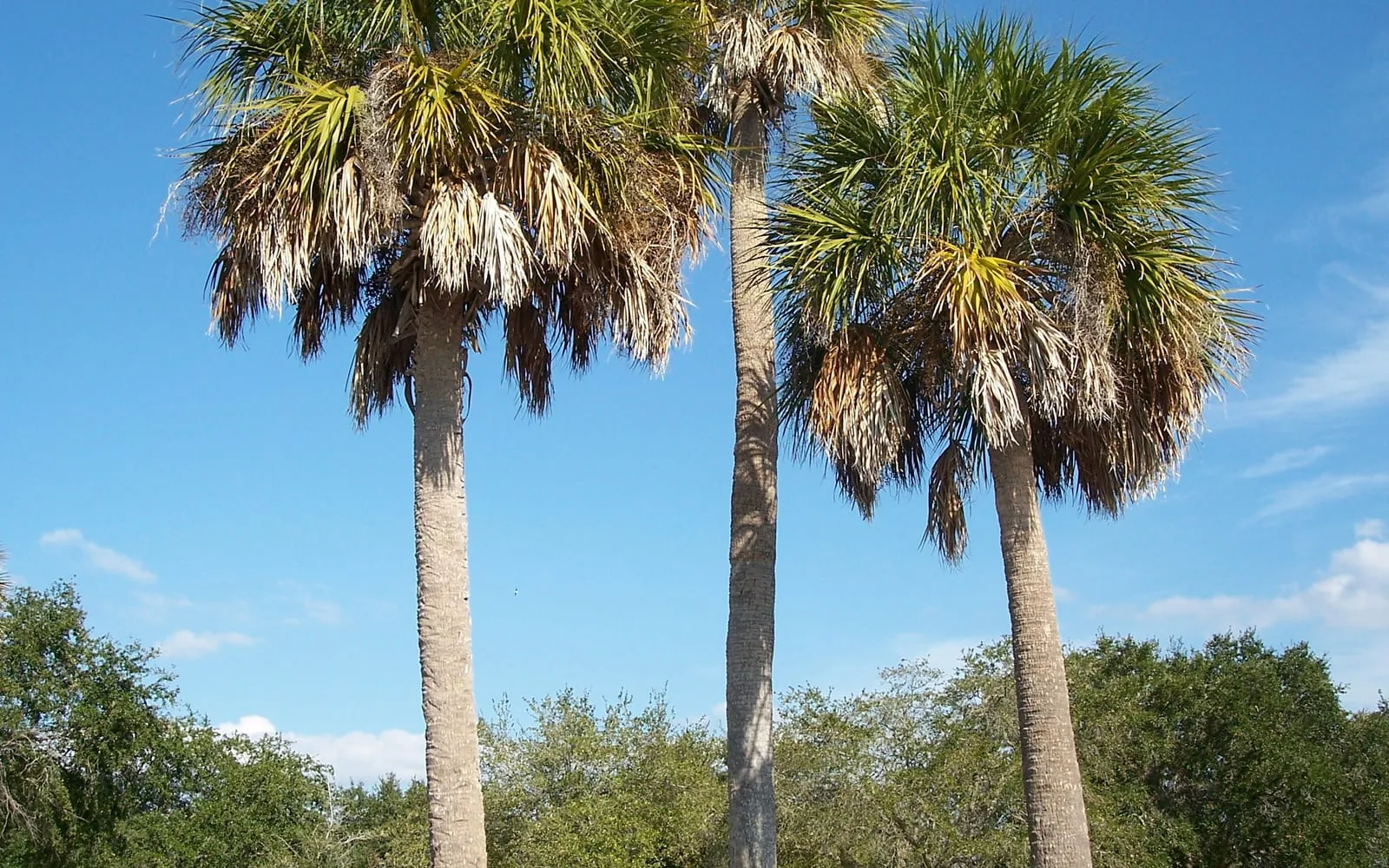
Fan-shaped fronds, deeply divided into narrow segments, radiate from the crown on long, sturdy stalks armed with small teeth along the edges. The overall colour is a deep, slightly blue-toned green, and a healthy crown carries enough fronds to look consistently full rather than sparse.
Young plants show no trunk above ground for a period that can run to several years, all their growth going into roots below the surface. Once trunk formation begins, older leaf bases often persist as a rough, crosshatched pattern for a time, a texture nurseries call a boot, before weathering away on an older specimen to leave a smooth, pale grey trunk similar in appearance to other tall fan palms.
Small white flowers appear in large branched clusters in early summer, followed by abundant small, round, dark fruit that ripens through autumn and draws significant numbers of birds and other wildlife.
Where it is from
Sabal palmetto grows naturally across the coastal plain of the southeastern United States, from North Carolina south through Florida and west along the Gulf coast, as well as through parts of the Bahamas and Cuba. It is equally at home on exposed dunes, in salt marshes at the landward edge, and in drier upland pine woods further inland, a tolerance for very different conditions that few other palms match.
That range across both coastal exposure and a real winter, further north than almost any other palm native to the Americas grows wild, is the source of its combined salt tolerance and cold hardiness. Few palms are asked to handle a Carolina winter and an oceanfront gale as the same plant, and this one has adapted to both.
How it grows
Plant it in full sun in well-draining to occasionally wet soil; it tolerates both drought and periodic flooding better than most trees, though it does not want permanently waterlogged ground.
Expect a slow start. A young plant, particularly one grown from seed rather than transplanted as an already-established specimen, may show little visible growth above ground for several years while its root system develops. This is normal rather than a sign of a struggling plant, and pulling at or disturbing a trunkless young palm to check its roots does far more harm than leaving it alone.
Transplanting an established specimen is a specialist job in commercial landscaping, and cabbage palms are notoriously slow to regenerate roots after being moved, which is why nurseries commonly remove most or all of the fronds at transplant time, a practice sometimes called a hurricane cut, to reduce water loss while the root system re-establishes. A transplanted palm can take a full growing season or more to resume normal growth, and heavy watering through that period matters more than almost anything else for its survival.
Through the seasons
Spring brings the resumption of active growth after any winter slowdown, and is a reasonable time to plant a new specimen.
Summer is the main growing and flowering season, with the large flower clusters opening and fruit beginning to set.
Autumn sees fruit ripen and drop, drawing wildlife, while growth begins to slow as temperatures fall.
Winter is the test of a given site’s suitability. An established plant tolerates brief hard freezes well; watch for foliage damage after a prolonged cold spell rather than after a single frosty night.
Care difficulty
Moderate overall, with the difficulty concentrated almost entirely in establishment rather than ongoing care. A young or newly transplanted plant needs patience through a slow, trunkless growth phase and consistent watering while its root system develops, and a transplanted specimen in particular can take a season or more to show it has survived the move at all. Once established, this is one of the more resilient palms available, tolerating drought, salt, wind and a real winter with very little routine attention beyond occasional feeding.
Watering
Water a young or newly transplanted plant regularly and deeply, keeping the root zone consistently moist while new roots develop; this species regenerates roots slowly after disturbance, and inconsistent watering during that period is a common cause of transplant failure.
Once established, it tolerates drought well and typically needs supplemental water only during an extended dry spell, particularly in a naturally sandy or free-draining site.
Warning signs, diseases and pests
Potassium deficiency is common in this species, especially in soil the nutrient has been depleted from, showing as yellow-orange spotting or frizzled, weak tips on the oldest fronds while newer growth stays green. A palm-specific fertiliser with a high proportion of potassium corrects it gradually, though already affected fronds will not recover their normal appearance.
Scale insects appear as small, flat, brownish bumps on the fronds and leaf bases, sapping the plant and occasionally leaving a sticky residue. Horticultural oil applied to affected areas is the standard treatment.
Root rot develops in ground that stays saturated for long periods rather than the occasional flooding this species otherwise tolerates well. Improve site drainage if standing water is a persistent rather than occasional feature of the planting spot.
Transplant shock is the single biggest risk to a moved specimen, showing as stalled growth, browning fronds or a general decline over the following months. Consistent deep watering and patience, sometimes for a full growing season or more, are the only real response, since there is no way to speed up root regeneration once it has been disturbed.
Growing environment
Full sun suits a mature plant best, while a young one tolerates and sometimes benefits from part shade during its slow trunkless stage.
A wide range of soil is tolerated, from dry sandy ground to periodically wet, salt-influenced soil near the coast, provided drainage is at least adequate over the longer term.
Wind and salt exposure, which would damage many other trees, are conditions this species is specifically adapted to and generally tolerates without protection.
Feeding
Apply a palm-specific fertiliser with a high proportion of potassium two to three times through the growing season, which addresses the deficiency this species commonly shows in cultivated soil more directly than a general-purpose feed would.
Consistent, moderate feeding from an early age helps prevent the visible nutrient problems this palm is prone to, which take a long time to correct once they appear in the crown.
Troubleshooting
My young palm has shown no trunk after several years. Is something wrong? Probably not. This species can spend years building its root system below ground before any trunk becomes visible, a normal stage called the grass stage rather than a sign of poor health.
A palm we transplanted looks poor months later. Will it recover? Possibly, but recovery is slow. Root regeneration after transplanting is notably sluggish in this species, and consistent deep watering through the following growing season gives it the best chance; a full year or more before it looks fully settled again is not unusual.
The oldest fronds have turned yellow-orange and frizzled at the tips. Potassium deficiency is the likely cause. Switch to a high-potassium palm fertiliser; new growth should improve over several seasons, though the already affected fronds will not recover.
How much cold can an established plant really take? More than most palms, including brief hard freezes well below freezing, but duration matters. A short, sharp frost does far less damage than several consecutive days near or below freezing, so a marginal climate is a bigger risk from a prolonged cold spell than from a single cold night.
Can I harvest the heart of palm from my own tree? Only at the cost of the tree itself. Removing the terminal bud, the only point new fronds grow from, kills the palm outright, so this is a one-time harvest rather than a technique for ongoing use from a living plant.