
Outdoor plant
Sacred Fig
Ficus religiosa
Also known as Bodhi Tree, Peepal Tree, Pipal
Practical guidance for growing sacred fig, Ficus religiosa, including its heart-shaped drip-tip leaves, obligate fig wasp pollination, its role as the Bodhi tree, frost tenderness, and its milky irritant sap.
At a glance
- Difficulty
- Moderate
- Water
- Regularly through active growth; reduced in the dry, leafless rest period
- Light
- Full sun
- Temperature
- True tropical to warm subtropical; no frost tolerance
- Hardiness
- USDA 10b-12, RHS H2, hardy to -1 C
- Type
- Semi-deciduous tropical tree, often beginning life as an epiphyte, extremely long-lived
- Height
- 20-30 m in the open ground of its native climate
- Native to
- the Indian subcontinent
A lowland tropical to warm subtropical tree with essentially no frost tolerance. It sheds its leaves briefly and predictably each year in the hot dry season before its native monsoon breaks, a rest triggered by drought rather than by cold, and that habit does not translate to surviving a temperate winter outdoors. Outside a frost-free climate it is grown in a container, most often trained as a bonsai, and brought under cover whenever temperatures approach freezing.
Hardiness zones describe winter cold alone. Summer heat, humidity, rainfall and the length of the growing season decide as much, so treat the range as the outer limit rather than as a recommendation.
Harmful if eaten
- Do not eat
- Milky latex sap in the leaves and stems
- Harm from
- Eating it and handling it
- Affects
- People, cats and dogs
Sacred fig produces a milky latex sap common to the genus Ficus, and the ASPCA lists Ficus among plants mildly toxic to cats and dogs, typically causing oral irritation, drooling and vomiting if a leaf or stem is chewed rather than anything more serious. The same sap can irritate human skin on contact, particularly with repeated handling during pruning, and a small number of people develop a genuine contact allergy to Ficus sap and pollen with repeated exposure, a reaction documented across the genus rather than specific to this species. The RHS does not list sacred fig individually among its potentially harmful garden plants. None of this makes the tree dangerous to keep around a household; gloves for pruning and keeping a curious puppy from chewing the foliage cover the realistic risk.
Sources: ASPCA toxic and non-toxic plants, RHS potentially harmful garden plants
About
Sacred fig is the tree under which the Buddha is said to have attained enlightenment at Bodh Gaya. Buddhism reveres it as the Bodhi tree, and Hinduism and Jainism hold it sacred too, under the common Sanskrit-derived name peepal.
Away from its religious significance it is a large, long-lived fig with a distinctive heart-shaped leaf drawn out into a long, slender tip, and a growth habit that often starts high off the ground, germinating in a crack in another tree’s bark or in the masonry of an old building before its roots ever reach soil.
Appearance and character
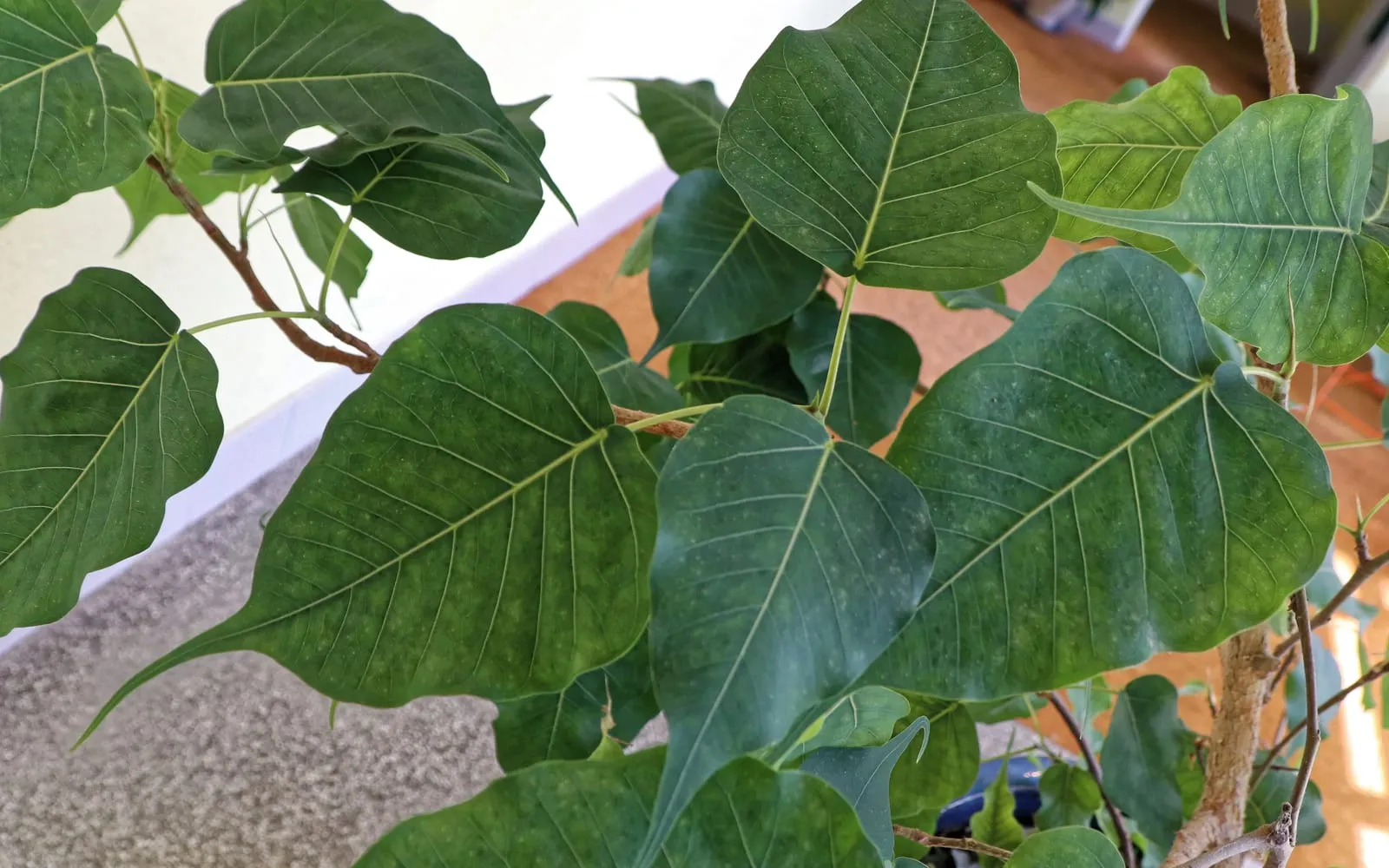
Leaves are heart-shaped at the base and taper to a long, narrow drip-tip, glossy and leathery, held on slender stalks so that the whole canopy moves and flutters in the lightest breeze, a trait shared with several other figs but especially noticeable here given the length of the tip.
Bark is smooth and pale grey on younger wood, developing a rougher texture with age, and aerial roots hang from branches and can reach the ground over time, thickening into secondary trunk-like supports on an old, wide-spreading specimen, though rarely to the dramatic banyan-like extent of some of its relatives.
The tree is briefly leafless in its native dry season before flushing new bronze-red foliage that hardens to green, a semi-deciduous habit rather than a true dormancy. Its tiny flowers are hidden entirely inside a fig, pollinated by a single specialised wasp species with no other host, one of the best-known examples in the plant kingdom of an obligate one-to-one relationship between a plant and its pollinator.
Where it is from
Ficus religiosa is native to the Indian subcontinent, ranging across India, Nepal, Bangladesh, Sri Lanka and into parts of Southeast Asia, and it typically begins life as an epiphyte, its sticky seeds deposited by fruit-eating birds and bats into a crevice in the bark of a host tree or in the joints of old stone or brick structures, sending roots downward in search of soil long before the seedling depends on any of its own.
Its pollination depends entirely on a single species of tiny fig wasp, Platyscapa quadraticeps, long listed under the older name Blastophaga, which enters the developing fig to lay eggs and in doing so carries pollen from one tree to the next; without that specific wasp, the tree cannot set viable seed at all, a level of mutual dependency typical of figs generally and especially well studied in this species.
Individual sacred figs are tended and revered across a huge span of history. The Sri Maha Bodhi in Sri Lanka, grown from a cutting of the original tree at Bodh Gaya and planted in 288 BC according to historical record, is widely cited as the oldest planted tree in the world with a continuous, documented history, still tended and visited today.
How it grows
Where the climate stays frost-free year round, plant in full sun in almost any reasonably drained soil, giving it room to eventually spread wide, since a mature specimen in open ground can reach a considerable size in both height and canopy width over decades.
Outside the tropics, grow it in a container. It is a popular subject for bonsai, tolerating hard root pruning and repeated shaping well, and a potted specimen can be kept small and ornamental for many years with regular attention rather than allowed to grow toward its natural size.
Repot a container specimen every two to three years, refreshing the growing medium and trimming roots as needed to keep it in scale with its pot.
Bring a container-grown tree under cover well before the first frost is expected, since it has essentially no cold tolerance and will drop leaves and can suffer lasting damage even from a light frost that many other so-called tender plants would tolerate.
Through the seasons
The dry season, corresponding to late winter into spring across much of its native range, is when the tree briefly sheds its leaves before flushing fresh bronze-red growth as conditions turn wetter.
The wet season brings the bulk of the year’s growth, and figs develop and ripen through this period, drawing the birds and bats that disperse the seed.
In a temperate climate, growth follows the warm months under glass or indoors, slowing markedly once light and temperature drop in autumn.
Winter, wherever the climate is not frost-free, means keeping the tree under cover, with reduced watering and no feeding until growth resumes in spring.
Care difficulty
Moderate. Where the climate is warm and frost-free year round, sacred fig grows readily with minimal attention. Everywhere else, the whole of its care revolves around one fact: it has no meaningful cold tolerance, so a container-grown specimen needs a frost-free space for the cooler months and careful watering that avoids both drought stress and a permanently soggy root zone.
Watering
Water regularly through active growth, allowing the top few centimetres of soil to dry out between waterings rather than keeping the root zone constantly wet.
Reduce watering markedly during the tree’s natural leafless rest period, whether that falls in its native dry season outdoors or during a slower winter indoors, since a dormant or semi-dormant root system takes up far less water and is more vulnerable to rot if kept damp.
Warning signs, diseases and pests
Scale insects are a common problem on Ficus generally, appearing as small, flat, brownish bumps along stems and leaf midribs, sapping the plant and often leaving a sticky residue behind.
Mealybug shows as small white, cottony masses tucked into leaf joints and new growth, and responds to the same treatment as scale.
Spider mite thrives in hot, dry air, particularly on an indoor or under-glass specimen, showing as fine pale speckling on the leaves. Raising humidity around the plant helps prevent it.
Root rot follows a pot or bed kept too consistently wet. Figs generally prefer a cycle of moist then drying-out conditions over constant damp, and a container specimen in particular needs drainage holes that stay clear rather than clogged with compacted compost.
Growing environment
Full sun suits it best wherever the climate allows outdoor planting, matching its origin as a large canopy tree of open tropical and subtropical settings.
Almost any reasonably drained soil is tolerated, including poor or compacted ground, which is part of why it establishes so readily on old walls and buildings in its native range.
Outside the tropics, a bright spot with as much direct or strong indirect light as possible suits a container specimen best, since low light produces thin, sparse growth on a tree adapted to full tropical sun.
Feeding
Feed with a balanced liquid fertiliser through active growth, roughly every two to four weeks, adjusting to the specimen’s size and the container it is growing in.
Stop feeding entirely during the leafless rest period, whether that occurs outdoors in a natural dry season or indoors over a slow winter, since a resting tree takes up very little and unused fertiliser only accumulates as salts in the growing medium.
Troubleshooting
My tree has dropped all its leaves. Check first whether this coincides with its natural dry-season rest, in which case fresh growth should follow once watering and warmth pick up again. Sudden leaf drop outside that pattern usually points to cold damage, a sudden change in light or location, or a root system sitting in water.
Can I grow this outdoors where I live? Only where winters stay frost-free. Even a light frost can damage or kill this tree, so anywhere that sees winter temperatures near or below freezing needs it grown in a container and brought under cover for the cold months.
White sticky sap came out when I trimmed a stem. That is normal latex sap, common to the whole fig genus. Wear gloves when pruning to avoid skin irritation, and keep pets from chewing cut stems or fallen leaves while the sap is still wet.
Will my tree ever produce real figs? It can flower and fruit given enough size, warmth and years, but pollination in the wild depends on a single specialised wasp species that a container specimen outside the tree’s native range will never encounter, so any figs it does produce will not contain viable seed.
Is this really the same kind of tree as the original Bodhi tree? Yes, botanically. Ficus religiosa is the species associated with the Buddha’s enlightenment, and the Sri Maha Bodhi in Sri Lanka, grown from a cutting of that original tree and planted in 288 BC, is one of the oldest continuously documented planted trees anywhere in the world.