
Houseplant
Sky Plant
Tillandsia ionantha
Also known as Sky Plant Air Plant, Blushing Bride
How to grow Tillandsia ionantha. The small clustering rosette that blushes scarlet before it flowers, dunked rather than soaked, and its rapid pups.
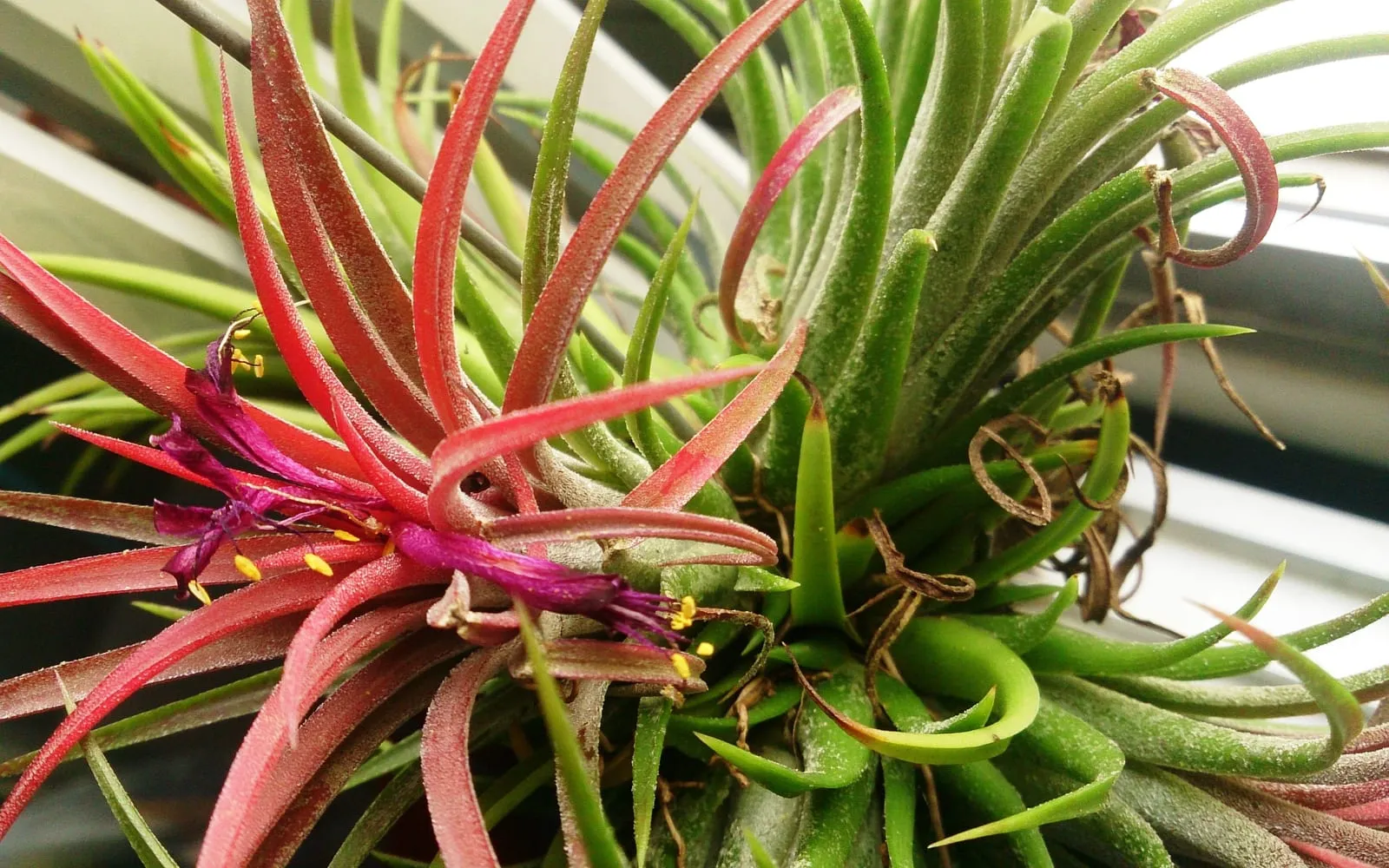
At a glance
- Difficulty
- Easy
- Water
- Mist or dunk the whole rosette two to three times a week, drying within a few hours
- Light
- Bright light with two to three hours of direct sun. More light than most houseplant Tillandsia want
- Temperature
- 10-30 deg C. Never below 4 deg C
- Humidity
- Moderate, with good air movement. Tolerates drier air better than larger tank bromeliads
- Hardiness
- USDA 9-11, RHS H1b, hardy to 4 C
- Type
- Evergreen epiphyte, flowering once per rosette and producing offsets rapidly around its base
- Height
- 5-10 cm across, clumps spreading wider over time
- Native to
- Mexico, Guatemala, Honduras, El Salvador, Nicaragua, Costa Rica
Dry tropical forest and scrubland across Mexico and Central America, with a marked dry season each year. The zone number covers the winter minimum only; the strong red blush this species is grown for depends on the bright light of that habitat rather than on temperature, and a shaded plant stays green regardless of how warm the room is.
Hardiness zones describe winter cold alone. Summer heat, humidity, rainfall and the length of the growing season decide as much, so treat the range as the outer limit rather than as a recommendation.
Not known to be toxic
Non-toxic. Tillandsia ionantha does not appear on the ASPCA's toxic plant list, and commonly cultivated Tillandsia species are recorded on the ASPCA's non-toxic register for cats and dogs. The RHS list of potentially harmful garden plants does not include it either. The leaves taper to a soft point rather than a rigid spine, and a small rosette handled by a curious cat or a child is more likely to be knocked off a shelf than to cause any injury. The one recurring hazard is not the plant itself but how it is often sold, glued into terrariums, fridge magnets or jewellery settings, and that glue kills the tissue it touches rather than posing any risk to a person or a pet.
Sources: ASPCA (Toxic and Non-toxic Plants, Tillandsia), RHS potentially harmful garden plants
About
A Sky Plant spends most of the year as a modest, silvery-green rosette barely the size of a golf ball, and then, once it is ready to flower, turns almost entirely scarlet from the centre outward. The colour change comes from the same kind of pigment shift that reddens a Neoregelia’s cup, though the two plants achieve it by different means and for a rosette a tenth the size, and it serves the same purpose: making a tiny flower more visible to whatever is meant to find it.
Tillandsia ionantha is among the most widely sold small air plants, prized for exactly that transformation and for how readily it multiplies once established. A single rosette that flowers typically leaves behind two, three or more offsets clustered at its base, and a small collection can turn into a dense mounted clump within a year or two without any deliberate propagation effort.
Unlike the broad silver ball of a Tillandsia xerographica or the rootless hanging strands of Spanish moss, a Sky Plant keeps a small, functional root system throughout its life, used for gripping whatever it is mounted on rather than for taking up water, which it still draws almost entirely through its leaves.
Appearance and character
A compact, upright rosette 5 to 10 cm across, made of narrow, slightly curved leaves covered in a fine silvery fuzz that is noticeably less dense than on a strongly silver species such as xerographica, which is why an unstressed ionantha reads as green rather than grey.
That fuzz is trichomes, the same water and nutrient-absorbing scales every Tillandsia relies on, and the lighter covering here is one reason this species wants water more often than a heavily silvered one: fewer trichomes means less reflective protection and a faster rate of water loss between waterings.
As the plant nears flowering, the whole rosette, or at least its inner leaves, blushes from green to a bright red or coral, often described as looking as though it has caught fire from the centre out. The blush can hold for weeks before the flower itself appears.
The flower is a single tubular violet bloom, emerging from the reddened centre and lasting only a few days, small enough that many owners notice the blush weeks before they spot the flower itself.
Offsets form quickly and abundantly around the base of a flowered rosette, more so than in most other Tillandsia species, and a plant left to cluster naturally forms a tight, rounded clump of a dozen or more small rosettes within a couple of years.
Where it is from
Tillandsia ionantha is native across Mexico and northern Central America, recorded from Guatemala, Honduras, El Salvador, Nicaragua and Costa Rica as well as Mexico itself.
It grows as an epiphyte on trees and, in more open habitat, directly on rock faces, favouring dry tropical forest, thorn scrub and similar seasonally dry vegetation rather than the humid rainforest that many other bromeliads come from.
That dry-season habitat is the reason the species tolerates, and indeed wants, more direct sun than most houseplant Tillandsia, and why the red blush develops so reliably in bright conditions and fails to appear at all in a shaded spot.
Populations across such a wide range vary noticeably in size, colour intensity and leaf shape, which is why plants sold under the same name can look quite different from one supplier to the next; several regional forms are recognised informally by growers even though they are not treated as separate species.
How it grows
Mount it, display it loose in a bowl, or wire it to a piece of driftwork or cork bark rather than potting it in anything, since it has no use for soil and a buried base rots within weeks.
Water by dunking the whole rosette in tepid water for a minute or two, or by misting it thoroughly, two to three times a week rather than on the longer twenty-to-thirty-minute soak schedule a larger, more silvery species such as xerographica uses. Its smaller size and lighter trichome covering mean it dries out faster and wants water more often as a result.
Shake off excess water afterwards and let it dry within a few hours, ideally somewhere with good airflow, since water trapped in the tight centre of the rosette can rot the base just as it can in any tank bromeliad, on a much smaller scale.
Give it more direct sun than most other air plants, two to three hours daily where possible. This is the biggest factor in whether the rosette blushes strongly or stays plain green.
Let offsets grow attached to the parent rather than separating them immediately. A cluster of several rosettes at different stages looks fuller and flowers more often overall than a collection of isolated single plants, since new rosettes keep reaching flowering size as older ones finish.
Separate a pup only once it has reached about half the size of the parent and has its own visible base, twisting it away gently or leaving the clump to grow as one mounted piece.
Feed sparingly by adding a heavily diluted bromeliad feed to the dunking water once a month through the growing season.
Through the seasons
Spring restarts active growth and is when many rosettes that have been building colour begin to flower. Resume monthly feeding, and check developing clumps for offsets ready to be separated if more space is needed.
Summer is the strongest growing period and the best time to give the plant extra direct sun, provided it is not scorching, since summer light levels are what push the deepest red blush.
Autumn slows growth gradually. Reduce feeding and keep watering steady as the two to three times a week routine, adjusting slightly for a cooler, less evaporative room.
Winter calls for closer attention to drying time. Increase airflow if the plant is kept somewhere warm and dry from central heating, since a small rosette that stays damp too long in a warm room is at more risk of rot than one left slightly under-watered.
Care difficulty
Easy, and one of the most forgiving Tillandsia species for a first-time grower, though its small size means mistakes show up faster than they would on a larger plant.
The two things that most commonly go wrong are water trapped in the centre of the tightly packed rosette, which rots the base, and too little light, which produces a plant that never blushes and rarely flowers even though it otherwise looks healthy.
Because it offsets so readily, a single mistake rarely wipes out an entire collection the way it might with a slower, single-rosette bromeliad; a clump usually has several rosettes at different stages, so losing one still leaves others in reserve.
Once the watering and light routine is established, a Sky Plant needs very little beyond regular dunking and asks nothing in the way of repotting, feeding heavily or precise humidity control.
Watering
Dunk the whole rosette in tepid water for a minute or two, or mist it thoroughly, two to three times a week.
Shake off any water pooled at the base afterwards and let it dry within a few hours in a spot with reasonable airflow, since a tight, damp centre is the main cause of rot in this species.
Water slightly more often in a warm, dry room and slightly less in a cool, humid one, judging by the leaves, which lose their slight curl and firm up noticeably after watering.
Use rainwater or filtered water where the tap supply is hard, since a build-up of mineral deposits shows clearly on the small leaves and can dull the red blush.
Signs of thirst are leaves that curl more tightly and lose their usual plumpness. Signs of a rotting base are a soft, darkened centre and outer leaves that pull away with little resistance.
Warning signs, diseases and pests
A soft, dark centre with leaves that detach easily is rot, from water left sitting in the tightly packed rosette after watering. Remove any obviously affected leaves, let the plant dry out fully, and shake it more thoroughly after future waterings.
A rosette that stays plain green and never blushes, even though it seems otherwise healthy, is most likely getting too little light. Move it somewhere with a few hours of direct sun and give it a season to respond.
Tightly curled, papery leaves point to underwatering. Increase how often you dunk or mist it, particularly in a warm or dry room.
Scale insects show as small, flat, brownish bumps, usually at the base of the leaves where they are hardest to see. Wipe them off with a cloth dipped in dilute soapy water, checking again after watering when they show up more clearly against wet leaves.
Mealybugs cluster as tiny white tufts between the leaf bases. A cotton bud dipped in isopropyl alcohol removes them, with a follow-up check a week later.
A parent rosette that browns and shrivels after flowering is behaving normally rather than failing. Leave it attached to its offsets, which will outlast it and eventually take over the space it leaves.
Growing environment
Bright light with two to three hours of direct sun, more than most houseplant Tillandsia want, gives the best chance of a red blush before flowering.
Warmth between 10 and 30 deg C, and protection from anything below 4 deg C, which damages the foliage within days.
Moderate humidity with good air movement. This species tolerates drier indoor air better than a broad tank bromeliad, though it still needs enough airflow to dry fully between waterings.
No soil at all. Mount it on cork bark, driftwood or a wire holder, or display it loose in a shallow bowl.
A spot close to a bright window, ideally one that gets some direct morning or late afternoon sun, suits it well, and an outdoor spot in a sheltered, bright position over summer often produces a deeper blush than an indoor windowsill can.
Away from radiators and other constant heat sources, which dry the small rosette out faster than the twice-weekly watering routine can keep up with.
Feeding
Feed once a month during the growing season by adding a heavily diluted bromeliad or air plant fertiliser, no more than a quarter of label strength, to the water used for dunking.
Avoid ordinary houseplant fertiliser at full strength, since a small rosette with a light trichome covering scorches from concentrated salts more readily than a larger, more heavily silvered species does.
Stop feeding entirely over winter, when growth slows and the plant needs little beyond its usual watering routine.
A Sky Plant that is never fed will still blush and flower reliably given enough light, since this species depends far more on light intensity than on feeding for its display.
Apply fertiliser only to a damp plant, since the trichomes need to be open to absorb anything at all, and a dry rosette takes up almost nothing from a feed applied without first wetting it.
Troubleshooting
Why has the whole plant turned red? That is the blush that precedes flowering, caused by pigments shifting in the leaves as the plant matures, and it is a sign of health rather than stress. A small violet flower usually follows within a few weeks.
My plant stays green and never blushes. It most likely needs more direct sun. Move it to a brighter spot with a few hours of direct light daily and give it a full growing season to respond.
How is this different from other air plants I’ve grown? A Sky Plant is smaller, wants water more often than a heavily silvered species such as xerographica, and offsets far more prolifically, typically leaving several pups around the base of every rosette that flowers.
The centre has gone soft and dark. That is rot, from water left sitting in the tightly packed rosette. Remove obviously affected leaves, let the plant dry out fully, and shake it more thoroughly after watering in future.
Can I keep the offsets attached to the parent? Yes, and it is often better to. A clump of rosettes at different stages flowers more often overall than separating each pup as soon as it appears.
It came glued into a terrarium display. Ease it away from the glue if you can reach the base. Hot glue and superglue kill the tissue they touch and block the point where new offsets form, so a plant left glued in place for a long time will struggle to thrive.
Does it need soaking like a larger air plant? No. A brief dunk of a minute or two, or a thorough misting, two to three times a week suits it better than a long soak, since its smaller size and lighter trichome covering mean it takes up what it needs faster than a larger species does.
Sky Plant problem guides
Not sure what is wrong? See the common houseplant pests guide.