
Outdoor plant
Umbrella Bamboo
Fargesia murielae
Also known as Fargesia, Clumping bamboo, Muriel bamboo
How to grow Fargesia murielae, the umbrella bamboo. The clump-forming bamboo that cannot run, why almost every plant on Earth flowered and died in the 1990s, and where it beats Phyllostachys.
At a glance
- Difficulty
- Easy
- Water
- Weekly through the first two years, then in drought
- Light
- Light shade or dappled sun. It dislikes hot full sun
- Temperature
- Fully hardy, to about -25 deg C
- Hardiness
- USDA 5-9, RHS H6, hardy to -25 C
- Type
- Evergreen clump-forming bamboo
- Height
- 3-4 m
- Native to
- Mountain forest in Hubei and Sichuan, central China
- Best month
- September in the Northern Hemisphere, March in the Southern Hemisphere
It clumps rather than runs, which is the single reason to choose it over Phyllostachys, and it will never need a root barrier. It comes from cool mountain forest in China, so it wants shade and moisture and scorches in hot dry sun. Fargesia species flower together across the world at intervals of eighty years or more and then die, which is a real risk when buying a named clone.
Hardiness zones describe winter cold alone. Summer heat, humidity, rainfall and the length of the growing season decide as much, so treat the range as the outer limit rather than as a recommendation.
Every month named in this guide is for the temperate Northern Hemisphere. If you garden in the Southern Hemisphere, shift each one by six months, so September becomes March. Closer to the equator the wet and dry seasons matter more than the calendar, and the shift stops being a useful guide.
Not known to be toxic
Non-toxic. The ASPCA lists bamboo among plants that are not toxic to cats, dogs or horses, and Fargesia does not appear on the RHS list of potentially harmful garden plants. The foliage is safe, which is why the giant panda can live on it, and Fargesia species are a significant part of the wild panda diet. Two clarifications are worth making. Lucky bamboo, sold in water in offices, is not a bamboo at all but Dracaena sanderiana, and that plant is toxic to cats and dogs, so the reassurance here does not transfer to it. And fresh bamboo shoots of any species contain taxiphyllin, a cyanogenic compound, so shoots intended for eating must be boiled before use. Fargesia shoots are small and rarely eaten, and nobody is harmed by a garden clump.
Sources: ASPCA (Bamboo, Bambusa spp), RHS potentially harmful garden plants
About
Bamboos divide into two groups and the division decides whether you will be happy with the plant in ten years.
Running bamboos, including every Phyllostachys, send out long underground rhizomes that surface metres from the parent. Clumping bamboos, including every Fargesia, produce short rhizomes that turn upward almost at once, so the plant expands as a slowly widening tussock. A Fargesia cannot run. There is no barrier to install and no neighbour to fall out with.
Fargesia murielae carries an extraordinary piece of botanical history. Ernest Wilson collected it in Hubei in 1907 and named it after his daughter Muriel. Almost every plant in Western cultivation was propagated vegetatively from that single collection, which made them all one clone sharing one flowering clock. In the 1990s that clock ran out. Plants across Europe and North America flowered simultaneously, set seed and died, and a great many gardeners lost their bamboo in the same season. Today’s plants are seedlings raised from that flowering, so the next event is roughly a century away.
Appearance and character
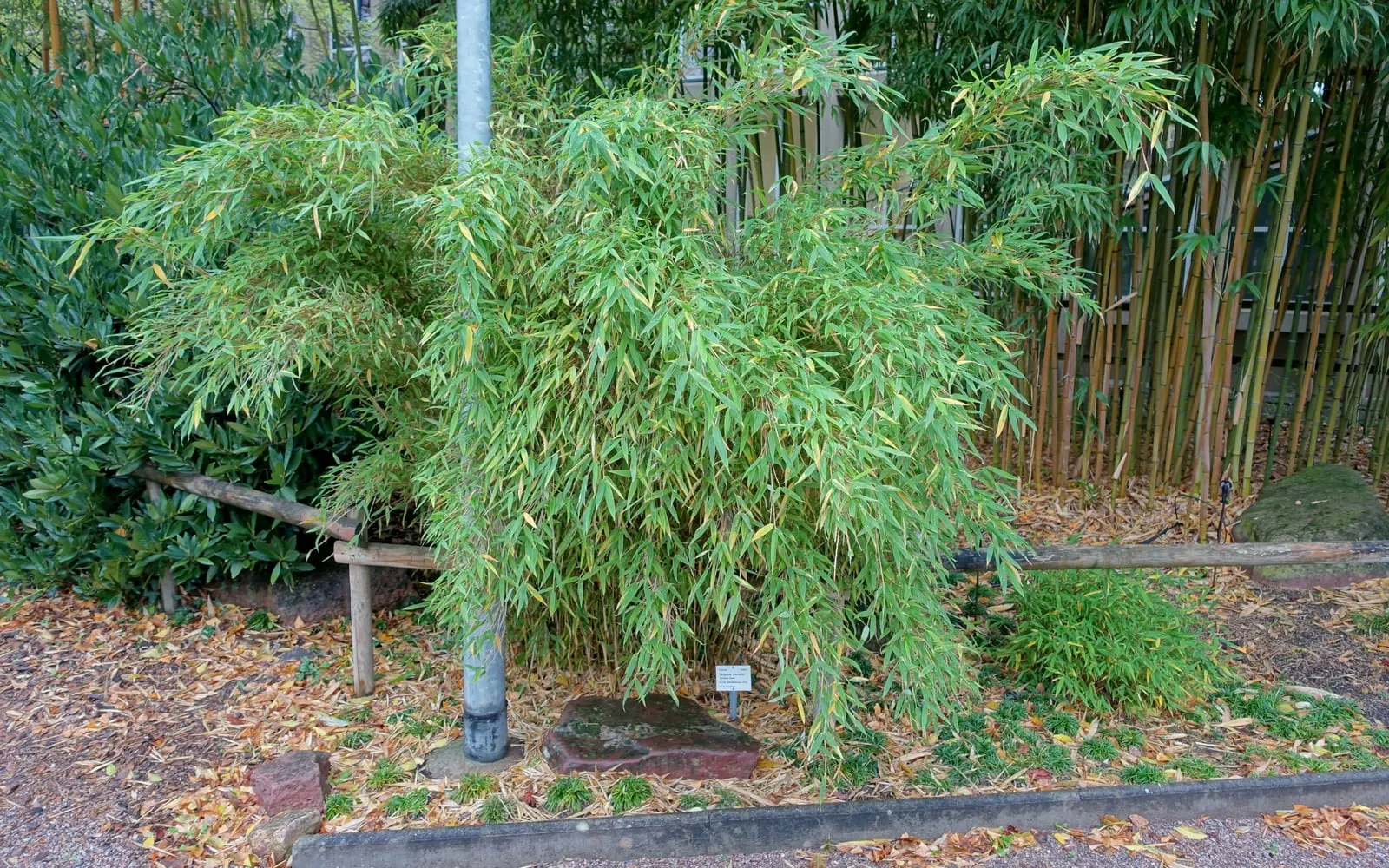
A dense arching clump of slender canes, 3 to 4 metres tall, reaching about 1.5 cm in diameter.
New canes emerge blue-green with a waxy bloom and mature to a soft yellow-green. They are thin enough to bend under the weight of foliage, which produces the fountain shape that gives the plant its common name.
Leaves are small, narrow and bright green, 5 to 10 cm long, tapering to a fine point, and they move constantly in the slightest breeze.
The clump expands outward by perhaps 5 to 10 cm a year, so a plant stays where you put it for decades.
‘Simba’ and ‘Bimbo’ are compact selections reaching around 2 metres, useful in a small garden or a large pot.
Fargesia rufa has reddish sheaths and better heat tolerance, and Fargesia nitida is taller with dark purple canes and needs more shade.
Where it is from
Mountain forest in Hubei and Sichuan in central China, growing at 1,500 to 2,500 metres in the understorey beneath deciduous trees.
Growing under a canopy is why this bamboo behaves differently from the sun-loving Phyllostachys. It wants light shade, and it scorches in hot open sun, particularly in a dry summer.
Those mountains are cold in winter, which is why Fargesia is among the hardiest bamboos available, coming through -25 deg C without damage.
The forest floor there stays moist and humus-rich. Drought is the condition Fargesia handles least well, and a plant in a dry sunny corner curls its leaves within days.
The same forests are giant panda habitat, and Fargesia species make up a substantial part of what wild pandas eat.
How it grows
An evergreen clump-forming bamboo with pachymorph rhizomes, meaning short thick rhizomes that curve upward and produce a new cane close to the parent.
New canes emerge in late spring and early summer, growing to their full height within a few weeks and then producing branches and leaves. A cane never thickens or lengthens after that first season.
Individual canes live around ten years. Cut the oldest out at ground level each spring to keep the clump looking fresh and let light into the centre.
The plant thickens rather than spreading, so the clump becomes denser and slightly wider each year without ever escaping.
Propagation is by division in spring. Cut a section from the edge of an established clump with a sharp spade, keeping plenty of root, and replant it immediately without letting it dry out.
Flowering is rare and, when it happens, usually fatal to the plant.
Through the seasons
Spring is when to plant, divide, feed and thin. New canes start to appear from May. Water new plantings well.
Summer brings the main growth and the highest water demand. Fargesia curls its leaves in drought as a signal, so watch for it and water before the clump suffers.
Autumn is a good planting season while the soil is warm. Reduce feeding.
Winter needs nothing. The plant is evergreen and fully hardy. Brush heavy snow off the canes so they are not bent permanently out of shape.
Care difficulty
Easy, and one of the most trouble-free evergreen screens available.
The single requirement is moisture. Fargesia has shallow roots and no tolerance for drying out. A plant in dry soil, in a hot sunny corner, or in an under-watered container will curl its leaves, brown at the edges and thin out. Mulching generously and siting it out of the hottest sun solves it.
The second point is patience. A newly planted Fargesia does very little in its first two years while it builds a root system, then begins producing taller canes each season. The old advice about bamboo is that it sleeps, creeps and then leaps.
Beyond that there is no pruning to learn, no barrier to install and no pest worth worrying about.
Watering
Water weekly through the first two growing seasons, giving a deep soak rather than a sprinkle.
Established clumps need water in prolonged dry spells. Fargesia is less drought-tolerant than most evergreens of its size.
Leaves curling inward lengthwise is the plant’s thirst signal, and it appears before any lasting damage. Water when you see it.
Container plants need frequent and generous watering through the growing season, often daily in hot weather. A pot is the one situation where a Fargesia can be killed outright.
Mulch thickly with compost or bark each spring, keeping it clear of the canes, to hold moisture through summer.
Reduce watering in winter without letting a container dry out completely.
Warning signs, diseases and pests
Leaves curling inward along their length means drought. It corrects within a day of watering.
Brown crispy leaf edges with leaf drop means the plant has been dry for a while, or is in too much sun and wind.
Yellowing leaves in quantity, with waterlogged soil, means the roots are sitting wet.
Some leaf drop in spring is normal. Bamboo is evergreen rather than everlasting, and it renews its foliage annually.
Bamboo mites cause fine pale stippling in rectangular patches on the leaves, with webbing on the undersides, and are worse on plants in hot dry positions.
Aphids produce honeydew that drips and turns sooty.
Old canes going brown and dying is ordinary. Canes live around a decade. Cut them out at ground level.
A clump flowering, with tufts of grassy flowerheads replacing leaves, is serious. The plant will usually die afterwards. Feed and water it heavily and take divisions in case, though survival is uncertain.
Growing environment
Light shade or dappled sun is ideal. Fargesia will take more sun in a cool damp garden and needs shelter from hot afternoon sun in a dry one.
Moist, fertile, well-drained soil with plenty of organic matter. Dig in compost before planting and mulch annually.
Fully hardy to about -25 deg C, and needs no winter protection.
Shelter from cold drying winds, which brown the foliage.
Plant clumps 1 to 1.5 metres apart for a screen. They will meet within three or four years without ever running.
No rhizome barrier is required. This is the whole reason to choose Fargesia over Phyllostachys when a garden is small or shares a boundary.
It grows well in a large container, given generous watering and repotting every three or four years.
Feeding
Feed twice, once in early spring and once in early summer, with a general-purpose or nitrogen-rich fertiliser. Bamboo is a grass, and it responds to nitrogen the way a lawn does.
An annual mulch of garden compost or well-rotted manure does most of the work and holds moisture at the same time.
Container plants need feeding monthly through the growing season, since they exhaust their compost quickly.
Stop feeding by the end of July so growth hardens before winter.
Lawn fertiliser is a cheap and effective bamboo feed, and should be used only where it will not reach anything that dislikes nitrogen.
Troubleshooting
Will it take over my garden? No. Fargesia is clump-forming and expands by 5 to 10 cm a year. If you want a bamboo that cannot spread, this is the genus to choose. Running bamboos are the ones needing a barrier.
The leaves have curled up. Drought. Water it thoroughly and they will uncurl within a day. Mulch to stop it recurring.
It has done nothing for two years. Normal. Bamboo builds roots before it builds canes. Feed, water and mulch, and it will accelerate in year three.
Brown edges on the leaves. Dry soil, hot sun, or cold wind. Move it to a sheltered lightly shaded spot, or mulch and water more.
Some canes have gone brown and died. Ordinary ageing at around ten years. Cut them out at ground level in spring.
It is flowering. Bad news. Bamboos flower rarely and usually die afterwards. Feed and water heavily, take divisions as insurance, and expect to replace it.
Which bamboo should I choose? For a small garden or a shared boundary, a Fargesia. For tall dramatic canes and space to contain them, Phyllostachys with a proper rhizome barrier. For a conservatory in a warm climate, Bambusa vulgaris.
Can I grow it in a pot? Yes, in a large one. Water generously and often, feed monthly through summer, and divide and repot every three or four years.