
Outdoor plant
Common Bamboo
Bambusa vulgaris
Also known as Golden bamboo, Buddha belly bamboo, Bambu
How to grow Bambusa vulgaris. The tropical clumping bamboo behind most of the world's bamboo construction, why it will not survive a temperate winter outdoors, and what to grow instead.
At a glance
- Difficulty
- Moderate
- Water
- Generously through the growing season. This is a thirsty plant
- Light
- Full sun to light shade
- Temperature
- Keep above 10 deg C. It is damaged near freezing and killed by frost
- Humidity
- High. It suffers in dry heated air
- Hardiness
- USDA 9b-12, RHS H1c, hardy to 5 C
- Type
- Evergreen clump-forming tropical bamboo
- Height
- 10-20 m in the tropics, 2-3 m under glass
- Native to
- Tropical Asia, though cultivated so widely that no wild origin is certain
- Best month
- May in the Northern Hemisphere, November in the Southern Hemisphere
It is a lowland tropical bamboo with no dormancy at all, so it stops growing near freezing and is killed by any real frost. It needs year-round warmth above about 15 C, high humidity and heavy rainfall, which outside the tropics means a heated glasshouse. It has naturalised across the tropics, including Hawaii and the Caribbean, where it forms dense stands along rivers.
Hardiness zones describe winter cold alone. Summer heat, humidity, rainfall and the length of the growing season decide as much, so treat the range as the outer limit rather than as a recommendation.
Every month named in this guide is for the temperate Northern Hemisphere. If you garden in the Southern Hemisphere, shift each one by six months, so May becomes November. Closer to the equator the wet and dry seasons matter more than the calendar, and the shift stops being a useful guide.
Not known to be toxic
Non-toxic as a growing plant. The ASPCA lists Bambusa species among plants not toxic to cats, dogs or horses, and bamboo does not appear on the RHS list of potentially harmful garden plants. Fresh shoots are a different matter and Bambusa vulgaris is the species where it matters most. All bamboo shoots contain taxiphyllin, a cyanogenic glycoside that releases hydrogen cyanide when the tissue is damaged, and the shoots of this species are notably high in it and correspondingly bitter. They must be peeled, sliced thinly and boiled in plenty of water, uncovered so the cyanide escapes as vapour, for at least twenty minutes before eating. This is why bamboo shoots reach the shops canned or cooked. Prepared properly they are safe, and eaten raw they cause serious poisoning. Do not eat shoots from this species without that preparation. Separately, lucky bamboo is Dracaena sanderiana rather than a bamboo, and that plant is toxic to cats and dogs.
Sources: ASPCA (Bamboo, Bambusa spp), RHS potentially harmful garden plants
About
Bambusa vulgaris is the most widely planted bamboo on Earth. It grows through the tropics of Asia, Africa, Latin America and the Pacific, and it supplies a large share of the scaffolding, housing, fencing and paper pulp that bamboo provides worldwide.
For a temperate gardener the important fact is temperature. This is a tropical clumping bamboo that wants a minimum of around 10 deg C, and it is damaged near freezing and killed by any real frost. It cannot live outdoors below USDA zone 9b.
That makes it a conservatory, heated greenhouse or large-conservatory plant here, grown for its thick golden canes rather than as a garden screen. If what you want is bamboo in a temperate border, this guide will tell you why to choose Fargesia or Phyllostachys instead, and the last section says which.
Appearance and character
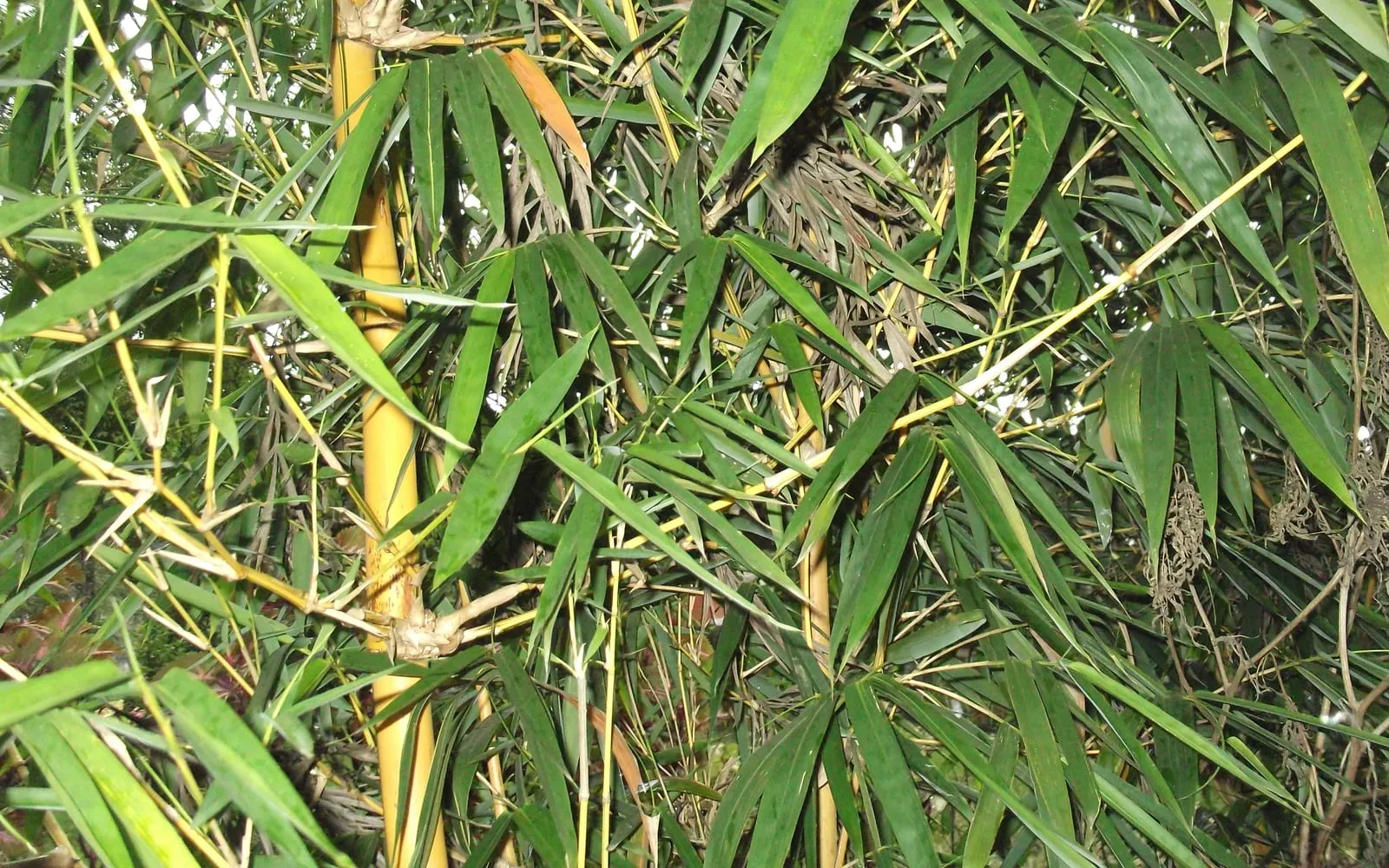
Thick arching canes, bright green or golden yellow, 5 to 10 cm in diameter, reaching 10 to 20 metres in the tropics and rather less under glass.
The canes are the feature. The commonly grown ‘Vittata’ is golden yellow with irregular dark green vertical stripes, and it is among the most handsome bamboo canes in cultivation.
‘Wamin’, the Buddha belly bamboo, has short internodes swollen into a series of bulges, giving a squat sculptural plant of two or three metres. It is often sold under the name Bambusa wamin.
Leaves are broad for a bamboo, 10 to 30 cm long and lance-shaped, mid to dark green, held in loose sprays.
Growth is clumping. The rhizomes are short and turn upward close to the parent, so the plant makes a dense expanding tussock rather than running.
Flowering is rare and gregarious, with whole populations flowering together. Many cultivated clones set no viable seed at all and are propagated entirely from cuttings.
Where it is from
Tropical Asia, most likely southern China and Indochina, though it has been carried around the tropics for so many centuries that no certainly wild population has been confirmed.
Its habitat is lowland tropical river valley and forest margin, hot and humid year-round, with heavy seasonal rain and rich moist soil.
Nothing in that description resembles a temperate winter. The plant has no dormancy, no frost tolerance and no mechanism for surviving cold, and this is the single reason it is a glasshouse plant outside the tropics.
It has naturalised across the tropics and is treated as an invasive weed in parts of Latin America, the Pacific islands and Africa, spreading along watercourses from cane fragments washed downstream.
The soil it prefers is rich, deep and moist, and it grows fastest where it is fed and watered hard.
How it grows
An evergreen clump-forming bamboo with pachymorph rhizomes, so the plant expands outward slowly and cannot run.
New canes emerge in the warm season and reach full height in weeks. A cane never grows taller or thicker after that first flush.
In the tropics this species is among the faster-growing plants on Earth, and under glass in a cool climate it grows at a fraction of that rate and reaches a fraction of the size.
Canes live around ten years. Cut the oldest out at the base each spring to keep the clump open.
Propagation is straightforward and unusual. Sections of cane containing a node will root when laid horizontally in warm damp compost, and branch cuttings taken at a node also work. Division of the clump in spring is the simplest home method.
Seed is rarely available because most cultivated stock does not flower or does not set viable seed.
Through the seasons
Spring is when growth restarts as temperatures climb. Divide, repot and start feeding. Increase watering.
Summer is the main growing season. Water and feed generously, ventilate the glasshouse to prevent scorching, and keep the humidity up.
Autumn slows growth. Reduce feeding from September and make sure the heating is working before the first cold nights.
Winter is a holding period. Keep the temperature above 10 deg C, keep the compost damp rather than wet, and watch for red spider mite, which thrives in the dry air of a heated glasshouse.
Care difficulty
Moderate in a heated glasshouse and impossible outdoors below USDA zone 9b, and the distinction is the whole guide.
Heat is the requirement. A minimum of 10 deg C through winter means a heated greenhouse or conservatory, and the running cost of that through a temperate winter is the real constraint on growing this plant.
Size is the second issue. Even restricted by a container this is a large bamboo, and it will fill a small conservatory within a few years.
Water and feeding are the third. It is a hungry, thirsty tropical grass, and a plant kept dry or underfed looks poor.
Given warmth, water, food and space it is not a difficult plant, and those four conditions rule it out for most temperate gardens.
Watering
Water generously through the growing season, keeping the compost consistently moist. This bamboo has a high water demand and suffers quickly when dry.
In a warm glasshouse in summer that may mean daily watering for a large container plant.
Reduce watering through winter while keeping the compost damp. Never let it dry out completely, and never leave it waterlogged in cold conditions.
Use rainwater where possible, particularly in a hard water area.
Mist the foliage or damp down the glasshouse floor in hot weather. High humidity suits the plant and discourages red spider mite.
Curling leaves indicate drought and correct within a day of watering.
Warning signs, diseases and pests
Browning and collapse after a cold night is frost or chill damage. Below about 5 deg C the foliage suffers, and a frost usually kills the plant outright.
Leaves curling lengthwise means drought.
Brown crispy leaf tips point to dry air, dry compost or both.
Yellowing leaves in quantity with sodden compost means the roots are too wet, which is more serious in cold conditions.
Red spider mite is the main glasshouse pest, producing fine stippling and webbing on the leaf undersides and thriving in hot dry air. Raise the humidity and damp down regularly.
Mealybugs gather at the nodes and in leaf sheaths as white fluff.
Scale insects show as brown bumps on canes and leaf undersides with sooty mould below.
Old canes browning at around ten years is ordinary. Cut them out at the base.
A clump flowering, with grassy tufts replacing leaves, usually precedes the death of the plant.
Growing environment
Full sun to light shade, and under glass anywhere that frosts.
Minimum temperature of 10 deg C. A heated greenhouse, a heated conservatory or a large warm sunroom are the realistic options here.
Rich, moist, free-draining compost. Use a loam-based John Innes No. 3 with added organic matter for a container plant.
High humidity suits it, and dry heated air brings red spider mite.
Choose a large heavy container, at least 60 cm across for a plant of any size, and expect to divide and repot every three or four years.
Give it room. Even a restricted plant reaches two to three metres under glass, and ‘Wamin’ is the sensible choice where space is limited.
This species will not survive a frost, and readers in USDA zones 9b and warmer can grow it in the ground, where its clumping habit makes it better behaved than a running bamboo.
Feeding
Feed monthly through the growing season with a high-nitrogen or general-purpose fertiliser. Bamboo is a grass and takes nitrogen readily.
A slow-release fertiliser applied in spring works well for container plants and saves repeated applications.
Top-dress large containers each spring with fresh compost where full repotting is impractical.
Stop feeding through winter while the plant is not growing.
Underfeeding shows as thin, short, pale canes each season, since a bamboo cane reaches its final size in its first few weeks and cannot improve later.
Troubleshooting
Can I grow it outdoors where I get frost? No. This is a tropical bamboo needing a minimum of about 10 deg C. Frost kills it. Grow it under heated glass, or choose a hardy species instead.
What should I grow instead? For a clump that cannot spread, choose Fargesia murielae, which is hardy to -25 deg C and tolerates shade. For tall dramatic canes, choose Phyllostachys nigra, which is equally hardy and needs a rhizome barrier because it runs.
Will it take over? Not by running. Bambusa is clump-forming, and it naturalises aggressively in tropical countries from cane fragments washed downstream, so never dispose of prunings into a watercourse in a warm climate.
The canes are green rather than gold. You may have the plain species rather than ‘Vittata’. Colour also improves with good light.
The leaves have curled. Drought. Water thoroughly and raise the humidity.
Fine webbing under the leaves. Red spider mite, which is the standard pest of bamboo under glass. Damp down the floor, raise the humidity, and rinse the foliage.
Can I eat the shoots? Only after thorough cooking. This species has notably high levels of cyanogenic compounds and bitter shoots. Peel, slice thinly and boil uncovered in plenty of water for at least twenty minutes. Never eat them raw.
Why is it called Buddha belly bamboo? That name belongs to ‘Wamin’, a cultivar with short internodes swollen into rounded bulges. It stays small and makes a good container plant.