
Outdoor plant
Black Bamboo
Phyllostachys nigra
Also known as Phyllostachys, Running bamboo, Kuro-chiku
How to grow black bamboo. Why a running bamboo needs a barrier before it needs anything else, how to install one properly, the legal risk of letting it spread, and how the canes turn black.
At a glance
- Difficulty
- Moderate
- Water
- Weekly through the first two years, then in drought
- Light
- Full sun or light shade. Sun gives the blackest canes
- Temperature
- Fully hardy, to about -20 deg C
- Hardiness
- USDA 6-10, RHS H6, hardy to -20 C
- Type
- Evergreen running bamboo, long-lived
- Height
- 4-8 m in a temperate climate
- Native to
- Hunan province, China, and cultivated across east Asia for centuries
- Best month
- September in the Northern Hemisphere, March in the Southern Hemisphere
It runs. Rhizomes travel several metres a year through good moist garden soil and come up through lawns, borders and neighbouring gardens, and the richer the ground the faster it moves. Encroachment onto a neighbouring property is actionable as private nuisance in England and Wales, several American states and municipalities regulate planting, and a root barrier 60 to 75 cm deep is the minimum precaution anywhere.
Hardiness zones describe winter cold alone. Summer heat, humidity, rainfall and the length of the growing season decide as much, so treat the range as the outer limit rather than as a recommendation.
Every month named in this guide is for the temperate Northern Hemisphere. If you garden in the Southern Hemisphere, shift each one by six months, so September becomes March. Closer to the equator the wet and dry seasons matter more than the calendar, and the shift stops being a useful guide.
Not known to be toxic
Non-toxic. The ASPCA lists bamboo among plants not toxic to cats, dogs or horses, and Phyllostachys does not appear on the RHS list of potentially harmful garden plants. Two points are worth adding. Fresh bamboo shoots of every species contain taxiphyllin, a cyanogenic glycoside that releases hydrogen cyanide, and shoots gathered for eating must be sliced and boiled in plenty of water, uncovered, for at least twenty minutes before use. Boiling destroys the compound and this is why bamboo shoots are always sold cooked or canned. Phyllostachys shoots are among the better-flavoured ones and are perfectly safe prepared properly. Separately, lucky bamboo is Dracaena sanderiana rather than a bamboo at all, and that plant is toxic to cats and dogs, so the safety of true bamboo does not extend to it.
Sources: ASPCA (Bamboo, Bambusa spp), RHS potentially harmful garden plants
About
Black bamboo is among the most striking plants you can put in a temperate garden, and it belongs to the group that has to be contained.
Phyllostachys is a running bamboo. Its rhizomes travel horizontally underground, often 30 to 60 cm below the surface, and send up new canes wherever they surface. Those rhizomes routinely travel several metres a year in warm moist soil, and they pass under fences, paths and patios without difficulty.
That behaviour has become a legal matter in Britain. Bamboo encroaching from one garden into another is actionable as a private nuisance, and courts have awarded damages against homeowners whose running bamboo spread next door. Removal from a neighbouring property, once established, costs thousands.
None of that is a reason to avoid the plant. It is a reason to install a barrier before you plant, which is a morning’s work and permanent.
Appearance and character
Upright canes reaching 4 to 8 metres in a temperate climate, 2 to 5 cm thick, in a tight or loose grove depending on how it is managed.
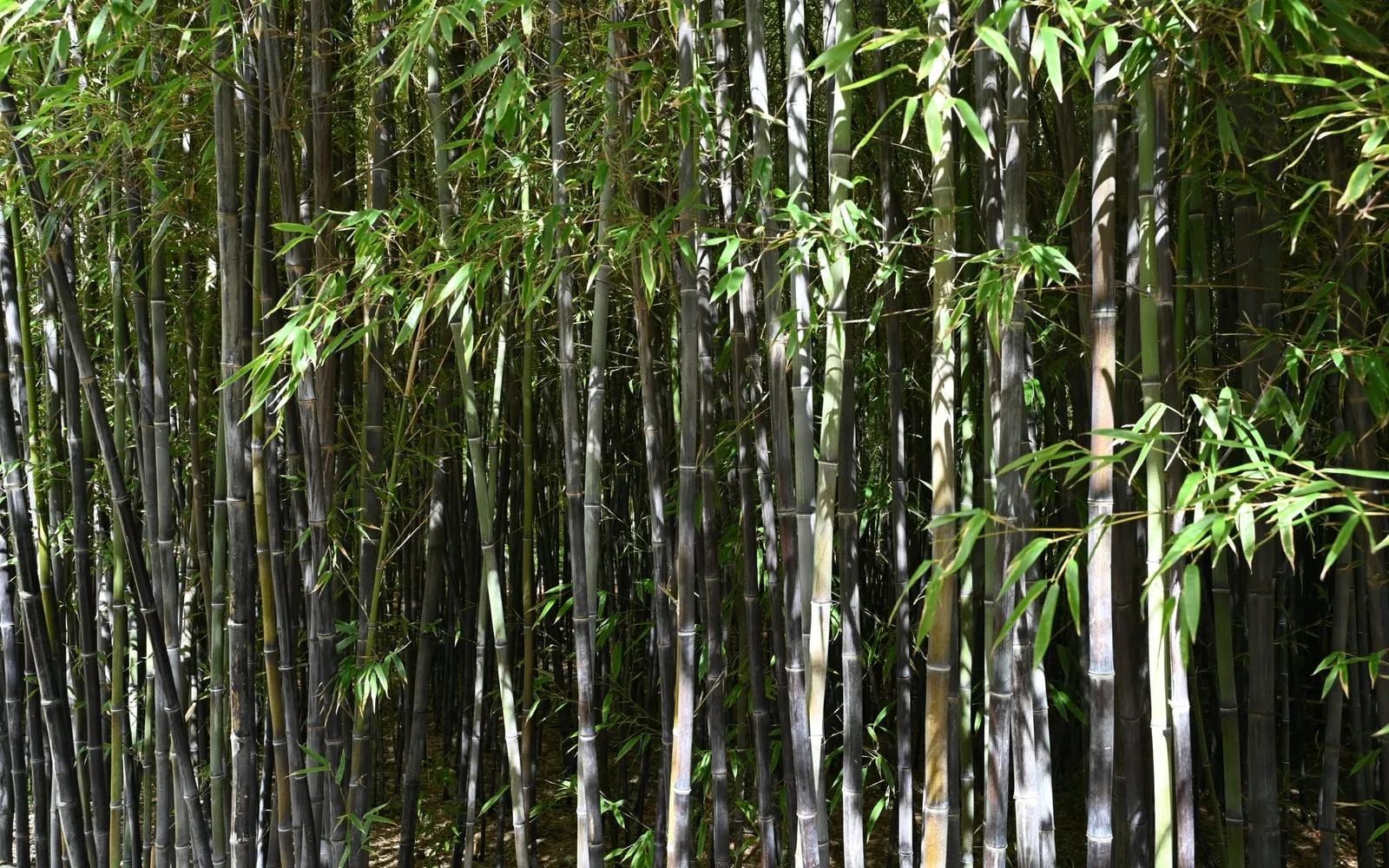
The colour is the point. New canes emerge green, sometimes with a faint bloom, and darken through olive and brown to a deep glossy black over their first year or two. A mature clump therefore carries green, mottled and black canes at once.
Leaves are narrow and mid-green, 5 to 12 cm long, held in loose sprays on fine branches from the upper part of each cane.
Canes are naturally free of branches for the lower part of their height, which is what allows the black colour to show. Stripping the lower branches from a mature grove deliberately, a technique called legging up, is what produces the classic look.
‘Boryana’ has canes blotched purple-brown rather than solid black, and ‘Henonis’ is a taller green-caned form.
Phyllostachys aurea and Phyllostachys bissetii are considerably more aggressive runners than P. nigra, so check the species when buying.
Where it is from
Originally Hunan province in China, and cultivated across China, Japan and Korea for so long that its wild distribution is uncertain.
Its natural setting is warm-temperate forest edge and river valley, in deep moist fertile soil with a long warm growing season.
Warm moist soil is what drives the running habit. The rhizomes spread fastest in exactly the conditions a well-tended garden provides, which is why a plant that seemed well behaved for three years suddenly appears in the lawn.
The plant is fully hardy to about -20 deg C, and its performance depends far more on summer warmth and moisture than on winter cold.
Bamboo is a grass, and a running rhizome is doing the same thing couch grass does, at a much larger scale.
How it grows
An evergreen running bamboo with leptomorph rhizomes, meaning long thin rhizomes that travel horizontally and produce canes at intervals along their length.
New canes emerge in late spring, push up as fat pointed spears, and reach full height within four to eight weeks. A cane never grows taller or thicker after that first season, so the height a clump reaches depends on the vigour of the plant in that year.
Each cane lives around ten years. Cutting the oldest out at ground level every spring keeps the grove looking good and lets light onto the black canes.
The plant expands by rhizome. Left unrestrained in good soil it will produce canes several metres from the original planting within a few years.
Propagation is by dividing a rooted section of rhizome with at least one cane in spring.
Flowering is rare, unpredictable and usually fatal to the plant.
Through the seasons
Spring is the busiest season. Plant, divide, feed and thin out old canes now. New shoots appear from May. This is also when to check the barrier and cut back any rhizome that has escaped.
Summer brings the main growth and the highest water demand. Water deeply in dry spells.
Autumn is a good planting season. Do the second annual rhizome check now, digging around the perimeter with a spade to sever anything travelling.
Winter needs little. The plant is evergreen and hardy. Knock heavy snow off the canes before it bends them permanently.
Care difficulty
Moderate, and the difficulty is containment rather than cultivation. The plant itself is easy.
Install the barrier before or at planting. Use HDPE rhizome barrier of at least 1.5 mm thickness, buried 60 to 75 cm deep, with 5 to 8 cm standing proud of the soil so escaping rhizomes are visible. Angle it slightly outward at the top, and seal the join with the manufacturer’s clamping strip rather than overlapping it loosely.
Rhizomes travel just under the surface and turn upward when they hit the barrier, which is why the proud edge matters. A barrier buried flush with the soil is a barrier rhizomes hop over.
The second task is the annual perimeter check. Once each spring, push a sharp spade in vertically all the way around the planting and sever anything crossing. Ten minutes a year prevents an expensive problem.
Watering
Water weekly through the first two growing seasons, giving a deep soak.
Established plants need water in prolonged dry spells. Leaves curling inward lengthwise is the thirst signal.
Container-grown bamboo needs frequent and generous watering, often daily in summer, and is easily killed by drying out.
Mulch generously each spring with compost or bark to hold moisture.
Bamboo in a container or a raised bed with a solid base is the simplest way to grow Phyllostachys safely in a small garden, and it makes watering the main ongoing job.
Reduce watering in winter without letting a container dry out.
Warning signs, diseases and pests
New canes appearing away from the planting, in a lawn, a border or next door, mean rhizomes have escaped. Deal with it at once. Sever the rhizome with a spade, trace it back, and dig it out.
Leaves curling lengthwise means drought and corrects within a day of watering.
Brown crispy leaf tips indicate dry soil, cold wind or both.
Yellowing leaves in quantity with waterlogged soil means the roots are too wet.
Some leaf drop in spring is normal renewal.
Bamboo mites cause rectangular pale stippled patches with fine webbing on the leaf undersides.
Aphids produce honeydew that turns sticky and then sooty black.
Old canes browning and dying is ordinary at around ten years. Cut them out at the base.
Canes staying green rather than blackening usually means too much shade. Black bamboo colours best in good light.
Growing environment
Full sun or light shade. Sun produces the darkest canes and the strongest growth.
Moist, fertile, well-drained soil. Bamboo grows on most soils and performs best where the ground holds moisture without waterlogging.
Fully hardy to about -20 deg C.
Shelter from cold drying winds, which scorch the foliage.
Install the rhizome barrier before planting, or plant into a large container or a raised bed with a solid base. Do not rely on a fence, a path or a wall to stop a rhizome, because none of them will.
Leave at least a metre between the barrier and any boundary so you can get a spade in to check.
Consider Fargesia instead if the garden is small, if you share a boundary closely, or if you would rather not maintain a barrier. It gives a similar evergreen screen and cannot run.
Plant 1 to 1.5 metres apart for a screen.
Feeding
Feed twice, in early spring and again in early summer, with a high-nitrogen or general-purpose fertiliser. Bamboo is a grass and responds strongly to nitrogen.
An annual compost or manure mulch feeds the plant and conserves moisture.
Container plants need monthly feeding through the growing season.
Stop feeding by the end of July so growth hardens before winter.
Feeding a running bamboo makes it run faster, which is a reason to keep the barrier in good order rather than a reason to starve the plant.
Troubleshooting
Will it spread? Yes. Phyllostachys is a running bamboo and its rhizomes travel several metres a year in good conditions. Install a barrier before planting, or grow it in a container.
What sort of barrier? HDPE rhizome barrier at least 1.5 mm thick, buried 60 to 75 cm deep with 5 to 8 cm standing above the soil, angled slightly outward, and joined with a proper clamping strip. Check the perimeter with a spade each spring.
It has come up in my neighbour’s garden. Act quickly. Encroaching bamboo is actionable as a private nuisance in England and Wales, and homeowners have paid damages and removal costs. Sever the rhizomes at the boundary, dig out what you can, and speak to your neighbour before they find it themselves.
The canes are still green. New canes start green and blacken over one to two years. More sun speeds it up.
The leaves have curled up. Drought. Water thoroughly and mulch.
Some canes have died. Ordinary at around ten years old. Cut them out at ground level each spring.
How do I get the bare-cane look? Remove the lower branches from mature canes with secateurs, and thin the grove so light reaches the stems. The technique is called legging up.
Can I eat the shoots? Yes, prepared correctly. Cut them as they emerge, peel, slice, and boil uncovered in plenty of water for at least twenty minutes to destroy the cyanogenic compounds. Never eat bamboo shoots raw.
Should I have chosen a different bamboo? If containment worries you, yes. Fargesia is clump-forming, needs no barrier, and tolerates shade better.