
Outdoor plant
Oleander
Nerium oleander
Also known as Rosebay, Rose laurel, Nerium
How to grow oleander, Nerium oleander. Overwintering it under cover in a cold climate, pruning after flowering, and why it is among the most poisonous plants sold in Europe.
At a glance
- Difficulty
- Moderate
- Water
- Twice weekly in summer in a pot, and sparingly in winter
- Light
- Full sun, and the more the better
- Temperature
- Hardy to about -5 deg C at best, and it needs frost-free winters
- Hardiness
- USDA 8b-11, RHS H3, hardy to -5 C
- Type
- Evergreen shrub, long lived and vigorous
- Height
- 2-4 m, and less in a container
- Native to
- The Mediterranean and south-west Asia, along seasonal watercourses
- Best month
- May in the Northern Hemisphere, November in the Southern Hemisphere
Heat and drought are what it wants and it flowers all summer in conditions that would finish most shrubs, which is why it lines motorways across the Mediterranean, the American south-west and Australia. Below about -5 C the top growth dies and below -10 the plant does. Oleander leaf scorch, spread by the same insect-borne bacterium behind Pierce disease, has killed large numbers of plants across southern California and Arizona.
Hardiness zones describe winter cold alone. Summer heat, humidity, rainfall and the length of the growing season decide as much, so treat the range as the outer limit rather than as a recommendation.
Every month named in this guide is for the temperate Northern Hemisphere. If you garden in the Southern Hemisphere, shift each one by six months, so May becomes November. Closer to the equator the wet and dry seasons matter more than the calendar, and the shift stops being a useful guide.
Poisonous if eaten
- Do not eat
- Every part, including dried leaves, smoke and the water it stands in
- Harm from
- Eating it and handling it
- Affects
- People, cats, dogs and horses
Oleander is among the most poisonous ornamental plants grown in Europe. Every part contains cardiac glycosides, principally oleandrin, which act on the heart in the same way as digitalis from foxglove. A small quantity of leaf can cause serious poisoning in a child, and single-leaf ingestions have caused significant illness. Symptoms begin with nausea, vomiting, stomach pain and drowsiness, then progress to a slow or irregular heartbeat, disturbed vision and, in severe cases, cardiac arrest. The plant is dangerous in ways that catch people out. Dried leaves stay toxic, smoke from burning it is toxic, water that cut stems have stood in becomes toxic, and there are accounts, some better documented than others, of poisoning from meat skewered on oleander sticks. Treat any suspected ingestion as a medical emergency and say oleander, since a cardiac glycoside poisoning is managed specifically. It is equally dangerous to dogs, cats, horses and livestock, and horses have been killed by clippings thrown over a fence. Wear gloves and eye protection when pruning, never burn the prunings, and dispose of them where no animal can reach them. Given all of this, think hard before planting it in a garden used by children or pets.
Sources: ASPCA toxic and non-toxic plants, RHS potentially harmful garden plants
About
In a cold climate most oleanders arrive as holiday souvenirs or garden centre impulse buys, and most of them die in their first winter.
The plant is the flowering shrub of Mediterranean roadsides and car parks, blooming all summer in heat and drought that would finish anything else. Below about -5 deg C it can still be grown well, as a container plant that spends summer outdoors and winter under cover.
Treating it as a hardy shrub is the mistake. It takes about -5 deg C at best, and cold combined with winter wet finishes it faster than either alone.
The other thing to know before buying one is that it is exceptionally poisonous. Every part contains cardiac glycosides, dried leaves stay toxic, the smoke from burning it is toxic, and the water in a vase of cut stems becomes toxic. Horses have died from clippings thrown over a fence.
None of that makes it unplantable. It does make it a poor choice for a garden used by small children or by a dog that chews things.
Appearance and character
An evergreen shrub reaching 2 to 4 m, forming a dense rounded bush of upright stems that sucker from the base.
Leaves are the giveaway when it is not in flower. They are narrow, leathery, stiff, lance-shaped, 8 to 15 cm long, a dull grey-green, with a prominent pale midrib, and carried in whorls of three.
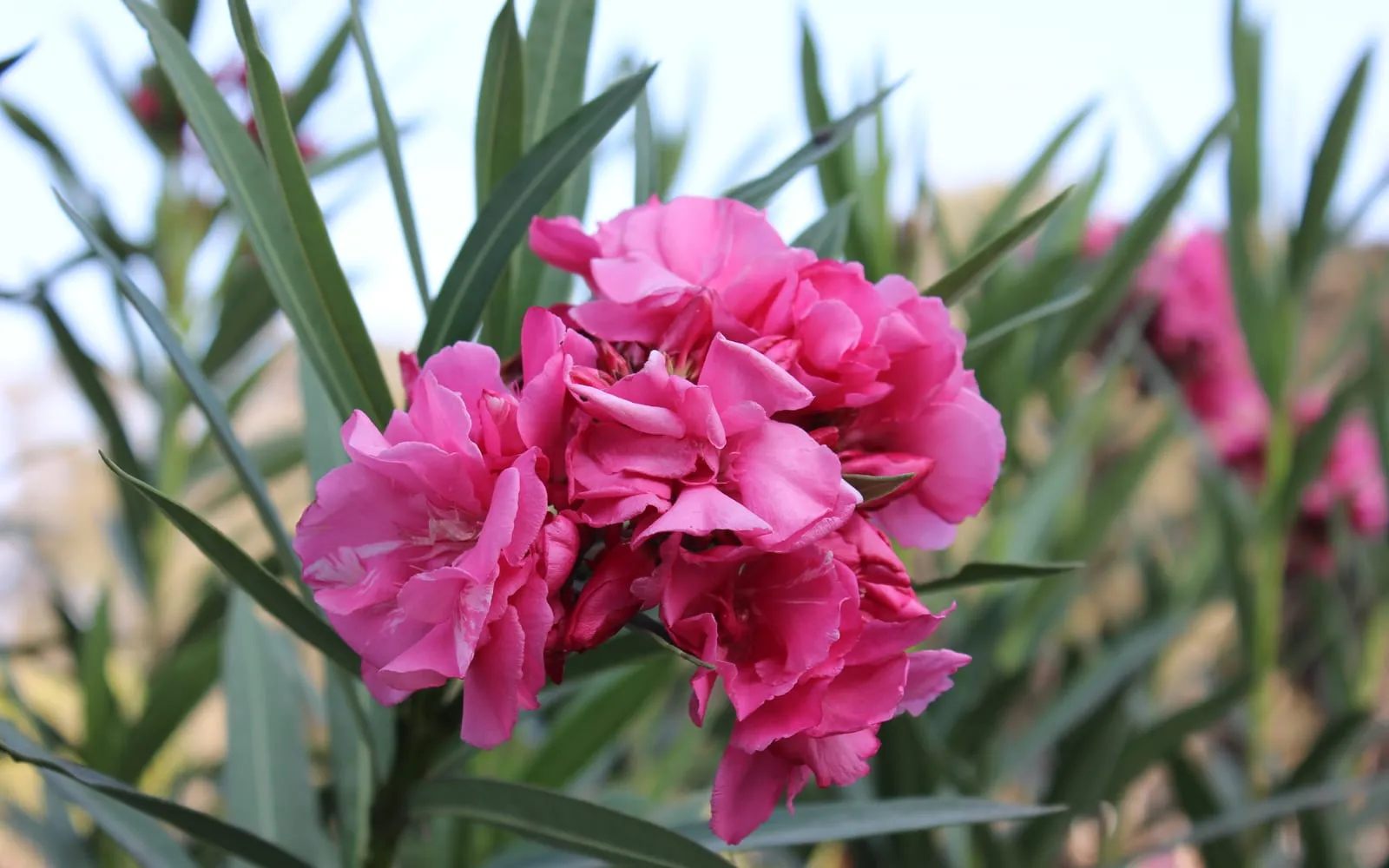
Flowers open from June to September in clusters at the shoot tips, each 3 to 5 cm across with five petals arranged in a pinwheel. Colours run from white through every shade of pink to deep red and pale apricot, and many cultivars are double.
Some varieties are scented and many are not, and the scent is worth checking before buying if it matters to you.
Seed pods are long narrow paired capsules that split to release seeds with silky plumes, though they form rarely where summers are cool.
The sap is clear and sticky, and it exudes readily from any cut.
Where it is from
The Mediterranean basin and south-west Asia, extending to China.
Its natural habitat explains the watering. Oleander grows along seasonal watercourses and dry riverbeds, ground that floods in winter and bakes in summer, with deep roots reaching water that is not apparent at the surface.
That is why the plant tolerates drought and also responds to generous summer watering. It is not a desert plant.
It has been cultivated since antiquity and is naturalised widely, including in California and Australia, where it is planted along motorways for its tolerance of heat, pollution and neglect.
Grown outdoors year-round it needs USDA zone 8b or warmer, which in Britain means only the mildest corners of the south-west and the Isles of Scilly.
How it grows
Grow it in a large container anywhere that frosts, which is the only reliable approach.
Use a soil-based compost with added grit, in a pot big enough to be stable, and make sure it drains freely.
Stand it outside in the sunniest position you have from late May, once the risk of frost has passed.
Water generously through summer and feed fortnightly with a balanced liquid feed. A well-fed oleander in full sun flowers continuously.
Bring it under cover before the first frosts, in October. A frost-free greenhouse, a conservatory, a porch or a cool bright room all work.
Keep it cool and dry over winter. Around 5 to 10 deg C with very little water is ideal. A warm dark room is the worst option and produces drawn, sickly growth covered in scale insects.
Prune after flowering, in late summer or early autumn. Shorten flowered shoots by about a third and take out any weak or crossing growth.
Do not cut off the short stubby shoots that appear just below the old flower clusters. Those carry the next year’s flowers and removing them is a common reason for a flowerless plant.
Wear gloves and eye protection whenever you prune, and wash your hands afterwards.
Repot every second or third year in spring, or top-dress a large pot.
Through the seasons
Winter is dormancy under cover. Keep it cool, bright and nearly dry, and check for scale insects.
Spring brings growth from March. Resume watering gradually, start feeding in April, and repot if needed.
Summer is the display. Move it outside after the last frost, water and feed generously, and expect flowers from June.
Autumn is the prune, straight after flowering, followed by bringing the plant back under cover in October.
Care difficulty
Moderate, and the difficulty is entirely about winter.
In summer it is an easy plant. It wants sun, water and food, and it responds to all three.
The failures happen between October and April. Too cold and it dies, too warm and dark and it becomes drawn and infested, too wet and the roots rot. The target is cool, bright and dry.
Scale insect under glass is the other recurring problem and is much easier to prevent than to cure.
The toxicity does not make it hard to grow. It makes it a plant to site thoughtfully and handle with gloves.
Watering
Water generously in summer, two or three times a week for a container plant in hot weather, allowing the surface to dry between soakings.
An oleander in full growth in a pot in July drinks a great deal, and drought stress shows as yellowing lower leaves that drop.
Reduce watering sharply from September and keep the plant almost dry through winter. Water only enough to stop the rootball shrinking, perhaps once a month.
Winter wet is the commonest killer. A cold pot standing in a saucer of water will rot the roots.
Never leave the water from a vase of cut oleander where an animal or child could drink it.
Warning signs, diseases and pests
Scale insects are the main pest, particularly on plants overwintered somewhere too warm. They appear as small brown limpets along the stems and leaf midribs, followed by sticky honeydew and black sooty mould. Wipe them off, improve the winter conditions, and treat persistent infestations.
Mealybug appears as white fluff in the leaf axils under the same conditions.
Aphids gather on flower buds in spring and wash off.
Yellow lower leaves dropping in summer usually mean underwatering. The same in winter usually means overwatering.
Brown leaf tips and margins indicate cold damage or drought.
Blackened shoots after winter are frost damage. Cut back to live wood in spring, and the plant usually recovers.
No flowers, on a healthy plant, is most often caused by pruning off the short shoots below the old flower heads, or by too little sun, or by a winter spent somewhere too warm.
Oleander leaf scorch, a bacterial disease spread by insects, has killed large numbers of plants across southern California and Arizona and is no threat in a cool climate.
Growing environment
Full sun, and as much of it as possible. This plant will not flower in shade.
Free-draining compost or soil. It tolerates poor stony ground and will not tolerate waterlogging.
Shelter from cold wind, and a position against a sunny wall if it is to stay outside in a mild area.
A container is the right approach anywhere that frosts, because it allows the plant to be moved under cover for winter.
Choose a heavy pot. A tall oleander in a light plastic container blows over.
Site it away from paths where children play and away from anywhere a dog or horse could reach it. Never plant it near a paddock fence.
Consider whether you want it at all if you have young children. Its garden value is real and there are safer plants that flower all summer.
Feeding
Feed fortnightly from April to September with a balanced liquid fertiliser, or use a high-potassium tomato feed once flowering starts to encourage more blooms.
Stop feeding entirely from late September so growth hardens before winter.
Top-dress or repot in spring with fresh soil-based compost.
A pale, slow, poorly flowering plant in a pot has usually exhausted its compost, and this is a genuine cause of disappointment in oleanders that have sat in the same container for years.
Troubleshooting
Can I grow it outdoors all year? Only in USDA zone 8b and warmer, which in Britain means the very mildest coastal parts of the south-west. Everywhere else it needs to be a container plant that winters under cover.
It died over winter. Almost always cold, wet roots, or both. Keep it cool, bright and nearly dry from October to March, and never leave the pot standing in water.
It has not flowered. Check three things. Whether the short stubby shoots below the old flower heads were pruned off, since those carry the next flowers. Whether it has enough sun. Whether it spent winter somewhere too warm and dark.
When do I prune it? After flowering, in late summer or early autumn. Shorten flowered shoots by a third and leave the small shoots beneath the old flower clusters.
Small brown limpets on the stems and sticky leaves. Scale insect, encouraged by a warm winter indoors. Wipe them off and overwinter the plant cooler and brighter.
How poisonous is it? Very. Every part contains cardiac glycosides, dried leaves stay toxic, burning it produces toxic smoke, and the water from a vase of cut stems is dangerous. Treat any suspected ingestion as a medical emergency and say oleander.
My dog chewed a leaf. Emergency vet, immediately, and tell them it was oleander.
What do I do with the prunings? Bag them and dispose of them where no animal can reach them. Never burn them and never throw them into a field or over a fence.