
Edible
Purslane
Portulaca oleracea
Also known as Summer purslane, Pigweed, Verdolaga, Little hogweed
How to grow purslane, Portulaca oleracea. The succulent salad that thrives in heat and poor soil, cutting it for repeat crops, and why it is a weed in half the world.
At a glance
- Difficulty
- Easy
- Water
- Weekly at most. It stores its own water
- Light
- Full sun. It grows poorly in shade
- Temperature
- 18-30 deg C. Killed by the first frost
- Hardiness
- USDA 5-11, RHS H2, hardy to 2 C
- Type
- Tender annual
- Height
- 10-30 cm
- Native to
- Probably India and the Middle East, now worldwide
- Best month
- June in the Northern Hemisphere, December in the Southern Hemisphere
A C4 plant, so it photosynthesises efficiently in heat and drought that shut other salads down, and it grows fastest when nothing else will. That efficiency also makes it one of the world's most widespread arable weeds. Frost kills it outright, and seed survives in soil for decades.
Hardiness zones describe winter cold alone. Summer heat, humidity, rainfall and the length of the growing season decide as much, so treat the range as the outer limit rather than as a recommendation.
Every month named in this guide is for the temperate Northern Hemisphere. If you garden in the Southern Hemisphere, shift each one by six months, so June becomes December. Closer to the equator the wet and dry seasons matter more than the calendar, and the shift stops being a useful guide.
Edible, with limits
- Safe to eat
- The leaves, stems and seeds, raw or cooked
- Harm from
- Eating it
- Affects
- People
Purslane is a food crop eaten across the Mediterranean, the Middle East, Mexico and Asia, and it is safe in ordinary quantities. The RHS does not list Portulaca oleracea as a potentially harmful garden plant. The ASPCA does list it as toxic to cats, dogs and horses, on the grounds of soluble calcium oxalates, and the practical risk is to livestock grazing large quantities rather than to a pet taking a mouthful. Purslane is a significant oxalate accumulator, comparable to spinach and above chard, which is the same caution that applies to sorrel and rhubarb. Ordinary portions are well within safe limits, boiling and discarding the water removes much of it, and anybody with a history of kidney stones should treat it as they treat spinach. Purslane also accumulates nitrate on rich soil. Set against that, it is the richest plant source of omega-3 fatty acids of any leafy vegetable, which is why it appears in nutrition literature far more often than its obscurity in Britain would suggest.
Sources: ASPCA (Purslane, Portulaca oleracea), RHS potentially harmful garden plants
About
Purslane is a succulent, and everything about growing it follows from that. It stores water in its leaves and stems, so it shrugs off the drought that ends a lettuce row, it wants sun and heat rather than damp and shade, and it rots quickly in cold wet soil.
The flavour is unlike anything else in a salad. Crisp, juicy, faintly salty and sharply lemony, with a texture closer to a young bean than to a leaf.
It is also one of the most successful weeds on earth, growing on every continent except Antarctica and appearing on lists of the world’s worst agricultural weeds. Gardeners in warm countries pull it out of the paths and gardeners in cool ones buy the seed. Both are dealing with the same plant.
Winter purslane, Claytonia perfoliata, is an unrelated hardy plant sold under a confusingly similar name and grown in autumn. This one is the summer crop.
Appearance and character
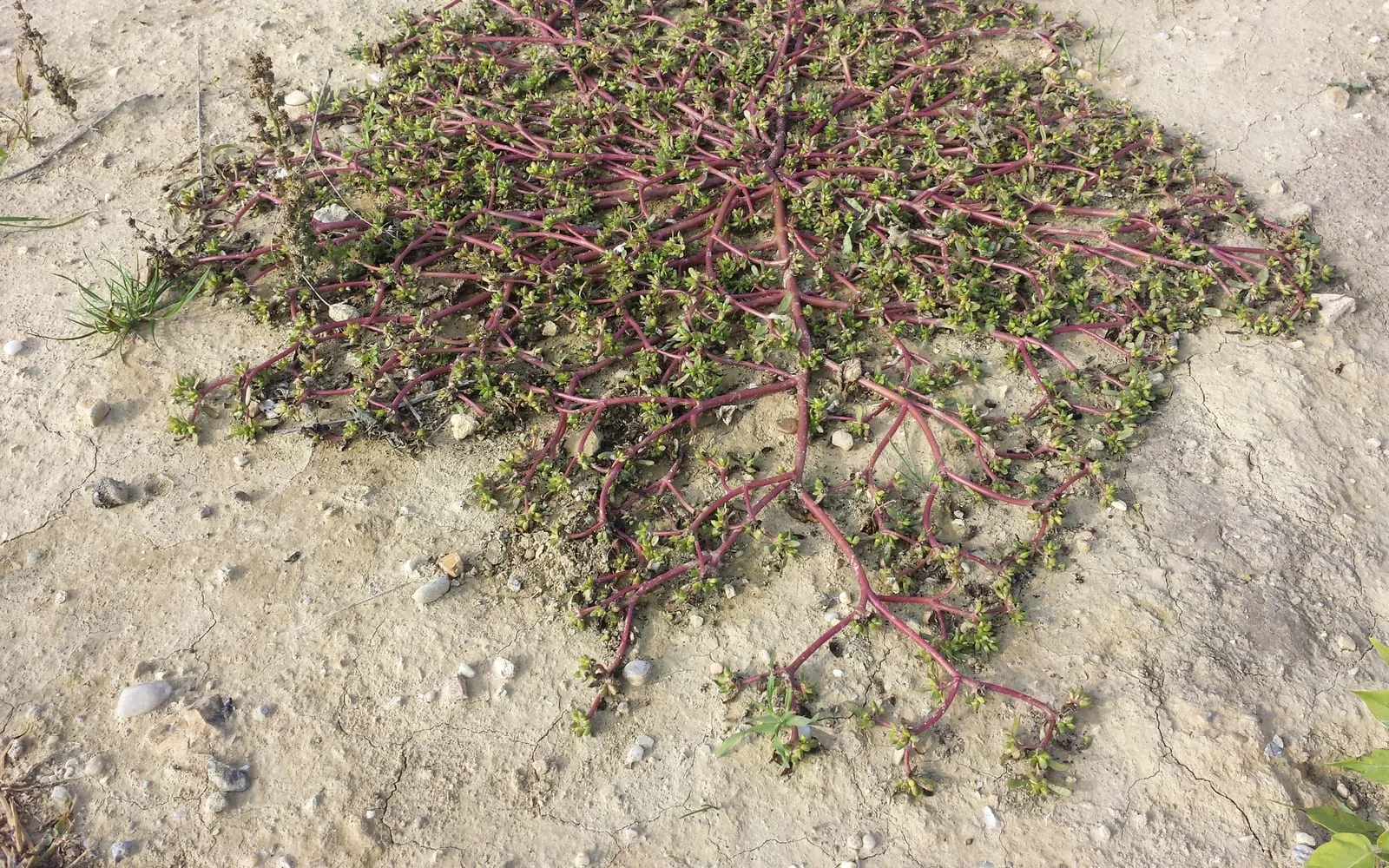
A low sprawling mat, 10 to 30 cm tall and spreading 30 to 40 cm, with thick fleshy stems that are usually deep red or bronze.
Leaves are small, thick, smooth and paddle-shaped, glossy and mid-green, held in clusters at the stem joints and at the tips.
The golden-leaved form sold as ‘Goldgelber’ is more upright, milder and slower, and it is the one usually grown for salad in Europe.
Flowers are tiny and yellow, five-petalled, opening only in bright sun and for a few hours in the morning.
Seed capsules are minute and split around the middle like a little lid, scattering thousands of black seeds.
Flavour is crisp, juicy and lemon-salty, and the texture is the point as much as the taste.
Where it is from
Purslane’s exact origin is unsettled, with India and the Middle East both proposed. It has been spread by human movement for so long that the wild distribution is unrecoverable.
Archaeological seeds turn up in Bronze Age Europe and in pre-Columbian North America, so it reached both long before recorded trade.
Egyptians, Greeks and Romans all ate it, and it appears in Dioscorides. Mediterranean, Middle Eastern and Mexican cooking all use it heavily. Fattoush in Lebanon and verdolagas with pork in Mexico are both built around it.
Britain grew it in Tudor and Stuart kitchen gardens, and John Evelyn praised it in his 1699 salad treatise, then it disappeared here as it did across northern Europe.
The plant’s modern reputation rests on its omega-3 content, which is higher than any other leafy vegetable measured.
How it grows
Sow direct into warm soil. Purslane germinates poorly below 15 deg C and rots in cold wet compost, so wait for late May or June rather than sowing early.
Sow thinly on the surface or barely covered, since the seed is tiny and needs light. Rows 20 cm apart, thinned to 15 cm.
Germination takes seven to ten days in warm soil.
Pick from six weeks, cutting the stem tips at 5 cm above the base. The plant branches and regrows, giving three or four cuts.
Cut before flowering for the best texture, since a flowering plant coarsens and the stems get stringy.
Sow every three weeks from late May to July for a continuous supply.
Pull the plants before the seed capsules ripen unless you want it permanently. A single plant produces tens of thousands of seeds that stay viable in soil for decades.
Through the seasons
Spring is too cold. Purslane sown in April sits in the ground and rots. Wait.
Early summer is the sowing window, from late May once the soil has reached 15 deg C. Sow on the surface and keep it damp until germination.
Summer is the season. This is the crop that keeps going through July and August heat, when spinach and lettuce have both given up. Cut every fortnight.
Late summer takes the last sowing in July for a September crop.
Autumn ends it. The first frost kills the plant outright. Pull the plants before the seed ripens and follow with something hardy.
Care difficulty
The easiest crop in this wave, provided it is sown late enough.
Soil temperature is the whole difficulty. Sown into cold ground it fails, and sown in June it succeeds without further attention.
Self-seeding is the thing to manage. Purslane seed is famously long-lived in soil, so cut before it flowers if you do not want it as a permanent resident.
Slugs take the seedlings and lose interest once the plant is established.
Overwatering is a more realistic risk than drought. This is a succulent and it rots in wet ground.
Nothing else needs doing. The plant needs no feeding, no support, no thinning beyond the first, and it ignores most pests.
Watering
Water sparingly. Purslane stores water in its stems and leaves and a plant that never dries out completely is doing well.
A weekly soak in a real drought is enough. Daily watering is unnecessary and encourages rot.
Keep the surface damp during germination, which is the one period it needs attention.
Water at the base and in the morning.
Avoid waterlogged ground entirely. Purslane on heavy wet soil rots at the base and collapses.
Container growing suits it well in a shallow wide pot of free-draining compost with added grit.
Warning signs, diseases and pests
Slugs graze seedlings off at ground level in a damp spring, which is one more reason to sow late.
Damping off collapses seedlings in cold wet compost. Sow into warm soil and do not overwater.
Root and stem rot follow waterlogging on heavy ground. Grow on a raised bed or in a container where the soil is heavy.
Self-seeding is the main long-term problem. The seed stays viable in soil for decades and a single plant sets tens of thousands.
Stringy, tough stems mean a plant that has flowered. Cut earlier.
Poor germination means cold soil. Wait for 15 deg C.
Aphids occasionally appear and are dealt with by predators.
Growing environment
Full sun, and as much of it as possible. Purslane in shade is thin, sprawling and unproductive.
Light, free-draining soil is what it wants, and it crops on poor, dry, sandy ground that would defeat most vegetables.
Neutral soil, pH 6 to 7.5, and it is tolerant of a wide range.
Warmth is the requirement rather than fertility, so a raised bed, the base of a south-facing wall, or a container on a patio all suit it.
Avoid heavy wet clay, which is the one situation where it will not work.
Rotate loosely. Purslane shares few problems with anything else in the vegetable garden.
Feeding
Purslane needs no feeding on any reasonable soil, and it crops on ground that has had nothing for years.
Avoid nitrogen. It gives soft sprawling growth, reduces the flavour, and raises the nitrate content of the leaves.
Never use fresh manure.
A container of ordinary multipurpose compost with grit added needs nothing else for the life of the crop.
If a plant looks starved after several cuts, give one dilute balanced liquid feed and no more.
Troubleshooting
Nothing germinated. Cold soil. Purslane needs 15 deg C or more. Sow from late May and do not be tempted earlier.
The seedlings collapsed at soil level. Damping off in cold wet compost. Sow later and water less.
The stems are stringy and tough. The plant has flowered. Cut the tips every fortnight before flowering starts.
It rotted at the base. Waterlogging. Purslane is a succulent and needs free drainage. Use a raised bed or a container.
Purslane is coming up everywhere. A plant seeded. The seed lives in soil for decades, so hoe the seedlings while small and pull the plants before capsules ripen.
Thin sprawling growth with few leaves. Too much shade. It needs full sun.
Is this the same as winter purslane? No. Winter purslane is Claytonia perfoliata, an unrelated hardy plant for autumn and winter sowing. This is the summer crop and it dies at the first frost.
Should I worry that it is a weed? Not where winters are frosty. It is killed by the first frost and does not survive the winter as a plant. The seed bank is the only thing that persists.
Purslane problem guides
Not sure what is wrong? See the common vegetable pests guide.