
Outdoor plant
Red Sage
Salvia miltiorrhiza
Also known as Danshen, Chinese sage, Tan shen
How to grow Salvia miltiorrhiza, the red sage of Chinese medicine. A hardy border salvia with brick-red roots, and why it interacts with warfarin.
At a glance
- Difficulty
- Moderate
- Water
- Through the first summer, then only in drought
- Light
- Full sun to light shade
- Temperature
- Hardy to about minus 15 deg C in dry soil
- Hardiness
- USDA 8-10, RHS H4, hardy to -12 C
- Type
- Hardy herbaceous perennial from thick red roots
- Height
- 40-80 cm
- Native to
- the hills of central and northern China, Japan
- Best month
- May in the Northern Hemisphere, November in the Southern Hemisphere
The least hardy of the medicinal salvias and, like the rest of the genus, killed by winter wet well before it is killed by cold. Sharp drainage buys several degrees. The thick red roots take two years, and a wet autumn rots them in the ground before lifting.
Hardiness zones describe winter cold alone. Summer heat, humidity, rainfall and the length of the growing season decide as much, so treat the range as the outer limit rather than as a recommendation.
Every month named in this guide is for the temperate Northern Hemisphere. If you garden in the Southern Hemisphere, shift each one by six months, so May becomes November. Closer to the equator the wet and dry seasons matter more than the calendar, and the shift stops being a useful guide.
Harmful if eaten
- Do not eat
- None identified. The root is the part used
- Harm from
- Eating it
- Affects
- People
Salvia miltiorrhiza root is one of the most used items in Chinese herbal practice and is sold in the West as a food supplement. The plant does not appear on the RHS list of potentially harmful garden plants, and the ASPCA does not list it among plants toxic to dogs, cats or horses. The reason this entry is not marked as harmless is the interaction with anticoagulants. Danshen affects blood clotting and its interaction with warfarin is one of the better documented herb and drug interactions on record, reported in the clinical literature since the 1990s and listed in standard interaction references. Anyone taking warfarin or another anticoagulant should not take danshen without telling the clinician managing their treatment. Growing the plant in a border carries none of that risk, and the flowers are a good nectar source.
Sources: NHS on herbal medicines, RHS potentially harmful garden plants, ASPCA toxic and non-toxic plants, LiverTox, Chinese and other Asian herbal medicines
About
Pull up a danshen plant and the roots are the colour of terracotta. That red is the tanshinones, a group of pigmented compounds unique to this species, and it is where both the Chinese name and the English one come from. Dan means red and shen places it in the same class of tonic roots as ginseng.
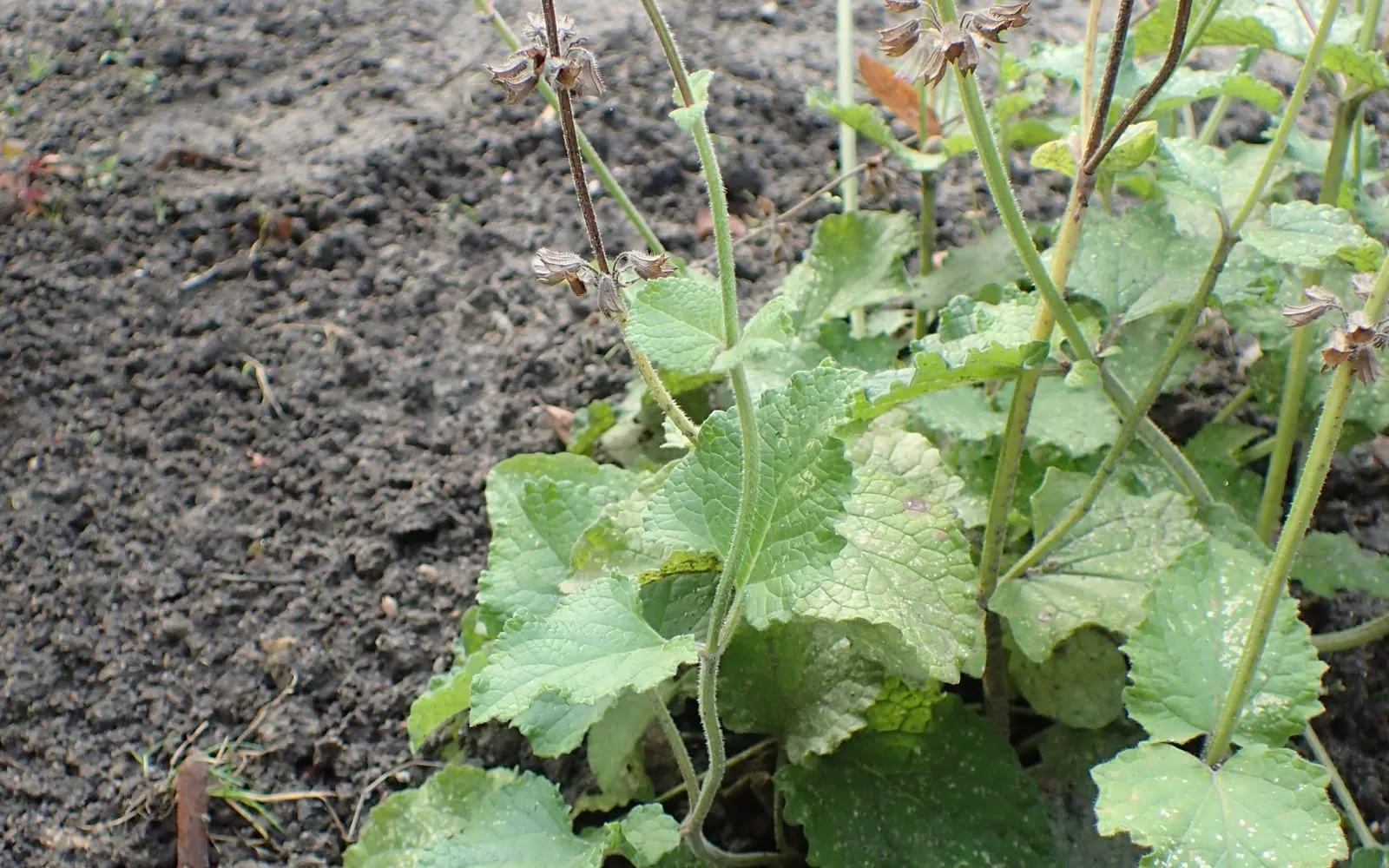
Above ground it is a salvia, and a good one. Hairy pinnate leaves in a basal clump, upright stems to 60 cm or so, and whorls of hooded flowers in a soft violet-blue through the summer. Anyone who grows Salvia nemorosa or the culinary sage will recognise the plant at once.
Chinese medicine uses the root more than almost anything else in the pharmacopoeia, mostly in relation to the circulation, and modern pharmacology has followed that lead. What a gardener needs to take from it is narrower: this root has a documented effect on blood clotting, which is why the guide names warfarin.
Appearance and character
The basal leaves are pinnate, with three to seven broad oval leaflets, the end one largest, all covered in fine hairs and toothed at the margin. They form a loose rosette from which the flowering stems rise.
Stems are square in section like every mint relative, hairy, and branch near the top. Flowers come in widely spaced whorls from June to September, each about 2 to 2.5 cm long with a hooded upper lip and a spreading lower one, in violet-blue and occasionally white.
The root is the character of the plant. It is thick, fleshy and brick red on the outside, branching into several fingers, running 20 to 30 cm down. Sliced, the cut face is red-brown with a paler centre, and the colour survives drying, which is how the dried root is graded.
Where it is from
The species grows wild on hillsides, grassy banks and stream sides in central and northern China, at altitudes from 100 to 1300 m, with populations in Japan too. Those hills have cold winters, hot summers and free-draining soil.
Commercial production is concentrated in Shandong, Shaanxi, Henan and Sichuan, where the crop is grown on a two-year cycle and lifted in autumn. Demand is large enough that the plant is one of the most widely cultivated medicinal species in China.
It is a rarity in gardens and worth more attention than it gets. It was introduced as an ornamental salvia and is hardy through most temperate winters given drainage, which is the same caveat that applies to half the salvias in cultivation.
How it grows
Seed germinates readily in spring at 18 to 20 deg C without pretreatment. Seedlings grow steadily through their first summer, form a good clump by autumn and usually flower in their second year.
The root thickens through the second season, which is when growers lift it. Left in the ground the plant continues as a perennial, spreading slowly into a larger clump, and it can be divided in spring.
Hardiness depends on drainage. In a gritty raised bed the plant comes through a normal winter without protection. In heavy soil that stays wet it rots at the crown, which is the reason most attempts in a wet climate fail.
Through the seasons
Sow under cover in March or plant out young plants in May once frosts have passed. Space at 40 cm on a sunny bank or in a gravel bed.
Flowering runs June to September and bumblebees work it hard. Deadhead the first flush for a second, or leave the spikes to set seed, which the plant does readily.
Cut the dead stems down in late autumn, or leave them and tidy in March, which gives the crown some protection. Lift roots in the autumn of the second year, wash, split thick pieces lengthways and dry them until brittle.
Care difficulty
Moderate, and the difficulty is winter rather than summer. A danshen plant grows easily from seed and flowers well in its second year. Keeping it alive through a wet British January is the part that needs planning.
Site it as you would a tender salvia. Give it full sun and sharp drainage on a slope or in a raised bed, and keep winter mulch away from the crown. Grit worked into the planting hole is worth more than any amount of feeding.
Where the garden is heavy clay, grow it in a large container in gritty compost and move the pot under cover for the winter. That is a reliable route to a harvestable root.
Watering
Water new plants through their first summer to establish them. After that the root system reaches deep enough to handle a summer without help.
The plant tolerates drought better than damp. Watering an established clump in ordinary weather does nothing useful and keeps the crown damper than it wants to be.
The important half of the water question is winter drainage. Standing water at the crown for a fortnight in a cold spell will kill a plant that has grown happily all summer.
Warning signs, diseases and pests
Slugs graze the emerging spring shoots and are the main pest of a young plant. Grit around the crown and a patrol on damp evenings deal with it.
Powdery mildew coats the leaves in white late in a dry summer, particularly on plants at the base of a wall. It is disfiguring rather than fatal, and a mulch to hold soil moisture reduces it. Capsid bug feeding distorts and puckers young shoots.
Root rot is the disease to plan against. It shows as a clump that comes back smaller each spring and then not at all, and the cause is nearly always winter wet. Nothing treats it once the root has gone soft.
Growing environment
Full sun for preference, though it tolerates a few hours of shade. Deep shade makes it lax and it flowers poorly.
Soil should be free-draining loam or sandy soil, neutral to slightly alkaline at pH 6.5 to 7.5, and not enriched. Grit or coarse sand worked in before planting does more for survival than anything else.
Shelter from cold wet winds helps, and a position at the foot of a south-facing wall in gritty soil is close to ideal. The plant is hardy to about minus 15 deg C in dry ground and much less so in wet.
Feeding
None. On any reasonable garden soil the plant needs no fertiliser, and feeding produces soft growth that flops and that fungal disease finds first.
If the soil is poor and sandy, a thin scattering of general fertiliser in spring is enough for a season. Avoid manure and rich mulches near the crown.
For a plant grown to lift the root, feeding is counterproductive in the same way it is with astragalus. Nitrogen goes into leaves, and the root is the point.
Troubleshooting
Can I take it with warfarin? No, not without speaking to whoever manages your anticoagulation first. The interaction between danshen and warfarin is one of the best documented herb and drug interactions on record.
Is it the same as culinary sage? No. Salvia officinalis is the kitchen herb, a Mediterranean evergreen subshrub grown for its leaves. Salvia miltiorrhiza is a Chinese herbaceous perennial grown for its red roots, and the leaves are not used in cooking.
Why did my plant die over winter? Wet soil at the crown. The species is hardy enough for the cold and not for winter rain in heavy ground. Grit, a raised bed or a pot under cover all solve it.
When do I lift the root? In autumn of the second year, once the top has died down. Split thick pieces lengthways and dry until they snap.
Will it flower in its first year? Sometimes, late and sparsely. A good display comes in the second summer.
Does it self-seed? Yes, moderately, in open ground. Seedlings come true and are easy to move while small.
Are the flowers good for pollinators? Very. Bumblebees work the hooded flowers through the summer, and it flowers over a long season for a hardy perennial.