
Outdoor plant
Fo-Ti
Reynoutria multiflora
Also known as He shou wu, Chinese knotweed, Flowery knotweed, Fleeceflower
How to recognise Reynoutria multiflora, the knotweed behind he shou wu. Telling it from Japanese knotweed, the liver injury record, and why not to plant it out.
At a glance
- Difficulty
- Moderate
- Water
- Rarely once established
- Light
- Sun or partial shade
- Temperature
- Hardy to about minus 15 deg C
- Hardiness
- USDA 6-9, RHS H5, hardy to -15 C
- Type
- Herbaceous perennial climber from tuberous roots
- Height
- 3-5 m
- Native to
- central and southern China, Taiwan, northern Vietnam, Japan
It belongs to the knotweed genus and behaves like it, running by tuberous root and regrowing from any fragment left behind, so give it a contained position. Cold cuts the top and the root survives. Reports of liver damage from the processed root are numerous enough that several countries require warning labels.
Hardiness zones describe winter cold alone. Summer heat, humidity, rainfall and the length of the growing season decide as much, so treat the range as the outer limit rather than as a recommendation.
Toxic if eaten
- Do not eat
- The root, which is the part taken as a supplement
- Harm from
- Eating it
- Affects
- People
This entry is about the root as a supplement rather than about the plant in a garden, because that is where the harm is documented. LiverTox, the United States National Library of Medicine reference on drug-induced liver injury, carries a monograph on Polygonum multiflorum, which is this species under an older name, and records a substantial number of published cases of acute liver injury following use of the root, some of them severe. Regulators in several countries have acted on that record. The plant does not appear on the RHS list of potentially harmful garden plants, and the ASPCA does not list it among plants toxic to dogs, cats or horses. The root also contains anthraquinones and acts as a laxative, which is consistent with the rest of the knotweed family. Nobody should be preparing the root of a garden plant, and anyone taking a fo-ti supplement should tell their GP, particularly if they are on any medication processed by the liver. The separate reason for care is horticultural rather than medical, and it is covered in the guide: this is a knotweed, and it spreads.
Sources: LiverTox, Polygonum multiflorum, LiverTox, Chinese and other Asian herbal medicines, NHS on herbal medicines, RHS potentially harmful garden plants, ASPCA toxic and non-toxic plants
About
Fo-ti is a knotweed, and the family connection is the first thing to register. Reynoutria multiflora sits in the same genus as Japanese knotweed under current classification, having passed through Polygonum and Fallopia on the way, and it shares the family habit of growing fast and spreading at the root.
The Chinese name he shou wu means black-haired Mr He, from a story about an elderly man whose hair returned to black after he took the root. That reputation has made it one of the most sold Chinese herbs in the world, and it has also produced the most substantial liver injury record of anything in this collection, with published cases running into the hundreds.
This guide is written for identification rather than as an invitation to plant one. The vine is attractive, with sprays of small white flowers in late summer over heart-shaped leaves, and it is grown in a few gardens. What it is not is a plant to put in open ground next to a hedge and forget about.
Appearance and character
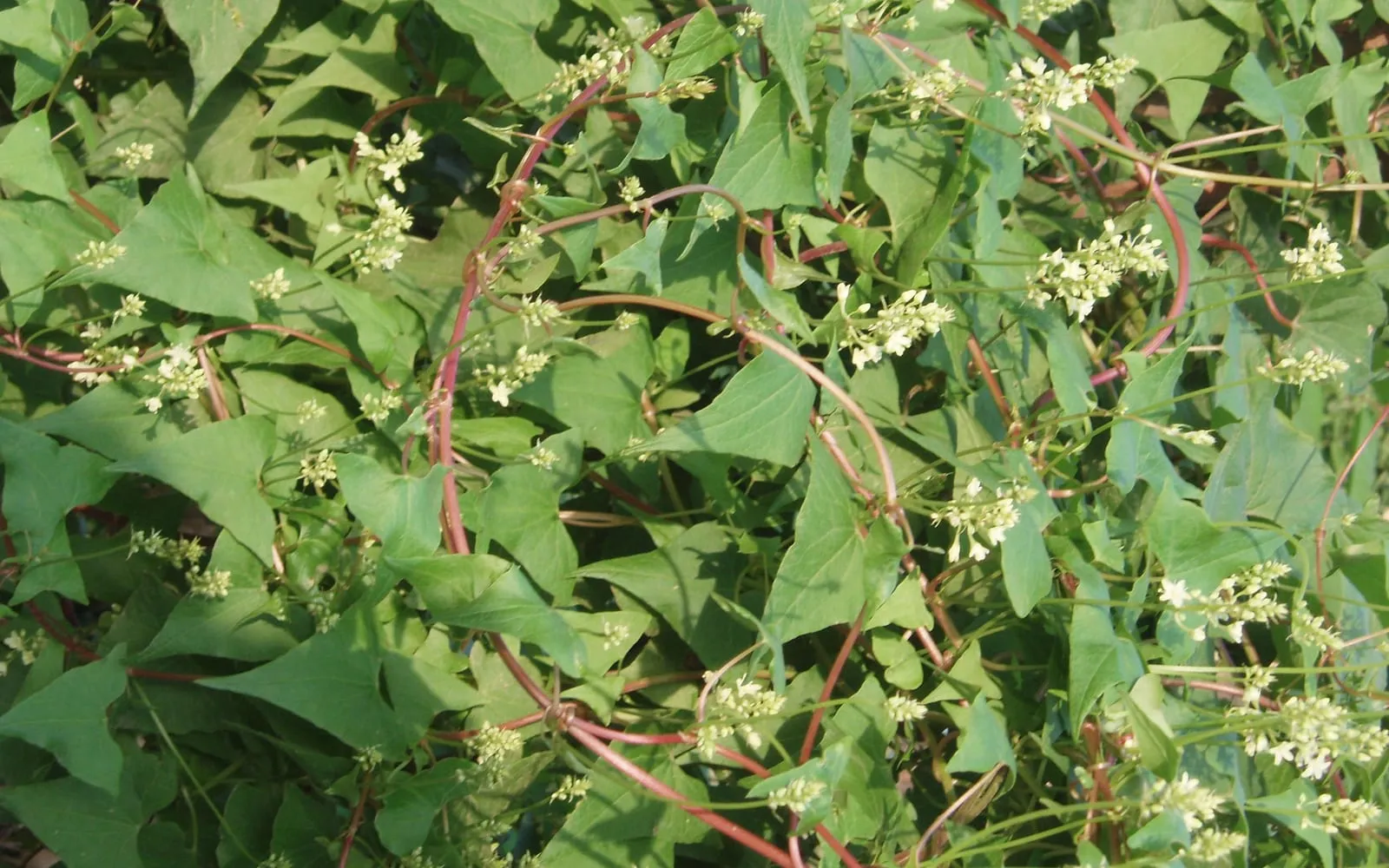
The stems twine, growing three to five metres in a season, thin and reddish, dying back to the ground each winter. New growth comes up in late spring from the crown and from spreading roots.
Leaves are heart-shaped to arrow-shaped, 3 to 7 cm long, pointed, with a smooth margin and a slightly leathery feel. Each leaf base carries a thin papery sheath around the stem, called an ochrea, which is the defining feature of the knotweed family and worth learning to spot.
Flowers open in August and September in loose branched sprays 10 to 20 cm long, each flower tiny, white to greenish, with the whole spray reading as a froth. The fruits are small three-angled nuts with papery wings. The roots swell into red-brown tubers, and it is those the herb trade digs.
Where it is from
The species grows wild across central and southern China, Taiwan, northern Vietnam and parts of Japan, in scrub, on rocky slopes and along woodland edges, climbing over whatever is available.
Commercial root comes largely from Guizhou, Guangdong and Sichuan, where it is cultivated on a three- to four-year cycle. Wild collection continues alongside that, and material in trade varies in age and preparation.
The plant has been introduced to gardens in Europe and North America as an ornamental climber and has naturalised in parts of the southern United States, where it is treated as a weed. It is not established in the wild in Britain.
How it grows
It grows the way knotweeds grow, fast and from a persistent underground system, with little regard for what is nearby. A vine covers a fence in one season and comes back from the root each spring.
Spread is by rhizome and by the tuberous roots, which detach and regrow if a fragment is left in the soil. Digging a plant out is therefore a thorough job rather than a quick one, and any piece missed regrows.
Seed is set in warm summers and germinates readily. Between root spread and seed the plant has two routes to escaping a garden, which is the argument for growing it in a container if at all.
Through the seasons
Shoots emerge in late April or May and climb through the summer. Flowering comes in August and September, and the display is pretty for several weeks.
The top dies back after the first hard frost and the plant overwinters as roots. Cut the dead growth away in late winter and remove it rather than composting it, since stem pieces can root.
If it is grown at all, grow it in a large container standing on a hard surface, with the drainage holes checked each autumn. Anyone who plants it in open ground should expect to be digging pieces out for years afterwards.
Care difficulty
Keeping it alive is easy. Keeping it in bounds is the work, and it is the reason this guide reads as it does.
The plant is not listed under Schedule 9 of the Wildlife and Countryside Act 1981, which covers Japanese knotweed, giant knotweed, the hybrid between them and Himalayan knotweed. Fo-ti is a different species and carries none of those legal restrictions in Britain. Its behaviour is milder than Japanese knotweed’s and it belongs to the same family of habits.
The sensible approach is a large pot, a hard standing, and a cut back every February. Anyone who wants a fast-growing white-flowered climber with none of this attached has a dozen better options.
Watering
Water in the first summer to establish it. After that it needs nothing in a temperate climate, which is consistent with everything else about the plant.
A container-grown plant needs regular watering through the growing season, because a vine that puts on four metres transpires accordingly and a pot dries fast.
The only soil condition it dislikes is permanent waterlogging, which rots the tubers. Everything else it tolerates.
Warning signs, diseases and pests
Very little troubles it. Aphids gather on soft growth in early summer and slugs graze emerging shoots in spring, and neither has any lasting effect on a plant this vigorous.
The warning signs worth watching are its own. New shoots appearing a metre from the parent plant mean the roots are running. Seedlings appearing after a warm summer mean it has set viable seed. Both are cues to take action rather than to wait.
Confusion with Japanese knotweed is the other risk, and it runs in both directions. A gardener who mistakes fo-ti for Japanese knotweed faces an unnecessary and expensive removal, and one who mistakes Japanese knotweed for fo-ti has a legal problem developing. The ochrea is common to both. The twining habit and heart-shaped leaves separate fo-ti from Japanese knotweed’s stout upright hollow canes and shovel-shaped leaves.
Growing environment
Sun or partial shade, on any reasonable soil. The plant is unfussy about pH, texture and fertility, which is what makes it grow where it is not wanted.
A large container on a hard surface is the format to use. Fifty litres or more, with a support, standing where any escaping root would be visible rather than on soil or gravel.
It is hardy to about minus 15 deg C. In a cold garden the top dies early and the roots come through unless the ground freezes hard and stays wet.
Feeding
None. The plant grows fast enough without help and feeding produces more of what you will be cutting back.
A container-grown plant in old compost benefits from repotting every second spring rather than from fertiliser, which is a chance to inspect the roots at the same time.
If growth is weak, look at drainage and light before reaching for a feed. A knotweed that is growing poorly usually has a physical reason.
Troubleshooting
Is this Japanese knotweed? No. Japanese knotweed, Reynoutria japonica, has stout upright hollow canes with purple speckling and broad shovel-shaped leaves, and it does not twine. Fo-ti is a slender twining climber with heart-shaped leaves. Both carry the papery sheath at the leaf base that marks the family.
Is it illegal to grow? No. Schedule 9 of the Wildlife and Countryside Act 1981 lists Japanese knotweed, giant knotweed, the hybrid between them and Himalayan knotweed. This species is not on it.
Should I plant it in the garden? Not in open ground. It spreads at the root and sets viable seed in a warm summer. A large container on a hard surface is the sensible format if you want the plant at all.
Why does the guide say so much about liver injury? Because the record is substantial. LiverTox documents a large number of published cases of acute liver injury following use of the root, which is more than can be said for any other plant in this collection.
How do I get rid of it? Dig thoroughly, following every root, and remove every tuber fragment, because pieces left behind regrow. Repeat the following season, since some will be missed.
What does he shou wu mean? Black-haired Mr He, from a story about an elderly man whose hair darkened after he took the root. It is the origin of the plant’s reputation.
Are the flowers worth having? They are pretty, a froth of small white flowers over several weeks in late summer, and there are many well-behaved climbers that flower as well without the root system.