
Outdoor plant
Common poppy
Papaver rhoeas
Also known as Field poppy, Corn poppy, Flanders poppy
How to grow common poppy, Papaver rhoeas. The cornfield poppy of Remembrance, why it only appears on disturbed soil, and sowing it so it comes back every year.
At a glance
- Difficulty
- Easy
- Water
- Rarely, and it is drought tolerant
- Light
- Full sun
- Temperature
- Fully hardy, and autumn-sown plants overwinter as rosettes
- Hardiness
- USDA 3-9, RHS H7, hardy to -30 C
- Type
- Annual, germinating in autumn or spring and dying after seeding
- Height
- 30-70 cm
- Native to
- Europe, north Africa and western Asia, and an ancient introduction to Britain
- Best month
- June in the Northern Hemisphere, December in the Southern Hemisphere
Seed needs disturbed bare ground and light to germinate, and it stays viable in the soil for decades waiting for it, which is why a field turns red the year after it is ploughed and not before. Nothing in the weather stops it. It has naturalised across North America, Australia and New Zealand from cultivation, and it carries no legal restriction anywhere, being unrelated to the opium poppy.
Hardiness zones describe winter cold alone. Summer heat, humidity, rainfall and the length of the growing season decide as much, so treat the range as the outer limit rather than as a recommendation.
Every month named in this guide is for the temperate Northern Hemisphere. If you garden in the Southern Hemisphere, shift each one by six months, so June becomes December. Closer to the equator the wet and dry seasons matter more than the calendar, and the shift stops being a useful guide.
Edible, with limits
- Safe to eat
- The ripe seeds
- Do not eat
- The green parts and the milky sap
- Harm from
- Eating it
- Affects
- People, cats, dogs and horses
Common poppy contains rhoeadine and related alkaloids in its milky sap, which are mild compared with the morphine of the opium poppy and are still enough to matter. Eating the green parts causes vomiting, abdominal pain and drowsiness, and the sap irritates skin in some people. The ASPCA lists Papaver species as toxic to cats, dogs and horses, and livestock poisoning from grazing large quantities of young poppy plants is recorded, though the bitterness usually stops them. The ripe seeds are a different matter and are edible, and the red petals have been used as a food colouring and to make a syrup across Europe. Papaver rhoeas is not a controlled plant and carries no legal restriction, and it is not the source of opium, which comes from Papaver somniferum. A child who has chewed a leaf or a petal is worth watching rather than an emergency. Wear gloves when handling a great deal of it if your skin is sensitive to the sap.
Sources: RHS potentially harmful garden plants, ASPCA toxic and non-toxic plants
About
The common poppy needs the ground to be broken, and that fact explains everything about it, including why it became the flower of Remembrance.
The seed lies dormant in the soil for decades and germinates when the ground is disturbed and exposed to light. That made it the classic weed of the cornfield, appearing across Europe wherever a plough went through, and it is why fields of poppies came up across the shelled and churned ground of the Western Front in 1915.
It also explains why a packet of poppy seed scattered on a lawn does nothing. The plant needs bare open soil, and where the ground is settled and covered it disappears within a year or two.
In a seed mix the poppy is a cornfield annual, sown on bare ground for a single summer of colour. A lasting wildflower meadow is a perennial grassland on poor soil, cut once a year, and poppies thin out of it as the ground settles.
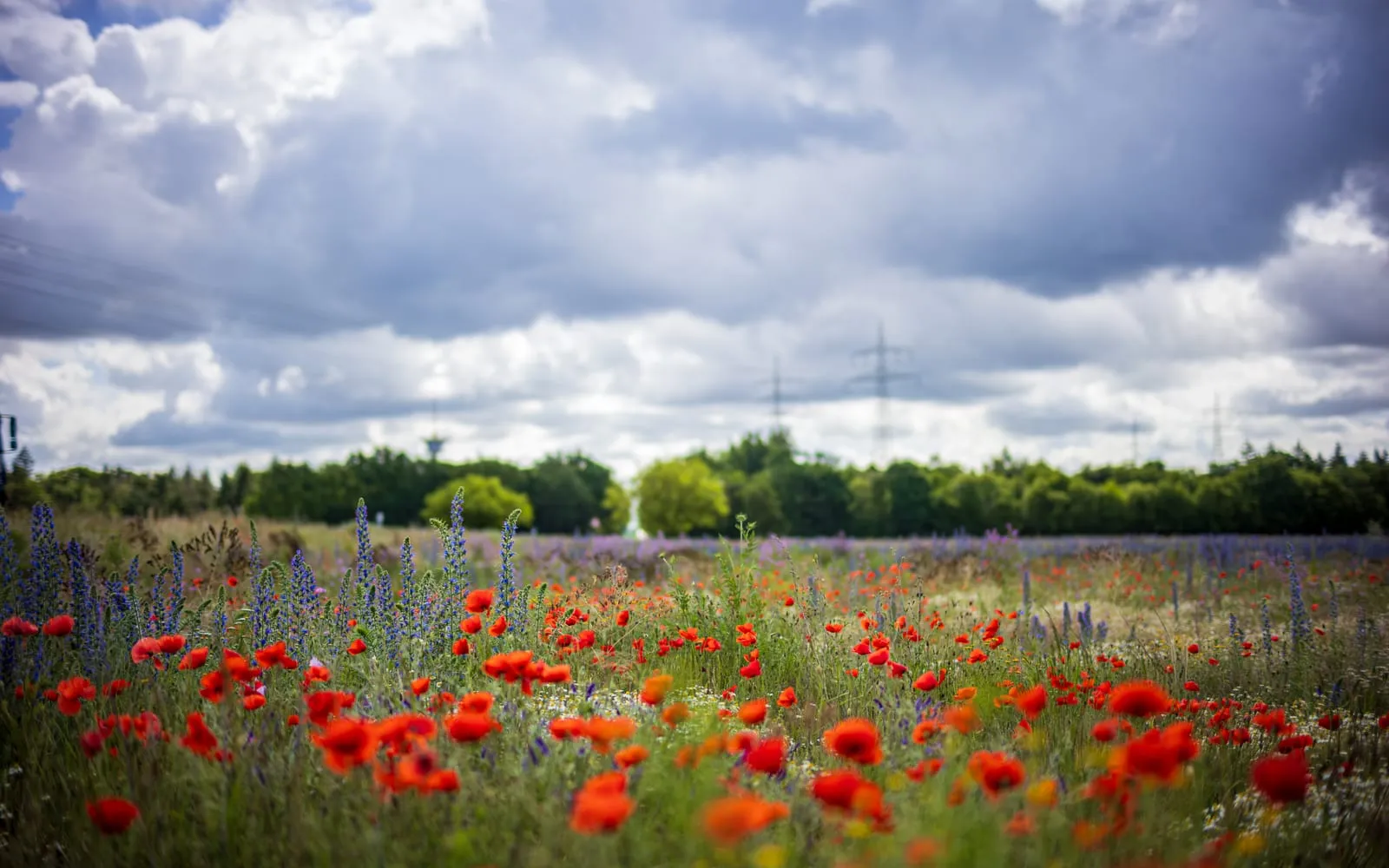
The flowers last a single day each. Four crumpled scarlet petals, usually with a black blotch at the base, open from a nodding hairy bud that lifts as it splits. A plant produces them in succession for weeks, so a stand flowers from June into August even though no individual flower lasts.
Modern arable farming has reduced it substantially, and it survives on field margins, roadsides, building sites and any freshly disturbed ground.
Shirley poppies are the garden strain selected from it in the 1880s, in pink, white, salmon and picotee as well as red.
Appearance and character
An annual reaching 30 to 70 cm, branching, with stiff spreading hairs on the stems.
Leaves are deeply cut into narrow toothed lobes, mid-green, bristly, and mostly held low on the plant.
Buds are nodding, oval and covered in stiff hairs, and they lift to vertical as the flower opens.
Flowers open from June to August, 5 to 10 cm across, with four broad crumpled petals in bright scarlet, most with a black basal blotch, around a ring of dark stamens and a flat capped ovary.
Each flower lasts a single day, and the plant produces them in succession over several weeks.
Seed capsules are round, smooth, hairless and flat-topped, 1 to 2 cm across, with a ring of pores below the flat cap through which the seed shakes out.
The capsule shape separates it from the long-headed and rough poppies. Papaver rhoeas has a round smooth capsule, Papaver dubium has a long narrow one, and Papaver hybridum has a bristly one.
Every part bleeds white latex when cut.
Where it is from
Europe, north Africa and western Asia, and an archaeophyte in Britain, meaning it arrived with early agriculture rather than being a true native.
It spread with cereal cultivation across Europe from the Near East, and its whole ecology is tied to disturbed arable ground.
Seed remains viable in the soil for many decades, waiting for disturbance, and this is why poppies appear on building sites, road cuttings and freshly ploughed field margins.
Its association with Remembrance began with the fields of Flanders, where the disturbed ground of the battlefields produced poppies in enormous quantity, and with John McCrae’s poem of 1915. Moina Michael and Anna Guerin turned it into a fundraising emblem, the American Legion adopted it in 1920 and the Royal British Legion in 1921, and it is now worn for remembrance across Canada, Australia and New Zealand as well.
Shirley poppies were raised by the Reverend William Wilks, vicar of Shirley in Surrey and secretary of the Royal Horticultural Society, who found a single white-edged plant in a field in 1880 and selected from it for twenty years.
Common poppy has declined markedly in British arable fields with modern herbicides and autumn cropping, and conservation headlands and field margin schemes are where much of it now survives.
How it grows
Sow onto bare disturbed soil. This is the whole of it. Rake a patch of ground to a fine tilth, scatter the seed on the surface, and press it down without covering it, since the seed needs light to germinate.
Sow in autumn for the best results, which gives larger plants and earlier flowers, or in early spring.
Choose full sun and poor to moderate soil. Rich ground gives soft leafy growth that flops.
Do not thin heavily. Poppies flower well when crowded and a thick stand supports itself.
Water a spring sowing in dry weather until it establishes, and after that leave it alone.
Do not transplant it. Poppies have a taproot and resent root disturbance, and seedlings moved from one place to another rarely survive. Sow where they are to flower.
Deadhead to prolong flowering, or leave the capsules to seed if you want it back.
Disturb the ground every autumn to keep a colony going. Rake or lightly fork the area after the plants die, which brings buried seed to the surface and triggers the next generation. A stand left undisturbed disappears within two or three years as the ground closes over.
Let it seed and then clear the dead plants in late summer.
Grow it with the other cornfield annuals. Cornflower, corn marigold, corncockle and scentless mayweed all want the same treatment and make the traditional arable flora mixture.
Do not feed it and do not enrich the soil.
Through the seasons
Winter autumn-sown plants sit as low rosettes of divided leaves and are fully hardy.
Spring growth accelerates from March, and this is the time for a spring sowing.
Summer flowers from June to August, with each flower lasting a day and the plant producing them in succession.
Autumn the plants die after seeding, and this is when to clear them, disturb the ground and sow for next year.
Care difficulty
Easy to grow and easy to lose.
Germination and flowering need nothing beyond bare ground and sun. There is no feeding, no staking, no watering and no pest control worth doing.
The difficulty is keeping it. A poppy colony depends on annual soil disturbance, and a border that is mulched, planted up and left alone loses it within two or three years.
Gardeners who scatter seed onto established planting and see nothing have run into that, rather than into a problem with the seed.
Watering
Water a spring sowing in dry weather until the seedlings are established.
An established stand needs no watering, and poppies are markedly drought tolerant.
Avoid watering over the flowers, which are fragile and last one day anyway.
Do not water in an attempt to prolong the display, which does nothing.
Poppies dislike waterlogged ground, and free drainage matters more than moisture.
Warning signs, diseases and pests
Nothing coming up from scattered seed is nearly always a lack of bare disturbed soil. Poppies need light and open ground to germinate, and seed scattered onto grass or a mulched border does nothing.
A colony disappearing after two or three years is the ground closing over. Rake or fork the area every autumn to bring the seed bank back to the surface.
Dense colonies of aphids on the stems and buds are common and feed a great many predators. They rarely need action.
Yellow blotches with grey-purple felt on the leaf undersides in a wet spring is downy mildew. Remove affected plants and thin the stand.
Floppy leafy growth with few flowers is soil that is too rich.
Seedlings that fail after transplanting is the taproot. Sow in place rather than moving them.
Slugs occasionally graze the seedlings.
Growing environment
Full sun, without compromise.
Any soil, and poor to moderate is better than rich. Free drainage matters and fertility does not.
Fully hardy to about -30 deg C, and autumn-sown plants overwinter as rosettes.
Sow at around 1 g per square metre, which is far less seed than it looks, and a thick stand supports itself.
It suits a wildflower area, a cornfield annual mixture, a new border with bare soil, a gravel garden, a building site edge, an allotment path or an area of ground being left between projects.
It does not suit an established mulched border or a lawn.
Grow it with the arable annuals that share its needs. Cornflower, corn marigold, corncockle, scentless mayweed and corn chamomile together make the traditional cornfield mixture, and all of them want bare disturbed ground in sun.
Its wildlife value is good. Bees work the flowers heavily for pollen, since poppies produce no nectar, and hoverflies and beetles visit them.
Choose Shirley poppies for the wider colour range in pink, white, salmon and picotee, or the plain species for the true field poppy.
Feeding
None, and feeding it is a mistake.
Rich soil produces soft leafy growth that flops and flowers less, which is the opposite of what the plant is for.
Do not add compost or manure to a poppy area.
Do not mulch it, since mulch stops germination and the whole colony depends on bare soil.
A stand with poor flowering is more likely too rich or too shaded than short of anything.
Troubleshooting
I scattered seed and nothing came up. Poppy seed needs bare disturbed soil and light to germinate. Rake a patch to a fine tilth, scatter the seed on the surface and press it down without covering it. Scattering onto grass or a mulched bed does nothing.
They flowered one year and never came back. The ground closed over. Rake or lightly fork the area every autumn to bring buried seed back to the surface, which is what a plough used to do in a cornfield.
Can I move the seedlings? No. Poppies have a taproot and resent disturbance. Sow them where they are to flower.
The flowers only last a day. That is normal. Each flower lasts one day and the plant produces them in succession for several weeks.
Should I feed them? No. Rich soil gives leafy floppy growth with fewer flowers.
Is this the opium poppy? No. The opium poppy is Papaver somniferum, with smooth blue-grey hairless leaves and a large round capsule. Common poppy is bristly with a small smooth round capsule and carries no legal restriction.
When should I sow? Autumn for the best results, which gives larger plants and earlier flowers, or early spring as an alternative.
What should I grow with it? Cornflower, corn marigold, corncockle and scentless mayweed, which are the other cornfield annuals and want the same bare disturbed ground in sun.
Are the seeds edible? The ripe seeds are, and the petals have been used for syrup and colouring. The green parts contain alkaloids and cause vomiting.