
Outdoor plant
Butterfly Bush
Buddleja davidii
Also known as Buddleia, Buddleja, Summer lilac
How to grow buddleja, Buddleja davidii. The hard March prune that keeps it flowering at eye level, deadheading to stop it seeding across the neighbourhood, and why it feeds butterflies but not caterpillars.
At a glance
- Difficulty
- Easy
- Water
- Rarely once established
- Light
- Full sun, which is where the flowers and the butterflies are
- Temperature
- Fully hardy, to about -25 deg C
- Hardiness
- USDA 5-9, RHS H6, hardy to -25 C
- Type
- Deciduous shrub, fast growing and short lived
- Height
- 2-5 m, or about 2 m if cut back every spring
- Native to
- Central and western China, on river gravels and rocky slopes
- Best month
- March in the Northern Hemisphere, September in the Southern Hemisphere
It flowers on this year growth, so a hard cut in late winter is what produces the long panicles, and an unpruned plant makes small flowers on tall bare legs. Poor dry rubble suits it better than good soil. It seeds by the million and is a declared noxious weed in Oregon and Washington, where sale is restricted to sterile cultivars, and it is controlled in New Zealand and listed under Schedule 9 in Britain. Sterile cultivars such as the Buzz and Lo and Behold series are the responsible choice anywhere it escapes.
Hardiness zones describe winter cold alone. Summer heat, humidity, rainfall and the length of the growing season decide as much, so treat the range as the outer limit rather than as a recommendation.
Every month named in this guide is for the temperate Northern Hemisphere. If you garden in the Southern Hemisphere, shift each one by six months, so March becomes September. Closer to the equator the wet and dry seasons matter more than the calendar, and the shift stops being a useful guide.
Skin irritant
- Do not eat
- The leaves and bark, which contain saponins and glycosides
- Harm from
- Handling it
- Affects
- People
Buddleja is not a plant that poisons people or pets in any normal garden situation. It is not listed by the ASPCA as toxic to cats or dogs, and it does not appear on the RHS list of harmful garden plants. The leaves and bark contain saponins and iridoid glycosides that would irritate the gut if eaten in quantity, and nothing about the plant invites eating it. The practical caution is skin rather than stomach. Some people react to the sap and the fine hairs on the underside of the leaves with mild irritation, which is worth knowing because pruning a large buddleja means a lot of contact with cut stems. Wear gloves and long sleeves for the March cut, and wash your forearms afterwards. Neither ASPCA nor RHS records a pet hazard, so a dog brushing past it or lying underneath is of no concern.
Sources: RHS potentially harmful garden plants, ASPCA toxic and non-toxic plants
About
Buddleja is sold as the butterfly bush and it earns the name. A plant in full sun in August carries peacocks, red admirals, small tortoiseshells and painted ladies at the same time, and few garden plants come close.
The same qualities make it a coloniser. It grows on railway embankments, chimney stacks, bomb sites and the mortar of old walls, and it arrived at those places by seed from gardens. A single plant produces something in the order of three million seeds a year, carried on the wind.
Both facts belong on the same page. Buddleja is worth growing, and the deadheading that stops it seeding is not optional tidiness.
Two things about its wildlife value are commonly overstated. It feeds adult butterflies with nectar and it supports almost no caterpillars outside China, because local insects have not adapted to it. A garden that wants butterflies rather than visiting butterflies needs nettles, grasses and native shrubs as well.
Appearance and character
A fast, rangy deciduous shrub reaching 2 to 5 m unpruned and about 2 m if cut hard each spring.
Stems arch outward from a woody base, pale grey-brown, with a soft pith that makes them easy to cut and easy to snap.
Leaves are long and lance-shaped, up to 25 cm, dark green above and covered in fine white felt beneath, held in opposite pairs.
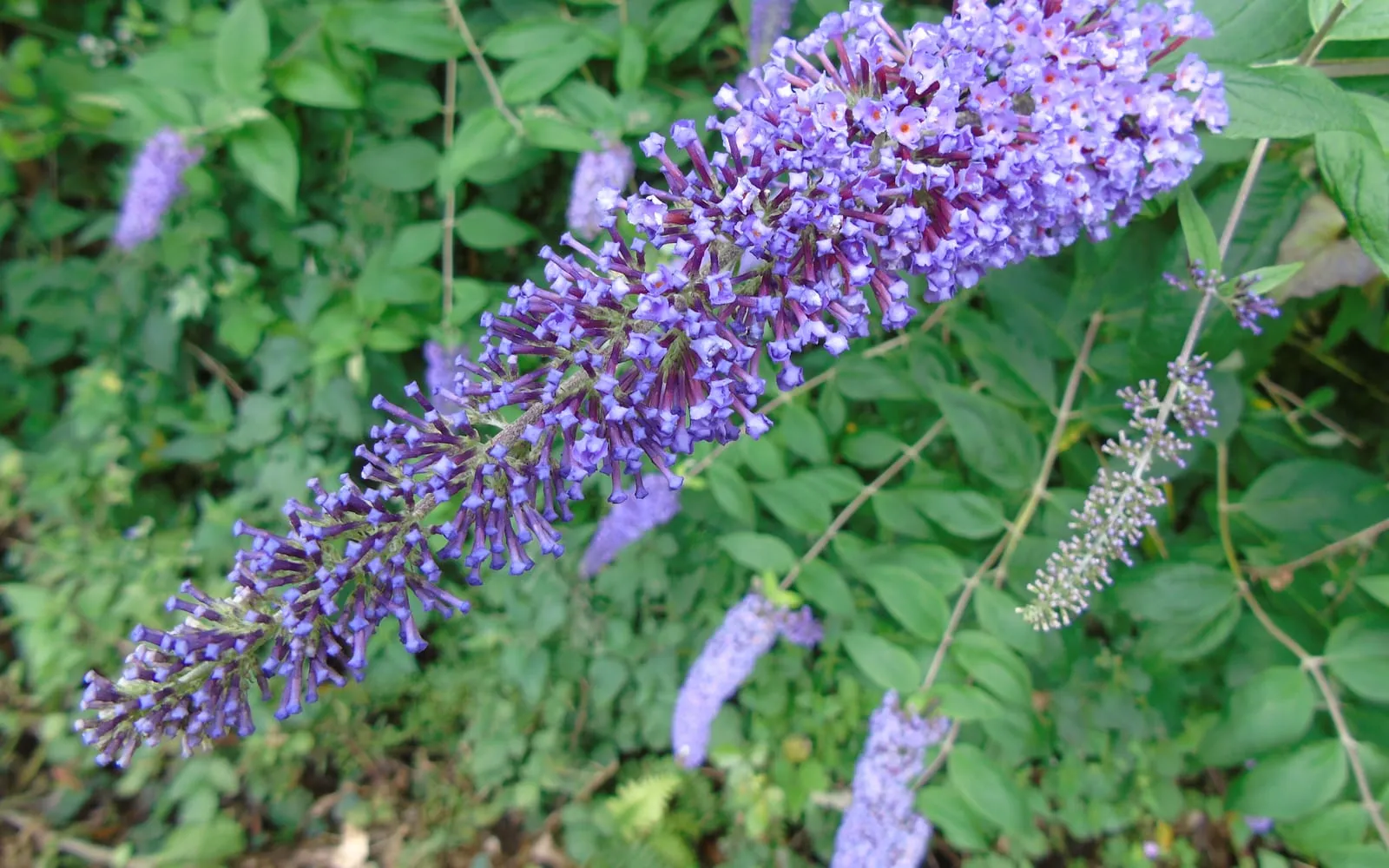
Flowers come in July and August in dense tapering spikes 15 to 30 cm long, made up of hundreds of tiny tubular florets. The usual colour is lilac-purple with a small orange eye at the mouth of each floret, and named forms run from white through pink to deep violet.
The scent is honeyed and carries a long way on a warm afternoon, which is what brings the butterflies in.
Seed heads follow, turning brown and staying on the plant through winter if they are not cut off.
Where it is from
Central and western China, where it grows on river gravels, screes and rocky limestone slopes.
A plant adapted to raw mineral ground, sharp drainage and full exposure finds a railway ballast bed or a gap in a parapet wall entirely familiar.
It was introduced to Britain around 1890 and had escaped into the wild by the 1920s. Bomb damage in the 1940s gave it a great deal of new habitat, and it is now naturalised across most of the country.
The species is named for Adam Buddle, an English botanist, and for Armand David, the French missionary who collected it.
How it grows
Plant between autumn and spring in full sun, in any soil that drains.
Poor soil is better than rich. A buddleja in fertile ground grows soft and rank and flowers less well than one in rubble.
Prune hard in March. Cut every stem back to a low permanent framework about 30 to 60 cm from the ground, leaving short stubs with a bud or two. This feels drastic and it is what the plant needs.
Buddleja flowers on the current season’s growth. An unpruned plant carries its flowers higher and higher each year on bare leggy stems until the display is above head height and the base is a thicket of dead wood.
Deadhead through the summer. Cut each spike off as it browns, taking it back to the next pair of leaves or a side shoot. This does two jobs, since it prompts a second flush of flowers into September and it stops the seed reaching your neighbours.
Renovate an old neglected plant by cutting the whole thing to 30 cm in March. It will regrow, and it is usually easier than trying to reshape it gradually.
Take cuttings in summer or hardwood cuttings in autumn. They root very readily, which is another way of saying the plant is hard to stop.
Through the seasons
Winter is dormancy, and the plant looks like a bundle of dead sticks with brown seed heads on top. Leave the top growth on until March, since it protects the crown in a hard frost.
Spring is the prune. Cut hard in March, and expect a metre or more of new growth by June.
Summer brings flowers from July, and the butterflies with them. Deadhead continuously.
Autumn produces a second flush from deadheaded plants, then seed. Cutting the last spikes off in October helps limit its spread.
Care difficulty
Easy to the point of being difficult to kill.
It tolerates drought, poor soil, chalk, coastal wind and hard frost, and it grows several feet in a season from a hard cut.
The work is entirely in the pruning and the deadheading, and both are simple. The March cut takes twenty minutes and decides the shape of the plant for the year.
Its weaknesses are the other side of its vigour. Plants are short lived, often declining after fifteen or twenty years, and the soft pithy stems break in wind if the plant is allowed to get tall.
Watering
Water in the first summer after planting and then leave it alone.
An established buddleja needs no watering in a temperate climate. It roots deeply and it grows naturally on gravel.
Container plants are the exception and need regular water in summer, though buddleja is a poor choice for a pot given its size and vigour. The dwarf ‘Buzz’ types are bred for it.
Overwatering and rich damp soil both produce soft growth and fewer flowers.
Warning signs, diseases and pests
Buddleja is remarkably free of disease. Most problems are cosmetic.
Capsid bug feeds on the shoot tips in early summer, leaving small ragged holes and distorted puckered young leaves. The plant grows through it and no treatment is needed.
Buddleja budworm, the caterpillar of a small moth, feeds inside the developing flower spikes and leaves them stunted, browned and webbed together. Pick off the affected spikes.
Mullein moth caterpillars, boldly marked in white with black and yellow spots, strip leaves in early summer. They are handsome and the plant recovers, so moving them is kinder than killing them.
Flowering high up on bare legs means the plant has not been pruned hard enough. Cut it to 30 cm in March.
Few or no flowers, on a well-pruned plant, usually means too much shade or too much nitrogen.
Seedlings appearing in paths, gutters, walls and neighbouring gardens are the genuine problem this plant causes. Pull them while small. A seedling rooted into mortar will damage the wall as it thickens and is far harder to remove later.
Growing environment
Full sun. Flowering falls away sharply in shade and the butterflies follow the sun.
Any free-draining soil, and it does better on poor thin ground than on rich loam. It is entirely happy on chalk.
It stands coastal exposure and urban pollution, and it is one of the few shrubs that will grow in the dry rubble at the foot of a wall.
Give it space. Even a hard-pruned plant makes a 2 m dome in a season, and the arching stems need room to arch.
Site it where the scent and the butterflies can be enjoyed, which usually means near a path or a seat rather than at the back of a border.
Consider Buddleja globosa, the orange ball tree, if you want something less invasive, or the dwarf ‘Buzz’ series for a small garden or a large pot. Sterile or low-fertility cultivars are increasingly available and are the responsible choice near open countryside.
Feeding
Buddleja needs no feeding in ordinary soil, and feeding it usually makes it worse.
Rich ground gives soft sappy growth that flops, breaks in wind and carries fewer flowers.
A mulch of compost after the March prune is worthwhile on very thin or stony soil, and does more by holding moisture than by feeding.
Avoid high-nitrogen lawn feeds reaching it, which is a common cause of a large leafy plant with a poor display.
A plant that flowers badly is nearly always short of sun or short of pruning rather than short of food.
Troubleshooting
All the flowers are at the top and the bottom is bare sticks. It has not been pruned hard enough. Cut every stem back to a low framework 30 to 60 cm from the ground in March.
When exactly do I prune it? March, once the worst frosts have passed and before growth gets going. It flowers on new wood, so cutting it in spring costs you nothing.
Can I cut a huge overgrown one right down? Yes. Take it to 30 cm in March. It regrows readily and this is the standard way to renovate one.
Seedlings are coming up everywhere. Deadhead every spike as it browns and cut the last ones off in October. Pull seedlings out of paths and walls while they are small, since a rooted plant will crack mortar.
Butterflies visit but I never see caterpillars. Buddleja provides nectar for adults and supports almost no caterpillars outside China, because local insects have not adapted to it. Add nettles, native grasses and a native shrub or two if you want butterflies to breed rather than just feed.
The flower spikes are stunted, brown and webbed. Buddleja budworm, feeding inside the spike. Pick off the affected heads.
The shoot tips are distorted with small holes. Capsid bug damage. The plant grows through it and no treatment is needed.
It broke apart in a gale. The stems are pithy and brittle, and tall unpruned plants split at the base. Hard spring pruning keeps it low and much sturdier.