
Outdoor plant
Miniature Chusan Palm
Trachycarpus wagnerianus
Also known as Wagner's windmill palm
How to grow miniature Chusan palm, Trachycarpus wagnerianus, outdoors. Its compact, wind-resistant fronds, and why it copes with storms better than its parent species.
At a glance
- Difficulty
- Easy
- Water
- Regular watering while young, drought-tolerant once established
- Light
- Full sun to partial shade
- Temperature
- Tolerates hard frost and snow once established
- Hardiness
- USDA 7-11, RHS H5, hardy to -15 C
- Type
- Evergreen perennial palm
- Height
- 3-6 m
- Native to
- East Asia, exact wild origin uncertain; long cultivated in Japan
Exceptionally hardy for a palm, tolerating hard frost and even a covering of snow once established, and grown successfully in temperate gardens across northern Europe and similar climates well beyond the tropics and subtropics most palms need. Consistent shelter from cold, drying wind while young does more for establishment than any amount of extra warmth.
Hardiness zones describe winter cold alone. Summer heat, humidity, rainfall and the length of the growing season decide as much, so treat the range as the outer limit rather than as a recommendation.
Not known to be toxic
Miniature Chusan palm has no toxicity listing from the RHS or the ASPCA and is considered safe around pets and children. It has no documented history of causing poisoning, and the main hazard around this palm is the stiff, sharply pointed leaf tips rather than anything chemical.
Source: RHS
About
The miniature Chusan palm is a smaller, tougher, more wind-resistant relative of the widely planted Chusan or windmill palm, prized by gardeners in cooler climates for a combination few other palms offer: real hardiness through a real winter, and stiff, compact fronds that shrug off wind and storm damage far better than the larger, more flexible fronds of its parent species. Its precise wild origin is uncertain, and some botanists suspect it may be a long-cultivated selection from Japan rather than a distinct wild species, though it is now grown and sold worldwide as a distinct, garden-worthy plant in its own right.
Its comparatively small, tidy crown and slow, manageable growth rate also make it a popular choice for a smaller garden or a large container, where the full-sized Chusan palm would eventually become too large.
Appearance and character
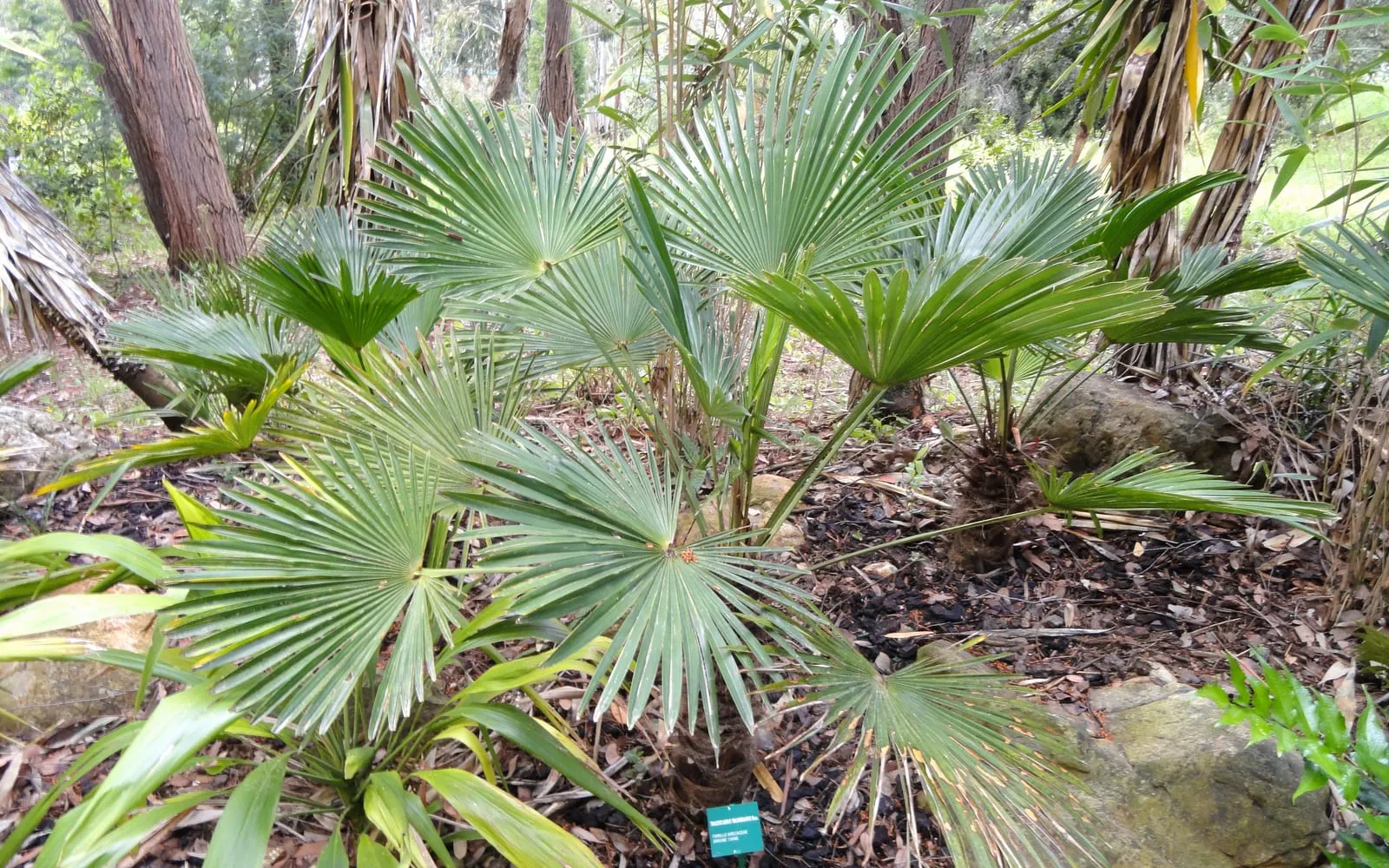
A single, slender, fibrous trunk, densely covered in a coarse, dark brown matted fibre, rises to support a compact, rounded crown of stiff, fan-shaped fronds, each one held more rigidly and cut less deeply than the larger, more drooping fronds of the ordinary Chusan palm. This stiffness is what gives the crown its notable wind resistance, since the fronds are less prone to tearing or shredding in a storm.
Small yellow flowers appear in branched clusters among the fronds in early summer, followed, on female plants, by small blue-black fruit, though flowering and fruiting are a minor feature compared with the plant’s foliage and overall structural presence in the garden.
Where it is from
Its precise wild origin remains debated among botanists, with some evidence pointing to East Asia broadly and a long history of cultivation in Japan specifically, where it has been grown and selected for so long that an unambiguously wild population may no longer be identifiable.
Whatever its exact origin, it shares the broader Trachycarpus genus’s adaptation to a monsoon climate with real seasonal temperature variation, which underlies its unusual cold tolerance compared with palms from more uniformly tropical regions.
How it grows
An evergreen palm growing from a single crown, adding fronds and, more slowly, trunk height over time. Growth is moderate, generally slower and more compact than the closely related Chusan palm, which is part of why this species suits smaller gardens and containers so well.
Because its fronds are stiffer and more wind-resistant than many other palms, it holds its crown intact through weather that would shred or strip a more flexible-leaved species, an advantage that becomes particularly apparent in an exposed or coastal garden.
Through the seasons
Spring growth resumes with new fronds emerging from the crown.
Summer is the main growing season, with small yellow flowers appearing among the fronds. Feed two to three times through this period.
Autumn growth slows gradually as temperatures cool.
Winter established plants tolerate hard frost and snow with minimal damage, one of the more reliably cold-hardy palms available for a temperate garden.
Care difficulty
Easy, and one of the more reliable palms for a temperate garden outside the tropics and subtropics. Its combination of cold tolerance and wind resistance removes two of the biggest obstacles most gardeners face when trying to grow a palm successfully in a cooler climate.
Watering
Regular watering supports strong establishment while young. Once settled, it tolerates real drought reasonably well, though a deep watering during any extended dry spell in summer supports better overall growth and a fuller, healthier-looking crown.
Warning signs, diseases and pests
Scale insects occasionally colonise the fronds and respond to a horticultural oil treatment for significant infestations. Palm leaf mite can appear in hot, dry conditions, causing a fine bronze or grey mottling across the frond surface; increasing humidity around the plant and washing down the fronds periodically helps prevent a build-up.
Browning or splitting at the base of older fronds where they meet the trunk is often no more than natural ageing and frond shedding rather than a disease, and is addressed by trimming away fully dead fronds cleanly at the base once they have turned entirely brown.
Slow growth in a young plant is normal for this naturally compact, unhurried species rather than a sign of poor health, and steady, if modest, improvement year on year is the expected pattern.
Growing environment
Full sun to partial shade both suit it well, and it copes with a wider range of light conditions than many other palms. Free-draining, humus-rich soil gives the best results, and shelter from the coldest, most drying winter winds while the plant is young supports faster, more even establishment, even though a mature specimen tolerates much harsher exposure.
Feeding
A palm-specific fertiliser containing adequate magnesium and potassium, applied two to three times through the growing season, supports healthy green fronds. This species is not a particularly heavy feeder, and modest, regular feeding suits it better than large, infrequent applications.
Troubleshooting
Fronds have a fine bronze or grey mottled appearance. Check for palm leaf mite, particularly in hot, dry conditions, and increase humidity around the plant while washing down affected fronds.
Growth seems slow compared with other palms in the garden. This is normal for the species, which grows more slowly and compactly than many other ornamental palms by nature rather than as a sign of poor care.
Older fronds are browning and splitting at the base. Usually natural ageing rather than disease. Trim away fully dead fronds cleanly once they have browned completely.
A young plant looks stressed after a hard winter. Check for real cold damage versus normal winter toughening; established plants of this species tolerate real frost well, and a young plant recovering from its first hard winter often improves markedly the following growing season.
You are trying to tell this species apart from the larger Chusan palm. Look at the fronds rather than the overall size, since a young plant of either species can be similarly compact. This species holds noticeably stiffer, less deeply cut fronds that resist wind damage, while the ordinary Chusan palm’s fronds are larger, more drooping and prone to shredding along their segments in strong wind.
Snow has settled heavily on the crown. Established plants generally tolerate this well thanks to their stiff fronds, though brushing off very heavy, wet snow can reduce the risk of individual fronds snapping under the weight.