
Outdoor plant
Japanese Forest Grass
Hakonechloa macra
Also known as Hakone grass
How to grow Japanese forest grass, Hakonechloa macra, one of the few ornamental grasses that thrives in shade rather than merely tolerating it.
At a glance
- Difficulty
- Moderate
- Water
- Regular watering; the soil should stay evenly moist, never waterlogged or bone-dry
- Light
- Partial to full shade; tolerates morning sun in a cooler climate
- Hardiness
- USDA 5-9, RHS H6, hardy to -20 C
- Type
- Hardy deciduous perennial grass, slow-growing
- Height
- 30-50 cm
- Native to
- Japan
Fully hardy through an ordinary temperate winter, and cold is rarely the factor that limits this species. Summer heat is closer to the real ceiling: it comes from cool, moist mountain woodland in Japan and performs best where summers are not extreme, sulking in scorched, humid heat even where winters are mild. A reader gardening somewhere with hot, dry summers should expect to give it more shade and more consistent moisture than the zone number alone suggests.
Hardiness zones describe winter cold alone. Summer heat, humidity, rainfall and the length of the growing season decide as much, so treat the range as the outer limit rather than as a recommendation.
Not known to be toxic
Japanese forest grass has no toxicity listing from the RHS or the ASPCA and is considered safe around pets and children. Its soft, thin leaves carry none of the sharp edges or awns that make some other ornamental grasses a mechanical hazard, and it is grown widely in shaded gardens without any recorded history of harm to people or animals that chew or brush against it.
Sources: RHS potentially harmful garden plants, ASPCA toxic and non-toxic plants
About
Most ornamental grasses want full sun and punish anything less with thin, floppy, reluctant growth. Japanese forest grass is one of the rare exceptions, a species that prefers shade and produces its best foliage and habit where a sun-loving grass would fail outright. It is one of the few real options for bringing grass-like texture into a shaded border, under trees, or along the north side of a building.
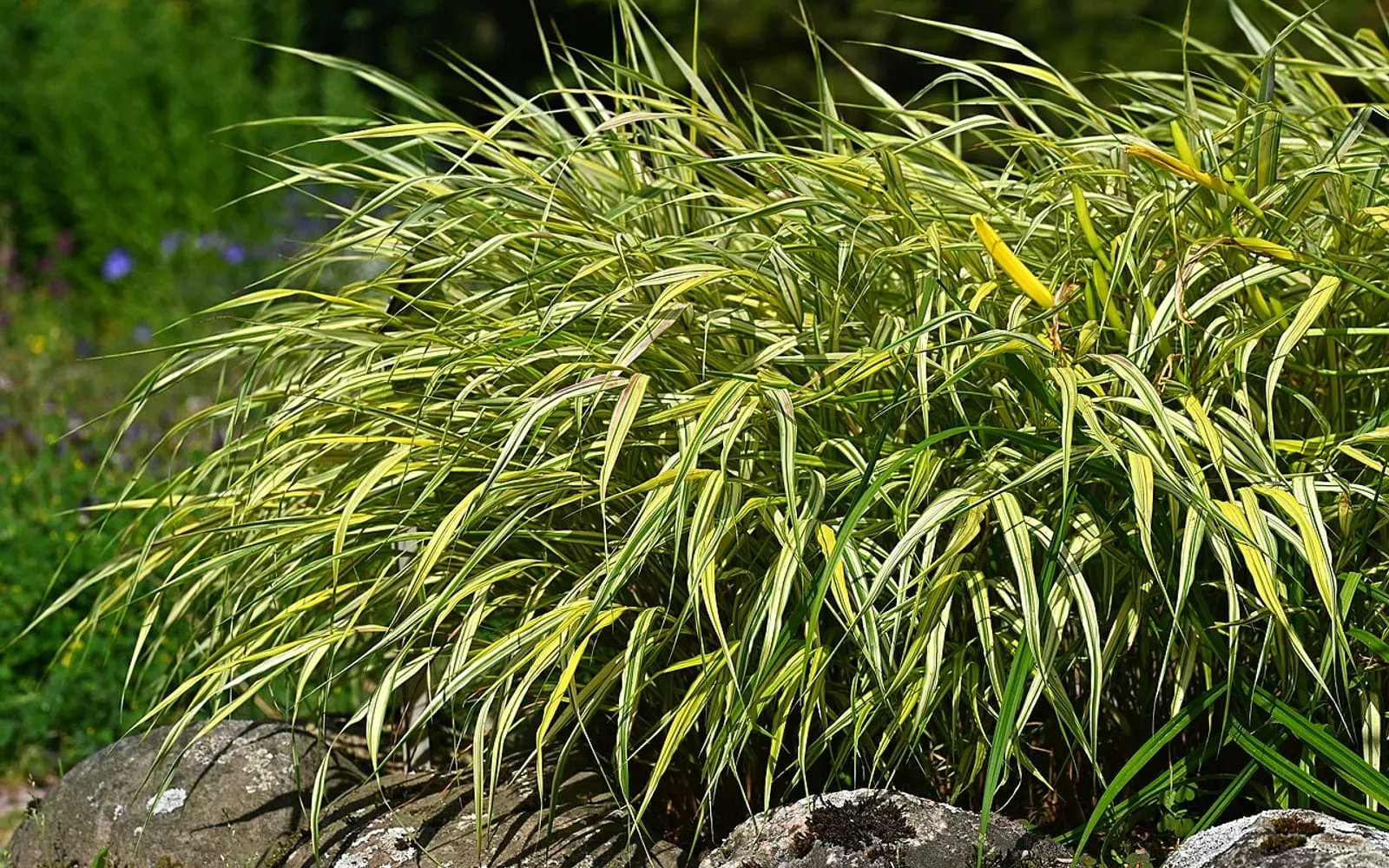
Its habit is as distinctive as its shade tolerance. Rather than an upright tuft, the foliage arches to one side in a cascading, almost combed-looking mound, giving it a softness that reads more like a woodland groundcover than a typical grass. It is a slow grower, taking several years to reach a full, mature spread, which is worth knowing before planting a single specimen and expecting quick coverage.
Appearance and character
Narrow, ribbon-like leaves emerge from the base and arch outward and downward in a consistent direction, building a low, flowing mound that looks almost combed into shape rather than randomly tufted. Many cultivars carry gold, cream or white variegation running the length of each blade, which brightens a dark corner in a way plain green foliage cannot, though the true species itself is a soft mid-green.
Foliage colours further through autumn, often taking on warm orange, copper or bronze tones before the plant dies back for winter, adding a second seasonal display distinct from its main summer role as a textural groundcover. Flower spikes appear in late summer but are inconspicuous, fine and pale, adding little to the display compared with the foliage.
Several named cultivars have overtaken the plain green species in popularity. ‘Aureola’, with leaves striped gold and cream, holds the RHS Award of Garden Merit and is the form most widely sold in the UK, while ‘All Gold’ carries an almost uniformly golden-yellow leaf that brightens a dark corner even more strongly. ‘Beni-kaze’ is grown less for variegation than for autumn colour, its green summer foliage turning a strong red rather than the more usual copper or bronze shown by the species.
Where it is from
Hakonechloa macra is native to mountainous woodland in Japan, growing on damp, shaded rock faces and slopes in a climate of cool, humid summers and reliably moist soil. That single native site, Japan’s Mount Hakone, gave the genus its name, and the plant remains uncommon in the wild, protected in parts of its native range.
Its origin on shaded, damp rock explains both its shade tolerance and its dislike of a hot, dry, exposed position, since neither condition resembles the mountain woodland it evolved in. A garden that offers cool shade and consistently moist, humus-rich soil comes closest to replicating that native habitat, which is the surest way to get strong growth from this otherwise slow-establishing species.
How it grows
Plant in spring into humus-rich soil enriched with leaf mould or well-rotted compost, in a shaded or partly shaded spot sheltered from strong wind and the harshest midday sun. Establishment is slow by the standards of most ornamental grasses, and a young plant can look modest for its first two or three seasons before its spreading rhizomes fill out into the mature, cascading mound the species is grown for.
Growth spreads gradually via short rhizomes rather than aggressively, staying well-behaved and slow to outgrow its space, which suits a mixed shaded border where a fast-spreading groundcover would swamp neighbouring plants. Once established, it rewards patience with years of reliable, low-maintenance display.
Little pruning is needed through the growing season. Cut the whole clump back close to the ground in late winter, once the foliage has died back and before new shoots emerge, to keep the display tidy and encourage fresh growth in spring.
Through the seasons
Spring brings the cutback of the previous year’s dead foliage, followed by fresh green shoots emerging slowly from the rhizomes as the soil warms.
Summer is the main growing season, with the mound filling out and the arching, cascading habit at its fullest and most textural.
Autumn brings a second display as the foliage colours to orange, copper or bronze before dying back, often the most striking phase of the year for this species.
Winter the top growth dies back completely in a cold climate, and the plant disappears below ground until spring, though in a milder climate some foliage can persist through a mild winter before the seasonal cutback.
Care difficulty
Moderate, mostly because of the patience needed while it establishes rather than because of any complicated ongoing care. Once settled, it needs consistent moisture, a shaded position and an annual cutback, but little else. A gardener expecting the rapid coverage typical of a faster-growing groundcover may find the slow early years frustrating.
Watering
Keep the soil evenly moist through the growing season, watering during dry spells rather than waiting for visible stress, since this species has no tolerance for the extended drought that many sun-loving prairie grasses shrug off. It is equally intolerant of waterlogging, so the target is consistently moist, well-drained soil rather than either extreme.
Warning signs, diseases and pests
Slugs and snails can graze the soft new shoots as they emerge in spring, sometimes seriously enough to set back a young plant, since the foliage stays tender for longer than that of a tougher, sun-grown grass. Protecting emerging growth in a known slug-prone garden is worth the effort while shoots are young and soft.
Rust occasionally appears as small orange-brown pustules on the leaf blades, usually in a wet season, and rarely does serious harm to an established plant.
Foliage that scorches brown at the tips or edges in summer generally signals too much sun, too little water, or both, rather than a disease. Moving the plant to deeper shade or improving soil moisture retention is the relevant fix.
Growing environment
Shade to partial shade suits this species best, and it is one of the few ornamental grasses that performs poorly rather than well in full sun, particularly in a hot climate. Humus-rich soil that holds moisture without staying waterlogged is ideal, closer to woodland soil than to the lean, gritty ground many other ornamental grasses prefer.
Feeding
A light application of balanced fertiliser in spring supports strong growth, particularly in soil that is not naturally rich in organic matter. Working leaf mould or compost into the soil each year does as much for this species as any bagged fertiliser, replicating the leaf litter it would receive on a woodland floor in its native range.
Troubleshooting
Growth has been very slow for the first two or three years after planting. This is normal for the species rather than a sign of trouble. It establishes slowly by nature, spreading gradually via short rhizomes, and growth accelerates noticeably once the root system matures.
Leaf tips are browning and scorched in summer. Check sun exposure and soil moisture. This usually means too much direct sun, too little water, or both, and moving the plant to deeper shade or watering more consistently through summer resolves it.
Slugs have damaged the new shoots in spring. Young growth is soft and vulnerable while it is emerging. Protect the crown in a slug-prone garden until the foliage toughens, after which damage becomes much less of a concern.
Can this grass cope with full sun? Only in a cool, moist climate. Anywhere with hot or dry summers, full sun produces scorched, stressed foliage, and the plant performs best with at least partial shade.
When is the right time to cut it back? Late winter, after the foliage has fully died back and before new shoots appear, cutting the whole clump close to the ground. Cutting back too early in autumn loses some of the plant’s late-season colour for no benefit.
The plant looks thin and never seems to fill in. Check that the soil is holding enough moisture and organic matter, since this species struggles in dry, poor ground far more than most ornamental grasses. Working compost or leaf mould into the surrounding soil each year usually improves density over subsequent seasons.
Is a variegated cultivar such as ‘Aureola’ harder to grow than the plain green species? Not meaningfully. The variegated forms share the same shade preference, moisture needs and slow establishment as the species, and ‘Aureola’ in particular is if anything the more widely grown and commercially available form, so a gardener is unlikely to find plain green Hakonechloa macra any easier to source or to keep.