
Outdoor plant
Hong Kong Orchid Tree
Bauhinia blakeana
Also known as Bauhinia
How to grow Hong Kong orchid tree, Bauhinia blakeana. Why every tree alive is a clone of one nineteenth-century original, flowering through winter when little else blooms, and why it rarely sets a single viable seed.
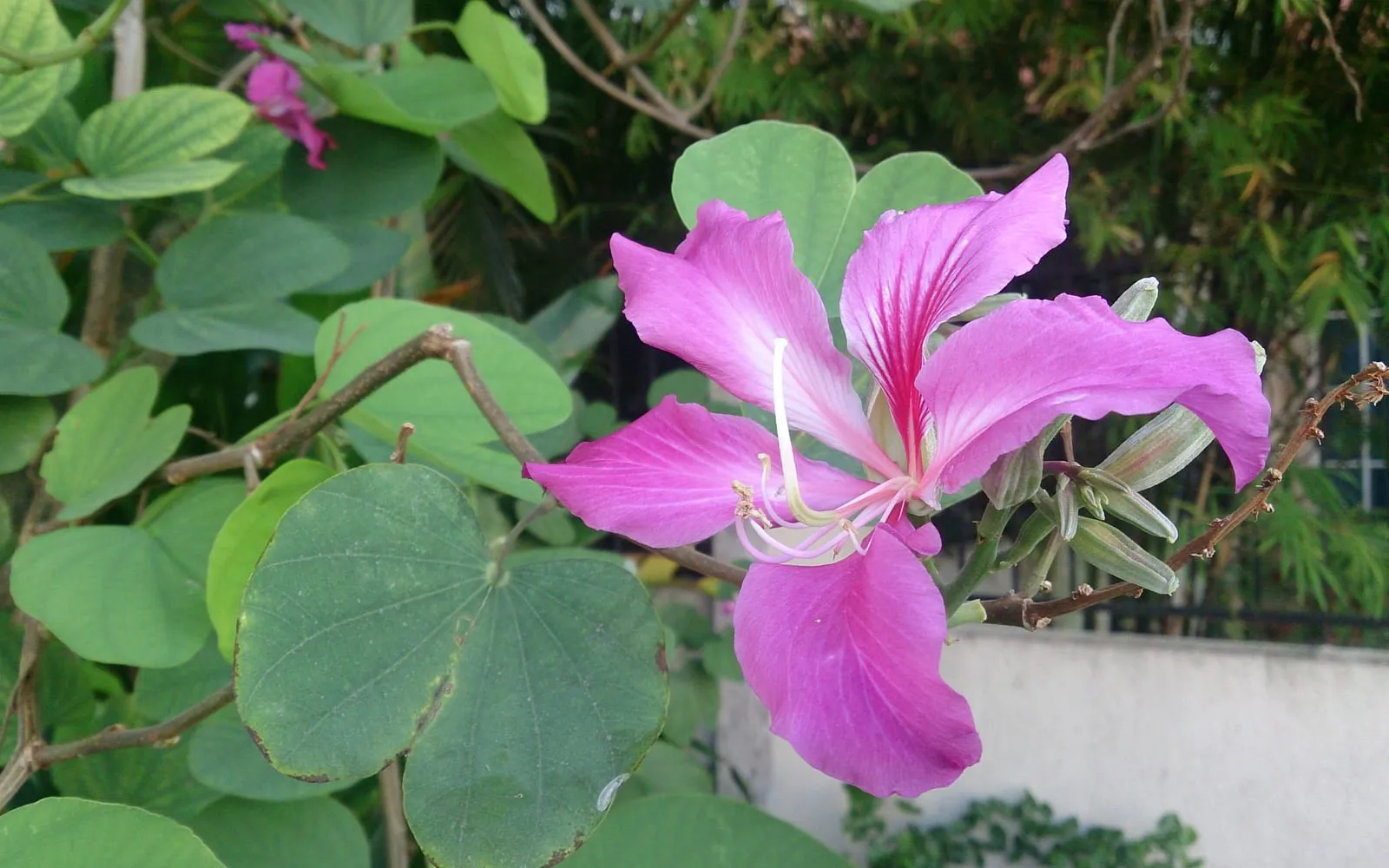
At a glance
- Difficulty
- Moderate
- Water
- Regularly through the growing season, less in a cool or dormant spell
- Light
- Full sun for the heaviest flowering
- Temperature
- Frost tender; damaged by any hard freeze
- Hardiness
- USDA 9b-11, RHS H2, hardy to -2 C
- Type
- Evergreen to semi-evergreen tree, propagated entirely by cuttings and grafts
- Height
- 6-12 m
- Native to
- of cultivated hybrid origin, Hong Kong
A subtropical tree with no meaningful tolerance of frost. Established wood takes a very light, brief chill without lasting harm, but a hard freeze kills stems outright and a sustained one kills the whole tree, so the zone range here is close to an absolute cutoff rather than a gradient of hardiness the way it is for a temperate species. It needs warmth through the growing season as much as it needs frost-free winters, and a cool summer produces a leafy tree that flowers only lightly.
Hardiness zones describe winter cold alone. Summer heat, humidity, rainfall and the length of the growing season decide as much, so treat the range as the outer limit rather than as a recommendation.
Not known to be toxic
Hong Kong orchid tree is not listed by the RHS among potentially harmful garden plants and does not appear on the ASPCA's toxic plant index for cats, dogs or horses. No part of it is a recorded poisoning hazard, and because the species is a sterile hybrid that rarely sets viable seed, the flat brown pods other Bauhinia species produce in quantity are uncommon on this one and, where they do form, are usually empty. Some other members of the genus have pods reported to cause mild stomach upset if eaten in large amounts, but this specific hybrid is grown throughout Hong Kong's parks, streets and school grounds without any safety caveat attached to it.
Sources: RHS potentially harmful garden plants, ASPCA toxic and non-toxic plants
About
Every Hong Kong orchid tree alive today is a clone descended from a single plant. It was found growing beside the ruins of a French mission on Hong Kong Island around 1880, most likely a natural hybrid between two other Bauhinia species, and it turned out to be sterile, setting no viable seed of its own. Every tree since has been raised from a cutting or a graft taken from that lineage, which makes it one of relatively few ornamental trees anywhere that is propagated exclusively by cloning rather than by seed.
The large, orchid-shaped flowers that give the species its common name appear through the cooler months, roughly November to March in its native climate, when most flowering trees are dormant, and the display made it an obvious choice as a civic emblem. The flower appears on Hong Kong’s flag and coinage, and the tree itself is now planted across the territory’s parks and streets as a symbol as much as an ornamental.
Appearance and character
Leaves are broad, rounded and distinctively bilobed, split at the tip into two lobes joined by a shallow notch, giving each leaf the silhouette of a butterfly or a folded heart, 10 to 15 cm across on a mature tree.
Flowers are large, 10 to 15 cm across, with five broad petals in shades of magenta-purple to deep pink, the uppermost petal often marked with darker veining and a paler throat, arranged loosely and opening over a long winter season rather than in one short flush.
The crown is broad and spreading, usually developing multiple low-branching stems rather than a single clear trunk, giving a mature tree a rounded, umbrella-like outline well suited to shade planting in a warm climate.
Bark is smooth and grey-brown on younger growth, developing a slightly rougher texture with age, though it is the leaves and flowers rather than the bark that carry the tree’s identity at every stage.
Because the species is a sterile hybrid, seed pods are uncommon, and where flat, bean-like pods do form they typically contain no viable seed, unlike the seed-heavy pods of most other Bauhinia species grown nearby.
Where it is from
Bauhinia blakeana has no wild native range at all. It arose as a chance hybrid, most likely between Bauhinia purpurea and Bauhinia variegata, discovered as a single specimen near Hong Kong in the nineteenth century and named after Sir Henry Blake, the colonial governor at the time it was first propagated and distributed from the Hong Kong Botanic Gardens.
Every tree grown anywhere in the world today traces back to that one original plant through cuttings and grafts, which is unusual among widely cultivated ornamental trees and means the entire global population shares identical genetics.
It became Hong Kong’s official floral emblem in 1965, appearing on the flag adopted for the territory after the 1997 handover and on the coinage still in circulation, and it remains one of the most widely planted street and park trees across Hong Kong and southern China, valued for a flowering season that fills the gap left by most other ornamental trees through winter.
How it grows
Plant in moist, fertile, well-drained soil, in full sun for the heaviest flowering, in a climate that stays essentially frost-free through winter. This is not a tree for a temperate garden outdoors, and it is grown as a large container specimen, moved under cover for winter, well outside its comfortable climate range.
Water regularly through the warm growing season, allowing the soil to dry slightly between waterings rather than keeping it constantly wet, and reduce watering considerably during any cool spell when growth slows.
Choose a sheltered, warm position within a frost-free climate, since even a brief light freeze damages soft new growth, and a hard freeze can kill the tree outright.
Prune lightly after the main flowering season to shape the crown and remove any damaged wood, since flowering happens on new growth and heavy pruning too close to the flowering season reduces the coming display.
Grow new plants from cuttings or a graft taken from an existing tree rather than from seed, since viable seed is rarely produced by this sterile hybrid, and any pods that do form are unreliable as a propagation source.
Through the seasons
Autumn into winter brings the main flowering display in its native subtropical climate, large magenta-purple blooms opening over several months while most other trees are bare or dormant.
Late winter into spring sees the flowering display taper off as new leafy growth resumes.
Summer is the main season of vegetative growth, extending shoots and building the framework that will carry the following winter’s flowers.
A cool or cold spell, wherever the tree is grown towards the margin of its climate range, checks growth sharply and can damage or kill soft tissue, the single greatest risk this species faces outside its native subtropics.
Care difficulty
Moderate, and the difficulty is almost entirely about climate rather than technique. Within a frost-free, warm climate, Hong Kong orchid tree grows readily and flowers reliably with straightforward watering and feeding.
Outside that climate, it becomes a container plant requiring frost protection every winter, which adds real ongoing effort compared with a hardy tree, and a specimen caught by a hard freeze even once can be killed outright rather than merely set back.
Watering
Water regularly and deeply through the warm growing season, allowing the surface of the soil to dry between waterings rather than keeping the roots constantly saturated.
Reduce watering considerably during any cool spell, when the tree’s growth slows and its water use drops with it, since cool wet soil is a common route to root rot in this species.
An established tree in the ground within its natural climate range tolerates brief dry spells reasonably well, though consistent moisture through the flowering season supports the best display.
Warning signs, diseases and pests
Scale insects appear as small, flat, brownish bumps on stems and leaf undersides, sapping the plant’s vigour gradually. A horticultural oil treatment on accessible growth usually controls a light infestation.
Mealybug shows as small white, cottony tufts clustered into leaf joints and along new growth. Wipe them away with a damp cloth or treat with horticultural soap.
Caterpillars of several butterfly species feed on the foliage, since Bauhinia is a recognised host plant for a number of them, and light feeding is generally tolerated without lasting harm to an otherwise healthy tree. Hand-picking is usually sufficient where damage becomes noticeable.
Root rot follows soil that stays wet for extended periods, particularly during a cool spell when the tree is taking up less water. Improve drainage, reduce watering frequency, and avoid planting in a low spot where water collects.
Growing environment
Full sun brings the heaviest flowering, though the tree tolerates light shade with a somewhat reduced display.
Moist, fertile, well-drained soil suits it best, and it performs poorly in soil that stays consistently waterlogged.
A frost-free climate is the single non-negotiable requirement. Where winter temperatures regularly drop below freezing, it needs to be grown in a large container and moved under cover, or grown as a seasonal specimen rather than attempted as a permanent outdoor planting.
Allow room for a broad, spreading, often multi-stemmed crown rather than a narrow upright one, since the species naturally develops wide rather than tall.
Feeding
Feed with a balanced fertiliser every four to six weeks through the active growing season, switching to a bloom-boosting feed with a higher phosphorus content as the flowering season approaches.
Stop feeding entirely during any cool or dormant spell, when the tree is using very little and unused fertiliser only builds up as salts in soil that is already less active.
A yearly application of well-rotted organic matter around the root zone supports steady growth through the warm season without the need for constant fertilising.
Troubleshooting
Why does every tree I see look identical? Because every Hong Kong orchid tree in cultivation is a clone. The species arose as a single sterile hybrid found near Hong Kong in the nineteenth century, sets no reliable viable seed, and has been propagated entirely by cuttings and grafts ever since, so the global population shares the same genetics.
My tree flowers in winter while everything else is dormant. Is that normal? Yes, and it is the tree’s defining feature. In its native subtropical climate it flowers through the cooler months, roughly November to March, filling a gap most other ornamental trees leave bare.
A light frost damaged the leaves and soft growth. This species has essentially no frost tolerance, and even a brief light freeze can damage soft tissue. Move a container specimen under cover before the first frost in a marginal climate, and prune out damaged growth once the risk of further frost has passed.
Can I grow this outside a warm climate? Only in a large container moved under cover for winter, or as a seasonal specimen. It has no meaningful cold hardiness and a hard freeze kills the tree outright rather than merely setting it back.
My tree produces very few seed pods compared with other Bauhinia species I’ve seen. This is expected. As a sterile hybrid, it sets little to no viable seed, and any pods that do form typically contain none, unlike the seed-heavy pods of other Bauhinia species grown nearby.