
Outdoor plant
Chilean Fire Bush
Embothrium coccineum
Also known as Chilean Firetree
How to grow Chilean fire bush, Embothrium coccineum. Why alkaline soil kills it however mild the winter, why it resents being moved once planted, and the root suckers that spread a single specimen into a thicket if left alone.
At a glance
- Difficulty
- Moderate
- Water
- Keep the soil consistently moist, especially through the first few years
- Light
- Full sun for the best flowering; tolerates light shade
- Temperature
- Hardy forms tolerate moderate frost; young plants are more tender
- Hardiness
- USDA 8-10, RHS H4-H5, hardy to -12 C
- Type
- Evergreen to semi-evergreen large shrub or small tree, suckering at the base
- Height
- 6-10 m, often smaller in cultivation
- Native to
- Chile, Argentina
Comes from the wet, mild margins of Patagonian rainforest and the cooler Andean forms sold as the Norquinco Valley strain take considerably more cold than the species average. What the zone number will not tell you is soil chemistry: like most Proteaceae, it cannot tolerate lime, and chalky or strongly alkaline soil kills it far more reliably than an ordinary winter does.
Hardiness zones describe winter cold alone. Summer heat, humidity, rainfall and the length of the growing season decide as much, so treat the range as the outer limit rather than as a recommendation.
Not known to be toxic
Embothrium coccineum does not appear on the RHS list of potentially harmful garden plants or the ASPCA's toxic plant database, and no poisoning reports are recorded against the species or the wider Proteaceae family it belongs to. The flowers are rich in nectar and are visited by hummingbirds in its native range without ill effect, and there is nothing in the foliage or bark flagged as hazardous to people, cats, dogs or horses. It can be grown without factoring toxicity risk into the decision.
Sources: RHS potentially harmful garden plants, ASPCA toxic and non-toxic plants
About
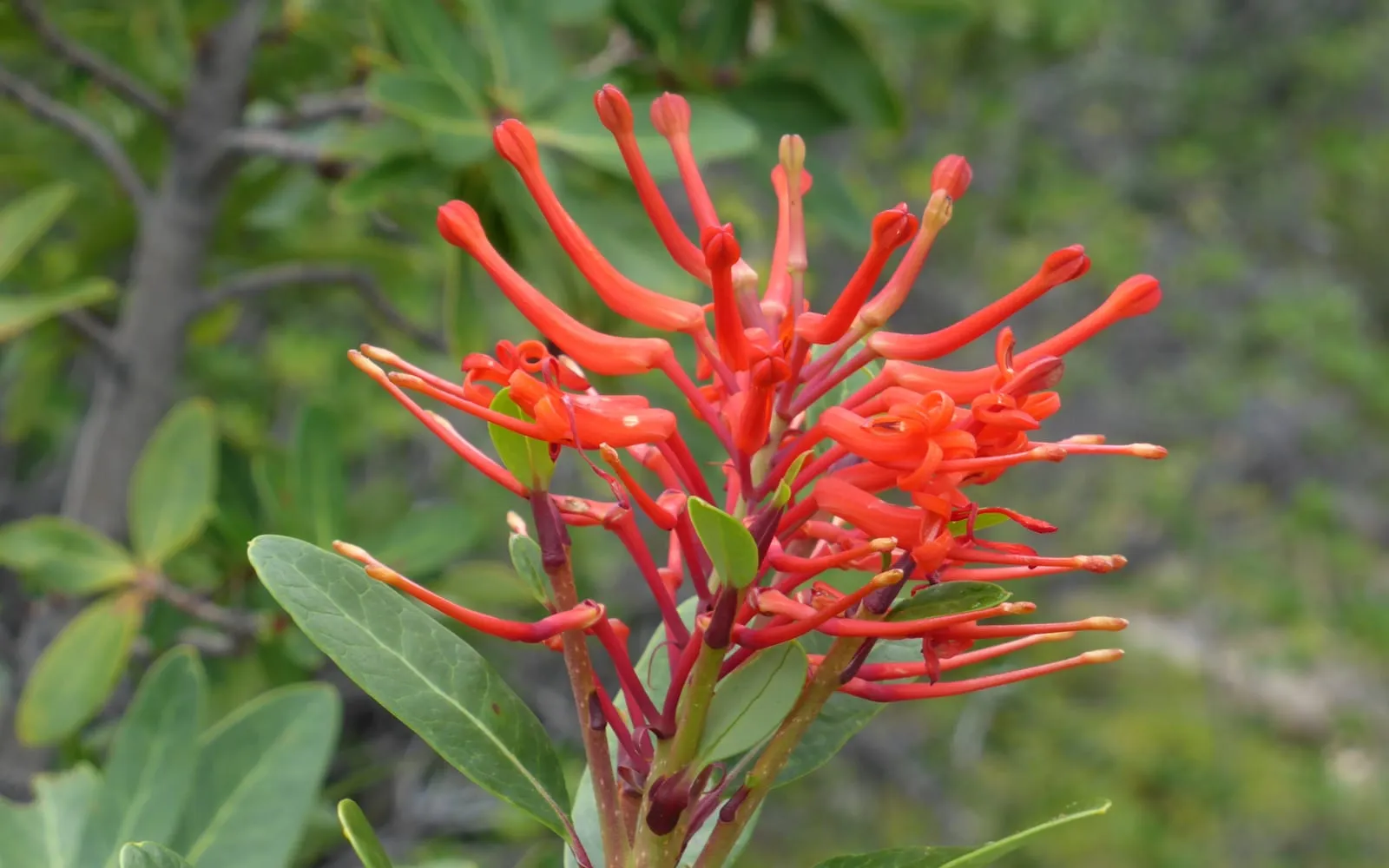
Chilean fire bush earns its name from the flowers, dense clusters of brilliant scarlet, tubular blooms that cover the branches in late spring and early summer with a colour few other hardy shrubs can match. It is a plant grown for one spectacular flush rather than year-round interest, though the evergreen forms hold reasonable structure the rest of the year too.
It is not an easy plant to please everywhere. Acid soil is non-negotiable, and it resents root disturbance once planted, so the best results come from choosing the right spot the first time and leaving it undisturbed afterwards.
Appearance and character
The leaves are leathery, oblong and dark green, borne on upright stems that in the wild often form multi-stemmed thickets through vigorous root suckering. Some forms, particularly those from higher and colder parts of its range, drop their leaves in winter, while milder-climate forms stay evergreen.
Gardeners grow it for the flowers. They open along the length of the previous year’s stems in tight clusters of narrow, tubular, brilliant scarlet blooms, sometimes shading towards orange, so densely packed on a well-flowered specimen that the branches all but disappear beneath them for several weeks.
Growth habit varies by form and seed origin. Some stay a large, rounded shrub, while others develop into a narrow, upright small tree. The suckering habit that spreads it into thickets in the wild shows up in gardens too, and an established plant will send up new shoots from the roots some distance from the main stem.
Where it is from
Embothrium coccineum grows through the temperate rainforest and Andean foothills of Chile and adjacent Argentina, from around latitude 33 south down through Patagonia to Tierra del Fuego near 55 south, a huge range that explains why hardiness varies so much between seed sources. Plants raised from the colder, higher-altitude Norquinco Valley population are noticeably tougher than the species average sold more broadly.
Its native ground is consistently moist, acidic and rich in leaf litter, under a rainfall regime with no real dry season. That background is the reason it struggles wherever the soil turns alkaline or dries out for any length of time, regardless of how mild the local winter is.
How it grows
Plant in acidic, humus-rich soil that holds moisture without becoming waterlogged, in full sun for the strongest flowering or light shade where summers run hot and dry. Alkaline or chalky soil is unworkable for this species and no amount of feeding corrects it.
Choose the planting position carefully and expect to leave the plant there permanently. It dislikes root disturbance badly, and container- grown plants establish far more reliably than anything lifted and moved, since the fine roots typical of Proteaceae are easily damaged and slow to recover.
Mulch generously with an acidic organic material such as composted bark or pine needles, which both feeds the soil and helps retain the moisture the roots need.
Control suckers by removing unwanted ones at their point of origin if a single-stemmed specimen is wanted, or leave them to develop a naturalistic thicket where space allows, which is closer to how the species grows in the wild.
Through the seasons
Spring brings the main flush of new growth and, towards late spring, the start of the scarlet flower display on hardier, earlier forms.
Summer carries the flowering display through into early summer on later-flowering forms, followed by a quieter period of vegetative growth. Keep the soil moist through any dry spell.
Autumn is a reasonable time to plant, giving roots a season to settle before winter, and deciduous forms begin dropping their leaves as temperatures fall.
Winter is dormancy for deciduous forms and a quieter period for evergreen ones. Protect young plants from the coldest weather until they are well established.
Care difficulty
Moderate to difficult, with the difficulty concentrated almost entirely in the initial siting rather than in ongoing care. Get the soil chemistry and moisture right, choose a hardy seed source for a cold garden, and plant it somewhere it will never need to move, and an established specimen then needs comparatively little attention. Get any of those wrong, alkaline soil, a dry spell during establishment, or a later attempt to relocate it, and the plant is hard to save.
Watering
Water regularly and generously through the first several years while the root system establishes, keeping the soil consistently moist rather than letting it swing between wet and dry.
Established plants in reliably moist soil need little supplemental watering, but a prolonged dry spell, especially combined with heat, stalls growth and can trigger premature leaf drop even on otherwise healthy specimens.
Warning signs, diseases and pests
Root rot follows waterlogged or alkaline soil and shows as yellowing foliage, wilting and dieback despite apparently adequate watering. There is no reliable cure once it has taken hold; prevention through acidic, free-draining soil is the only real defence.
Honey fungus occasionally attacks older or already stressed plants, producing gradual dieback and, eventually, fungal growth at the base. Removal is usually the only option once it is confirmed.
Aphids cluster on soft spring growth and are rarely serious, usually controlled by natural predators before intervention is needed.
Leaf spot appears as small brown or black marks on the foliage in humid, still conditions with poor air movement. Improving airflow around the plant, including thinning congested suckers, generally keeps it in check.
Growing environment
Full sun gives the strongest, most floriferous display, while light shade suits it in a hot, dry summer climate where full sun would stress the roots and foliage.
Acidic soil is essential rather than merely preferred. Test the soil pH before planting, since even a moderately alkaline soil that other shrubs tolerate will slowly weaken and eventually kill this species.
Shelter from strong, drying winds helps protect both the evergreen foliage and the flower buds, particularly on more tender forms grown near the cold edge of their range.
Feeding
Feeding needs are modest on good acidic soil, where an annual mulch of composted bark or leaf mould usually supplies enough fertility on its own.
On poorer soil, an ericaceous, low-phosphorus feed applied in spring supports stronger growth, following the same low-phosphorus logic that applies to most plants in the Proteaceae family. Avoid any fertiliser or soil conditioner containing lime, which works directly against the acid soil this species needs.
Troubleshooting
The leaves have yellowed and growth has stalled. Check the soil pH first, since alkaline soil is the single most common cause of decline in this species. A test kit will confirm it quickly, and there is no practical way to keep the plant happy long-term in soil that tests strongly alkaline.
It has not flowered even though it looks healthy. Often age or insufficient sun. Young plants can take several years to reach flowering size, and a position in too much shade suppresses flowering even on a mature, healthy specimen.
Suckers keep appearing away from the main plant. Normal behaviour for this species rather than a problem. Remove unwanted suckers at ground level as they appear if a single clean stem is preferred, or allow them to develop into a naturalistic thicket.
I moved it and it has struggled ever since. Root disturbance is poorly tolerated by this species, and a struggling transplant may take a full growing season or more to recover, if it recovers at all. Keeping the soil consistently moist and providing shelter from wind and strong sun gives it the best chance.
Can I grow it in a container? Only short-term while young, in ericaceous compost with excellent drainage. It is not well suited to long-term container growing, since its dislike of root disturbance makes the repotting a container eventually needs a genuine risk to the plant.