
Outdoor plant
Clematis montana
Clematis montana
Also known as Mountain clematis, Himalayan clematis, Anemone clematis
How to grow Clematis montana. Why it belongs in pruning group one, the size it reaches, why it shrugs off clematis wilt, and why hard renovation can kill it.
At a glance
- Difficulty
- Easy
- Water
- Regularly for the first two years, then rarely
- Light
- Full sun to partial shade, with the roots shaded
- Temperature
- Very hardy, to -20 deg C
- Hardiness
- USDA 6-9, RHS H5, hardy to -15 C
- Type
- Deciduous climber, vigorous and long-lived
- Height
- 8-12 m
- Native to
- The Himalayas and western China
- Best month
- May in the Northern Hemisphere, November in the Southern Hemisphere
It flowers on last year growth, so prune it within a month of flowering and never in winter, and it makes far more growth in a season than most people plan for. It is banned from sale and distribution in New Zealand under the National Pest Plant Accord, where it smothers native forest edges, and it is a weed in parts of Australia. Established plants take drought and poor soil.
Hardiness zones describe winter cold alone. Summer heat, humidity, rainfall and the length of the growing season decide as much, so treat the range as the outer limit rather than as a recommendation.
Every month named in this guide is for the temperate Northern Hemisphere. If you garden in the Southern Hemisphere, shift each one by six months, so May becomes November. Closer to the equator the wet and dry seasons matter more than the calendar, and the shift stops being a useful guide.
Toxic if eaten
- Do not eat
- Every part, and the sap most of all
- Harm from
- Eating it and handling it
- Affects
- People, cats, dogs and horses
Clematis belongs to the buttercup family and carries the same irritant. The sap contains protoanemonin, released when stems or leaves are crushed, and it causes burning of the mouth, drooling, vomiting and diarrhoea if eaten, with redness and blistering on sensitive skin. The ASPCA lists Clematis as toxic to cats, dogs and horses, and the RHS lists it among plants that are harmful if eaten and that may irritate the skin. Serious poisonings are rare because the taste is acrid and stops most animals after a mouthful. The realistic exposure is a gardener pruning a large montana without gloves in warm weather, which is enough to leave the forearms itching. Wear gloves and long sleeves for pruning, wash afterwards, and avoid rubbing your eyes. Protoanemonin breaks down as the tissue dries, so cut stems on a compost heap become harmless within days, and there is no hazard from dried prunings. Grazing animals leave clematis alone in normal circumstances, and the same compound is present in the buttercups already in most fields.
Sources: ASPCA (Clematis), RHS potentially harmful garden plants
About
Two things about clematis montana account for nearly every question asked about it. It belongs in pruning group one, and it is far larger than the label suggests.
Group one means it flowers in May on wood made the previous summer. Prune it in late winter, as people do with the large-flowered hybrids, and you cut off the entire display. The only safe time is the fortnight after flowering.
The size is the other thing. A montana reaches 8 to 12 m and will cover a house wall, swallow a pergola and pull down a fence panel. Planted against a small trellis it becomes a permanent problem, and planted up an old apple tree or along a long boundary it is one of the best value climbers there is.
Appearance and character
A vigorous deciduous twining climber reaching 8 to 12 m, clinging by coiling leaf stalks rather than by tendrils or suckers, so it needs something to twine around.
Leaves are divided into three leaflets, each toothed and pointed, mid-green and often bronze-tinged when young.
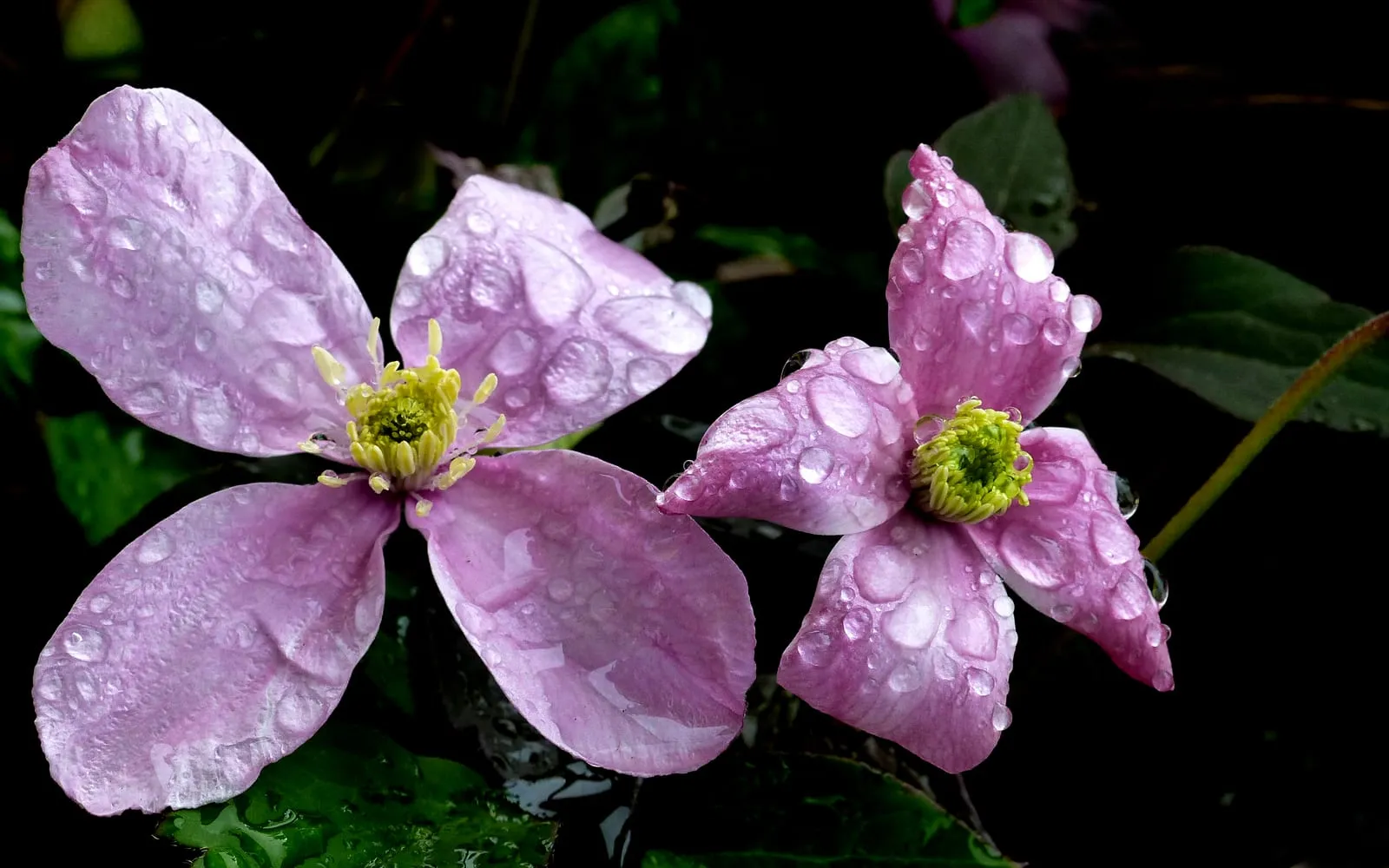
Flowers open in May, occasionally into early June, smothering the entire plant so completely that the foliage disappears. Each is 5 to 6 cm across and flat, with four broad tepals around a boss of pale yellow stamens.
Clematis have no petals. The showy parts are sepals, which is why the correct term is tepals and why they hold their shape so well in rain.
The scent is real and worth siting for. Var. rubens and ‘Elizabeth’ smell distinctly of vanilla on a warm evening, and the plain white species has a lighter almond note.
Seed heads follow, silky whorls that catch the light and hold through autumn.
Stems become thick, brown, woody and stringy with age, and the base of an old plant is a considerable tangle.
Forms are worth choosing between. The species is white, var. rubens is pink with bronze foliage, ‘Elizabeth’ is soft pink and the most strongly scented, and ‘Freda’ is deeper pink and slightly less vigorous.
Where it is from
The Himalayas and the mountains of western China, where it scrambles through trees and over rocks at 1,500 to 4,000 m.
Its mountain origin explains the hardiness. Clematis montana is unbothered by cold and grows perfectly well on a north-facing wall, which most large-flowered hybrids will not do.
Scrambling through trees explains the habit and the size. In the wild it climbs to the light and flowers in the canopy, which is exactly what it does on a house wall and why an unpruned plant ends up bare at the bottom.
Lady Amherst introduced it to Britain in 1831. Var. rubens came later, collected by Ernest Wilson in China in 1900.
The group is entirely distinct from the large-flowered hybrids in its pruning, its flowering season and, importantly, in its resistance to clematis wilt.
How it grows
Plant in autumn or spring into any reasonable soil that drains. Clematis montana grows happily on chalk.
Choose the position for the eventual size rather than the plant in the pot. A large wall, a long fence, an old tree, a substantial pergola or a bank all suit it. A small obelisk does not.
Give it something to twine around. Wires, netting or trellis all work, and it cannot cling to bare brick.
Plant with the roots shaded and the top in sun. A slab, a stone or a low shrub over the root area keeps them cool, which is the traditional rule and a sound one.
Unlike the large-flowered hybrids, montana does not need planting deep. That advice exists so a wilted hybrid can reshoot from below ground, and montana does not get wilt.
Water thoroughly for the first two years while it establishes. This is the period when clematis are lost.
Prune only after flowering, in late May or June, and only to keep it in bounds. Cut back to a strong bud or shoot. Anything you remove after midsummer is next year’s flower.
Avoid hard renovation. Clematis montana often fails to reshoot from old bare wood, and cutting a mature plant back to the base can kill it outright. Reduce it over two or three seasons instead, or accept that a badly overgrown plant may be easier to replace.
Through the seasons
Winter is dormancy and the season to leave it entirely alone. Every flower bud for May is already on the plant.
Spring brings the leaves in April and then the flowers in May. Feed and mulch as growth starts.
Early summer is the only pruning window. Cut back within a fortnight of the last flower fading.
Autumn brings the seed heads and leaf fall. Plant new stock now, and tie in any long growth before winter gales.
Care difficulty
Easy to grow and easy to get wrong in two specific ways.
Pruning at the wrong time is the commonest mistake and costs a whole year of flower.
Underestimating the size is the other, and it is much harder to undo, because the plant resents the hard cutting back that would fix it.
Establishment needs attention. Water well for two summers and it will then look after itself for decades.
Clematis wilt, the disease that kills large-flowered hybrids, barely affects the montana group. That is one of the main reasons to grow it.
Watering
Water thoroughly through the first two summers after planting, which is when clematis are most often lost.
Established plants need water only in a prolonged drought, and a large montana on a dry wall benefits from an occasional deep soak.
Water at the base rather than over the foliage.
Mulch generously each spring with garden compost, keeping it clear of the stems, which keeps the roots cool and holds moisture.
The classic instruction to keep the roots cool matters more than the frequency of watering.
Warning signs, diseases and pests
No flowers in May, on a healthy-looking plant, almost always means it was pruned between midsummer and spring. Prune only in the fortnight after flowering.
A plant that is bare at the base with all the flower six metres up is behaving naturally, since it climbs to the light. Training some stems horizontally along wires encourages flowering lower down, and hard cutting back is risky.
Death after hard pruning is a real outcome with this group. Montana frequently fails to break from old bare wood. Reduce a large plant over several seasons rather than in one cut.
Clematis wilt causes sudden collapse of whole stems in the large-flowered hybrids and is uncommon on montana. If a montana stem wilts, look for physical damage at the base first.
Slugs graze the emerging shoots in spring, which matters most on a young plant.
Powdery mildew appears on a plant in a hot dry position late in the season.
Earwigs and aphids occur on the new growth without doing lasting harm.
Growing environment
Full sun to partial shade. Montana flowers well on a north-facing wall, which sets it apart from most clematis.
Any reasonable soil that drains, including alkaline and chalky ground.
The roots shaded and the top in the light. Plant a low shrub in front, or lay a stone slab over the root area.
Space and something strong to climb. Assume 8 m and treat anything less as temporary.
Good positions include a large house wall with wires, a long boundary fence, a mature tree that can carry it, a sturdy pergola and a steep bank.
Poor positions include a small trellis, an arch over a path where it will need constant cutting, and anywhere near a gutter or roof tile.
Shelter is unnecessary. It stands wind and cold without difficulty.
Feeding
Feed once in early spring with a potassium-rich fertiliser such as sulphate of potash or a rose feed.
Mulch generously with garden compost or well-rotted manure in spring, keeping it off the stems.
Avoid high-nitrogen feeds, which produce leafy growth at the expense of flower on a plant that is already vigorous enough.
Stop feeding after flowering.
An established montana on decent soil needs very little and often flowers well with no feeding at all.
Troubleshooting
It did not flower this year. It was almost certainly pruned at the wrong time. Clematis montana flowers on last year’s wood, so prune only in the fortnight after the flowers fade.
When exactly do I prune it? Late May or June, within about two weeks of the last flower. Never in winter or early spring.
It has taken over the whole wall. That is its natural size, 8 to 12 m. Reduce it gradually over two or three seasons after flowering, since a single hard cut into old wood can kill it.
Can I cut it right back to start again? Risky. Unlike the late-flowering clematis, montana often fails to reshoot from bare old wood. Reduce it in stages or replace it.
All the flowers are at the top and the base is bare. Normal for a plant that climbs to the light. Train some stems horizontally along wires to encourage flowering lower down.
Will it get clematis wilt? Very unlikely. Wilt is a problem of the large-flowered hybrids, and the montana group is highly resistant, which is one of its main advantages.
Does it need planting deep like other clematis? No. Deep planting is advice for large-flowered hybrids so they can recover from wilt. Montana does not need it.
Will it grow on a north wall? Yes, and it flowers well there, which most clematis will not.