
Outdoor plant
Silky Oak
Grevillea robusta
Also known as Southern Silky Oak, Australian Silver Oak
Practical guidance for growing silky oak, Grevillea robusta, including fast growth, fern-like foliage, toothbrush flowers, skin-irritant sap, and cultivation well outside its native range.
At a glance
- Difficulty
- Moderate
- Water
- Regularly while young and fast-growing, then only in extended drought
- Light
- Full sun for the strongest growth and eventual flowering
- Temperature
- Frost-tender while young; considerably hardier once the trunk has thickened
- Hardiness
- USDA 9-11, RHS H3, hardy to -6 C
- Type
- Evergreen tree, very fast-growing when young
- Height
- 18-30 m in favourable conditions, often kept smaller by pruning
- Native to
- eastern Australia
A young tree is cut back hard by a frost that an established trunk tolerates, so age changes how hardy it appears in a garden. It comes from a subtropical margin with reliable warmth and rainfall through the growing season, and a cool, short summer slows it far more than a single cold night does.
Hardiness zones describe winter cold alone. Summer heat, humidity, rainfall and the length of the growing season decide as much, so treat the range as the outer limit rather than as a recommendation.
Skin irritant
- Do not eat
- Leaf hairs, sap and flowers
- Harm from
- Handling it
- Affects
- People
Grevillea foliage and flowers carry resorcinol compounds, chemically related to the ones in poison ivy and poison oak, and contact with the leaf hairs or sap causes an itchy contact dermatitis in some people, a reaction documented widely enough in horticultural and dermatological sources to have its own common name, Grevillea dermatitis. Not everyone reacts, and reactions vary from mild itching to a more persistent rash, so gloves and long sleeves are sensible when pruning or handling cut foliage, particularly for anyone who already knows they react to poison ivy or mango sap. No toxicity to eating any part of the plant is documented, and it does not appear on the ASPCA toxic plant database for cats, dogs or horses.
Sources: RHS potentially harmful garden plants, ASPCA toxic and non-toxic plants
About
Silky oak is grown across the subtropics and warm temperate world almost as often as a fast, handsome shade tree as it is for its own flowers. Seedlings put on well over a metre a year in good conditions, and gardeners in California, East Africa, India and Hawaii have planted it by the roadside and over coffee and tea plantations for more than a century for exactly that speed.
It is not related to the true oaks at all. The common name comes from the silvery sheen and figured grain of the timber, once widely used in furniture and still cut from plantation trees in parts of its introduced range.
Appearance and character
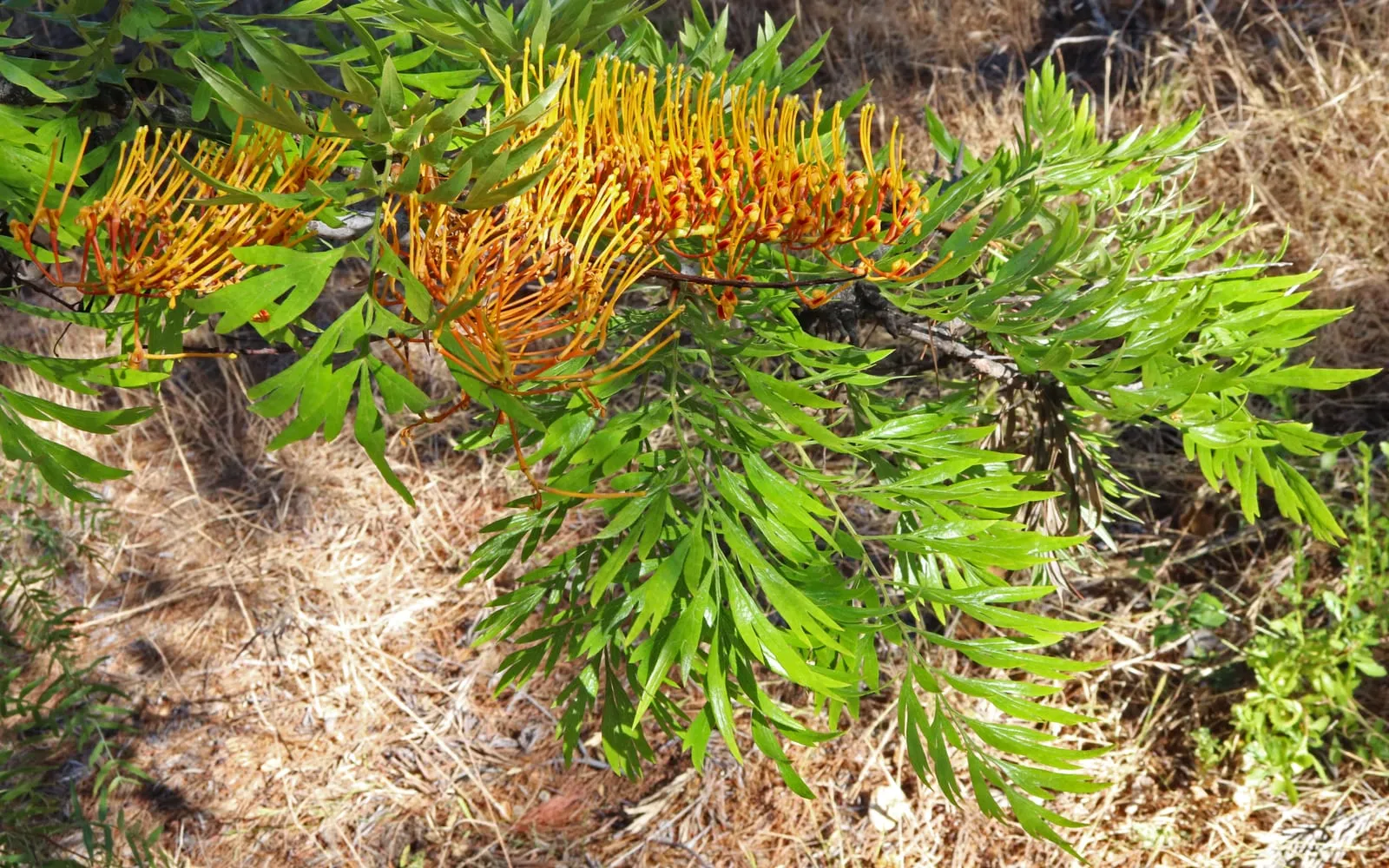
The leaves are large, bipinnate and fern-like, dark green above with a soft silvery underside, giving a mature tree a feathery, textured crown quite unlike the coarse foliage most trees of this size carry.
Flowers appear in dense, one-sided racemes of golden orange, curled stamens that give the common comparison to a row of toothbrush bristles. They open mostly on older wood, which is why a tree grown outside its native climate can spend a decade or more as a fast, handsome foliage tree before it flowers at all, if it flowers reliably in that climate ever.
The bark is dark grey and finely fissured with age, and the timber beneath it carries the fine silky grain the tree is named for.
Where it is from
Grevillea robusta is native to the subtropical rainforest margins and gallery forest of eastern Australia, in Queensland and northern New South Wales, where it grows as a fast-colonising tree along watercourses and forest edges with reliable warmth and rainfall through the growing season.
It was taken abroad in the nineteenth century for its speed and its timber and has since become one of the most widely planted introduced trees in the subtropics, valued as living shade for coffee and tea in parts of East Africa and India and as an ornamental street tree elsewhere. In several of those places it now self-seeds freely enough to be treated as a naturalised or invasive species outside cultivation.
How it grows
Plant in full sun in well-drained, slightly acidic soil, protecting young trees from frost until the trunk has thickened and the tree has built up some size. Established silky oak tolerates poor, gravelly ground far better than compacted or waterlogged soil.
Growth in the first several years is fast, often outpacing nearby trees planted at the same time, and the wood produced at that speed is correspondingly soft. Stake young trees in a windy site and prune to a single strong leader early, since a fork low on a fast-grown trunk is a weak point later on.
Like other members of the Proteaceae family, it carries fine proteoid roots that scavenge nutrients efficiently from poor soil, so it tolerates mild phosphorus sensitivity, though rather less acutely than protea or waratah, and does not need the strict low-phosphorus regime those two species demand.
Through the seasons
Spring brings the strongest flush of new growth, and flowering on a mature tree in a suitable climate.
Summer is steady growth, with regular water helping a young tree put on size fastest.
Autumn is a reasonable time to plant in a mild climate, giving roots a season to establish before winter.
Winter brings the greatest risk to a young tree, which needs protection from anything beyond a light frost until well established.
Care difficulty
Moderate. Silky oak needs little in the way of routine attention once past its tender youth, tolerating poor soil, drought and coastal exposure with ease. The real management task is structural: fast growth produces soft wood and weak forks that need correcting early with formative pruning, since a large, poorly structured limb on a mature tree is a genuine safety concern in wind.
Take skin contact with the foliage and flowers seriously when pruning, since the reaction it can cause is uncomfortable even though the tree is otherwise easy to grow.
Watering
Water regularly through the first two or three growing seasons while the root system establishes and the trunk thickens.
An established tree tolerates real drought, drawing on a deep root system, though a supplementary deep soak in a prolonged dry spell keeps growth steadier and reduces stress-related leaf drop.
Warning signs, diseases and pests
Gall mites distort new growth into swollen, misshapen tissue, mostly cosmetic on a large tree. On a young one, prune out and destroy affected growth to keep the developing crown even.
Scale insects form small bumps on stems and along the underside of leaves, sapping vigour over time. Horticultural oil applied during dormancy controls a light infestation.
Root rot follows waterlogged or compacted soil, showing as yellowing foliage and dieback that starts in the crown. Improving drainage before planting is the best prevention, since there is no reliable cure once it has taken hold.
Leaf spot appears as small dark blotches in humid, still conditions, rarely serious on an established tree. If it recurs, thin surrounding growth, since better air movement usually solves it without any spray.
Growing environment
Full sun brings the fastest, sturdiest growth and the best chance of flowering on a mature tree.
Well-drained, slightly acidic soil suits it best, though it tolerates poor and gravelly ground that would slow many other fast-growing trees. Waterlogged soil is the one condition it does not forgive.
It tolerates wind and coastal exposure reasonably well once established, which is part of why it has been planted so widely as a shade and shelter tree far from its native range.
Feeding
Feeding is rarely essential in reasonable soil. A light application of a low-phosphorus native fertiliser in spring supports a young tree putting on size quickly, but a mature tree in average garden soil needs little beyond what it draws from its own root system.
Avoid heavy, high-phosphorus feeding, which this species handles less comfortably than most non-Proteaceae trees, even though it is more tolerant of it than protea or waratah.
Troubleshooting
My skin itched after pruning it. This is a known reaction to resorcinol compounds in the leaf hairs and sap. Wear gloves and long sleeves when handling foliage in future, and wash any exposed skin promptly after contact.
The tree is ten years old and has never flowered. This is common outside its native subtropical climate, where flowering depends on maturity and a warm enough growing season. A tree that is otherwise healthy and growing well may just need more years, or may be in a climate too cool to flower reliably at all.
A large branch split off in wind. Fast early growth produces soft wood and weak forks. Formative pruning while the tree is young is the best prevention; a mature tree with poor structure should be assessed by an arborist rather than left as is.
Seedlings keep appearing in nearby beds and wild areas. In many introduced regions silky oak self-seeds readily and is treated as naturalised or invasive outside cultivation. Check local guidance before planting it near wild land, and remove unwanted seedlings promptly.
Can I grow it in a large container while young? Yes, for the first few years, in a well-drained, slightly acidic potting mix, though its fast growth rate means it will need potting up or planting into open ground sooner than most container trees.