
Outdoor plant
Witch hazel
Hamamelis mollis
Also known as Chinese witch hazel, Hamamelis
How to grow witch hazel, Hamamelis mollis. Why the graft matters, spotting rootstock suckers before they take over, the soil it needs, and why the flowers survive frost.
At a glance
- Difficulty
- Moderate
- Water
- Regularly for the first three years, then rarely
- Light
- Full sun or light dappled shade, sheltered from cold wind
- Temperature
- Very hardy. The open flowers survive hard frost
- Hardiness
- USDA 5-8, RHS H6, hardy to -25 C
- Type
- Deciduous shrub or small tree, slow-growing and long-lived
- Height
- 3-4 m, and eventually more
- Native to
- Central and eastern China
- Best month
- January in the Northern Hemisphere, July in the Southern Hemisphere
It flowers in the depths of winter and the shredded petals roll up in hard frost and open again when it lifts, so the display survives cold that would finish any other winter flower. Acid to neutral soil is needed and chalk turns the leaves yellow. Almost all garden plants are Hamamelis x intermedia grafted onto Hamamelis virginiana, the eastern North American species, so pull off any suckers rising from below the graft.
Hardiness zones describe winter cold alone. Summer heat, humidity, rainfall and the length of the growing season decide as much, so treat the range as the outer limit rather than as a recommendation.
Every month named in this guide is for the temperate Northern Hemisphere. If you garden in the Southern Hemisphere, shift each one by six months, so January becomes July. Closer to the equator the wet and dry seasons matter more than the calendar, and the shift stops being a useful guide.
Not known to be toxic
Non-toxic. The ASPCA does not list Hamamelis among plants harmful to cats, dogs or horses, and the RHS does not include witch hazel in its list of potentially harmful garden plants. The related American species, Hamamelis virginiana, is the source of the witch hazel sold in pharmacies, a distilled astringent made from the bark and twigs and used on the skin for bruises and insect bites. That preparation is for external use, and the commercial product contains alcohol, so a bottle of it is worth keeping out of reach of children for that reason rather than because of the plant. Garden witch hazels present no hazard at all. The seeds are ejected explosively from the ripe capsules, which is the origin of the family name Hamamelidaceae being associated with the old country term "snapping hazel", and they are of no concern beyond the surprise.
Sources: ASPCA toxic and non-toxic plants, RHS potentially harmful garden plants
About
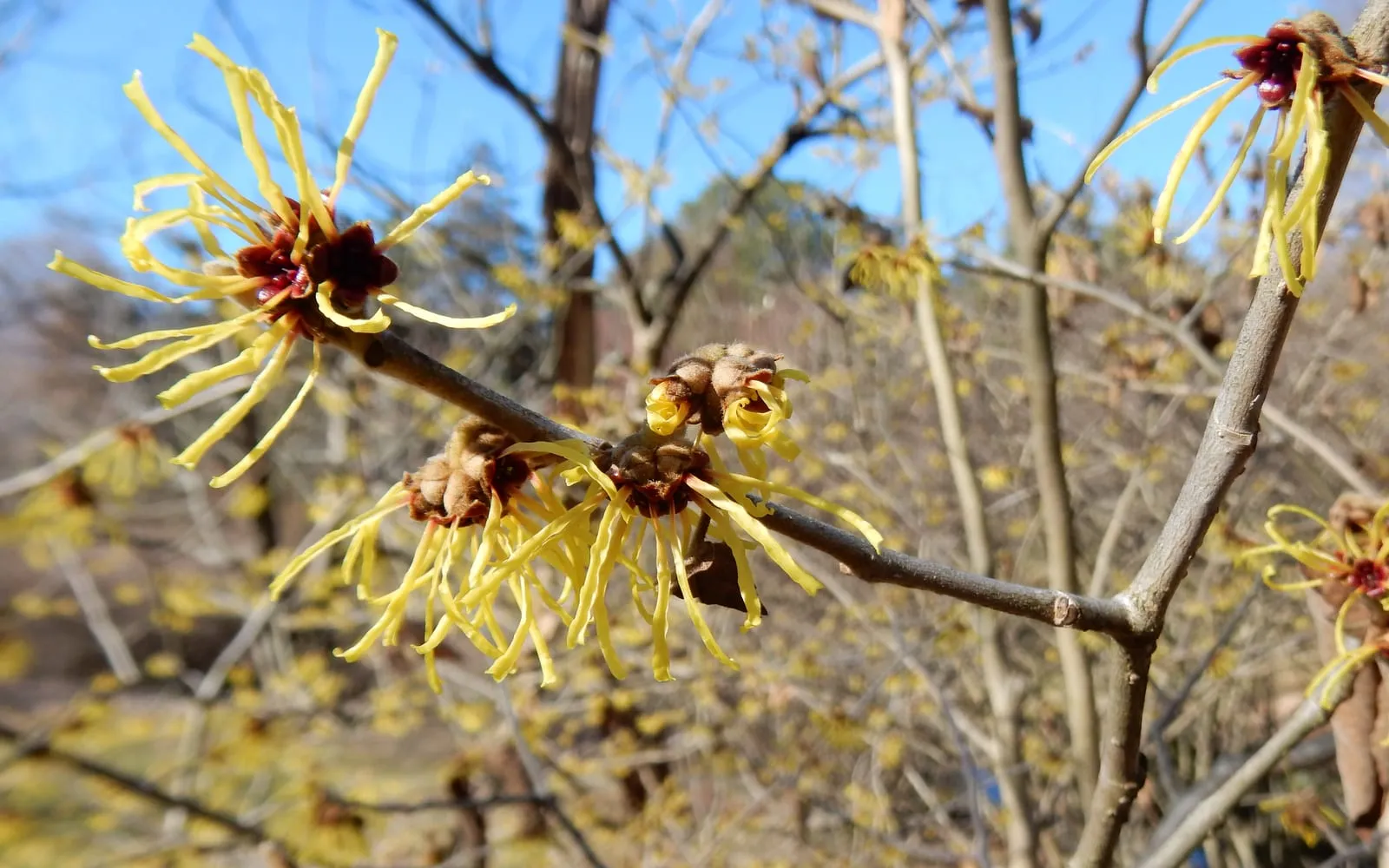
Witch hazel flowers in January, when the ground is frozen and nothing else is doing anything at all. The blooms are spidery clusters of yellow ribbon petals on bare grey branches, and on a still cold afternoon a single mature shrub scents the air several metres around it.
The flowers manage this because the petals roll up in hard frost and unfurl again when the temperature lifts, a trick that lets the same bloom survive weeks of freezing and thawing.
The catch is that nearly every witch hazel sold is grafted, usually onto a different species. Suckers rising from below the graft grow faster than the variety you paid for, and a plant left unwatched for a few years turns into the rootstock. Check the base every spring and remove suckers promptly.
Appearance and character
A slow-growing deciduous shrub or small tree with a distinctive open vase shape and wide, almost horizontal branching, reaching 3 to 4 m over many years.
Flowers open from December to February in tight clusters directly on the bare wood. Each has four narrow crimped petals like strips of ribbon, most often golden yellow, with a dark red or purple centre.
The scent is the reason to grow Hamamelis mollis in particular. It is sweet, spicy and carrying, and stronger than most of the coppery-red hybrids that have been bred for colour.
Leaves are large, rounded and softly hairy, mid-green, with a scalloped edge and a slightly lopsided base.
Autumn colour is the second display. The foliage turns butter yellow through orange and holds it for weeks.
Seed capsules are woody and split explosively when ripe, throwing the black seeds several metres.
Where it is from
Central and eastern China, where it grows in mountain woodland and on forest margins in moist, humus-rich, acid soil under a light canopy.
Charles Maries collected it for the Veitch nursery in 1879, and it reached temperate gardens properly in the late nineteenth century. The species name mollis, meaning soft, refers to the downy leaves.
Its woodland habitat explains the requirements. Light dappled shade, moisture at the root, plenty of leaf litter and shelter from wind all reproduce the forest margin it comes from.
Flowering in midwinter suits a plant pollinated by winter-active moths and small flies, and the rolling and unrolling of the petals is an adaptation to exactly that climate.
Four other species are grown. Hamamelis japonica from Japan, Hamamelis virginiana and Hamamelis vernalis from North America, and the hybrid Hamamelis x intermedia, which crosses the Chinese and Japanese species and supplies most of the named red and orange varieties.
How it grows
Plant in autumn or early spring into moist, free-draining, acid to neutral soil enriched with leaf mould or composted bark.
Choose the position with care. Witch hazel resents being moved and establishes slowly, so it should be planted where it will stay.
Site it where you will pass it in winter. The scent is the whole point and it is wasted at the far end of a garden nobody visits in January.
Find the graft union, a swelling low on the stem, and note where it is. Anything growing from below that point is rootstock and must be removed the moment it appears.
Prune very little. Remove dead, damaged or crossing wood after flowering, and cut back any branch that spoils the shape. The natural vase habit is the plant’s best feature and hard pruning ruins it.
Mulch generously each spring with leaf mould, keeping it clear of the stem.
Water through the first three summers without fail. Establishment is slow and drought in those years sets the plant back badly.
Cut a few flowering branches for the house in January, which is a legitimate form of pruning and brings the scent indoors.
Through the seasons
Winter is the flowering season, from December through February. Nothing needs doing beyond enjoying it and cutting a stem or two.
Spring brings the leaves and the light pruning. Mulch with leaf mould, feed, and check the base for suckers as growth starts.
Summer is a quiet season of steady growth. Water young plants thoroughly in dry spells and keep watching for rootstock shoots.
Autumn gives the second display as the leaves turn butter yellow and orange. Plant new shrubs now.
Care difficulty
Moderate, and the difficulty is in the soil and the graft rather than the daily care.
Shallow chalk defeats it. Witch hazel needs acid to neutral, moisture-retentive ground with organic matter, and it will not thrive on thin limy soil whatever you add.
Suckering from the rootstock is the failure that catches most owners. The rootstock is usually Hamamelis virginiana, which has smaller, duller autumn-borne flowers, and it gradually replaces the variety above.
Establishment is slow. Expect little growth for two or three years, and water through them.
Once settled, the plant needs almost nothing and lives for decades.
Watering
Water thoroughly through the first three summers. This is the period when witch hazels are lost, and drought stress at that stage shows for years afterwards.
Established plants need water only in a prolonged dry spell.
Use rainwater where the soil is acid and the tap water is hard.
Mulch heavily with leaf mould each spring. Moisture retention matters more to this plant than watering frequency.
Avoid waterlogged ground, which it dislikes as much as drought.
Containers are difficult. The plant is slow, resents disturbance, and needs a large pot of ericaceous compost with careful watering, so the ground is better wherever possible.
Warning signs, diseases and pests
Suckers from below the graft union are the problem to watch for. They often carry slightly different leaves, grow faster than the rest of the plant, and produce poor flowers. Trace each shoot to its origin, and remove anything arising below the graft by pulling or cutting it flush at the point of origin. A witch hazel that suddenly flowers dull yellow in autumn instead of bright yellow in January has already been taken over.
Yellow leaves with green veins mean the soil is too alkaline. Mulch with ericaceous material and apply sequestered iron, and accept that a shallow chalk garden is the wrong home for this plant.
Poor growth in the first years after planting is usually drought or root disturbance. Water thoroughly and mulch.
Honey fungus attacks witch hazel and is fatal, showing as sudden death of a branch or the whole plant with white sheets under the bark.
Coral spot produces pink-orange pustules on dead and dying wood. Cut back to clean healthy growth.
Leaf scorch with brown margins follows cold drying wind or a dry summer.
A plant that has never flowered may still be too young, since grafted specimens often take two or three years to settle.
Growing environment
Full sun or light dappled shade. Deep shade produces few flowers and poor autumn colour.
Moist but free-draining soil, acid to neutral, with plenty of leaf mould worked in. Deep soil over chalk is workable, and thin soil over chalk is not.
Shelter from cold drying wind, which damages the flowers and scorches the leaves.
Space to develop the natural shape. The horizontal branching is the plant’s character and a cramped position hides it.
Position it near a path, a door or a gate that gets used in winter, so the scent is where people walk.
A background of dark evergreen shows the pale flowers far better than an open sky does.
Avoid moving an established plant. Witch hazel transplants badly at any size.
Feeding
Feed once in spring with a general or ericaceous fertiliser as growth starts.
Mulch annually with leaf mould, which supplies both nutrients and the soil structure the plant wants.
Sequestered iron corrects yellowing on soil that is more alkaline than ideal.
Avoid heavy nitrogen, which produces soft growth at the expense of flower buds.
Container plants need a slow-release ericaceous feed each spring and repotting every few years.
Troubleshooting
Shoots are coming up from the base with different leaves. Rootstock suckers below the graft union. Remove them at the point of origin as soon as they appear, or they will take the plant over.
It flowers dull yellow in autumn now, not bright yellow in winter. The rootstock has replaced the grafted variety. The original is gone, and the choice is to keep the rootstock or replace the plant.
Yellow leaves with green veins. The soil is too alkaline. Mulch with ericaceous material and apply sequestered iron. Thin chalk soil will not support it long-term.
It has hardly grown in three years. That is normal. Witch hazel is slow to establish, and thorough watering and a leaf mould mulch are what speed it up.
Can I move it? Only if you must, and it will sulk for years. Plant it where it is to stay.
How much should I prune it? As little as possible. Take out dead and crossing wood after flowering and leave the vase shape alone.
Which one has the best scent? Hamamelis mollis itself, and ‘Pallida’ among the hybrids. Many of the red and orange varieties are bred for colour and smell of very little.
Will it grow in a pot? Poorly, and only in a large container of ericaceous compost with careful watering. It is a plant for the ground.